
CELPIP Blog
CLB score expiry for immigration applicants: what to know
CLB score expiry for immigration applicants: what to know

Your CLB score expiry matters more than almost any other detail in your immigration file: results must be less than two years old on two specific dates. Miss either one and your application can be refused outright, no matter how strong your scores are.
The two checkpoints are:
- The day you create or update your Express Entry profile
- The day you submit your electronic application for permanent residence (e‑APR)
IRCC’s own guidance is blunt about the consequence: if two years have passed by the time you submit, the application gets refused, full stop. That’s the rule this entire article is built around.
Key Takeaways
Your language test results must be less than two years old both when you create your Express Entry profile and when you submit your permanent residence application, or IRCC will refuse your file.
| Point | Details |
|---|---|
| Two checkpoints, not one | Results must be valid at both profile creation and e‑APR submission, which can be months apart. |
| Count from the test date | The two-year clock starts on your actual test day, not when your certificate is issued. |
| ITA window is 60 days | Check your expiry date before accepting an invitation, since results can lapse mid‑window. |
| CLB thresholds vary by skill | Each of listening, reading, writing, and speaking converts separately using official test charts. |
| Practice smart before a retake | Celpipguide’s mock exams and AI feedback help you target weak skills quickly if a retake becomes necessary. |
Table of Contents
- Understanding CLB score expiry for immigration applications
- Which language tests IRCC accepts
- When exactly must your CLB score be valid?
- How test scores convert to CLB levels
- What to do if your language test results expire
- Planning your test timing to avoid expiry
- How to submit and prove your language test results
- What most applicants get wrong about test timing
- Get retake-ready before your CLB score expiry date
- Sources
- FAQ
Understanding CLB score expiry for immigration applications
The two-year clock starts on your test date, not the date your certificate arrives in your inbox. That distinction trips up more applicants than you’d think, because some providers issue official results several days after test day, and counting from the wrong date can leave you short by a week or two.
CLB stands for Canadian Language Benchmarks, the standard IRCC uses to translate raw test scores into a common scale across every accepted test. If you’ve never seen the term before, think of it as a universal ruler: a CELPIP score of 9 and an IELTS band of 6.5 both land on the same rung of that ruler, which is what makes cross-test comparison possible for immigration purposes. Understanding how CLB score validity works, and why it’s tied so rigidly to the test date, is the foundation for everything else in your Express Entry timeline.
Which language tests IRCC accepts
IRCC only recognizes results from a short list of designated tests, and only specific versions of each one count.
- English: CELPIP‑General, IELTS General Training, PTE Core
- French: TEF Canada, TCF Canada
Notice the wording on IELTS: General Training, not Academic. Academic IELTS results are not accepted for immigration purposes, even though the exam looks nearly identical on paper. The same kind of version mismatch trips people up with other tests too, so never assume a “similar” version will do.
When you’re checking whether your test report is even usable, look for three things on the document itself: the test date, the test report or reference number, and confirmation of the official version name. These three fields are exactly what IRCC cross-checks against the testing agency’s own records.
Pro Tip: Photograph or scan your test report the day you receive it. Testing agencies sometimes take weeks to issue replacement copies, and you don’t want to be scrambling for a reference number three days before an e‑APR deadline.
When exactly must your CLB score be valid?
IRCC checks validity at two separate, hard checkpoints, and passing one doesn’t guarantee you’ll pass the other.
- Profile creation. Your test results must be less than two years old the day you submit or update your Express Entry profile.
- Application submission (e‑APR). Your results must still be less than two years old the day you actually file your permanent residence application, which can be months after you entered the pool.
Here’s where the timing traps hide. Say you write CELPIP on March 1, 2024. You create your Express Entry profile on February 1, 2026, comfortably inside the two-year window. You wait in the pool, receive an invitation to apply (ITA) on February 20, 2026, and now you have 60 days to submit, as set out in the Ministerial Instructions governing Express Entry. Your two-year window closes on March 1, 2026, which is only nine days after your ITA lands. If your e‑APR isn’t in before that date, your results have expired and your file gets refused on that basis alone.
That scenario isn’t rare. Practitioners consistently flag it as one of the most common and avoidable mistakes in the entire Express Entry process: assuming that clearing the profile checkpoint means you’re safe right through to submission.
If your results are set to lapse before you can file, IRCC lays out your options plainly: retake the test before the ITA arrives, submit your e‑APR before the expiry date, or decline the invitation and re‑enter the pool with fresh results. There’s no fourth option where an expired test gets waved through.
How test scores convert to CLB levels
Every accepted test has its own scoring scale, and IRCC (along with the test providers themselves) publishes official conversion charts that map raw scores to CLB levels, skill by skill. There’s no universal formula you can eyeball. Reading, writing, listening, and speaking each get scored and converted separately, so it’s entirely possible to hit CLB 9 on speaking and CLB 6 on writing from the same test sitting.

Here’s a simplified illustration of how the major programs’ CLB thresholds tend to line up against rough test benchmarks. Always verify your exact scores against the official chart for your specific test, since ranges shift periodically.
The CLB score to Express Entry points breakdown shows just how steep the point jumps can be between adjacent CLB levels, particularly once you cross CLB 9. A single question answered differently on a writing task can shift you from CLB 8 to CLB 9, and that shift alone can be worth dozens of Comprehensive Ranking System points.
Pro Tip: Don’t just look at your overall band or level. Pull up the official conversion table for your exact test and check each of the four skills individually, because program eligibility is almost always assessed skill by skill, not as an average.
If you’re testing with CELPIP specifically, the four skills scoring breakdown walks through how each section converts, and how close you might already be to the next CLB tier.
What to do if your language test results expire
If your results are going to age past two years before you can submit, IRCC’s own guidance treats this as entirely predictable, not a crisis, provided you act early enough.
- Retake the test. Book a new sitting well before your current results lapse, so you have a fresh two-year window.
- Update your Express Entry profile. Enter the new scores as soon as they’re issued. IRCC recalculates your Comprehensive Ranking System score automatically.
- Check validity against your expected submission date. If you’re invited to apply, confirm your (possibly new) results will still be under two years old on the day you actually file.
- Decline the ITA if needed. If your only valid results will lapse mid‑application, it’s better to decline and re‑enter the pool with a fresh test than to file with expired evidence.
One reassuring detail: IRCC checks validity at the moment of submission, not continuously throughout processing. Once your e‑APR is accepted with valid results, a later expiry date doesn’t retroactively affect your file. The two checkpoints are the only two moments that matter.
Planning your test timing to avoid expiry
The safest approach is to work backward from when you expect to submit, not forward from when you happen to be ready to test.
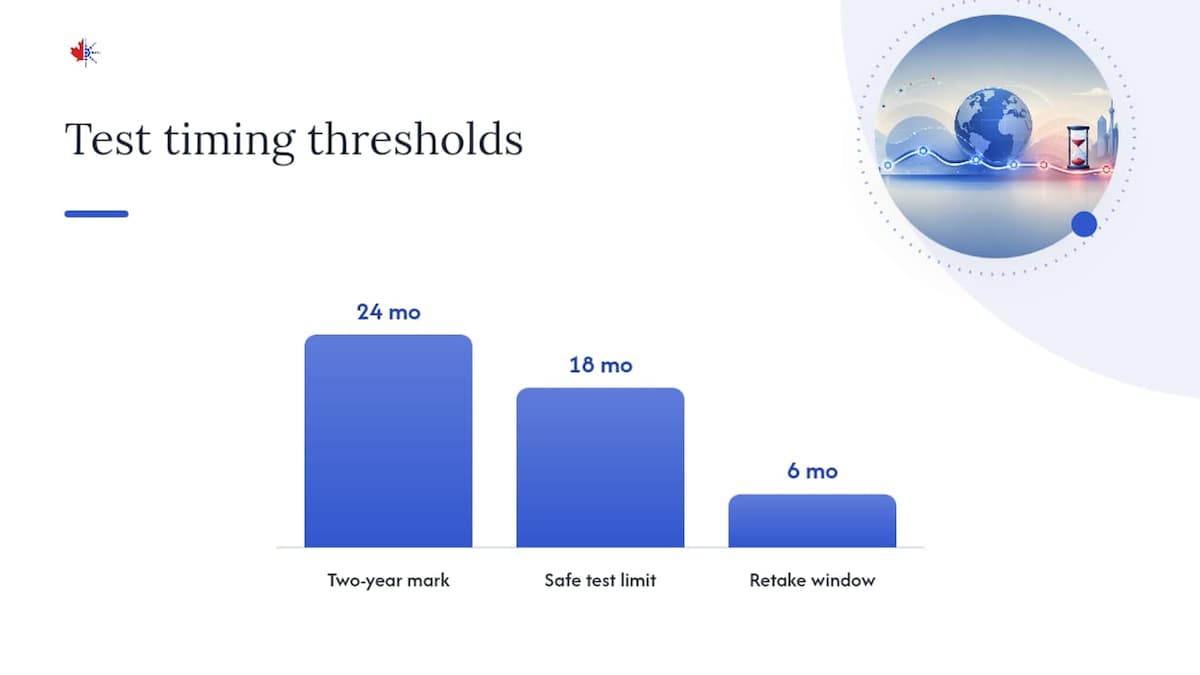
- Avoid testing more than 18 months before you expect to create your Express Entry profile, leaving a buffer for pool wait times and the 60‑day ITA window.
- If you’re already in the pool and approaching the two-year mark, consider a proactive retake rather than waiting for an ITA to force your hand.
- Budget for the possibility of a retake. Government-approved test fees generally run in the $300 to $400 CAD range, though this varies by provider and testing city.
- Build a simple retake checklist: diagnostic assessment first, then a focused study block targeting your weakest skill, then book the test, then keep every piece of documentation.
The applicants who avoid expiry problems are almost always the ones who treat their test date as a hard deadline they set themselves, not one that gets imposed on them by an ITA they didn’t see coming. A structured study plan built around your timeline makes that kind of proactive scheduling far more realistic than trying to cram in the final weeks before a deadline.
Pro Tip: If you’re within six months of your two-year mark and still waiting in the pool, don’t wait for an ITA to decide whether to retest. Book the retake now, on your own schedule, while you still have options.
How to submit and prove your language test results
When you complete your Express Entry profile or e‑APR forms, IRCC asks for specific, verifiable details, not just a summary of your scores.
- Test type and official version (for example, CELPIP‑General, not CELPIP‑General LS)
- Exact test date
- Test report or reference number
- Scores broken down by each of the four skills
IRCC verifies these numbers directly with the testing agency, comparing what you entered against the agency’s own records. Discrepancies, even small typos in a reference number, can trigger delays or requests for clarification. Keep both a physical and a digital copy of your official report, and hold onto the test report number somewhere you can find it instantly, not buried in an old email.
Pro Tip: Save a PDF of your test report and its reference number in the same folder as your Express Entry documents the day you receive it, not the week before your e‑APR deadline.
What most applicants get wrong about test timing
The mistake I see most often isn’t a lack of understanding of the two-year rule itself. Most applicants know that number. What catches people off guard is treating “valid at profile creation” as the finish line, when it’s really just the first of two separate checkpoints.
The gap between entering the pool and actually submitting an e‑APR can stretch for months, and that gap is exactly where scores quietly expire. The fix isn’t complicated: build your test timing around your expected submission date, not your expected profile date, and treat any test approaching 18 months old as one you should already be planning to retake. Applicants who build in that buffer rarely end up scrambling.
Get retake-ready before your CLB score expiry date
If a retake is now on your calendar, the difference between a stressful scramble and a confident second attempt usually comes down to how targeted your practice is in the weeks you have left. Celpipguide gives you a structured way to close skill gaps fast: full-length mock exams, an AI teacher that gives instant feedback on your writing and speaking tasks, and a diagnostic that shows exactly which skill is holding your CLB level back before you spend hours studying the wrong thing.
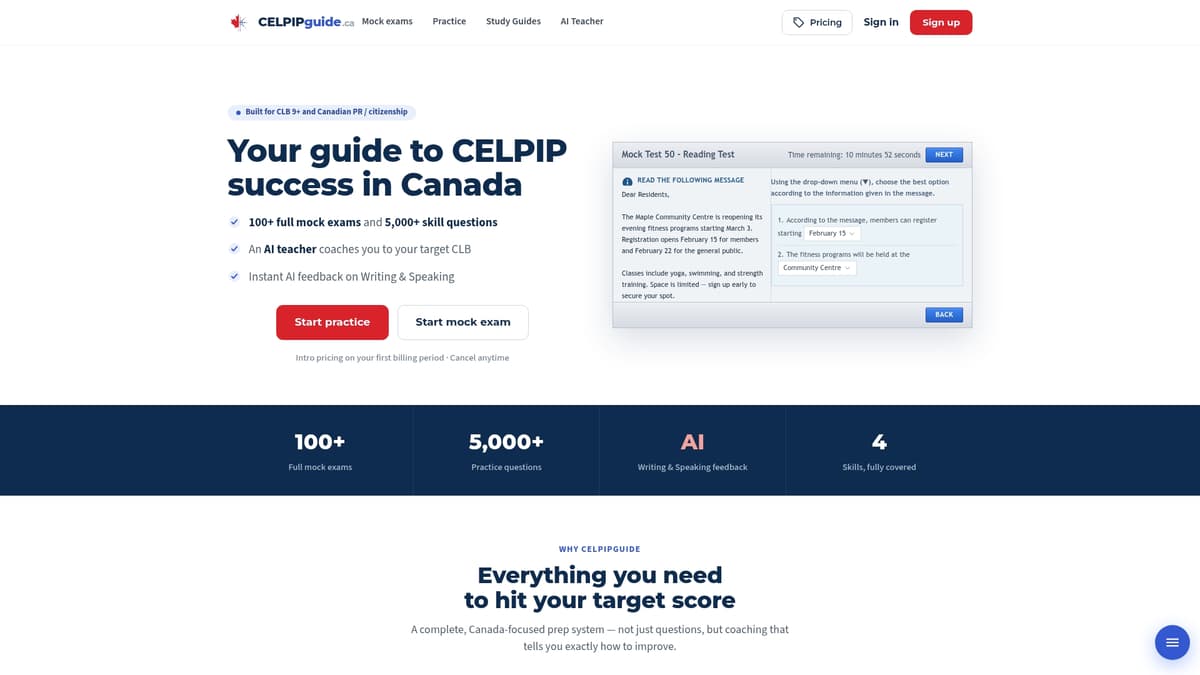
That kind of focused prep matters most when your test date is locked in and your two-year window is already ticking. The CELPIP Exam Practice Hub lets you start with a full simulated exam under real conditions, so you know precisely where you stand before you plan your remaining study time.
Sources
- Canada
This article is general information, not a substitute for advice from a qualified lawyer. Consult a qualified legal professional about your own circumstances before acting on anything here.
FAQ
How long is a CLB test valid for?
Your language test results are valid for two years from the test date. They must still be under two years old both when you create your Express Entry profile and when you submit your permanent residence application.
Is CLB 4 enough to immigrate?
CLB 4 meets the minimum threshold for some provincial and pilot programs, but it falls short of the requirements for Federal Skilled Worker eligibility, which typically calls for CLB 7 or higher.
Can I get PR with CLB 7?
CLB 7 is commonly the benchmark threshold for Federal Skilled Worker eligibility and other economic programs, though your overall competitiveness also depends on your Comprehensive Ranking System score and other factors like work experience and education.
What CLB score is required for PR?
There’s no single CLB score required across all PR pathways. Requirements range from CLB 4 for some provincial streams up to CLB 7 or higher for Federal Skilled Worker eligibility, so check the specific program’s minimums.
What happens if my test results expire while I’m in the Express Entry pool?
If your results will expire before you can submit your e‑APR, IRCC expects you to retake the test, submit before the expiry date, or decline the invitation and re‑enter the pool with fresh results.