
CELPIP Blog
Reading comprehension CLB score: what it really means
Reading comprehension CLB score: what it really means

TL;DR:
- Your reading comprehension CLB score is a critical factor in Canadian immigration eligibility and licensing. A low reading score can disqualify applications and significantly reduce CRS points, impacting your chances of receiving an invitation. Improving your reading CLB level offers the highest return on CRS points and is essential for regulated professions requiring advanced reading skills.
Your reading comprehension CLB score is a stand-alone benchmark within the Canadian Language Benchmarks (CLB) framework that directly determines your immigration eligibility, CRS points, and access to regulated professions in Canada. The CLB system, administered by the Centre for Canadian Language Benchmarks (CCLB), measures four skills independently: reading, writing, listening, and speaking. Your reading score does not get averaged with the others. It stands alone, and if it falls short, your entire application can fall short with it. Understanding the role of reading comprehension CLB score is the first step toward building a profile that actually gets you to Canada.
How does the reading comprehension CLB score affect immigration eligibility?
The reading score carries more weight than most candidates expect. IRCC programs like the Federal Skilled Worker Program (FSWP), Canadian Experience Class (CEC), and Federal Skilled Trades Program (FSTP) each set minimum CLB thresholds per skill. Your lowest individual skill score determines eligibility, not your average across all four.

This means a CLB 10 in speaking and writing cannot rescue a CLB 6 in reading. The lowest score rule is absolute. If your reading score misses the minimum, you are disqualified from the program regardless of how strong your other skills are.
The Comprehensive Ranking System (CRS) adds another layer of impact. Each CLB level increase in reading adds meaningful points to your CRS score. According to the CLB points breakdown, dropping from CLB 10 to CLB 9 across all skills results in a 20–30 point CRS reduction. The gap between CLB 7 and CLB 9 across all skills adds roughly 44 CRS points. In competitive Express Entry draws, that difference can delay your invitation by six months or more.
Here is a simplified view of how reading CLB levels translate to CRS impact:
| CLB reading level | Approximate CRS contribution | Practical impact |
|---|---|---|
| CLB 7 | Baseline eligibility for most programs | Meets minimum; limited CRS advantage |
| CLB 8 | Moderate CRS gain | Competitive in lower-draw rounds |
| CLB 9 | Strong CRS gain | Frequently invited in Express Entry draws |
| CLB 10 | Maximum language CRS points | Top-tier competitive profile |
For a detailed breakdown of how each CLB skill score maps to CRS points, the Express Entry points guide from Celpipguide walks through the numbers clearly.
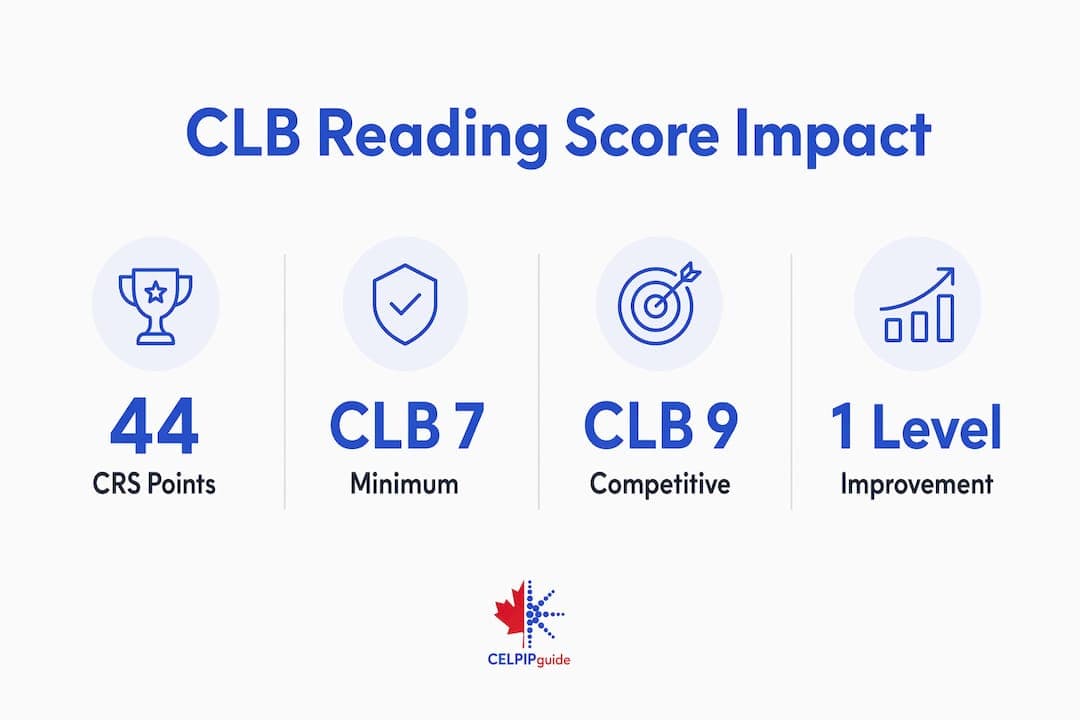
Pro Tip: If you are sitting just below a CRS cut-off, check your reading score first. Raising it by one CLB level often yields a bigger CRS gain than adding another year of work experience.
What CLB reading level do regulated professions require?
Reading proficiency is not just an immigration concern. Regulated professions in Canada treat CLB reading scores as a proxy for professional readiness. Engineering, teaching, and healthcare licensing bodies require CLB 7 or higher reading proficiency as part of credential recognition and licensing exam eligibility.
The reason is practical. Professionals in these fields must read complex regulatory documents, workplace policies, patient records, and legal agreements. A CLB 7 reading level signals that a candidate can handle moderately complex written material with reasonable accuracy. CLB 9 and above signals the ability to navigate dense policy texts and technical documentation with confidence.
Employers also screen for reading ability, even when they do not ask for formal CLB scores. Client-facing and documentation-heavy roles align with CLB 7–9 reading benchmarks in practice. Candidates who score in this range tend to perform better in written assessments and workplace onboarding.
Key reading requirements by sector:
- Engineering and trades: CLB 7+ for licensing exams and technical documentation
- Healthcare (nursing, pharmacy, medicine): CLB 8–9 for patient communication and regulatory compliance
- Teaching: CLB 7–8 for curriculum reading and professional development materials
- Legal and financial services: CLB 9+ for contract review and client correspondence
Pro Tip: If your target profession requires CLB 8 or higher, treat that as your reading floor, not your ceiling. Aim for CLB 9 to give yourself a buffer during the licensing process.
Common misconceptions about the reading comprehension CLB score
The most costly mistake candidates make is treating CLB scores as an average. They see a strong speaking score and assume it compensates for a weaker reading result. It does not. IRCC evaluates each skill independently, and a low reading score disqualifies an application even when every other skill meets the threshold.
A second misconception is that improving credentials or gaining more work experience is the fastest route to a higher CRS score. The data says otherwise. Raising a single skill from CLB 8 to CLB 9 yields a bigger CRS point increase than several additional years of work experience or a second post-secondary credential. Reading is often the skill with the most room for improvement, which makes it the highest-return target for many candidates.
Here is a practical approach to avoid these pitfalls:
- Identify your weakest CLB skill first. Run a diagnostic test to find your actual reading level before you plan your study schedule.
- Set a target CLB level, not a test score. Know which CLB level you need for your specific program and profession, then work backward to the CELPIP or IELTS score that maps to it.
- Retake strategically. Language test results expire after two years, so timing your retake to maximise your reading score before submission matters.
- Do not neglect reading in favour of speaking practice. Many candidates over-invest in speaking preparation because it feels more urgent. Reading improvements often deliver faster CRS gains.
- Track your progress by CLB level, not raw score. A jump from CELPIP 7 to CELPIP 9 in reading is a CLB level change with real immigration consequences.
Avoiding common CELPIP mistakes in the reading section is just as important as building new skills. Many candidates lose points on questions they could answer correctly with better test strategy.
How to interpret CLB reading levels and improve your score
CLB reading levels describe a clear progression of ability. At CLB 7, you can understand moderately complex sentences and workplace documents with some re-reading. At CLB 9, you can comprehend complex texts, policy documents, and materials that require inference and contextual understanding. CLB 10 and above means you can read dense, technical, or formal texts with full comprehension and minimal re-reading.
Understanding where you sit on this scale tells you exactly what skills to build. A CLB 7 reader needs to practise reading longer passages with unfamiliar vocabulary. A CLB 8 reader needs to work on inference questions and understanding implied meaning. A CLB 9 reader needs to sharpen speed and accuracy on complex academic or professional texts.
Test score conversions help you set concrete targets:
| CLB level | CELPIP reading score | IELTS reading band |
|---|---|---|
| CLB 7 | 7 | 6.0 |
| CLB 8 | 8 | 6.5 |
| CLB 9 | 9 | 7.0 |
| CLB 10 | 10 | 7.5 |
Practical steps to raise your reading CLB level:
- Read Canadian news sources, government websites, and professional publications daily to build vocabulary in context.
- Practise timed reading to build fluency. Speed matters on test day.
- Work through official-aligned sample reading tasks to understand question formats.
- Focus on inference and main idea questions, which carry the most weight at CLB 8 and above.
- Use a free CELPIP reading practice test to benchmark your current level before committing to a full study plan.
Reading proficiency at CLB 9 and above also pays dividends beyond the test. Newcomers at this level navigate workplace documents, legal agreements, and licensing processes with significantly more confidence after arriving in Canada.
Key takeaways
Your reading comprehension CLB score is the single most consequential individual skill score in your Canadian immigration and professional licensing profile.
| Point | Details |
|---|---|
| Reading score is independent | A low reading CLB disqualifies your application even if all other skills are strong. |
| CRS impact is significant | Moving from CLB 7 to CLB 9 in reading adds roughly 44 CRS points across all skills. |
| Professions require CLB 7+ | Regulated fields like engineering, healthcare, and teaching use CLB reading benchmarks for licensing. |
| Retaking tests is strategic | Scores expire after two years; a targeted retake to raise reading alone can unlock eligibility. |
| Reading gains outperform credentials | Raising reading by one CLB level typically yields more CRS points than additional work experience. |
Why I think most candidates underestimate their reading score
I have seen this pattern more times than I can count. A candidate spends months polishing their speaking skills, records practice responses, and feels confident going into the test. Then their reading score comes back at CLB 7, and suddenly their Express Entry profile is stuck below the cut-off. They did not fail the test. They failed to prepare for the right skill.
Reading feels passive. You sit down, you read, you answer questions. It does not feel like something you need to train for the way you train for speaking. That is exactly why it catches people off guard. The CLB reading assessment at higher levels is not testing whether you can read. It is testing whether you can read quickly, accurately, and with enough comprehension to answer inference questions under time pressure.
The candidates I have seen make the fastest progress are the ones who treat reading preparation the same way they treat writing. They practise with timed passages, they review every wrong answer, and they build vocabulary deliberately. They also check their CLB 9+ strategy early, because the habits that get you to CLB 9 in speaking transfer directly to reading.
My honest advice: run a diagnostic test this week. Find out exactly where your reading CLB sits. If it is below your target, make it your primary focus for the next six to eight weeks. Reading is the skill most candidates can improve the fastest with the right practice. Do not leave those CRS points on the table.
— Reza
Celpipguide can help you raise your reading CLB score
Preparing for the CELPIP reading section is much more effective when you practise with tests that mirror the real exam format.
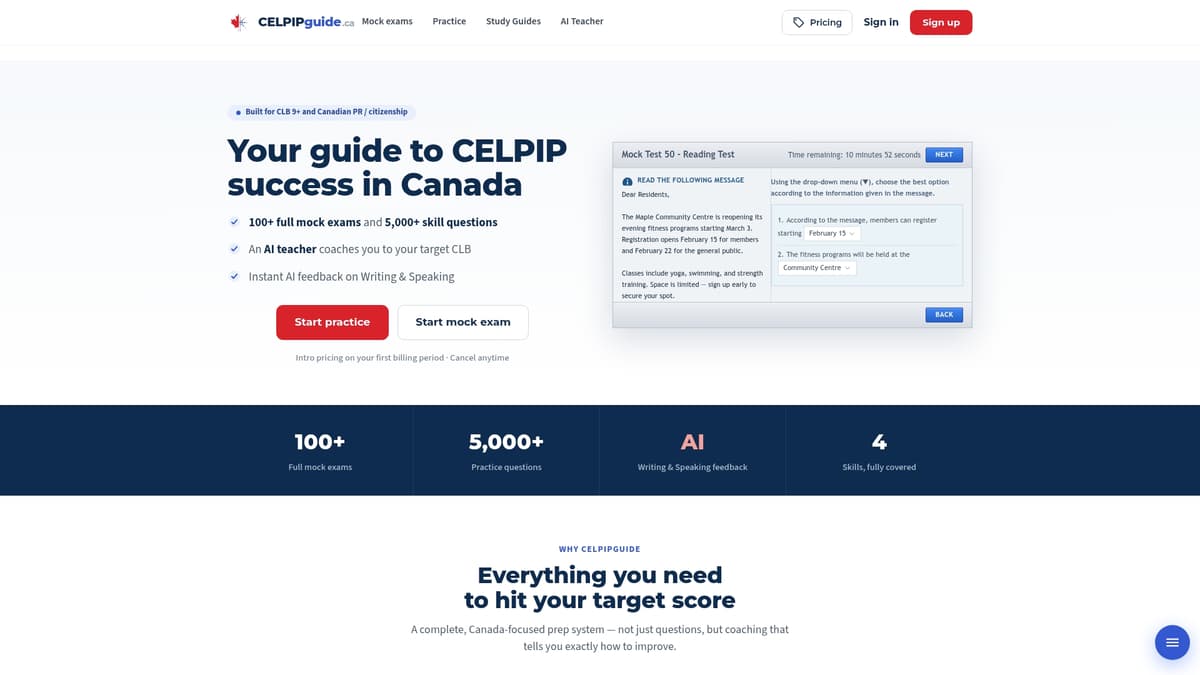
Celpipguide offers over 100 full mock exams and 5,000 practice questions built to CEFR and CLB standards. The platform’s AI teacher identifies your specific reading weaknesses and builds a personalised study plan around them. You get instant feedback after every practice session, so you know exactly what to fix before test day. Whether you are targeting CLB 7 for basic eligibility or CLB 9 for a competitive CRS score, the CELPIP exam practice hub gives you the structured, skill-specific preparation that makes the difference. Start with a diagnostic test and see where your reading level actually stands.
FAQ
What is the minimum CLB reading score for Express Entry?
The Federal Skilled Worker Program requires a minimum CLB 7 in all four skills, including reading. The Canadian Experience Class requires CLB 7 for NOC TEER 0 and 1 occupations, and CLB 5 for TEER 2 and 3.
Can a high speaking score compensate for a low reading CLB score?
No. IRCC evaluates each CLB skill independently, and your lowest score determines eligibility. A strong speaking result cannot offset a reading score that falls below the program minimum.
How many CRS points does improving my reading CLB score add?
The gap between CLB 7 and CLB 9 across all skills adds roughly 44 CRS points. Even a single-level improvement in reading contributes meaningfully to your total CRS score.
What CELPIP score equals CLB 9 in reading?
A CELPIP reading score of 9 corresponds to CLB 9, which is equivalent to approximately a 7.0 band in IELTS reading. This level is competitive for most Express Entry draws.
How long are CLB test scores valid for immigration purposes?
Language test results are valid for two years from the test date. Retaking the test specifically to raise your reading score is a common and effective strategy for candidates below their target CLB level.