
CELPIP Blog
CLB scores Express Entry points breakdown: 2026 guide
CLB scores Express Entry points breakdown: 2026 guide

TL;DR:
- Achieving CLB 9 across all four skills increases CRS points significantly and improves your same-day chances.
- Focusing on improving just one language skill from CLB 8 to CLB 9 can add up to 8 points and boost competitiveness.
CLB scores are the Canadian Language Benchmark levels that convert your English or French test results into Comprehensive Ranking System (CRS) points for Immigration, Refugees and Citizenship Canada’s (IRCC) Express Entry system. Language proficiency is the highest-value CRS factor, worth up to 136 points for your first official language alone. Understanding the full CLB scores Express Entry points breakdown gives you a clear picture of exactly where your points come from and where you can gain more.

1. How CLB levels translate into Express Entry CRS points
The CRS awards points for each of the four language skills separately: Listening, Reading, Writing, and Speaking. The points per skill increase significantly as your CLB level rises.
For a single applicant (no spouse or common-law partner), the points per skill are:
| CLB Level | Points per skill | Total (4 skills) |
|---|---|---|
| CLB 7 | 17 | 68 |
| CLB 8 | 23 | 92 |
| CLB 9 | 31 | 124 |
| CLB 10+ | 34 | 136 |
For married or common-law applicants, the points per skill are lower because the spouse’s language score is counted separately. A single applicant can earn a maximum of 136 points for first language proficiency across all four skills at CLB 10+.
The jump from CLB 8 to CLB 9 is the most valuable single improvement you can make. Raising all four skills from CLB 8 to CLB 9 adds 32 CRS points for a single applicant. That is equivalent to the CRS difference between holding a Bachelor’s degree and a Master’s degree.
Pro Tip: If you are currently at CLB 8 in any skill, pushing that one skill to CLB 9 adds 8 points immediately. Four skills at CLB 9 instead of CLB 8 adds 32 points total.
2. What are the minimum CLB requirements by Express Entry program?
Each Express Entry program sets its own minimum CLB threshold. Failing to meet the minimum in even one skill disqualifies you from that program entirely.
Here are the minimum CLB requirements by program:
- Federal Skilled Worker Program (FSWP): CLB 7 in all four skills (Listening, Reading, Writing, Speaking).
- Canadian Experience Class (CEC): CLB 7 in all four skills for TEER 0 or TEER 1 occupations; CLB 5 in all four skills for TEER 2 or TEER 3 occupations.
- Federal Skilled Trades Program (FSTP): CLB 5 for Speaking and Listening; CLB 4 for Reading and Writing.
Meeting the minimum only gets you into the pool. It does not make you competitive. Competitive candidates target CLB 9 or higher to earn significantly more CRS points and improve their chances of receiving an Invitation to Apply (ITA). Think of the minimum CLB as the door. CLB 9 is where you start winning.
3. Which language tests does IRCC accept?
IRCC accepts specific approved tests only. Submitting results from any other test, or the wrong version of an accepted test, leads to immediate disqualification.
Accepted tests for English proficiency:
- IELTS General Training
- CELPIP-General
- PTE Core
Accepted tests for French proficiency:
- TEF Canada
- TCF Canada
Test results must be less than two years old at the time you submit your Express Entry profile. CELPIP uses a direct 1-to-1 CLB mapping, meaning each CELPIP score level corresponds exactly to one CLB level. IELTS requires a conversion chart to determine the equivalent CLB level.
Academic versions of IELTS are not accepted for Express Entry. Only IELTS General Training is valid. Submitting academic results voids your language proof entirely.
Pro Tip: CELPIP-General is designed specifically for Canadian immigration. Its direct CLB mapping removes the guesswork of score conversion, making it a practical choice for Express Entry candidates.
4. Why CLB 9 is the strategic target for Express Entry
CLB 9 is the level where your CRS score starts to pull significantly ahead of the competition. The points difference between CLB 7 and CLB 9 in all four skills is 56 points for a single applicant. That gap is enormous in a system where draws often separate candidates by just a few points.
CLB 9 or higher combined with other factors unlocks skill transferability bonuses worth up to 50 additional CRS points. These bonuses apply when strong language scores combine with Canadian work experience or a post-secondary credential. This makes CLB 9 a multiplier, not just a milestone.
Key reasons to target CLB 9:
- Higher base CRS points: 31 points per skill versus 17 at CLB 7.
- Skill transferability bonuses: Unlocked at CLB 9+ when combined with education or work experience.
- Second language bonus: Achieving CLB 7 or higher in your second official language adds up to 24 bonus CRS points.
- ITA competitiveness: Most recent Express Entry draws have cut off well above the minimum eligibility score.
“Minimum CLB 7 gets you into the pool. CLB 9 gets you an invitation.”
Many candidates focus entirely on meeting the minimum and then wonder why they never receive an ITA. The CLB score chart shows clearly that the real CRS gains happen above CLB 8. Aiming for CLB 9 across all skills is the single most impactful thing most candidates can do.
5. How improving one language skill boosts your CRS score
CRS calculates points for each language skill independently. You do not need to improve all four skills at once to see a meaningful CRS gain. Raising just one skill from CLB 8 to CLB 9 adds 8 points. Raising two skills adds 16 points.
Many candidates incorrectly assume they need to move their entire CLB tier upward to gain points. That is not how the system works. Improving a single skill’s CLB score can yield a 50+ point increase when the starting point is low enough and the gain spans multiple CLB levels.
The practical approach is to identify your weakest skill and focus your preparation there. Common weak skills for test-takers include:
- Writing: Requires structured responses and formal register.
- Speaking: Timed responses and unfamiliar task formats catch many candidates off guard.
- Reading: Speed and vocabulary under time pressure are common challenges.
Pro Tip: Review your score report after each practice test and rank your four skills from lowest to highest. Spend 60% of your study time on the bottom one or two skills. That is where your CRS gains are hiding.
Resources like CELPIP practice tasks by skill let you target specific weaknesses without repeating full-length tests every session.
6. Understanding CLB levels and the second official language bonus
Most candidates focus entirely on their first official language. The second official language bonus is one of the most overlooked opportunities in the Express Entry scoring system.
Achieving CLB 7 or higher in your second official language adds up to 24 bonus CRS points. In tight Express Entry draws, 24 points can be the difference between receiving an ITA and waiting another six months. For English speakers, this means taking TEF Canada or TCF Canada. For French speakers, it means taking IELTS General Training, CELPIP-General, or PTE Core.
The second language bonus is separate from your core language points. It sits in its own CRS category and stacks on top of everything else. Candidates who invest time in even basic proficiency in their second official language gain a real competitive edge.
Key takeaways
Language proficiency is the most actionable factor in Express Entry CRS scoring, and CLB 9 across all four skills is the threshold where points, bonuses, and ITA competitiveness converge.
| Point | Details |
|---|---|
| CLB 9 is the competitive target | CLB 9 earns 31 points per skill versus 17 at CLB 7, a 56-point total gap for single applicants. |
| Minimum CLB is not enough | Meeting program minimums only qualifies you; competitive draws require scores well above CLB 7. |
| Improve skills independently | Raising one skill from CLB 8 to CLB 9 adds 8 CRS points without changing any other skill. |
| Use only accepted test versions | Only IELTS General Training, CELPIP-General, and PTE Core are valid; academic versions disqualify you. |
| Claim the second language bonus | CLB 7+ in your second official language adds up to 24 bonus CRS points in a separate category. |
Why I think most candidates leave CRS points on the table
I have seen hundreds of Express Entry candidates make the same mistake. They study hard, pass their language test, meet the CLB 7 minimum, and then wait. And wait. The problem is not their effort. It is their target.
Language skills are the one factor in Express Entry you can actually change. You cannot get younger. You cannot instantly earn more Canadian work experience. But you can retake CELPIP-General and push a CLB 8 Writing score to CLB 9. That single change adds 8 CRS points. Do it across all four skills and you add 32 points. That is a transformation in your profile.
The second language bonus is equally underused. I have spoken with candidates who are conversational in French but never bothered to take TEF Canada. That decision cost them 24 CRS points. In a draw that cuts at 491, those 24 points are the entire margin.
My honest advice: treat CLB 9 as your floor, not your ceiling. Use targeted practice for your weakest skills. Understand exactly how CLB 9+ strategies for speaking and writing work before your test date. The candidates who receive ITAs are not luckier than you. They prepared with a specific score target in mind.
— Reza
Celpipguide: practice tools built for CLB score improvement
Knowing the CLB points breakdown is the first step. Closing the gap between your current score and CLB 9 takes focused, skill-specific practice.
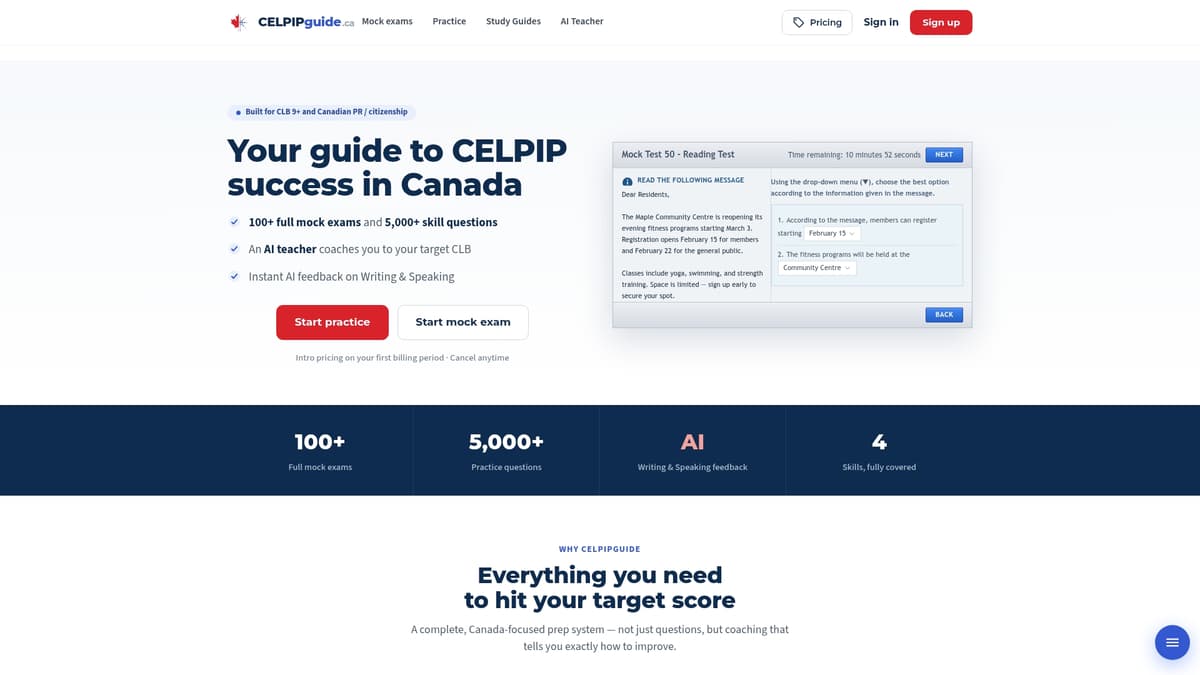
Celpipguide gives you access to over 100 full-length CELPIP mock exams that simulate the real test environment, so you know exactly what to expect on test day. The platform’s AI teacher analyses your responses, identifies your weakest CLB skills, and builds a personalised study plan around them. You can also use the CELPIP vocabulary tracker to master the specific words that appear in exam tasks. Whether you are targeting CLB 9 for the first time or retaking to improve one skill, Celpipguide gives you the tools to practise with purpose.
FAQ
What is a CLB score in Express Entry?
A CLB score is a Canadian Language Benchmark level that converts your official language test result into a standardised number used by IRCC to calculate your CRS points. Each of the four language skills receives its own CLB level.
What CLB score do I need for Express Entry?
The Federal Skilled Worker Program and Canadian Experience Class (TEER 0/1) both require a minimum of CLB 7 in all four skills. The Federal Skilled Trades Program requires CLB 5 for Speaking and Listening, and CLB 4 for Reading and Writing.
How many CRS points does CLB 9 give?
CLB 9 earns 31 CRS points per language skill for a single applicant, totalling 124 points across all four skills for the first official language. That is 56 more points than CLB 7 across all four skills.
Does CELPIP map directly to CLB levels?
Yes. CELPIP-General uses a direct 1-to-1 CLB mapping, meaning each CELPIP score level corresponds exactly to one CLB level without a conversion chart. IELTS General Training requires a separate conversion to determine the equivalent CLB level.
Can improving one language skill increase my CRS score?
Yes. CRS awards points per skill independently, so raising one skill from CLB 8 to CLB 9 adds 8 CRS points even if your other three skills stay the same. Targeting your weakest skill is the most efficient way to gain points.