
CELPIP Blog
Express entry English score improvement tips: 2026 guide
Express entry English score improvement tips: 2026 guide

TL;DR:
- Improving your lowest CLB skill is essential because it controls your Express Entry eligibility and CRS score. Focused practice with feedback over two to four months significantly raises CLB levels, especially when retaking only after mock tests confirm readiness. Test-specific preparation and deliberate error analysis outperform general English study in achieving the necessary CLB 9 threshold.
Your English score is the single most powerful lever in your Express Entry Comprehensive Ranking System (CRS) profile. The right express entry english score improvement tips are not about studying harder. They are about studying the right things, in the right order, for the right exam. IRCC accepts only three English tests for Express Entry: IELTS General Training, CELPIP-General, and PTE Core. Each maps to Canadian Language Benchmark (CLB) levels, and reaching CLB 9 across all four skills is the strategic target that separates competitive profiles from stalled ones.
1. Why your weakest skill controls your entire CRS score

The single lowest CLB skill score determines your Express Entry eligibility. This is the most misunderstood rule in the system. A candidate with CLB 9 in Listening, Reading, and Speaking but CLB 7 in Writing does not score as a CLB 9 candidate. That one weak skill pulls the entire profile down.
The CRS impact of CLB improvement is significant. Moving from CLB 8 to CLB 9 across all four skills can add 32 to 50 CRS points. That point gain outweighs the benefit of upgrading from a Bachelor’s to a Master’s degree.
Here is what this means practically:
- Identify your lowest scoring skill from your most recent mock test or official result.
- Allocate about 60% of your study time to that skill first.
- Bring the weak skill to the same CLB level as your strongest before spreading effort evenly.
- Track each skill separately in every practice session, not just your overall score.
Pro Tip: Print your last mock test result and circle the lowest skill score in red. That number is your only priority until it moves up by at least one CLB level.
2. How to build a study plan that actually moves your score
A meaningful improvement of 1–2 CLB levels generally requires 2–4 months of focused study, with 60–90 minutes of daily practice. Shorter timelines under three weeks are usually ineffective unless you are correcting a specific technical error.
A realistic weekly cycle looks like this:
- Monday and Tuesday: Timed skill practice on your weakest area only. Use full-length, exam-format tasks.
- Wednesday: Error analysis session. Review every wrong answer and label the error type (grammar, vocabulary, time management, comprehension).
- Thursday and Friday: Targeted drills based on Wednesday’s error list. Do not repeat tasks you already do well.
- Saturday: One full timed mock test under real exam conditions. No pausing, no phone.
- Sunday: Review Saturday’s mock test results at the criterion level. Note which rubric categories dropped your score.
Daily mock tests without criterion-level feedback produce little improvement. The feedback loop is what drives progress, not the volume of tests completed.
Pro Tip: Use a simple spreadsheet to track your CLB score per skill after every mock test. A flat line across three sessions means your current method is not working. Change the approach, not just the effort.
3. Skill-specific techniques that raise your CLB score
Each of the four skills responds to different techniques. Generic study habits do not move individual CLB levels. Here is what works for each skill.
Listening
- Predict the answer type before the audio plays. If the question asks “how many,” you are listening for a number.
- Track every error after each session. Group errors into categories: missed detail, wrong word form, distraction.
- Practise with audio at slightly faster speeds to build processing speed before the real exam.
- Avoid listening passively to English podcasts and calling it study. Passive exposure does not build the accuracy that CLB scoring demands.
Reading
- Scan for keywords in the question first, then locate the relevant paragraph in the passage.
- Manage time by section. If one question takes more than 90 seconds, mark it and move on.
- Focus on grammar-level comprehension. Many reading errors come from misreading sentence structure, not vocabulary gaps.
- Practise with time management strategies specific to your exam format, since CELPIP-General and IELTS General Training have different passage structures.
Writing
Simple, error-free writing scores higher than complex but error-prone text. This is the rule most candidates ignore. Examiners prioritise coherence, logic, and clear structure over complex vocabulary or long sentences.
- Write short, clear sentences with one idea each.
- Use a logical paragraph structure: topic sentence, supporting detail, example, conclusion.
- Avoid memorised templates. Examiners recognise them, and they hurt your coherence score.
- Proofread specifically for subject-verb agreement and article errors, which are the two most common CLB-level Writing mistakes.
Speaking
- Practise timed responses out loud, not in your head. Thinking through an answer silently does not build the fluency that examiners hear.
- Aim for clarity over complexity. A clear, well-paced answer at a moderate vocabulary level scores better than a rushed, complex one.
- Avoid overthinking the topic. Spend the first five seconds organising one main point and two supporting details, then speak.
- Record yourself once per week and listen back. Most candidates are surprised by filler words and unnatural pausing they did not notice while speaking.
Common CELPIP mistakes in Speaking often come from over-preparation on templates rather than genuine fluency practice.
4. Test-specific preparation beats general English study
General English courses and fluent spoken English do not significantly improve CLB scores required for Express Entry. Candidates must practise test-specific skills aligned with IELTS General Training, CELPIP-General, or PTE Core formats to cross CLB thresholds.
This distinction matters because each exam has its own task types, timing constraints, and scoring rubrics. A candidate who is conversationally fluent but unfamiliar with CELPIP’s email-writing task format will lose points on structure, not language ability. The fix is format-specific practice, not more conversation.
IRCC accepts only IELTS General Training, CELPIP-General, and PTE Core for Express Entry English proficiency. Academic versions of these tests are not accepted. Test results are valid for two years, with unlimited retakes allowed.
5. Booking and retaking your test the right way
Retaking a test without data is expensive and often pointless. Booking a retake should be based on data showing stable target scores in the last two full, timed mock tests. Booking based on personal confidence often leads to unnecessary retakes and wasted fees.
Follow this retake framework:
- Run two complete, timed mock tests in the week before your planned booking date.
- If both mocks show your target CLB score in every skill, book the test.
- If one or more skills are still below target, delay booking by two to four weeks and return to targeted drills.
- Track your score trend per skill, not just your overall average. A rising trend in your weak skill is the signal to book.
Pro Tip: Set a minimum score threshold for each skill before you allow yourself to book. Write it down. Treat it as a rule, not a suggestion. This one habit prevents most unnecessary retake fees.
One more consideration many candidates overlook: combining English scores with French proficiency results creates a stronger CRS profile. Even basic French can add substantial CRS points, improving your Invitation to Apply chances faster than English improvements alone. If you have any French background, a TEF Canada or TCF Canada result is worth pursuing in parallel.
6. The feedback loop: the method that actually works
The feedback loop model is the most reliable English proficiency improvement method. It works in four steps: diagnose specific criteria, practise under timed conditions, receive criterion-level feedback, correct the behaviour, and repeat. Focusing on your highest-cost repeated errors produces faster score gains than fixing minor errors or switching tasks randomly.
Passive practice, such as repeatedly taking tests without error analysis, produces minimal score improvements. The candidates who improve fastest are the ones who can name their top three recurring errors after every session. That level of self-awareness comes from deliberate review, not from volume.
AI-powered feedback tools and qualified tutors both serve this function well. The key is criterion-level diagnosis. Knowing you “lost points in Writing” is not enough. Knowing you consistently lose points on task response because your supporting examples are too vague is the insight that changes your score.
Key takeaways
The most effective way to raise your Express Entry CRS score through English is to identify your lowest CLB skill, apply test-specific practice with criterion-level feedback, and book your retake only when mock test data confirms readiness.
| Point | Details |
|---|---|
| Weakest skill controls eligibility | Your lowest CLB score sets your CRS points; fix it before anything else. |
| Study 60–90 minutes daily for 2–4 months | Shorter timelines rarely produce meaningful CLB-level gains. |
| Use the feedback loop method | Diagnose errors by criterion, practise the fix, and repeat every week. |
| Book retakes based on mock test data | Two stable target-score mocks signal readiness; confidence alone does not. |
| Test-specific practice is non-negotiable | CELPIP-General, IELTS General Training, and PTE Core each require format-specific preparation. |
What I have learned about improving English scores for Express Entry
I have seen candidates study for six months and barely move their CLB score. I have also seen candidates jump two CLB levels in ten weeks. The difference is almost never effort. It is method.
The biggest mistake I see is treating CLB improvement like general language learning. Watching English TV, chatting with native speakers, and reading news articles are fine habits. They will not move your CELPIP-General Writing score from CLB 7 to CLB 9. Only practising the exact task type, under timed conditions, with feedback on the exact rubric criteria, will do that.
The psychological side is real too. Many candidates avoid their weakest skill because it feels discouraging. I understand that. But your weakest skill is the only one that matters right now. Spending 60% of your study time on something you find hard is uncomfortable. It is also the fastest path to an ITA.
One thing I tell every candidate: cross the CLB threshold first, then worry about fluency. The exam rewards structure and clarity. A candidate who writes simple, logical, error-free paragraphs will outscore a fluent speaker who writes complex, error-prone ones every single time. Build the skill the exam rewards, not the skill that feels impressive.
If you are feeling anxious about test day itself, that is worth addressing directly. Managing test anxiety is a separate skill, and it has a measurable effect on performance. Do not leave it unaddressed in your preparation.
— Reza
Celpipguide: practise smarter for your CELPIP-General exam
Knowing the right techniques is step one. Applying them under real exam conditions is where scores actually change.
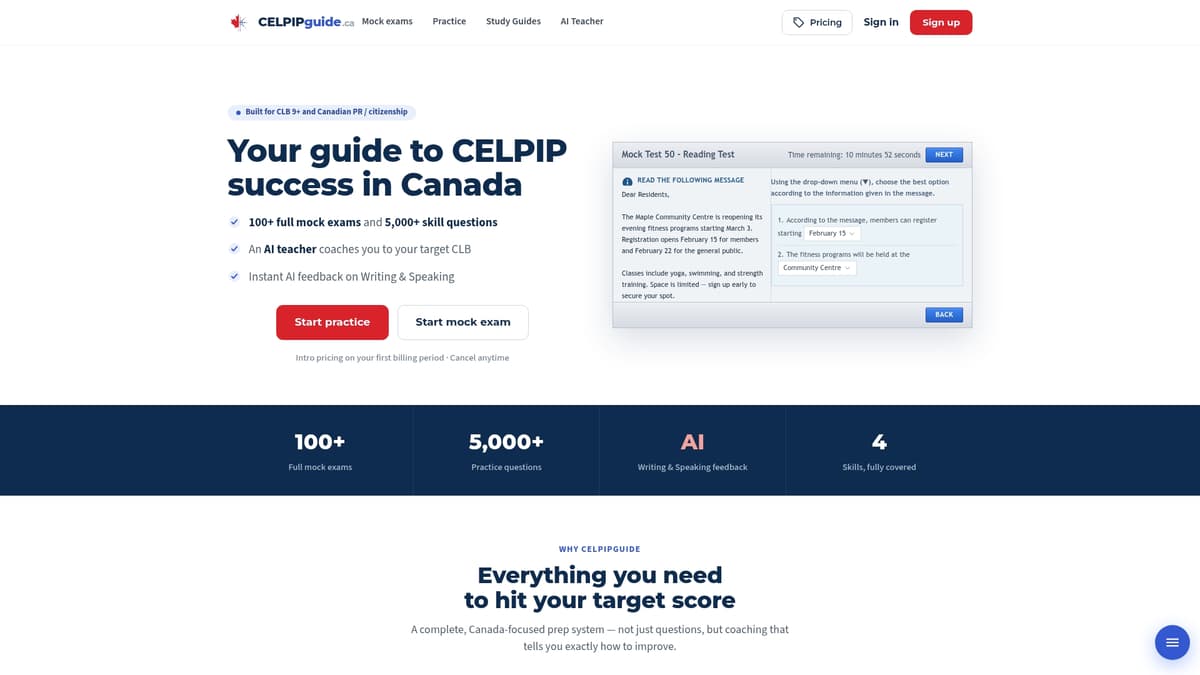
Celpipguide gives you access to over 100 full-length CELPIP practice exams built to match the real test format, plus 5,000 practice questions mapped to CEFR and CLB standards. The AI teacher on the platform delivers instant, criterion-level feedback on Writing and Speaking tasks, so you know exactly which rubric categories to fix. A diagnostic test at the start builds your personalised study plan, and skill-specific sample tasks let you drill your weakest area without wasting time on skills you have already mastered. If you are serious about reaching CLB 9, this is where to put your practice hours.
FAQ
What CLB level should I target for Express Entry?
CLB 9 across all four skills is the target that maximises your CRS points. Moving from CLB 8 to CLB 9 in all skills can add 32 to 50 CRS points to your profile.
Which English tests does IRCC accept for Express Entry?
IRCC accepts IELTS General Training, CELPIP-General, and PTE Core. Academic versions of these tests are not accepted, and results are valid for two years.
How long does it take to improve by one CLB level?
A meaningful improvement of 1–2 CLB levels generally requires 2–4 months of focused study at 60–90 minutes per day. Timelines under three weeks are rarely effective.
Should I retake the test if I feel ready?
Book a retake only when two full, timed mock tests show your target CLB score in every skill. Personal confidence is not a reliable readiness signal.
Does general English study help my Express Entry score?
General English courses and conversational practice do not significantly improve CLB scores. Test-specific preparation aligned to your chosen exam format is what moves CLB levels.