
CELPIP Blog
Common CELPIP mistakes students make: 2026 guide
Common CELPIP mistakes students make: 2026 guide

TL;DR:
- The most damaging CELPIP mistakes are preparation errors like poor timing habits and using unsuitable study materials.
- Addressing these issues through smart practice, targeted feedback, and correct resource use can significantly improve scores.
The most damaging common CELPIP mistakes students make are not grammar errors. They are preparation errors: wrong timing habits, no examiner feedback, and study materials built for a different exam entirely. Each of these errors directly lowers your Canadian Language Benchmark (CLB) score and delays your immigration or career goals. The good news is that every mistake on this list is fixable. You do not need to be a native speaker to score CLB 9 or higher. You need to practise smart, use the right resources, and stop repeating the same test errors that hold most candidates back.
1. Why timing mismanagement is the most costly CELPIP mistake

Poor time management costs candidates an average of 2–3 CLB levels. That is not a minor dip. That is the difference between qualifying for permanent residency and having to rewrite the exam.
The CELPIP Reading and Writing sections run on strict, non-negotiable timers. Many students spend too long on early questions and then rush or skip the final tasks entirely. Skipping even one Writing task can collapse your score in that section.
Common timing errors include:
- Spending more than 90 seconds on a single Reading question
- Failing to monitor the on-screen countdown during Writing tasks
- Not practising with a real computer interface before test day
- Leaving Speaking responses unfinished because of poor pacing
Pro Tip: Practise every mock exam on a computer, not paper. The CELPIP interface has a built-in timer that behaves differently from a phone stopwatch. Getting comfortable with it before test day removes one major source of panic.
The fix is straightforward. Set strict time limits during every practice session. Treat every timed drill as the real exam. Over time, your brain learns to pace itself automatically.
2. Practising without examiner-level feedback
68% of CELPIP candidates who fail repeat the same errors without examiner-level feedback. That statistic should stop you in your tracks. Practising without quality feedback does not build skill. It reinforces mistakes.
Self-recording your Speaking responses and listening back is useful, but it has a ceiling. You cannot hear what you do not know to listen for. The same applies to Writing. Reviewing your own essays without a scoring rubric means you are guessing at what the examiner wants.
The most effective approach to getting useful feedback includes:
- Using structured practice tests that score your responses against CELPIP rubrics
- Reviewing detailed written feedback on each Writing task, not just a number
- Comparing your Speaking responses to scored sample answers at your target CLB level
- Tracking which error types recur across multiple attempts
Pro Tip: Celpipguide’s AI teacher delivers instant feedback on Writing and Speaking tasks, pinpointing exactly where you lose marks. That kind of specific, rubric-based critique is what separates candidates who improve quickly from those who plateau.
Feedback is not optional. It is the mechanism by which improvement actually happens.
3. Underestimating the Listening and Speaking sections
The Listening section has the highest failure rates of any CELPIP component. Most students underestimate it because they assume everyday English is enough. It is not.
CELPIP Listening uses direct Canadian communication style. Speakers do not over-explain. Implied meanings are common. Students who overthink inference questions and search for hidden complexity consistently choose wrong answers. The correct answer is usually the most direct one.
Here are the most frequent Listening and Speaking errors to watch for:
- Overthinking inference questions and rejecting the obvious answer
- Speaking too fast during timed responses, reducing clarity
- Using a tone that is too formal or too casual for the scenario given
- Failing to note key details during Listening passages
- Panicking when you miss a word and losing focus on the rest of the passage
For Speaking, the task description tells you exactly what register to use. A message to a neighbour sounds different from a complaint to a manager. Read the scenario carefully and match your tone to it. Celpipguide’s listening practice guide walks through exactly these scenarios with targeted exercises.
4. Using IELTS materials to prepare for CELPIP
Many candidates lose marks by using generic IELTS preparation materials not tailored to Canadian contexts. This is one of the most common Celpip test errors among newcomers, and it is entirely avoidable.
CELPIP and IELTS are both English proficiency exams, but they test different things. CELPIP is built around Canadian workplace and social scenarios. It tests idioms, vocabulary, and communication styles that are specific to life in Canada. IELTS materials do not cover these contexts.
| Feature | CELPIP | IELTS |
|---|---|---|
| Format | Computer-based only | Paper or computer |
| Context | Canadian workplace and social life | International academic and general |
| Speaking | Recorded responses, no live examiner | Live examiner interview |
| Vocabulary focus | Canadian idioms and workplace language | General academic English |
| Accepted by | IRCC for Canadian immigration | Universities and immigration globally |
Studying with IELTS materials trains you for the wrong exam. You will practise academic writing structures that CELPIP does not reward. You will miss the Canadian-specific vocabulary that CELPIP actively tests. Use CELPIP-specific vocabulary practice to build the word bank that actually appears on your exam.
5. Booking the wrong CELPIP test type
Candidates frequently confuse CELPIP General LS with the CELPIP General test type. This is a preparation mistake that happens before you even sit down to study. Booking the wrong test can invalidate your results for permanent residency applications.
CELPIP General tests all four skills: Listening, Reading, Writing, and Speaking. CELPIP General LS tests only Listening and Speaking. IRCC accepts both for most immigration streams, but specific programmes require specific test types. Confirm which version your application requires before you register.
This mistake is easy to avoid. Check the IRCC website or your immigration consultant’s guidance before booking. Then build your preparation around the exact sections you will be tested on.
6. Relying on memorised speaking templates
Clear, natural speech is more effective than memorised and rehearsed templates in Speaking tasks. Fixed phrases reduce your flexibility. When the task prompt does not match your template, you freeze or force an awkward fit.
Examiners score CELPIP Speaking on task fulfilment, vocabulary range, and coherence. A memorised opening like “I am going to talk about three points” does not earn marks. It wastes your limited response time and signals that you are not engaging with the specific task.
Effective Speaking habits look like this:
- Read the task prompt fully before you begin speaking
- Respond directly to what is asked, not to a pre-planned structure
- Use natural connectors like “because,” “so,” and “which means” instead of formal transitions
- Vary your vocabulary rather than repeating the same words
Pro Tip: Review CLB 9+ speaking samples to hear what natural, high-scoring responses actually sound like. Then record yourself responding to the same prompt and compare directly.
The goal is to sound like a confident, clear communicator, not a textbook.
7. Writing sentences that are too complex
Writing overly complex sentences often introduces grammar errors that cost marks in the Writing section. This is a frequent Celpip writing error among students who believe longer sentences signal higher ability. They do not.
CELPIP Writing is scored on clarity, coherence, vocabulary, and grammar. A sentence with three embedded clauses is harder to write correctly than three short sentences. When you make a grammar error inside a complex structure, it is more visible and more damaging to your score.
Simple, clear writing looks like this:
- “I am writing to request a refund.” (Not: “I am writing with the purpose of making a formal request regarding a refund.”)
- “The meeting was cancelled.” (Not: “The meeting, which had been scheduled for Tuesday, was subsequently cancelled.”)
Use writing task samples to study how high-scoring responses balance clarity with vocabulary range. The best CELPIP writers use precise words in simple structures, not complicated sentences with basic words.
8. Ignoring unscored experimental questions
Unscored experimental questions in Listening and Reading look identical to scored questions. Students who try to identify which questions are experimental waste time and mental energy. That wasted focus costs marks on the questions that do count.
The correct approach is simple: treat every question as if it is scored. Do not skip. Do not guess randomly. Do not spend extra time trying to detect patterns. Consistent, equal attention across all questions is the most reliable strategy.
Key takeaways
Avoiding common CELPIP mistakes requires fixing preparation habits before test day, not just practising more of the same.
| Point | Details |
|---|---|
| Timing costs CLB levels | Poor pacing loses candidates 2–3 CLB levels across Reading and Writing sections. |
| Feedback drives improvement | Without examiner-level feedback, most candidates repeat the same errors on every attempt. |
| IELTS materials mislead | CELPIP tests Canadian-specific vocabulary and scenarios that IELTS prep materials do not cover. |
| Natural speech beats templates | Fixed speaking phrases reduce flexibility and lower scores on dynamic tasks. |
| Simple writing scores higher | Clear, short sentences reduce grammar errors and improve Writing section marks. |
What I have learned from watching students prepare for CELPIP
The mistake I see most often is not on the list of obvious errors. Students misread the task instructions. They write a formal email when the task asks for a friendly note to a neighbour. They give a three-point argument when the task asks for a personal opinion. The instructions tell you exactly what to do. Reading them carefully takes 20 seconds and can save you an entire CLB level.
The second thing I have noticed is that students who improve fastest are not the ones who study the most hours. They are the ones who study with the right feedback loop. They practise a task, get specific feedback, fix the error, and practise again. That cycle, repeated consistently, produces real score gains.
Using CELPIP-specific resources matters more than most students realise. The exam is built around Canadian life. The vocabulary, the scenarios, the tone expectations, all of it reflects how people communicate in Canadian workplaces and communities. If your study materials do not reflect that reality, you are preparing for a different exam.
My honest advice: take a full mock exam under real conditions before you do anything else. It will show you exactly where your time goes, which sections feel hardest, and what your baseline CLB level actually is. That information is worth more than any study plan built on guesswork.
— Reza
Celpipguide: practise the right way from day one
Knowing the mistakes is only half the work. Fixing them requires the right tools.
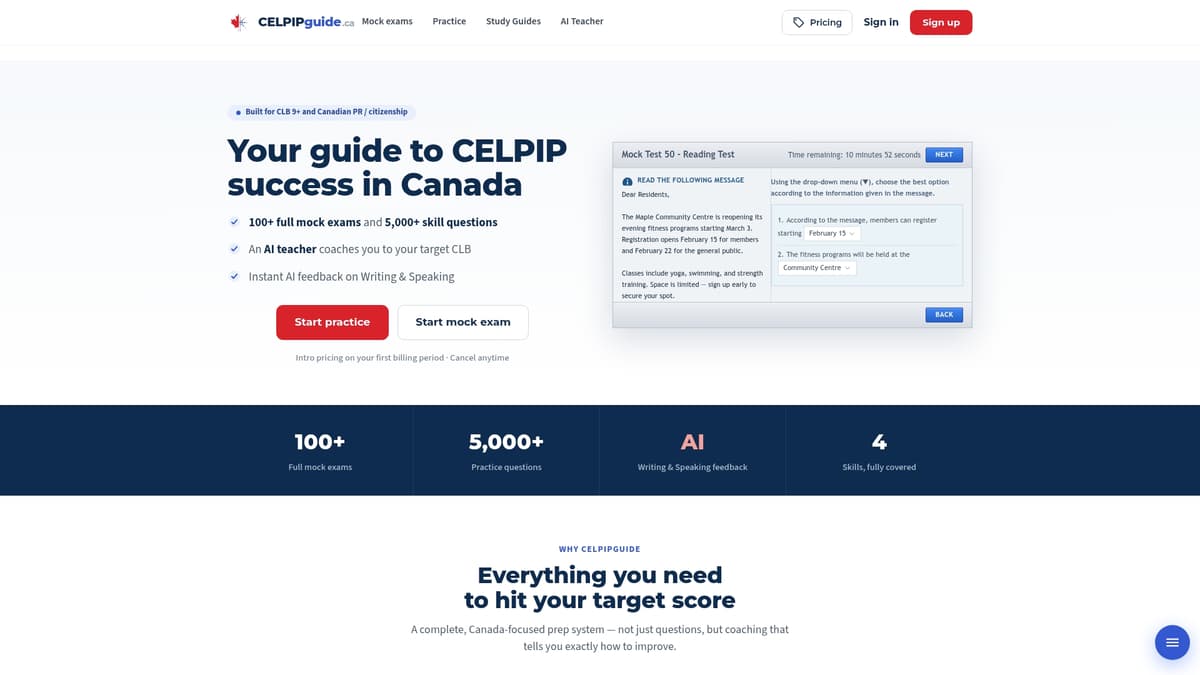
Celpipguide offers over 100 full mock exams and 5,000 practice questions built specifically for the CELPIP exam. Every Writing and Speaking task comes with instant AI feedback scored against real CELPIP rubrics, so you know exactly where you lose marks. The diagnostic test identifies your weakest sections first, so you spend your study time where it counts most. Whether you are aiming for CLB 7 for permanent residency or CLB 9 for citizenship, Celpipguide gives you the feedback and practice volume to get there with confidence.
FAQ
What is the most common CELPIP mistake students make?
Poor time management is the single most costly error. It costs candidates an average of 2–3 CLB levels across the Reading and Writing sections.
Can I use IELTS study materials to prepare for CELPIP?
IELTS materials do not cover Canadian-specific vocabulary, workplace scenarios, or the computer-based format that CELPIP requires. Use CELPIP-focused resources instead.
How do I avoid repeating errors on CELPIP?
Get examiner-level feedback on every Writing and Speaking practice task. Without specific rubric-based critique, most candidates repeat the same mistakes on every attempt.
What is the difference between CELPIP General and CELPIP General LS?
CELPIP General tests all four skills. CELPIP General LS tests only Listening and Speaking. Booking the wrong version can invalidate your results for immigration applications.
Does speaking naturally really score higher than using templates?
Yes. CELPIP Speaking rewards task fulfilment, vocabulary range, and coherence. Memorised templates reduce flexibility and lower scores when the prompt does not match your prepared structure.