
CELPIP Blog
CELPIP test anxiety: overcome strategies that work
CELPIP test anxiety: overcome strategies that work

TL;DR:
- CELPIP test anxiety triggers the fight-or-flight response, impairing memory and speaking ability during the exam.
- Managing anxiety involves mental strategies like breathing techniques, timed practice, and mindset shifts to enhance confidence and reduce stress.
CELPIP test anxiety is the acute stress response that blocks your ability to recall vocabulary, maintain fluency, and communicate clearly during the exam. The brain’s fight-or-flight response during high-stakes testing actively inhibits memory and verbal fluency, which means your English skills can feel worse on exam day than they actually are. The good news is that test anxiety is common and treatable. The CELPIP test anxiety overcome strategies in this guide combine brain-based stress management, timed simulation practice, and mindset shifts that work specifically for this exam.
What causes CELPIP test anxiety and how does it show up?

Test anxiety in the CELPIP context is not simply nervousness. It is a predictable stress pattern triggered by specific conditions, and recognising those conditions is the first step toward managing them.
The most common causes include:
- High personal stakes. For many test takers, the CELPIP result directly affects immigration applications, permanent residency, or Canadian citizenship. That weight alone activates a threat response before the exam even begins.
- Unfamiliarity with test conditions. Lack of familiarity with test conditions fuels fear. When you have never sat through a full timed CELPIP session, the format itself becomes a source of uncertainty.
- Cognitive overload from time pressure. The CELPIP has strict time limits across all eight sections. When you feel the clock running, your working memory narrows and your ability to plan responses drops sharply.
- Error fixation. Dwelling on a mistake mid-task pulls your attention away from the next question. Dwelling on minor mistakes intensifies anxiety and breaks your flow.
- Racing thoughts and pacing problems. Many test takers either rush through tasks or freeze entirely. Both patterns signal that anxiety is controlling the session rather than preparation.
Recognising which of these triggers affects you most is practical, not theoretical. Once you know your pattern, you can apply the right fix.
What are the key mental strategies to manage anxiety during the CELPIP exam?
The most effective mental strategies work in real time, during the exam itself. You do not need to eliminate anxiety completely. You need to reduce it enough to think clearly and speak fluently.
-
Adopt the acknowledge-correct-move-on mindset. The CELPIP exam prioritises effective communication, not perfection. Flawless speech is not required. When you make an error, acknowledge it briefly, self-correct if natural, and move forward. Stopping to dwell on a mistake costs you time and compounds your stress.
-
Use the 4-7-8 breathing technique before each task. The 4-7-8 breathing technique activates the parasympathetic nervous system, which is the body’s natural calm response. Inhale for four counts, hold for seven counts, and exhale for eight counts. Repeat this three to five times before a speaking task. It takes under a minute and measurably lowers your heart rate.
-
Control your speaking pace deliberately. Speeding up speech when anxious is common but reduces clarity and comprehension. Practise speaking at a moderate pace during your preparation so that the habit carries into the exam. Slower, clearer speech scores better than fast, muddled responses.
-
Use positive mental rehearsal. Before your exam date, spend five minutes visualising yourself sitting calmly at the test station, reading the prompt, and responding with confidence. Mental rehearsal trains your brain to associate the exam environment with competence rather than threat.
-
Take a mindful pause before responding. You are allowed a preparation window before speaking tasks. Use it fully. A deliberate pause signals control, not hesitation, and gives your brain time to organise a response.
Pro Tip: Pair the 4-7-8 breathing technique with a physical anchor, such as pressing your fingertips together, during practice. On exam day, the physical cue alone can trigger the calm response without needing to count.
How does realistic timed practice reduce CELPIP exam stress?
Timed practice is the single most effective tool for reducing exam stress. The reason is neurological. The brain perceives the CELPIP as a threat partly because it is unfamiliar. Repeated exposure allows the brain to reclassify the exam as a known, manageable situation rather than a threat. Each timed session you complete makes the real exam feel less alarming.
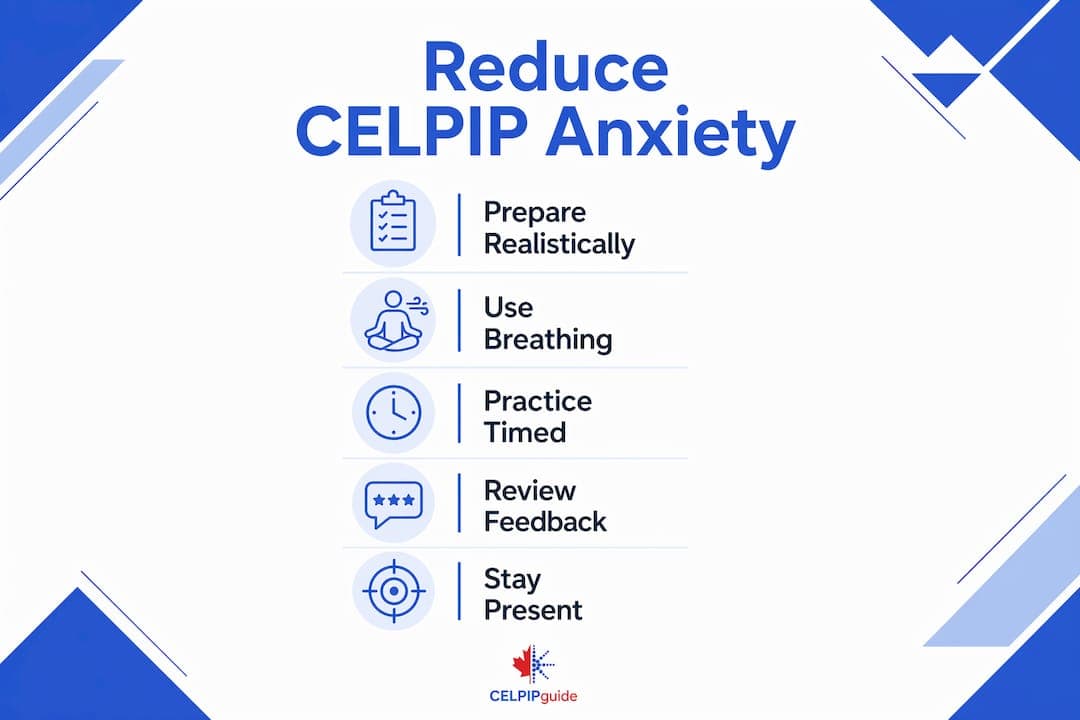
The table below shows how different practice approaches compare in terms of anxiety reduction.
| Practice approach | Effect on anxiety |
|---|---|
| Reading study notes | Low. Builds knowledge but not exam familiarity. |
| Untimed practice tasks | Moderate. Builds skill but not clock confidence. |
| Timed full-length mock exams | High. Retrains the brain’s stress response to the exam format. |
| Timed practice with detailed feedback | Highest. Combines familiarity with targeted improvement. |
Practising with a timer is non-negotiable. Without it, you are preparing for a different experience than the one you will face. Celpipguide offers over 100 full-length mock exams that replicate the exact timing and format of the CELPIP. Each session builds the mental resilience that reduces clock anxiety.
Detailed feedback matters just as much as the practice itself. When you can see exactly where your writing or speaking fell short, the exam stops feeling like a mystery. You replace vague fear with specific targets. Celpipguide’s AI teacher delivers instant feedback on writing and speaking tasks, so you know precisely what to work on next. Use the time management guide to understand how to pace yourself across each section before you sit your first mock exam.
Pro Tip: After each timed mock exam, write down one thing that went well and one thing to improve. This two-step review keeps your focus on progress rather than failure.
What lifestyle habits support overcoming CELPIP test anxiety?
Mental strategies work best when your body is prepared. Physical health directly affects cognitive function, and small daily habits create a significant difference on exam day.
- Prioritise sleep in the week before your exam. Consistent sleep, hydration, and light exercise reduce baseline stress and support cognitive function. Sleep deprivation impairs working memory, which is exactly the cognitive resource you need most during the CELPIP.
- Stay hydrated on exam day. Dehydration increases cortisol, the primary stress hormone. Bring water to the test centre if the rules permit it, and drink consistently in the hours before your session.
- Do light physical activity the morning of your exam. A 20-minute walk raises your mood and lowers baseline anxiety without tiring you out. This is not about fitness. It is about arriving at the test centre with a calmer nervous system.
- Eat a balanced meal two hours before the exam. Avoid high-sugar foods that cause energy spikes and crashes. A meal with protein and complex carbohydrates keeps your blood sugar stable throughout the session.
- Handle technical issues immediately. Experienced test takers signal the invigilator right away when a technical problem occurs. Attempting to fix a microphone or screen issue yourself wastes time and spikes your stress. Raise your hand and let the invigilator handle it.
- Arrive early and settle in. Rushing to the test centre is one of the most avoidable sources of pre-exam anxiety. Plan to arrive at least 30 minutes early so you have time to breathe, review your mental strategy, and feel grounded before the session starts.
Key takeaways
Overcoming CELPIP test anxiety requires combining brain-based mental strategies, consistent timed practice, and physical preparation habits that work together to reduce stress and build real confidence.
| Point | Details |
|---|---|
| Anxiety blocks real skills | The fight-or-flight response inhibits memory and fluency, not your actual English ability. |
| Mindset over perfection | Adopt the acknowledge-correct-move-on approach; the CELPIP rewards communication, not flawless speech. |
| Timed practice retrains the brain | Full-length mock exams under real time conditions reduce clock anxiety through repeated exposure. |
| Breathing techniques work in real time | The 4-7-8 technique activates calm before speaking tasks and takes under one minute. |
| Physical habits matter | Sleep, hydration, and light exercise directly support cognitive function and lower baseline stress on exam day. |
From fear to fluency: what I have learned working with CELPIP test takers
The pattern I see most often is this: a test taker has solid English skills, practises regularly, and still underperforms on exam day. The culprit is almost never vocabulary or grammar. It is the fear of not being perfect.
Perfection is the enemy of fluency. When you spend mental energy monitoring every word for errors, you have less capacity to actually communicate. The CELPIP rubric rewards coherence, task completion, and natural flow. A response with one small grammatical slip but strong organisation will outscore a halting, over-corrected response every time.
What I tell every test taker I work with is this: test anxiety is common and treatable. The strategies that work are not complicated. They require consistency. Breathing before tasks, pacing your speech, completing timed mocks, and sleeping well the night before are not glamorous. They are the actual difference between your practice score and your real score.
The test takers who improve the most are not the ones who study the hardest. They are the ones who practise the most realistically and manage their nerves the most deliberately. You can do both.
— Reza
Celpipguide: practice tools built for confident test takers
Anxiety shrinks when the exam feels familiar. Celpipguide gives you the tools to make that happen before you sit the real test.
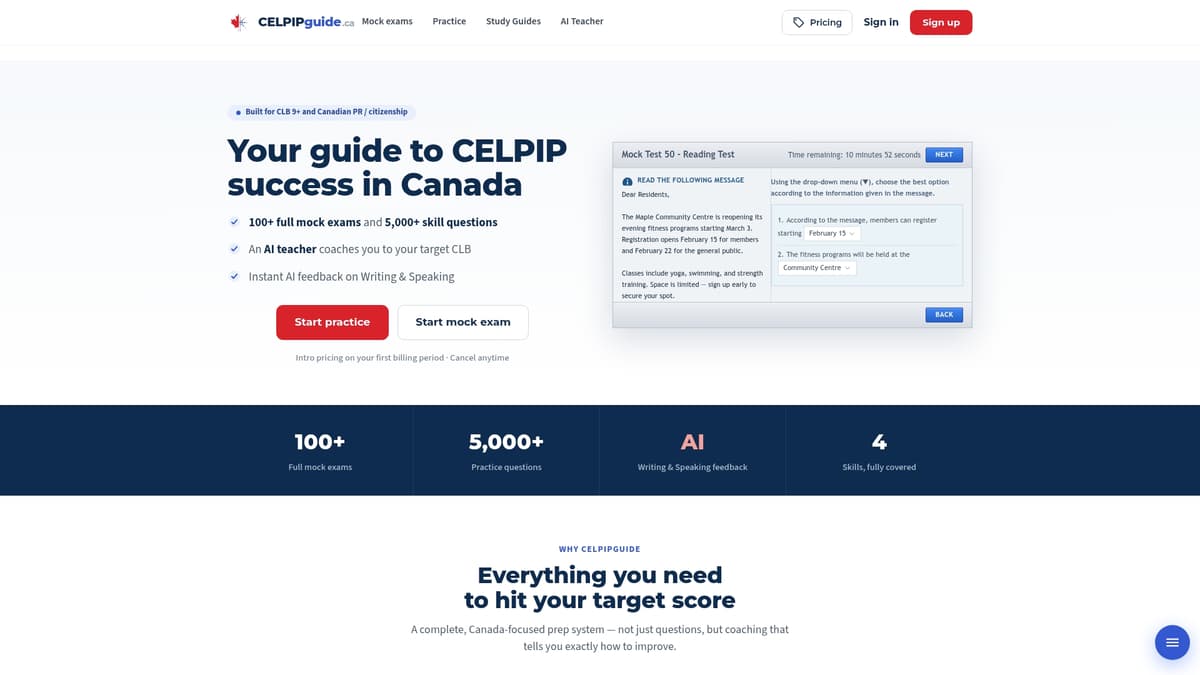
Celpipguide’s full practice exam hub includes over 100 full-length mock tests and 5,000 practice questions, all timed to match the actual CELPIP format. The built-in AI teacher delivers instant scoring and feedback on your writing and speaking tasks, so you know exactly where to focus. A personalised diagnostic test identifies your weakest areas from day one, and the vocabulary builder strengthens the language confidence that keeps anxiety low. If you want to start with a no-cost session, the free practice test is available right now with no sign-up required.
FAQ
What is CELPIP test anxiety?
CELPIP test anxiety is the acute stress response that blocks memory recall and verbal fluency during the exam. The brain’s fight-or-flight system activates under high-stakes conditions, making your English skills feel worse than they actually are.
How can I calm my nerves right before a speaking task?
Use the 4-7-8 breathing technique: inhale for four counts, hold for seven, and exhale for eight. Repeat three to five times. This activates the parasympathetic nervous system and lowers your heart rate within one minute.
Does timed practice actually reduce exam anxiety?
Yes. Repeated exposure to timed, full-length practice sessions retrains the brain to classify the exam as familiar rather than threatening. Each mock exam you complete reduces the uncertainty that drives anxiety.
What should I do if I make a mistake during the exam?
Acknowledge the error briefly, self-correct if it feels natural, and move on immediately. The CELPIP prioritises effective communication over perfection, so dwelling on mistakes costs you more than the mistake itself.
What if I have a technical problem during the CELPIP?
Signal the invigilator immediately and do not attempt to fix the issue yourself. Trying to troubleshoot a microphone or screen problem wastes time and raises your stress level when you need to stay focused.