
CELPIP Blog
CELPIP four skills immigration scoring: 2026 guide
CELPIP four skills immigration scoring: 2026 guide

TL;DR:
- CELPIP scores are assessed independently for each skill, with scores directly mapping to Canadian Language Benchmark levels. Improving from CLB 7 to CLB 9 can add up to 56 CRS points, greatly increasing chances of receiving an Invitation to Apply.
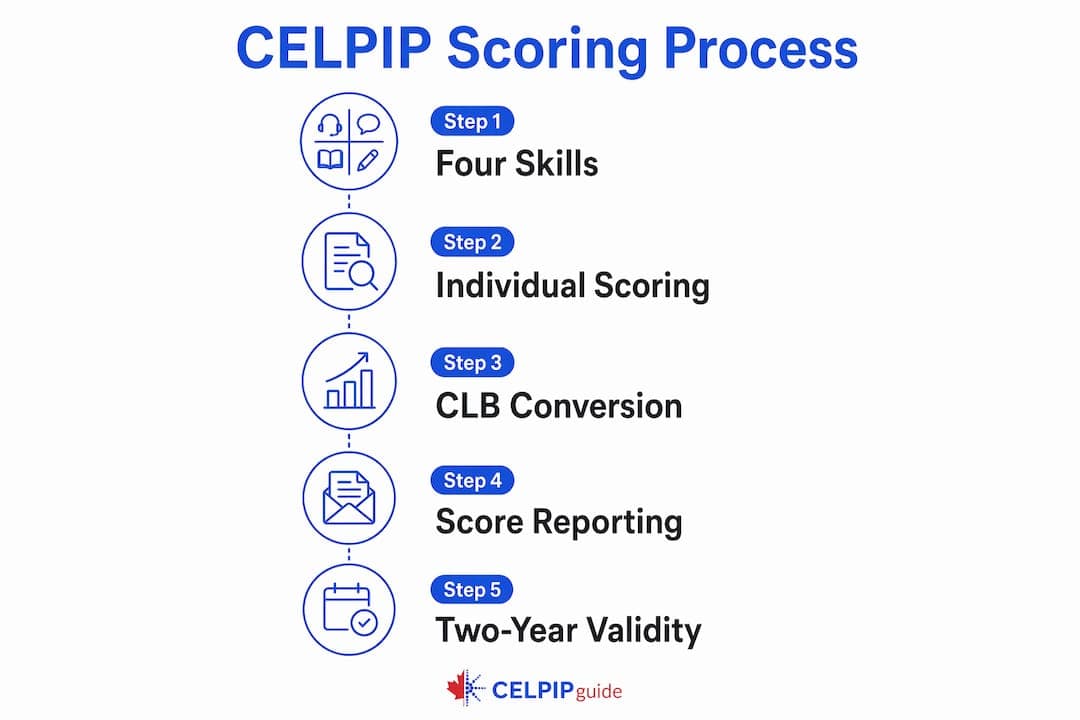
CELPIP four skills immigration scoring is defined as the individual assessment of Listening, Reading, Writing, and Speaking, each scored on a 1–12 scale that maps directly to Canadian Language Benchmark (CLB) levels used by Immigration, Refugees and Citizenship Canada (IRCC). Every skill score stands alone. No averaging happens across the four areas. This matters enormously for your Express Entry profile, because a single weak skill can disqualify your application, while strong scores across all four can add significant Comprehensive Ranking System (CRS) points. If you are preparing for Canadian immigration, understanding this system is the first practical step you can take.
How do CELPIP scores convert to Canadian Language Benchmarks (CLB)?
The CELPIP scoring system uses a direct, linear 1:1 mapping to CLB levels for each of Listening, Reading, Writing, and Speaking. A CELPIP 7 equals CLB 7. A CELPIP 9 equals CLB 9. Scores of 10, 11, or 12 all map to CLB 10 or higher. This simplicity is genuinely useful. You do not need a conversion chart or a formula. The number you score is the CLB level you receive.

Each skill is evaluated independently. IRCC does not blend your four scores into a single average. If you score CELPIP 10 in Listening but CELPIP 6 in Writing, your Writing result is CLB 6. That single score determines your eligibility for programs with a CLB 7 minimum. This is the detail that catches many candidates off guard.
| CELPIP score | CLB level | Immigration status |
|---|---|---|
| 4 or below | CLB 4 or below | Below most program minimums |
| 7 | CLB 7 | Minimum for Express Entry eligibility |
| 9 | CLB 9 | Competitive; maximum first-language CRS points begin here |
| 10–12 | CLB 10+ | Highest CRS point allocation |
Pro Tip: Practise each skill separately during your preparation. A strong overall feeling about your English does not protect you if one skill lags behind. Identify your weakest area first and give it the most time.
What are the minimum CELPIP score requirements for Canadian immigration programs?
For Federal Skilled Worker (FSW) and Canadian Experience Class (CEC), the minimum language requirement is CLB 7 in all four skills. That means you need a CELPIP score of at least 7 in Listening, Reading, Writing, and Speaking. Scoring below CLB 7 in even one skill disqualifies your application from these programs. There is no partial credit and no rounding up.
Different programs carry different thresholds. The Federal Skilled Trades Program requires CLB 5 for Speaking and Listening, and CLB 4 for Reading and Writing. Provincial Nominee Programs often set their own minimums, typically CLB 7 for most streams, though some occupation-specific streams accept CLB 4 or 5. You should check the exact requirements for your target province before booking your test.
Key minimums to keep in mind:
- Express Entry (FSW and CEC): CLB 7 in all four skills
- Federal Skilled Trades: CLB 5 in Speaking and Listening; CLB 4 in Reading and Writing
- Provincial Nominee Programs: typically CLB 7, but varies by stream and occupation
- Canadian citizenship: CLB 4 in Speaking and Listening
Scoring at the bare minimum gets you in the door. It does not make you competitive. Most successful Express Entry candidates score well above CLB 7, because the CRS rewards higher language scores with substantially more points.
How do CELPIP four skills scores impact your Express Entry CRS points?
Language proficiency is one of the highest-value factors in the CRS point system. Improving from CLB 7 to CLB 9 raises your first official language points from 68 to 124 in Express Entry. That is a difference of 56 points from language alone. In a system where Invitations to Apply (ITAs) are often issued within a narrow CRS band, those points can determine whether you receive an invitation or wait another round.
CLB 9 also unlocks access to the highest skill transferability points. If you hold a post-secondary degree and score CLB 9 or higher, you can earn additional transferability points that are not available at CLB 7 or 8. The combination of core language points and transferability bonuses makes CLB 9 the target for any serious Express Entry candidate.
| CLB level | First official language CRS points | Skill transferability access |
|---|---|---|
| CLB 7 | 68 | Partial |
| CLB 8 | 98 | Partial |
| CLB 9+ | 124 | Full |
A second official language (French) also contributes CRS points if you meet the threshold. Even modest French scores at CLB 5 or higher add bilingualism bonus points. For candidates whose primary language is English, adding French preparation to your study plan can provide a meaningful CRS boost.
Pro Tip: Use a CRS calculator to model your score at CLB 7 versus CLB 9. Seeing the actual point difference in your profile makes the extra preparation effort feel concrete and worth it.
What is the CELPIP score reporting process and validity period?
CELPIP test results are available online within 4–8 business days of your test date. An Express Rating option delivers results faster. Results are valid for exactly two years from the test date for all Canadian immigration and citizenship purposes. Planning your test date around your application timeline is therefore critical. If your scores expire before IRCC processes your application, you will need to retest.
Here is how to manage your score reporting correctly:
- Create your CELPIP account before test day. Your results will be posted there and you will receive an email notification when they are ready.
- Share your scores with IRCC through your Express Entry profile. You enter your scores manually, and IRCC verifies them directly with Paragon Testing Enterprises, the test administrator.
- Check your Provincial Nominee Program requirements separately. Some PNPs require you to submit scores directly to the province, not just to IRCC.
- Track your expiry date. Mark the two-year anniversary of your test date in your calendar. If your application is still in progress as that date approaches, schedule a retest.
- Retest strategically. You can retest as many times as you like. IRCC accepts your most recent valid scores, so retesting before expiry gives you a clean opportunity to improve.
The two-year validity window is generous enough for most applicants. The risk comes from waiting too long to take the test, then finding your scores expire before you receive an ITA.
What strategies help maximize CELPIP scores for immigration success?
Effective preparation for the CELPIP four skills assessment starts with knowing where you stand. A diagnostic test tells you which skills need the most work. Spending equal time on all four skills when one is clearly weaker is not efficient. Fix the floor first, then raise the ceiling.
Targeted practice by skill makes a measurable difference:
- Listening: Practise with free listening tests that mirror the CELPIP format. Focus on note-taking during audio clips, because the test does not allow replays.
- Reading: Work on reading speed and skimming techniques. The Reading section is time-pressured, and reading practice tests help you build the pace you need.
- Writing: Learn the task types (email writing and survey response) and practise using clear paragraph structure. Feedback on your writing is the fastest way to improve.
- Speaking: Record yourself answering practice prompts and listen back critically. The speaking practice tests on Celpipguide simulate the computer-delivered format, which is important because CELPIP is fully computer-delivered, including speaking via microphone.
Time management during the test is a separate skill from language ability. Candidates who know the format and have practised under timed conditions consistently perform better than those who rely on language ability alone. Full mock exams build the stamina and pacing you need for a single-session test.
Official practice materials that reflect authentic CELPIP tasks give you the most accurate preparation. Generic English practice does not prepare you for the specific question types, Canadian contexts, and time constraints of the actual test.
Pro Tip: Take at least two full-length mock exams before your test date. The first one shows you your weak points. The second one shows you whether your preparation worked.
Key takeaways
CELPIP four skills immigration scoring works on a direct 1:1 CLB conversion per skill, and improving from CLB 7 to CLB 9 adds up to 56 CRS points, which can determine whether you receive an Invitation to Apply.
| Point | Details |
|---|---|
| Direct CLB mapping | CELPIP scores convert 1:1 to CLB levels; no averaging across skills. |
| Minimum CLB 7 required | Scoring below CLB 7 in any single skill disqualifies FSW and CEC applications. |
| CLB 9 maximises CRS points | Moving from CLB 7 to CLB 9 adds up to 56 first-language CRS points. |
| Two-year score validity | CELPIP results expire exactly two years from test date; plan your timeline accordingly. |
| Skill-specific preparation | Identify your weakest skill first and target it with format-specific practice. |
Why CLB 9 is the target most candidates underestimate
I have worked with a lot of immigration candidates, and the most common mistake I see is treating CLB 7 as the goal. It is the floor, not the target. When you look at recent Express Entry draw cutoffs, the difference between receiving an ITA and waiting another six months often comes down to 20 or 30 CRS points. Language scores are one of the few factors you can actually control and improve before your application.
The non-averaging rule surprises people every time. A candidate who scores CELPIP 10 in three skills and CELPIP 6 in Writing does not have a “mostly CLB 10” profile. They have a disqualifying Writing score. I always tell people to treat each skill as its own exam, because that is exactly how IRCC treats it.
Choosing CELPIP over other designated tests comes down to personal comfort with the format. All designated tests convert to the same CLB scale and are treated equally by IRCC. If you are comfortable with computers and prefer not to face a live examiner for Speaking, CELPIP is a natural fit. If you are not sure, take a practice test in each format before committing.
Managing test anxiety is real preparation work. Candidates who have completed multiple full mock exams walk into the test centre knowing exactly what to expect. That familiarity reduces anxiety and frees up mental energy for the actual language tasks.
— Reza
Celpipguide: practise all four skills before your test date
Celpipguide is built specifically for candidates preparing for Canadian immigration through CELPIP. The platform offers over 100 full-length mock exams covering all four skills, plus 5,000 practice questions aligned with CEFR language standards. An AI teacher delivers instant feedback on Writing and Speaking tasks, so you know exactly where to improve rather than guessing.
Free sample tasks by skill let you test the platform before committing. Personalised study plans adapt to your diagnostic results, so your preparation targets the skills that will move your CLB score the most. For candidates aiming at CLB 9 or higher, Celpipguide’s skill-specific practice tests provide the targeted repetition that builds real confidence.
FAQ
What is the CELPIP scoring scale for immigration?
CELPIP scores range from 1 to 12 per skill, with each score mapping directly to the equivalent CLB level. IRCC uses CLB levels to assess language proficiency for all economic immigration programs.
Does IRCC average CELPIP scores across the four skills?
No. IRCC evaluates each skill independently. A low score in any single skill can disqualify an application, regardless of how well you score in the other three.
How long are CELPIP scores valid for immigration?
CELPIP results are valid for exactly two years from the test date for all Canadian immigration and citizenship purposes.
What CELPIP score do I need for Express Entry?
You need a minimum CELPIP score of 7 in all four skills, which equals CLB 7. Competitive candidates typically aim for CELPIP 9 or higher to maximise CRS points.
How many CRS points does improving from CLB 7 to CLB 9 add?
Improving from CLB 7 to CLB 9 raises your first official language CRS points from 68 to 124, a gain of 56 points that can significantly improve your chances of receiving an Invitation to Apply.