
CELPIP Blog
CLB score and PR application: your 2026 guide
CLB score and PR application: your 2026 guide

TL;DR:
- The Canadian Language Benchmark score is the official standard for assessing immigrant language proficiency in Canada. A higher CLB level increases eligibility, CRS points, and chances of receiving an ITA in Express Entry. Focusing on improving just one weak skill to CLB 9 yields the largest return on preparation effort.
The Canadian Language Benchmark (CLB) score is the official language proficiency standard Canada uses to evaluate immigrants for permanent residency. It converts your results from IRCC-approved tests like CELPIP-General, IELTS General Training, and PTE Core into a 12-level scale that IRCC reads directly. The role of CLB score in PR applications goes beyond a simple pass or fail. Your CLB level determines whether you qualify for a programme at all, and it shapes how many Comprehensive Ranking System (CRS) points you earn. If you are preparing for Express Entry or any major Canadian immigration pathway, your CLB score is the single most controllable factor in your profile.
What role does the CLB score play in PR applications?
Your CLB score does two jobs at once: it sets your eligibility floor, and it builds your CRS point total. Miss the minimum CLB requirement and IRCC rejects your application outright, regardless of your education or work experience. Clear that floor and every additional CLB level you gain translates directly into more CRS points, which raises your rank in the Express Entry pool.

IRCC assesses each of the four language skills separately: listening, speaking, reading, and writing. This detail matters more than most applicants realise. Your lowest skill score determines your eligibility, while each individual skill score contributes its own CRS points. A strong average means nothing if one skill falls below the programme threshold.
The CLB scale runs from 1 to 12. Levels 1 to 4 represent basic proficiency, levels 5 to 8 represent intermediate to advanced ability, and levels 9 to 12 represent near-native fluency. Most competitive Express Entry profiles sit at CLB 9 or above.
How do CLB scores determine eligibility for immigration programmes?
Each Express Entry programme sets its own minimum CLB requirements. Knowing these thresholds before you book your test saves you from costly surprises.
- Federal Skilled Worker Programme (FSWP): Requires CLB 7 in all four skills. This applies to TEER 0 and TEER 1 occupations.
- Canadian Experience Class (CEC): Also requires CLB 7 for TEER 0 and TEER 1 jobs. Workers in TEER 2 and TEER 3 occupations need CLB 5.
- Federal Skilled Trades Programme (FSTP): Requires CLB 5 for speaking and listening, and CLB 4 for reading and writing. This lower threshold reflects the practical nature of trades work.
- Provincial Nominee Programmes (PNPs): Requirements vary from CLB 4 to CLB 7 depending on the province and occupation stream.
The FSTP distinction is worth noting. A trades applicant who scores CLB 7 across all skills does not gain eligibility points over a CLB 5 candidate, but they do earn significantly more CRS points. Meeting the minimum is the floor, not the goal.
One critical rule applies across all programmes: IRCC uses your lowest skill score to determine eligibility. If you score CLB 8 in listening, speaking, and reading, but CLB 6 in writing, IRCC treats your profile as CLB 6 for eligibility purposes. That single weak skill can disqualify you from FSWP entirely. Targeted practice on your weakest skill is not optional. It is the most direct path to protecting your application.
How does your CLB level affect CRS points and Express Entry ranking?
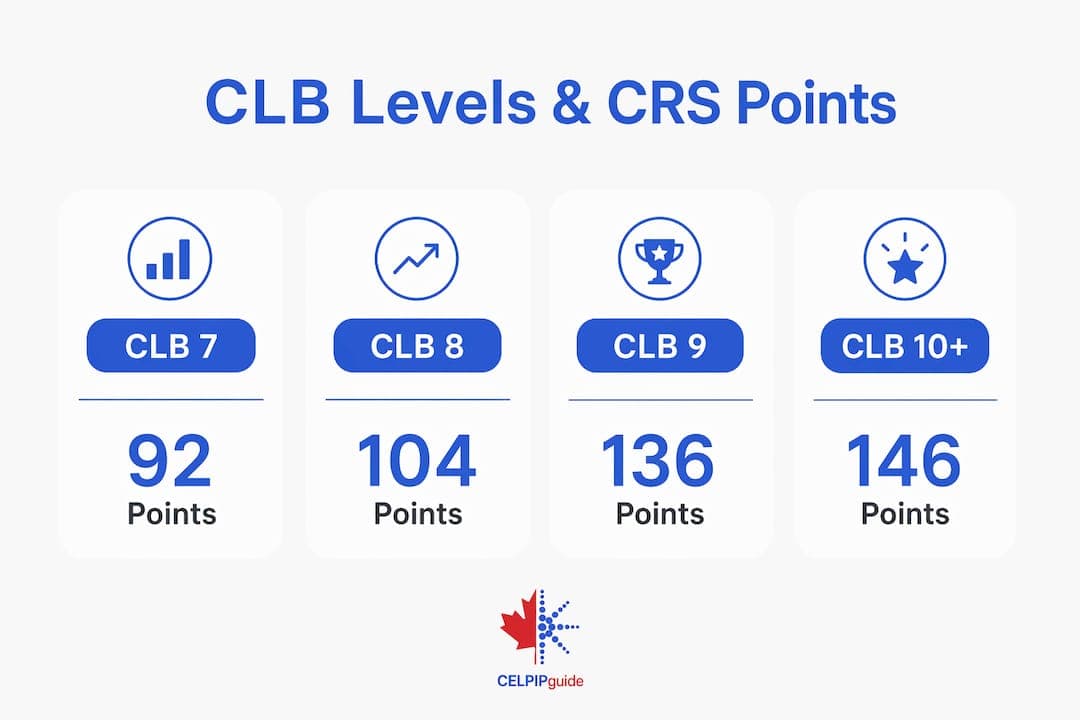
This is where the numbers get genuinely motivating. The difference between CLB 7 and CLB 9 is not just two levels on a scale. It is 44 CRS points for a single applicant. A single applicant with CLB 9 in all skills earns roughly 136 CRS points from language alone, compared to 92 points at CLB 7. In a pool where draws regularly happen within a 10 to 20 point range, 44 points is the difference between waiting years and receiving an Invitation to Apply (ITA) within months.
The jump from CLB 8 to CLB 9 alone delivers a 32-point CRS boost. That single level increase outperforms the CRS gain from upgrading a Bachelor’s degree to a Master’s degree. This is why immigration analysts consistently identify language proficiency as the highest-impact lever for improving your CRS score, ahead of education and age, which you cannot change.
| CLB level | CRS points per skill (single) | Total for 4 skills |
|---|---|---|
| CLB 7 | 23 points | 92 points |
| CLB 8 | 23 points | 92 points |
| CLB 9 | 31 points | 124 points |
| CLB 10+ | 34 points | 136 points |
Note: Point values reflect single applicant language scores. Spousal language scores follow a separate, lower scale.
Beyond CLB 10, the returns diminish significantly. Reaching CLB 11 or 12 requires substantial additional effort for a modest CRS gain. CLB 9 is the strategic sweet spot: it delivers the largest single jump in points relative to the study time required.
French proficiency adds another layer. If your English CLB is already strong, adding French at NCLC 5 or above earns 25 to 50 additional CRS points through the bilingualism bonus. For applicants near the cutoff score, French proficiency can be the deciding factor.
Pro Tip: Check the CLB scores Express Entry breakdown to see exactly how each skill level maps to CRS points before you set your study targets.
What are the most common CLB score mistakes in PR applications?
Most application errors are avoidable. They come from misunderstanding how CLB works, not from poor English ability.
-
Submitting the wrong test version. Only IELTS General Training, CELPIP-General, and PTE Core are accepted by IRCC. IELTS Academic is not accepted. Submitting an academic result causes automatic rejection of the language component and delays your entire application.
-
Confusing raw scores with CLB levels. A raw IELTS score of 7.0 does not automatically equal CLB 9. Each band score maps to a specific CLB level per skill. You must use the official conversion chart to confirm your CLB level before submitting.
-
Ignoring your weakest skill. IRCC evaluates each skill independently, and a single low score limits your eligibility and your CRS total. Applicants often focus on their strongest skills and neglect the one holding them back.
-
Letting results expire. Language test results are valid for two years only. If your results expire before IRCC processes your application, you must retake the test. Plan your test date with your expected application timeline in mind.
-
Targeting only the minimum CLB requirement. Meeting CLB 7 qualifies you for FSWP, but it places you at the bottom of the CRS ranking. Applicants who stop at the minimum rarely receive ITAs in competitive draws.
Pro Tip: Before booking your test, confirm the exact CLB requirement for your target programme and occupation TEER category. A five-minute check prevents months of delay.
How can you improve your CLB score for better PR prospects?
Improving your CLB score is the most direct way to strengthen your PR application, and the approach matters as much as the effort.
- Target your weakest skill first. Applicants typically have one skill that sits one to two CLB levels lower than the others. Closing that gap produces the fastest CRS improvement. If writing is your weak point, practise writing tasks daily with structured feedback rather than spreading your time evenly across all four skills.
- Aim for CLB 9, not CLB 7. The 44-point CRS difference between CLB 7 and CLB 9 makes the extra preparation time worthwhile. Set CLB 9 as your target from the start, even if CLB 7 meets the minimum requirement for your programme.
- Use official and approved practice resources. Practise with materials that mirror the actual test format. For CELPIP-General, use resources that replicate the exact task types, timing, and scoring rubrics. Celpipguide offers over 5,000 practice questions and more than 100 full mock exams built specifically for this purpose. You can start with skill-specific practice tasks to identify where you need the most work.
- Time your test strategically. Book your test so results arrive at least two months before your planned application submission. This gives you time to retake the test if your score falls short, without risking expiry.
- Consider adding French. If your English CLB is already at 9 or above, studying French to NCLC 5 adds 25 bonus CRS points. That investment pays off quickly if you are close to the draw cutoff. Resources for achieving CLB 9 in speaking and writing can also inform how you approach French skill development.
Key takeaways
Your CLB score is the most controllable and highest-impact factor in your Express Entry profile, and targeting CLB 9 across all four skills delivers the strongest return on your preparation time.
| Point | Details |
|---|---|
| CLB determines eligibility | Your lowest skill score sets your programme eligibility, so no single skill can be neglected. |
| CLB 9 is the strategic target | Moving from CLB 7 to CLB 9 adds 44 CRS points, more than upgrading from a Bachelor’s to a Master’s degree. |
| Test version matters | Only IELTS General Training, CELPIP-General, and PTE Core are accepted; submitting the wrong version causes rejection. |
| Results expire in two years | Plan your test date so results remain valid through your full application timeline. |
| French adds bonus points | Adding French at NCLC 5 or above earns 25 to 50 extra CRS points through the bilingualism bonus. |
Language scores are the lever most applicants underestimate
I have worked with a lot of people preparing for Express Entry, and the pattern I see most often is this: applicants spend months researching job offers, provincial nominees, and education upgrades, while their language score sits at CLB 7 and quietly costs them 44 CRS points they could have earned.
The reason language gets underestimated is that it feels harder to control than other factors. You either speak English or you do not, right? That is not how CLB scoring works. Most applicants are already close to CLB 9. They have one skill, usually writing or speaking, that sits at CLB 7 or 8. A focused six to eight week preparation period targeting that one skill is often enough to close the gap.
What I tell every applicant is this: do not treat CLB 7 as the finish line. Treat it as the starting point. The CRS pool is competitive, and the applicants who receive ITAs consistently are the ones who pushed to CLB 9 or above. The 32-point jump from CLB 8 to CLB 9 alone is worth more than most education upgrades. That is not an opinion. That is what the CRS point table shows.
If your English CLB is already strong, add French to your plan. NCLC 5 is achievable with dedicated study, and 25 extra CRS points can move you from the waiting list to an ITA. Language is the one factor in your profile that responds directly to effort. Use that.
— Reza
Celpipguide can help you reach CLB 9 faster
Knowing your CLB target is one thing. Getting there is another.
Celpipguide is built specifically for CELPIP-General test-takers preparing for Canadian immigration. The platform offers over 100 full-length mock exams and 5,000 practice questions, all mapped to the CLB levels IRCC uses for Express Entry. An AI teacher reviews your writing and speaking responses and delivers instant feedback, so you know exactly which skill to work on next. If CLB 9 is your target, the CELPIP practice exam hub gives you the structured, scored practice you need to get there with confidence. You can also try free skill-specific practice tests to see where you stand right now.
FAQ
What is a CLB score and why does it matter for PR?
The Canadian Language Benchmark (CLB) score converts your IRCC-approved language test results into a standardised 12-level scale. IRCC uses this scale to assess both your eligibility for immigration programmes and your CRS point total.
What is the minimum CLB score for Express Entry?
The Federal Skilled Worker Programme and Canadian Experience Class (TEER 0/1) require CLB 7 in all four skills. The Federal Skilled Trades Programme requires CLB 5 for speaking and listening, and CLB 4 for reading and writing.
How many CRS points does CLB 9 add compared to CLB 7?
A single applicant with CLB 9 in all four skills earns roughly 44 more CRS points than a CLB 7 applicant. That gap is larger than the CRS gain from upgrading a Bachelor’s degree to a Master’s degree.
Can one low skill score affect my entire PR application?
Yes. IRCC uses your lowest skill score to determine programme eligibility. A CLB 6 in writing disqualifies you from FSWP even if your other three skills are CLB 9.
How long are language test results valid for immigration?
Language test results are valid for two years from the date of the test. IRCC does not accept expired results, so plan your test date with your application timeline in mind.