
CELPIP Blog
CLB 10 in immigration: what it means and how it scores
CLB 10 in immigration: what it means and how it scores

CLB 10 is the top language band that earns first-language points under Canada’s Express Entry system, and hitting it tells you your English or French is advanced enough to handle complex, high-stakes communication without much strain. On the CELPIP-General test, that means a 10 in every skill. On IELTS General Training, the targets are Listening around 8.5, Reading around 8.0, Writing about 7.5, and Speaking about 7.5. Hit those numbers and, as a single applicant, you’ll bank up to 34 points per ability for a total of 136 toward your Comprehensive Ranking System score. With a spouse or common-law partner, it’s 32 points per ability, 128 total. Here’s the part most people miss: CLB 10 is also a ceiling, score higher, and you don’t get any extra first-language points.
Key Takeaways
CLB 10 is the highest first-language band the CRS system rewards, worth up to 136 total points for single applicants and 128 with a partner, with no additional points for scoring higher.
| Point | Details |
|---|---|
| CLB 10 test targets | CELPIP-General needs a 10 in each skill; IELTS General Training needs L8.5, R8.0, W7.5, S7.5. |
| CRS points ceiling | CLB 10 earns 34 points per ability (136 total) single, or 32 per ability (128 total) with a partner, with no bonus above it. |
| Marginal gains taper | Moving from CLB 9 to CLB 10 adds only 12 total points for a single applicant, far less than earlier CLB jumps. |
| Isolate your weak skill | Diagnose which single ability is capping your CLB level instead of restudying all four. |
| Start with a diagnostic | Celpipguide’s Readiness Check identifies your gap skill and builds a targeted plan toward CLB 10. |
This article is general information, not a substitute for advice from a qualified lawyer. Consult a qualified legal professional about your own circumstances before acting on anything here.
Table of Contents
- What does CLB 10 mean for immigration applicants?
- How do IELTS, CELPIP, and TEF scores convert to CLB 10?
- What can you actually do at CLB 10?
- How does CLB 10 affect your Express Entry CRS score?
- Is chasing CLB 10 worth it for your profile?
- How do you actually reach CLB 10?
- Where these numbers come from
- What mistakes do applicants make when chasing CLB 10?
- How are immigration policy changes affecting CLB 10 requirements?
- Prioritizing language gains against everything else
- Reach CLB 10 faster with structured practice
- Sources
- FAQ
What does CLB 10 mean for immigration applicants?
CLB 10 sits in Stage III of the Canadian Language Benchmarks framework, the “advanced” tier reserved for people who can operate comfortably in demanding academic, professional, and social settings. It’s not the top of the scale (CLB 12 exists, technically), but for almost every practical immigration purpose, it’s the finish line that matters.
The Canadian Language Benchmarks descriptors describe someone at this level as able to follow extended, abstract discussions, produce clear and well-organized writing on unfamiliar topics, and manage nuanced spoken exchanges where tone and implication matter as much as vocabulary. That’s a meaningfully higher bar than CLB 7 or 8, where you’re still working to sound natural rather than just accurate.
For immigration purposes, this translates into cold, hard numbers on your CRS profile. It also signals to provinces and employers that you can walk into a Canadian workplace or classroom and function like someone who grew up speaking the language, even if you didn’t.
How do IELTS, CELPIP, and TEF scores convert to CLB 10?
Every immigration applicant eventually asks the same question: what score do I actually need? The answer depends entirely on which test you’re taking, and IRCC’s official conversion tables leave no ambiguity here.
| Test | Listening | Reading | Writing | Speaking |
|---|---|---|---|---|
| CELPIP-General | 10 | 10 | 10 | 10 |
| IELTS General Training | 8.5 | 8.0 | 7.5 | 7.5 |
These figures come straight from IRCC’s official equivalency guidance, and they only apply to the test versions IRCC accepts for immigration: CELPIP-General (not CELPIP-General LS) and IELTS General Training (not IELTS Academic, which is a different test entirely and won’t count toward your CRS score no matter how well you do). For French, TEF Canada and TCF Canada have their own conversion charts published on the same government pages, and the benchmark logic works the same way: each skill is scored independently and mapped to its own CLB level.
One quirk worth knowing: CELPIP scores of 10, 11, and 12 all get grouped into the same CLB 10 points band for CRS purposes. If you scored a 10 on CELPIP Speaking, chasing an 11 or 12 on a retake buys you nothing extra in points, even though it looks better on paper.
Pro Tip: Don’t average your scores across skills to guess your CLB level. Each skill is converted separately, so a Speaking score that’s a full band below your Reading score will drag down that specific ability’s CLB rating, and its CRS points, on its own.
What can you actually do at CLB 10?
CLB 10 isn’t an abstract number. It maps to real, describable abilities, and seeing them spelled out helps you judge your own readiness far better than a score alone can.
- Listening: you can follow multi-step spoken instructions in unfamiliar situations, such as renovation guidance from a contractor, and pick up on tone shifts or unspoken frustration in a workplace complaint.
- Speaking: you can participate in a heated debate or negotiation, adjust your register depending on who you’re talking to, and defend a position with detailed reasoning rather than short, memorized phrases.
- Reading: you can work through dense, specialized texts (technical manuals, policy documents, academic articles) and extract the argument even when the vocabulary is unfamiliar.
- Writing: you can produce structured, persuasive documents on abstract or unfamiliar subjects, adjusting tone and formality to suit a professional or academic audience.
In CEFR terms, CLB 10 lines up roughly with C1, the level European frameworks describe as “effective operational proficiency.” CLB 11 and 12 push toward C2, near-native fluency that few immigration applicants ever need to demonstrate, and honestly, few native speakers would ace either. One caveat from the CLB-OSA benchmarks worth keeping in mind: even at CLB 10, very fast native speech, regional idioms, and cultural humour can still trip people up. That’s normal, not a sign you’re not ready.
How does CLB 10 affect your Express Entry CRS score?
This is where the definition turns into dollars and points, and it’s the part most applicants are really searching for.
| Applicant status | Points per ability | Total across four abilities |
|---|---|---|
| Single applicant | 34 | 136 |
| With spouse/common-law partner | 32 | 128 |
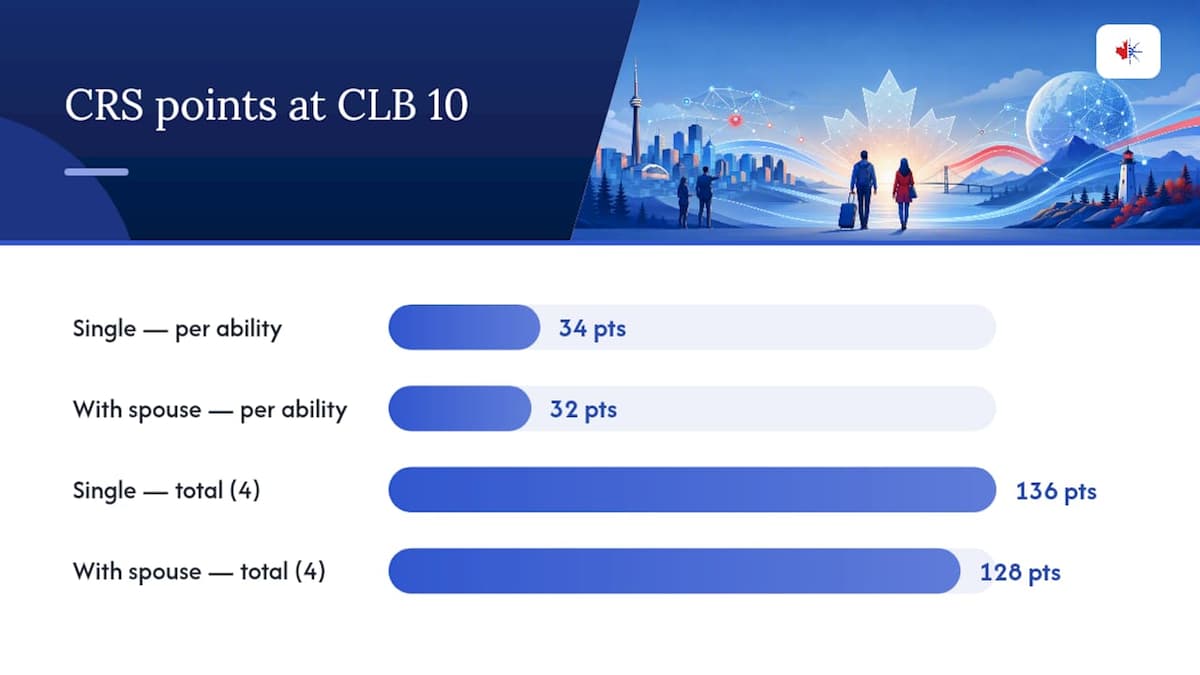
The gap between single and coupled applicants exists because IRCC’s CRS criteria reserve a small slice of points for a spouse’s own language and education, so the core applicant’s maximum shifts slightly. Either way, CLB 10 is the highest band that earns first-language points. There’s no CLB 11 or 12 bonus tier in the CRS table. If you already have CLB 10 across the board and retest hoping for more points, you’re wasting your money and your Sunday morning.
This ceiling effect matters most in Express Entry, but CLB bands also gate eligibility for other streams. The Federal Skilled Worker Program sets a minimum threshold (generally CLB 7) just to qualify, and several Provincial Nominee Program streams set their own bands, sometimes CLB 7, sometimes CLB 9, depending on the occupation and province. Reaching CLB 10 rarely unlocks a program on its own, but it does push your CRS profile as high as language alone can take it. For a full picture of how each CLB level maps to points, the CLB scores Express Entry points breakdown walks through every band side by side.
Is chasing CLB 10 worth it for your profile?
Not everyone needs CLB 10, and treating it as a universal goal wastes time that could go toward a bigger CRS lever.
- Single, high-skilled applicants competing in competitive Express Entry draws benefit most, since every extra point matters when cutoff scores are tight.
- Candidates targeting PNP streams with high language thresholds should check the specific program’s requirement rather than assuming CLB 10 is needed everywhere; many streams cap out at CLB 7 or 9.
- Applicants already sitting comfortably above the latest draw cutoff may find CLB 9 is functionally enough, since the jump from CLB 9 to CLB 10 only adds 3 points per ability, a modest 12 points total for a single applicant.
- Applicants who are one skill away from CLB 10 (say, Speaking sitting at CLB 9 while everything else is already 10) get outsized returns from a narrow, targeted retake rather than a full retest.
A useful decision rule: if reaching CLB 9 from your current level and reaching CLB 10 cost roughly the same in study time, always prioritize CLB 9 first. It represents a larger jump in the CRS tables at most bands. Only chase CLB 10 once you’ve confirmed the marginal points will actually move your rank in recent draws. The CLB score and PR application guide breaks down how language scores interact with the rest of your PR eligibility if you want a fuller picture before deciding.
How do you actually reach CLB 10?
Getting from CLB 8 or 9 to CLB 10 is less about learning new grammar and more about precision, with tighter organization in writing, sharper argument structure in speaking, and faster processing in listening and reading. Here’s a plan that works.
- Take a diagnostic test first. Don’t guess where you’re weak. A proper diagnostic tells you which skill is holding your overall CLB back, and it’s often just one, not all four.
- Study the specific skill, not the whole test. If Writing is your gap, focus there. Generic “practice everything” study plans waste weeks on skills you’ve already mastered.
- Run full-length mock exams under real timing. CLB 10 requires stamina as much as accuracy. Endurance under time pressure is where scores slip on test day.
- Get rubric-based feedback on writing and speaking. These two skills are subjective enough that self-assessment usually misses the exact issue holding you at CLB 9.
- Decide on a retake only after your mocks consistently hit target bands. Retesting before you’re consistently scoring CLB 10 on practice material is the single most common way applicants waste test fees.
For per-skill targets, CELPIP requires a 10 in each of Listening, Reading, Writing, and Speaking, while IELTS General Training needs 8.5, 8.0, 7.5, and 7.5 respectively. Resources like how to get CLB 9+ in CELPIP Speaking and Writing and the guide on why your writing score determines your CLB level both dig into the specific habits that separate a CLB 9 writing sample from a CLB 10 one, which usually comes down to organization and precision rather than raw vocabulary.
Pro Tip: If you’re one skill short of CLB 10, don’t retake the whole test. Most test centres let you focus your prep entirely on that one skill, and a narrow, targeted improvement plan is far cheaper than a full retest cycle across all four abilities.

Where these numbers come from
Every figure in this article traces back to a small set of official sources, and it’s worth knowing them so you can double-check anything before booking a test or submitting an application.
- IRCC’s CRS criteria page sets the points-per-ability tables for Express Entry.
- IRCC’s language test results page publishes the official test-to-CLB conversion charts.
- The official CLB descriptor document defines what each benchmark level actually means in practice.
- IRCC’s Express Entry language test documentation confirms which test versions are accepted.
Immigration rules and conversion charts do get updated, sometimes without much fanfare, so confirm the current bands on IRCC’s own pages before you register for a test or file an application. Also double-check which version of your chosen test you’re booking: IELTS General Training and IELTS Academic are scored on the same scale but measure different things, and only General Training counts for most Canadian immigration streams. CELPIP-General is the accepted version; CELPIP-General LS is not.
What mistakes do applicants make when chasing CLB 10?
The most common error is treating all four skills as equally important when only one is actually holding the CLB level down. Applicants retake the entire test, spend money and months of prep, and end up with the same weak skill because they never isolated it in the first place.
A second mistake is confusing IELTS Academic with IELTS General Training. They share a name and a numeric scale, but the reading and writing sections are entirely different tests, and an Academic result won’t convert on IRCC’s immigration equivalency charts at all.
Applicants also chase scores past CLB 10 without checking whether it matters. Since CELPIP scores of 10, 11, and 12 all land in the same CRS points band, spending another testing cycle to move from a 10 to an 11 adds nothing to your Express Entry profile. That energy is better spent on work experience points, arranged employment, or a provincial nomination, all of which can move your CRS score far more than a language retake at this stage.
Finally, some applicants underestimate how much test-day stamina matters at this level. CLB 10 tasks are longer and denser than lower bands, and fatigue in the final section of a listening or reading test can quietly cost a full band, even when your underlying skill is solid.
How are immigration policy changes affecting CLB 10 requirements?
Express Entry has shifted toward category-based draws in recent years, targeting specific occupations, French-language proficiency, and other criteria rather than pulling strictly by CRS rank alone. That shift means a high CLB score, including CLB 10, doesn’t guarantee an invitation the way it might have when general draws dominated the system.
French-language ability has also taken on a larger role, with certain draws prioritizing candidates who demonstrate strong French skills regardless of their English CLB level. If you’re weighing where to invest your study time, it’s worth checking current draw trends on IRCC’s Express Entry pages rather than assuming English CLB 10 is always the highest-leverage move.
None of this changes the core scoring mechanics described here. The points-per-ability table for CLB 10 has stayed consistent, but which draws you’re eligible for, and how much a language boost actually helps your specific profile, depends on the category IRCC is drawing from that round.
Prioritizing language gains against everything else
Applicants tend to treat CLB 10 as a badge of honour rather than a strategic decision, and that’s backwards. The smarter approach is to treat CLB 9 as your first real milestone, since the jump from CLB 8 to CLB 9 typically unlocks more aggregate CRS points than the jump from 9 to 10. Once you’re sitting at CLB 9 across the board, pause and do the math: how many CRS points would CLB 10 actually add, and would that shift matter against recent draw cutoffs?
In my experience reviewing applicant strategies, the cheapest score gains almost always come from writing and speaking, not listening or reading. Those two skills are graded on structure and clarity, which you can improve with targeted practice far faster than you can improve raw listening speed or reading comprehension under time pressure. If you’re stuck at CLB 9 in one of those two skills, that’s usually where a few weeks of focused work pays off fastest.
Language points are only one lever on your CRS profile, and they’re not always the most efficient one. A provincial nomination adds 600 points outright. A valid job offer, additional education credentials, or Canadian work experience can all move your score more than a marginal language gain. Treat CLB 10 as one part of a broader strategy, not the finish line itself.
Reach CLB 10 faster with structured practice
Most applicants stall out at CLB 9 not because their English is weak, but because they’re studying the wrong skill or guessing at what the test actually rewards. Celpipguide fixes that with a diagnostic that pinpoints exactly which ability is holding your CLB score back, then builds a study plan around it instead of making you redo everything from scratch.
The platform gives you over 100 full-length mock exams and 5,000 practice questions calibrated to CELPIP’s real scoring rubrics, plus AI-driven feedback on writing and speaking tasks that flags the specific issues costing you a band, not just a generic score. That per-skill precision is what separates a targeted three-week prep cycle from a wasted retest.
Results depend on your starting point and how much time you put in, but the CELPIP Readiness Check takes a few minutes and tells you exactly where you stand against CLB 10 targets right now.
Sources
- Express Entry: Comprehensive Ranking System (CRS) criteria — IRCC
- Language test results for IRCC programs — IRCC
- Canadian Language Benchmarks: English language benchmarks (official PDF) — IRCC
- Express Entry: Language test results — IRCC
- Listening benchmarks — CLB‑OSA
FAQ
What is the CLB 10 score?
CLB 10 is an advanced Canadian Language Benchmark level requiring a CELPIP-General score of 10 in each skill, or IELTS General Training scores of Listening 8.5, Reading 8.0, Writing 7.5, and Speaking 7.5.
What does CLB 10 mean on the IELTS score?
On IELTS General Training, CLB 10 requires Listening 8.5, Reading 8.0, Writing 7.5, and Speaking 7.5, and it only applies to General Training results, not IELTS Academic.
Is CLB 10 equivalent to CEFR C1 or C2?
CLB 10 aligns roughly with CEFR C1, the “effective operational proficiency” level, while C2 corresponds more closely to the rarer CLB 11 and 12 bands.
How many CRS points does CLB 10 earn?
CLB 10 earns up to 34 points per ability (136 total) for a single applicant, or 32 points per ability (128 total) for someone with a spouse or common-law partner, and it’s the highest band that earns first-language CRS points.