
CELPIP Blog
CELPIP Answer Review in Canada: No Reopening After You Submit
CELPIP Answer Review in Canada: No Reopening After You Submit

No, you generally cannot reopen a submitted CELPIP task, and answer-level review is not part of the standard service after the test. What you receive is a skill-by-skill score report, and government tables such as Canada map those scores to CLB levels. We at CELPIPguide built our practice tools around that reality.
TL;DR:
- Check on-screen instructions: some tasks are linear, while reading or listening answers may change before advancing; writing edits must fit within the countdown.
- For online tests, check your CELPIP account for status; officer review precedes final results, and confirmation may take a few days or a few weeks.
- If you need a replacement score report, contact CELPIP with your test date, location or mode, registration details, and identification ready.
- Run a timed mock on the device and headset you plan to use, then assess speaking and writing against a rubric to expose weak skills.
Table of Contents
- How does CELPIP answer review and navigation work during the test?
- What can you do, and not do, after you submit?
- How do you check your CELPIP score and request copies or missing results?
- What test-day habits keep you from needing a review later?
- How can we help you practise under real exam constraints?
- Why does simulating exam conditions beat hoping for a review?
- FAQ
- Sources
How does CELPIP answer review and navigation work during the test?
I get this question a lot: “Is there a review screen where I can go back and fix things?” The honest answer is that it depends on the task, and on the version of the test you are sitting. Treat the on-screen instructions as the final word, because they tell you whether you can move back or not.
Here is what to expect from the interface in general:
- Some question types are linear. Once you move on, the screen does not take you back.
- Listening tasks are driven by audio. The recording is controlled by the test interface, so follow its on-screen instructions.
- Speaking responses are recorded against a timer. You get your preparation time, then your recording time, and then the next task begins.
- Writing tasks run against a countdown, so any “review” has to happen inside your own time limit, before you submit.
- After submitting a task, you should not expect to be able to submit it again.
Why does the test work this way? The format is built to measure how you perform in real time, and the same conditions apply to every candidate. A review loop would change what is being measured.
That does not mean you are helpless inside a task. In a writing task, for example, you can reread and edit your own text until time runs out. In reading and listening sections, you can often change an answer before you move on, as long as the screen still lets you. The skill to build is making your first pass count.

Pro Tip: Spend a little time at the start of any new section reading the on-screen instructions, not rushing to the first question. That is where the test tells you whether going back is allowed.
If you want a deeper walkthrough of how to handle each section, our guide to CELPIP test navigation covers section tactics step by step.
What can you do, and not do, after you submit?
Once you submit, the conversation changes from “my answers” to “my scores.” CELPIP issues skill scores, and the government treats those scores as the authoritative result. The Canada.ca language-level page shows how CELPIP-General scores line up with CLB levels, and nothing in that process reopens individual questions.
Here is what that means in practice:
- You should not expect to reopen, edit or resubmit any item after the test ends.
- Your official outcome is the score report, not a copy of your responses.
- Timing depends on the test mode. For online tests, Canada.ca explains that an officer reviews results before they are final, and confirmation can take a few days or a few weeks.
- If you need proof of your result, the route is a copy of your official score report, not a replay of the test.
I know that can feel unsettling when you walk out unsure about a task. But the useful move is to plan for the score report, not to wait for a review that is not part of the process. If your result is below your goal, the productive next step is a targeted retake plan.
How do you check your CELPIP score and request copies or missing results?
If you are waiting on a result or need a replacement, work through it in order:
- Sign in to your CELPIP account and look at your results status. Depending on the delivery mode, you may see an in-progress status before a completed one.
- Wait out the review window. For online tests, an officer review comes before finalisation, so a delay does not automatically mean something is wrong, as the Canada describes.
- Prepare your details. Have your test date, test location or mode, registration information and a piece of ID ready before you reach out.
- Contact CELPIP directly if you lost your result or need a copy. Canada to do exactly this.
- Match your score to your purpose. For citizenship or immigration, check the requirement on the relevant Canada.ca page, then compare it with your report.
If you want to understand what your numbers mean against CLB levels, our CELPIP progress tracker walks through the mapping and result expiry.
What test-day habits keep you from needing a review later?
Most “I wish I could go back” moments trace to a handful of avoidable things. A few habits cover most of them:
- Test your equipment early. Check your headset, microphone, keyboard and internet connection well before the session, so a technical surprise does not eat into a timed task.
- Know your timing. Timed mock exams teach you how long each task really takes, so you stop burning minutes on one item.
- Use flags only when the screen allows it. If a section lets you mark a question and return, use it for the hard ones and keep moving.
- Pace first, polish second. A complete answer with small flaws usually beats a perfect half answer.
- Report problems right away. If something fails mid-test, tell the test staff or support immediately and write down what happened and when.
For speaking in particular, practising with a rubric changes how calm you feel. Our guide to self-scoring CELPIP speaking shows how to judge your speaking responses.
Pro Tip: Run one full mock exam in the exact room, on the exact device, with the exact headset you plan to use on test day. Surprises show up in practice, where they cost nothing.
How can we help you practise under real exam constraints?
Since you cannot lean on a review mode in the real test, the best protection is practising under the same limits. With our Plus plan, you can practise under timed conditions and move on after submitting.
Here is what you get:
- Full mock exams so you can practise the timing and format
- Timed practice that mirrors the one-submission, no-rewind feel of the real test
- AI feedback on speaking and writing with instant, rubric-based comments, so you find weak spots before test day
- Diagnostic and personalised study plans that point you at your weakest skill first
- Progress tracking so you can see your score trend, not guess at it
Plus is $29.99 one-off, and you can start from the Plus plan page. Use coupon BLG30 to check whether an additional discount is available. If your goal is a specific CLB level, our CLB 9 diagnostic plan page may be a useful companion.
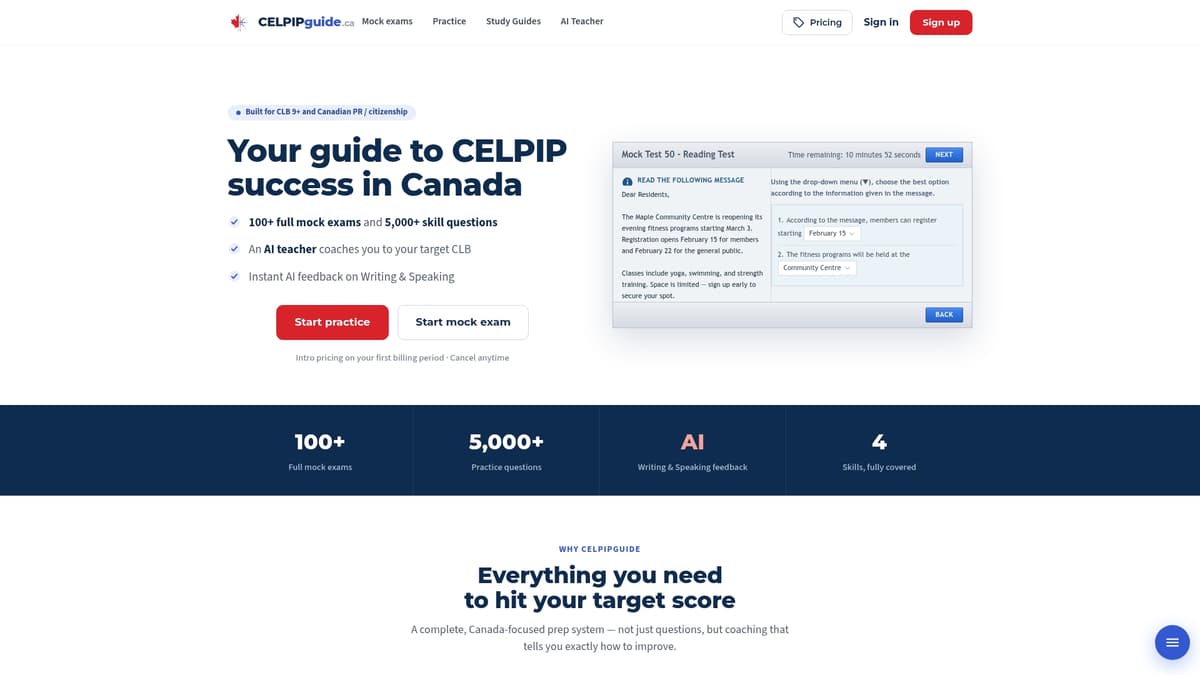
Start your first timed mock today, and walk into the real test already used to the pressure.
Why does simulating exam conditions beat hoping for a review?
When I was preparing, I wasted energy imagining ways to double-check things after the fact. What actually moved my scores was timed mocks, followed by honest, rubric-based feedback on each response. After enough rounds, a one-shot submission stopped feeling scary, because I had done it dozens of times. I would rather you invest in that routine than in a safety net that the test does not offer. Structured practice also makes it far less likely you will ever need to chase a result afterwards. Trust the process, trust the rubric, and let your preparation do the reviewing for you.
— Reza
FAQ
How do I check my CELPIP score?
Sign in to your CELPIP account and open your results page, where your status shows as in progress or completed. For online tests, an officer reviews results before they are final, and confirmation can take a few days or a few weeks.
Can I reopen my CELPIP answers after submitting?
No. Each task is submitted once, and you receive skill scores instead of access to your submitted items. If you need proof of your result, request a copy of your official score report from CELPIP.
How do I practise speaking for CELPIP?
Practise with a timer, record yourself, and score each response against a rubric. Our guide to CLB 9 speaking structure gives templates for speaking tasks.
Is it easy to get a 7 in CELPIP?
It depends on your starting level and how consistently you practise under timed conditions. A diagnostic test shows which skill holds you back, and then targeted mocks close the gap faster than general study.