
CELPIP Blog
Hit CLB 9 in CELPIP Speaking: Structure, 8 Task Templates and Mock Tests
Hit CLB 9 in CELPIP Speaking: Structure, 8 Task Templates and Mock Tests

The CELPIP speaking section has eight tasks in about 15 to 20 minutes, each one testing a different speaking skill, from giving advice to describing a scene. The one structural move that works for all eight: answer the question directly first, back it up with two reasons or examples, then close with a short wrap-up sentence. That single pattern, repeated and adapted, is what separates a band 7 response from a band 9 one.
TL;DR:
- The key to high CELPIP scores is mastering the answer structure of directly addressing the prompt, supporting with two reasons, then wrapping up confidently.
- Effective pacing involves spending around 10-15 seconds on the opening, 30-40 on supporting details, and 10 seconds on the conclusion, to maintain coherence and completeness.
- Focusing on a repeatable skeleton pattern for each task helps manage nerves, improve fluency, and ensure task fulfillment over memorizing vocabulary alone.
- Scoring well depends on controlling four dimensions: relevant content, natural vocabulary, clear pronunciation, and full task completion, not just advanced words.
- Regular practice with timed mock tests, feedback, and recording responses builds automaticity, reduces anxiety, and raises overall performance.
Table of Contents
- Overview of the speaking section: tasks, timing, and what each task tests
- How CELPIP speaking is scored: rubric dimensions and CLB mapping
- Task-by-task structure: repeatable micro-structure and specific templates
- Language, grammar and delivery choices that raise your scores
- A practice plan using mock tests and feedback
- Common mistakes to avoid in each speaking task
- Strategies to manage nerves and improve fluency
- Examples of high-scoring sample answers for each task
- Pronunciation and intonation tips specific to CELPIP speaking
- What actually moves the needle on test day
- How Celpipguide Plus supports your practice plan
- FAQ
- Sources
- Authoritative sources and further reading
Overview of the speaking section: tasks, timing, and what each task tests
I remember staring at my practice test the first time and thinking, eight tasks? That felt like a lot until I realized the whole section moves fast, with short prep windows and short response windows built right in. You are never improvising from a blank page. You get a prompt, a bit of prep time, then you talk.
The speaking component typically runs 15 to 20 minutes and covers eight distinct tasks, each built around a different real-life scenario. The idea behind this format is practical: CELPIP wants to see how you actually use English in situations you would face in Canada, not just whether you can recite grammar rules.
Here is what the eight tasks generally ask you to do:
- Give advice to someone facing a personal or practical dilemma
- Talk about a personal experience connected to a specific topic
- Compare two options and recommend one
- Describe a scene or image in detail
- Make a persuasive request or ask for something assertively
- Offer a solution to an unexpected problem
- Express and support an opinion on a debatable topic
- Describe an unusual situation from an image and predict what happens next
Each task gives you a short preparation window, usually 30 seconds to a minute, followed by a response window of 60 to 90 seconds depending on the task. During prep time, do not try to script word-for-word sentences. Instead, jot down two or three key points and a rough order. That little outline becomes your spine when you start speaking, and it keeps you from freezing mid-answer.
Pacing matters here. Spend your prep seconds deciding what your two supporting points will be, because that decision, more than any specific vocabulary choice, is what keeps your response organized once the clock starts.
How CELPIP speaking is scored: rubric dimensions and CLB mapping
Knowing what the raters are actually listening for changes how you prepare. CELPIP speaking responses are evaluated across four dimensions: content and coherence, vocabulary, listenability, and task fulfilment.
Content and coherence looks at whether your ideas are relevant and logically connected. Vocabulary checks whether your word choices are accurate and varied enough for the topic. Listenability covers pronunciation, rhythm, and whether a listener can follow you without strain. Task fulfilment asks a simple question: did you actually do what the prompt asked?

The gap between a band 7 and a band 9 response is rarely about using fancier words. A band 7 answer usually completes the task with reasonably clear ideas but may wander slightly or rely on simpler sentence patterns. A band 9 answer stays tightly on topic, links ideas with natural transitions, and sounds effortless even under time pressure. The difference often comes down to control: does the speaker sound like they are managing the task, or does the task sound like it is managing them?
CELPIP speaking contributes to an overall CLB score, and a CLB 9 is a common target for Express Entry and other immigration pathways that require strong performance across all four language skills. That is one reason so many test takers fixate on band 9: it is not just a bragging number, it is often the actual threshold a program needs.
This is also why I tell people not to skip the scoring dimensions when they practise. If you only drill vocabulary but never check your task fulfilment, you could sound articulate and still lose points for missing half the prompt’s actual question. Knowing the four dimensions means you know exactly what to listen for when you review your own recordings.
Task-by-task structure: repeatable micro-structure and specific templates
Here is the part I wish someone had handed me on day one: a universal skeleton, then eight small variations.

The core pattern for every task is this: answer directly in your first sentence, give two reasons or examples with a quick supporting detail each, then close with a one-line wrap-up that echoes your opening. That is it. You are not reinventing a structure for each task, you are reusing the same bones with different muscle.
Here is how that skeleton adapts to each of the eight tasks:
- Giving advice: Open with your recommendation (“I think you should…”), give two reasons tied to the person’s situation, then close with encouragement (“Either way, you’ll figure this out”).
- Personal experience: State the experience in one sentence, add two details (when, where, why it mattered), then close with what it taught you or how it changed your perspective.
- Comparing and persuading: Name your pick first, give one reason favouring it and one reason against the alternative, then close with a confident restatement (“That’s why I’d choose…”).
- Describing a scene: Start with the overall setting in one sentence, then describe two or three specific details moving logically (left to right, foreground to background), and close by noting the general mood or activity.
- Making a persuasive request: State what you need clearly, support it with two reasons (urgency, fairness, or practicality), then close with a polite but firm restatement of the request.
- Dealing with a difficult situation: Name the problem in one sentence, propose a solution with two supporting reasons, then close with a next step or reassurance.
- Expressing opinions: State your opinion directly, back it with two reasons or examples, then close by restating your stance in slightly different words.
- Unusual situation and prediction: Describe what you see in one sentence, explain two details suggesting what is unusual, then predict what might happen next and close with a brief reason why.
Quick example outline for task 7 (opinion): “I believe remote work benefits most employees. First, it cuts commute time, which means more hours for family or rest. Second, many people focus better without office distractions. So overall, I’d say flexible work arrangements are worth keeping.”
That is a complete, rubric-friendly answer in under 90 seconds, and it follows the same skeleton you would use for task 1 or task 5.
A few sentence frames help you move between the parts without stalling:
- To open: “I think…” / “In my experience…” / “Looking at this image…”
- To transition into reason two: “Another reason is…” / “On top of that…” / “What’s more…”
- To close: “That’s why…” / “Overall, I believe…” / “So in the end…”
Timing cues matter as much as content. Aim to spend roughly 10 to 15 seconds on your opening answer, 30 to 40 seconds on your two reasons combined, and the last 10 seconds on your wrap-up. If you notice you are running long on your first reason, trim your second one rather than rushing your closing line. An unfinished answer without a clear wrap-up tends to cost you more on coherence than a slightly shorter second example would.
Language, grammar and delivery choices that raise your scores
Vocabulary and listenability are the two dimensions test takers most often undersell, usually because they think bigger words automatically mean a bigger score. They do not. A natural, accurate collocation beats a forced, rare word almost every time, since raters are listening for control, not a thesaurus.
For task-appropriate vocabulary, think in terms of precise but common phrasing: “weigh the pros and cons,” “strike a balance,” “under the circumstances,” or “come to a decision.” These phrases sound natural because native speakers actually use them, and they show range without sounding memorized.
Grammar complexity matters too, but it should emerge from real sentence connections, not forced clauses. Linking ideas with “even though,” “as a result,” or conditional structures like “if I were in that position, I would…” demonstrates the kind of sentence control that raters associate with higher bands.
Delivery is where nerves usually show up first. Chunking your speech, pausing briefly after a complete idea rather than mid-thought, keeps your pacing natural and gives you a half-second to plan your next point. Controlled pauses read as confidence; rushed run-on sentences read as panic, even when the content is fine.
Pro Tip: Record yourself answering a practice prompt, then listen back only for your pauses: if they land after full ideas rather than in the middle of a word or phrase, your listenability score is probably in good shape.
A few delivery habits worth rehearsing:
- Practise reading a short paragraph aloud daily to build steady breath control
- Slow down slightly on key nouns and verbs so raters catch your main points
- Rehearse your opening sentence out loud until it feels automatic, since a confident start sets the tone for the rest of your response
A practice plan using mock tests and feedback
Templates only help once you have drilled them enough that they come out automatically under pressure. That takes a repeatable weekly cycle, not random cramming the night before your test.
- Diagnostic first: Take one full mock speaking test to see where you currently stand across all four dimensions before building a plan around guesses.
- Focused template drills: Pick two or three task types where your diagnostic showed weakness and drill just those templates, five to ten short responses each, timed.
- Full mock test: Once a week, sit through a complete 15 to 20 minute mock speaking test under real timing to rebuild stamina and simulate exam pressure.
- Feedback review: Go through rubric-style feedback on that mock test, tag each mistake by dimension (content, coherence, vocabulary, listenability, task fulfilment), and plan next week’s drills around whichever dimension shows the most repeated errors.
An AI feedback loop is genuinely useful here because it flags patterns you might miss on your own, like consistently running short on task fulfilment in comparison tasks or losing coherence whenever you get nervous on opinion prompts. Track simple metrics week over week: average response length versus the time limit, number of filler words per response, and how many of your target vocabulary phrases actually showed up. Small, measurable goals, like cutting filler words by half or hitting your full response length three sessions in a row, keep practice from feeling vague.
Common mistakes to avoid in each speaking task
A few patterns show up again and again in practice responses, and almost all of them trace back to skipping the structure rather than lacking ideas.
In the advice and persuasive request tasks, test takers often state the problem but forget to actually state a clear recommendation, which hurts task fulfilment directly. In the scene description task, a common slip is describing details randomly instead of moving in a logical order, which makes the response harder to follow. In opinion tasks, many responses state a stance but then drift into unrelated points instead of sticking to two focused reasons.
Timing mistakes are just as common. Rushing through the opening answer to save time for examples backfires, since a vague opening line confuses the rater about what you are even answering. On the flip side, spending too long on your first reason often means an abrupt, unfinished second point or no closing line at all.
The simplest fix across every task is the same: before you speak, confirm in your head what the prompt is actually asking, then commit to your skeleton (answer, two reasons, wrap-up) rather than letting nerves push you off script.
Strategies to manage nerves and improve fluency
Nerves tend to shrink your vocabulary and speed up your pace, which is exactly backward from what helps your score. The fix is not to eliminate nerves, since that is unrealistic under exam pressure, but to build habits that keep you functional despite them.
Breathing matters more than people expect. A slow breath during your prep seconds, before you start talking, resets your pacing and keeps your opening sentence from coming out rushed. Practising your sentence frames until they are automatic also helps, because you are not spending mental energy deciding how to start, you are just filling in the content.
Fluency improves fastest through repetition under timed conditions, not through studying vocabulary lists in isolation. Speaking the same template structure across different prompts, opinion today, advice tomorrow, builds the kind of automatic recall that holds up even when you are nervous. Recording yourself and listening back, even just once a week, also desensitizes you to hearing your own voice, which oddly enough reduces anxiety for a lot of test takers.
Examples of high-scoring sample answers for each task
A strong answer to the advice task might open with, “I think you should talk to your landlord directly about the repair.” A strong scene description might begin, “This photo shows a busy outdoor market with several vendors selling fruit.” A strong opinion response could open, “I believe online learning has made education more accessible for working adults.”
What all of these share is not clever phrasing, it is instant clarity about what the response is actually answering. The rater knows within the first sentence exactly what position or description is coming, which immediately supports both coherence and task fulfilment. From there, the two supporting reasons do the real work: concrete, specific, and tied directly back to the opening claim rather than introducing a new idea halfway through.
The closing line in each case echoes the opening without repeating it word for word, which signals control rather than memorization. That small habit, closing with a variation of your opening claim, is one of the simplest ways to sound finished rather than cut off.
Pronunciation and intonation tips specific to CELPIP speaking
CELPIP listenability scoring is not about sounding like a specific accent. It is about whether a listener can follow you without extra effort. That distinction matters because a lot of test takers over-correct toward an accent they think sounds more “Canadian” instead of focusing on clarity.
Word stress is one of the highest-value fixes available. English relies heavily on stressed syllables to convey meaning, so stressing the wrong syllable in a multi-syllable word can genuinely confuse a listener even when every sound is technically correct. Practising common exam vocabulary with correct stress, “ad-VICE” as a noun versus the verb form, for example, pays off more than chasing a native-like accent.
Intonation also signals whether you are finishing a thought or continuing one. A falling tone at the end of your wrap-up sentence tells the rater you are done and confident in your answer. A flat or rising tone on that same sentence can make even a complete answer sound unfinished or uncertain. Practising your closing lines with a deliberate downward intonation is a small habit that measurably improves how finished your response sounds.
What actually moves the needle on test day
Most CELPIP speaking advice focuses on vocabulary lists, and I think that is the wrong priority for the majority of test takers. Vocabulary matters, but structure is what keeps a response from falling apart under a 60-second clock. I have seen plenty of strong English speakers score lower than expected simply because they never rehearsed a repeatable shape for their answers, so nerves took over and their ideas came out in the wrong order.
The conventional advice to “just speak naturally” undersells how much a memorized skeleton actually frees you up to sound natural. Once the answer, two reasons, wrap-up pattern is automatic, your mental energy goes toward word choice and delivery instead of panicking about what to say next.
If you take one thing from this guide, prioritize the skeleton before the vocabulary. Drill the structure until it is boring, then layer in better phrasing once the shape is solid.
— Reza
How Celpipguide Plus supports your practice plan
Building the weekly cycle above (diagnostic, drills, mock test, feedback) is a lot easier when the tools are already built for it instead of pieced together from scattered practice sheets. A Plus plan gives you a direct route to exactly that cycle, without the guesswork of finding reliable mock material on your own.
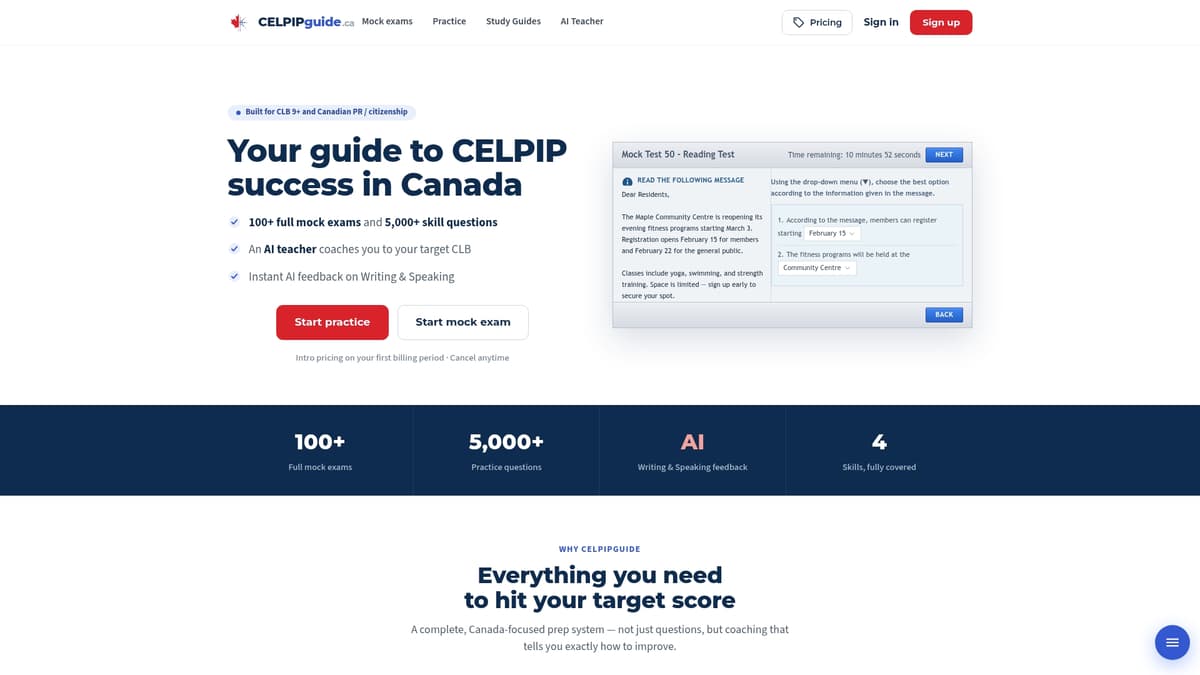
What is actually included:
- Numerous full mock exams to run your weekly timed practice and diagnostic sessions
- Thousands of practice questions across all four skills so your drills can vary
- An AI scoring tool that gives instant, rubric-style feedback on your speaking responses, tagged by dimension
- Study plans that adjust based on which scoring dimension needs the most work
For practising prompts beyond CELPIP’s own bank, a writing prompt generator can also help you drill opinion and hypothetical tasks with fresh scenarios when you want extra variety between mock sessions.
Ready to put the structure into practice? Get the Plus plan for 29.99 $ and use coupon BLG30 for 30% off.
FAQ
How to get 9 in CELPIP speaking?
Getting a band 9 means consistently applying a clear structure (direct answer, two solid reasons, a confident wrap-up) across all eight tasks while keeping your vocabulary natural and your pacing steady. It also requires regular practice under real exam timing so the structure becomes automatic rather than something you have to think through mid-response.
How many parts is speaking in CELPIP?
The CELPIP speaking section has eight separate tasks, each focused on a different real-life scenario like giving advice, describing a scene, or expressing an opinion. The whole section typically takes about 15 to 20 minutes to complete.
How does CELPIP mark speaking?
CELPIP speaking responses are scored on four dimensions: content and coherence, vocabulary, listenability, and task fulfilment. IRCC’s Express Entry guidance maps the resulting band scores to CLB levels used in immigration applications.
Is it hard to get 7 in CELPIP?
A band 7 is achievable for most test takers with steady, structured practice, since it requires clear, relevant answers rather than flawless, native-level fluency. The bigger challenge is usually consistency across all eight tasks rather than any single task being especially difficult.
What CELPIP speaking score do I need for citizenship?
For certain citizenship pathways, official guidance requires CELPIP-G results of 4 or higher in listening and speaking. Requirements vary by pathway, so check the current official page for your specific situation.
Authoritative sources and further reading
For official scoring details and score mapping, these sources are worth bookmarking alongside your practice schedule:
- CLB mapping for post-graduation work permit eligibility
- Express Entry language test results and point calculations
- Citizenship language proof requirements and minimum results