
CELPIP Blog
CLB 9 Target: CELPIP for PR Diagnostic Plan to Fix Your Weakest Skill
CLB 9 Target: CELPIP for PR Diagnostic Plan to Fix Your Weakest Skill

CELPIP‑General is the only version of CELPIP that IRCC accepts for permanent residency, whether you’re applying through Express Entry, the Canadian Experience Class, or the Federal Skilled Trades Program. Most programs need at least CLB 7 across all four skills, some accept CLB 5, and if you’re chasing a competitive Comprehensive Ranking System score, CELPIP 9 is where the real CRS gains show up. Confirm your test version before you book, and track the two‑year validity window from day one.
TL;DR:
- CELPIP-General, testing all four skills, is required for IRCC’s permanent residence programs, unlike CELPIP-General LS, which only tests listening and speaking for citizenship.
- Achieving CLB 9 in all four skills significantly boosts CRS points, often more than gaining extra work experience or credentials.
- Scores are valid for two years, so applicants must ensure their test results stay valid at both profile entry and application submission stages.
- Preparation should focus on your weakest skill first, with timed drills and full mocks to track progress before booking the exam.
- Provincial nominee programs may have lower language thresholds than federal ones, so check the specific program requirements to optimize your chances.
Table of Contents
- Which CELPIP test is accepted for permanent residence
- How CELPIP scores convert to CLB and what each program needs
- How your CELPIP score shapes your CRS points
- Validity, timing, and retake rules you can’t ignore
- Test format, timing, and how to book CELPIP‑General
- A prioritized study plan to raise your CELPIP bands
- CELPIP scores matter beyond federal immigration programs too
- What to expect on test day and how to walk in prepared
- Free and paid resources worth using to prepare
- Building English fluency outside the exam itself
- Why CLB 9 is the realistic target, not CLB 7
- Get your CELPIP prep organized before you book
- Official pages worth bookmarking
- Sources
- FAQ
Which CELPIP test is accepted for permanent residence
There are two CELPIP exams on the market, and mixing them up is the single most expensive mistake I see applicants make. CELPIP‑General is the one you need for Express Entry and PR. CELPIP‑General LS tests only listening and speaking, and it’s built for Canadian citizenship applications, not permanent residency. IRCC will not accept it for your PR profile, no matter how good your scores are.
Here’s what separates the two, and why the difference trips people up:
- CELPIP‑General tests all four skills (listening, reading, writing, speaking) and generates a full score report accepted for Express Entry, CEC, FSWP, and FSTP.
- CELPIP‑General LS covers only two skills and exists specifically for citizenship applicants who already have PR status.
- Booking the wrong one wastes your test fee and your slot, since results aren’t interchangeable between programs.
Before you register, double check the exam name on your confirmation email against the official registration portal. It sounds obvious until you’re the person who booked LS by accident three weeks before an application deadline.
How CELPIP scores convert to CLB and what each program needs
CELPIP has one major advantage over other accepted tests: its scoring scale maps directly onto the Canadian Language Benchmark (CLB) system, one point for one level, in every skill. A CELPIP 7 in speaking is a CLB 7 in speaking. No conversion table, no rounding, no guesswork.
That simplicity doesn’t mean the requirements are simple, though. Minimum thresholds vary by program, and IRCC applies them separately to each of the four skills:
- Federal Skilled Worker Program (FSWP): CLB 7 (CELPIP 7) in all four abilities.
- Canadian Experience Class, TEER 0/1 jobs: CLB 7 (CELPIP 7) across the board.
- Canadian Experience Class, TEER 2/3 jobs: CLB 5 (CELPIP 5) in all four abilities.
- Federal Skilled Trades Program: mixed minimums, typically CLB 5 in speaking and listening, CLB 4 in reading and writing.
The catch that catches people off guard: your scores are evaluated per skill, not averaged. Score a CELPIP 9 in reading and listening but a 6 in writing, and that writing score is what determines your eligibility, not your strongest results. Your weakest skill sets the ceiling for the whole application.
How your CELPIP score shapes your CRS points
Language ability is one of the heaviest weighted factors in the CRS, and the jump between CLB bands is not linear. Since job offer points effectively disappeared from the scoring model, CLB 9 has become the practical target for candidates who want to stay competitive in Express Entry draws.
Pro Tip: Don’t just look at your total CRS score. Break down how many points come from language specifically, then ask what a one‑band improvement in your weakest skill would do to that subtotal. It’s often more than raising an already‑strong skill by two bands.
Consider two single applicants with identical age, education, and work experience. One holds CLB 7 across all four skills. The other holds CLB 9. The CLB 9 candidate earns meaningfully more core and skill‑transferability points, often enough on its own to shift from “watching the draws” to actually receiving an invitation. That gap is why CELPIP score improvement between rounds of testing is one of the highest‑leverage moves you can make in your whole application, often more impactful than adding another year of work experience.
Validity, timing, and retake rules you can’t ignore
Your CELPIP results are only good for two years, and that clock matters at two separate moments, not just one.
- Your results must be valid when you first enter your profile into the Express Entry pool.
- They must still be valid when you actually submit your PR application after receiving an invitation.
If your results expire while you’re sitting in the pool, waiting for a draw, you can’t patch the gap with a partial retake. You have to sit the full CELPIP‑General exam again, all four skills, from scratch. Given that draws can take months to materialize, build a buffer. If you expect to be in the pool for a year or more, schedule your test with enough runway that it won’t lapse before you actually apply—consider getting mortgage pre-approval in Canada as part of your broader financial planning to ensure your steps align smoothly.
Test format, timing, and how to book CELPIP‑General
CELPIP‑General runs as a single sitting covering four sections: listening, reading, writing, and speaking. Most test‑takers finish in around three hours, and results are typically released within days rather than weeks, which is faster than several other options on the market.
A few practical things to nail down before test day:
- Confirm you’re booking CELPIP‑General, not the LS version, directly on the official registration portal.
- Check current fees on the same portal. Prices shift, and third‑party guides often quote outdated numbers.
- Bring valid government‑issued photo ID that matches the name on your registration exactly.
- Decide between an in‑person test centre and any accepted remote option, and book early. Popular centres in cities like Toronto, Vancouver, and Calgary fill up fast around Express Entry draw cycles.
A prioritized study plan to raise your CELPIP bands
Start with a full diagnostic mock, not a stack of random practice questions. You need a real baseline before you can decide where your study hours actually go.
Once you have that baseline, prioritize your weakest skill first. It sounds obvious, but most self‑study plans do the opposite. People polish the skill they already enjoy and avoid the one that’s dragging their eligibility down. Remember, your lowest band caps your whole application, so a mediocre score in your strongest skill is worth less than a one‑band jump in your weakest.
Listening and Reading tend to improve fastest because they’re built on objective accuracy. Timed drills and error review move the needle within weeks. Speaking and Writing move slower because they’re graded against detailed descriptors, and improvement depends on understanding exactly what raters reward, not just “sounding fluent.”
Here’s a rough four‑week cadence that works for most applicants:
- Weeks 1 to 2: Daily 20 minute timed drills in your weakest skill, plus one full mock exam to check for movement.
- Week 3: Shift focus to your second‑weakest skill while maintaining light maintenance practice on the first.
- Week 4: Full mock under real exam conditions, then a targeted review of every missed rubric point before you commit to a booking date.
This is exactly where a platform like Celpipguide’s practice hub earns its keep. Full‑length mocks, a real diagnostic, and instant feedback on writing and speaking let you measure whether your weakest skill has actually moved, instead of guessing based on how confident you feel walking out of a practice session.
CELPIP scores matter beyond federal immigration programs too
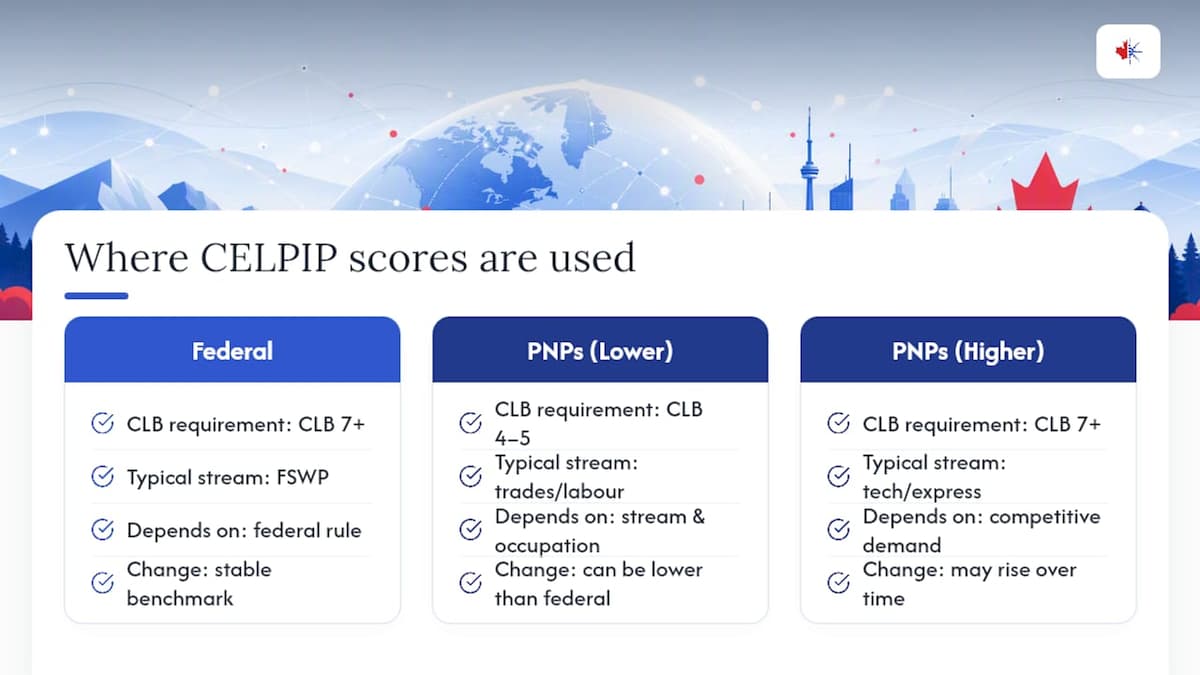
Federal Express Entry isn’t the only door CELPIP unlocks. Several Provincial Nominee Programs (PNPs) set their own language thresholds, and they don’t always match the federal minimums you’ve been studying toward.
Some provincial streams, particularly those targeting skilled trades or specific labour shortages, accept CLB 4 or CLB 5 where the federal equivalent program demands CLB 7. Others, especially tech‑focused or express provincial streams tied to in‑demand occupations, hold candidates to the same CLB 7 or higher bar as FSWP. The requirement depends entirely on which stream you’re targeting, not a single province‑wide rule.
This matters practically because a candidate who falls short of CLB 7 for FSWP might still qualify for a provincial stream at CLB 5, provided their occupation and work experience line up with what that province is recruiting for. Conversely, some provincial tech streams have pushed language requirements higher over time as competition for nominations increased, so a score that cleared the bar two intake cycles ago might not clear it now.
The practical move: once you know your target province and stream, check that stream’s own language page directly rather than assuming your federal‑program score automatically qualifies you elsewhere. CELPIP results transfer across programs, but the pass line moves depending on which door you’re walking through. A single CELPIP‑General result, taken once and valid for two years, can support applications to multiple programs simultaneously if you keep the timing aligned.
What to expect on test day and how to walk in prepared
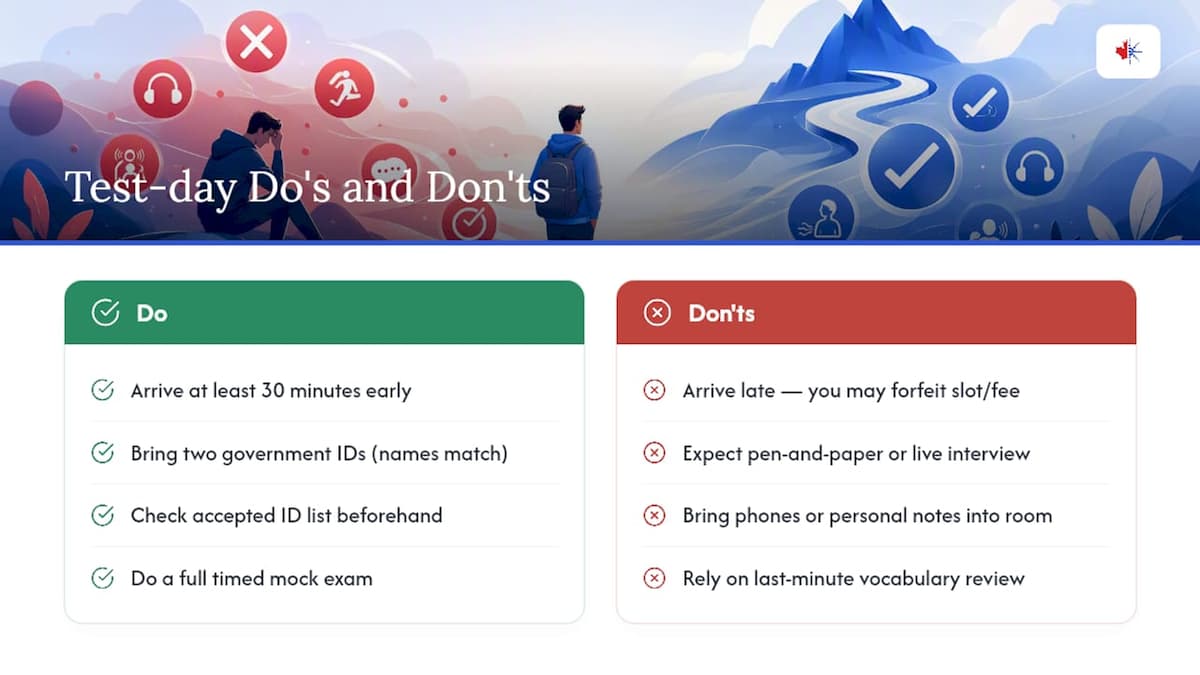
Test day logistics trip up otherwise well‑prepared candidates more often than the actual content does. Arrive at your test centre at least 30 minutes before your scheduled time. Late arrivals can mean forfeiting your slot and your fee entirely, with no exceptions for traffic or transit delays.
Bring two pieces of valid, government‑issued ID, and make sure the name on both matches your registration exactly, down to spelling and middle names. A passport plus a driver’s licence usually covers it, but check the official registration portal for the current accepted ID list before you go.
Once you’re checked in, expect a structured, computer‑based format. You’ll type your writing responses and speak your speaking responses into a headset microphone, recorded for later scoring. There’s no pen‑and‑paper option and no face‑to‑face speaking interview, which surprises people expecting an interview‑style exam. Personal items, phones, and notes stay outside the testing room. You’ll get scratch paper for the reading and listening sections if you need to jot down notes.
Pace yourself section by section rather than treating the whole three hours as one long block. Each section has its own time limit, and running out of time on reading won’t give you extra minutes on writing. If nerves are your biggest risk factor, doing at least one full timed mock exam under exam‑like conditions in the week before your test matters more than any last‑minute vocabulary review.
Free and paid resources worth using to prepare
CELPIP’s official site offers sample questions and a general test overview at no cost, and that’s the right starting point for understanding format and question types before you spend a cent. It’s useful for orientation. It’s thinner when it comes to volume, and volume is what actually moves your band score.
Free resources tend to fall short in three specific ways: limited practice questions, no rubric‑based feedback on writing or speaking, and no way to simulate the pressure of a full timed mock. You can learn what a Task 4 email response looks like for free. You can’t easily learn whether your Task 4 response would score a 7 or a 9 without structured, criteria‑based feedback.
That’s the gap paid preparation is built to close. A personalized study plan that adapts to your diagnostic results, paired with rubric‑based scoring on your actual writing and speaking attempts, tells you precisely where you’re losing points instead of leaving you to guess. For a test where each skill is scored independently and your weakest one caps your eligibility, that specificity is worth more than a broad library of generic tips. Balance both: use free resources to learn the format, then invest in structured practice once you know exactly which skill needs the work.
Building English fluency outside the exam itself
Test‑specific practice sharpens your technique, but it can’t manufacture fluency you don’t have yet. If your everyday English use is limited, no amount of CELPIP drilling substitutes for genuine language exposure.
Immersion doesn’t require moving countries. Switching your phone, streaming services, and daily podcasts to English forces your brain into constant low‑stakes practice. Local speaking clubs and conversation meetups, common in most major Canadian cities and increasingly common online, give you unscripted speaking practice that mimics the unpredictability of the CELPIP speaking tasks far better than scripted drills do.
Reading English news daily builds the vocabulary range CELPIP’s reading section draws on, while writing even short daily journal entries in English trains the sentence structure and organization that raters look for in the writing tasks. None of this replaces targeted CELPIP practice, but it builds the underlying fluency that targeted practice then sharpens into exam‑ready scores. Think of general fluency as the foundation and CELPIP‑specific prep as the finishing work laid on top of it.
Why CLB 9 is the realistic target, not CLB 7
Chasing exactly CLB 7 leaves no margin. Test scores have natural variance, and re‑evaluations don’t always tip in your favour. Aiming for CLB 9 builds in a buffer while also unlocking meaningfully more CRS points, which matters more now that fewer alternate pathways to extra points exist. Spend your prep hours on your weakest skill before you spend another dollar on other profile upgrades like credential assessments, since a one‑band language gain often outweighs them.
— Reza
Get your CELPIP prep organized before you book
Studying for CELPIP without a diagnostic is like packing for a trip without checking the weather. You might land on something useful, but you’re just as likely to waste hours polishing a skill that was never your problem. Many specialized CELPIP prep platforms start differently: a real diagnostic first, then numerous full mock exams and thousands of practice questions tailored to your initial scores, often including AI-based instant, rubric-based feedback on writing and speaking responses to help you know your likely score range.
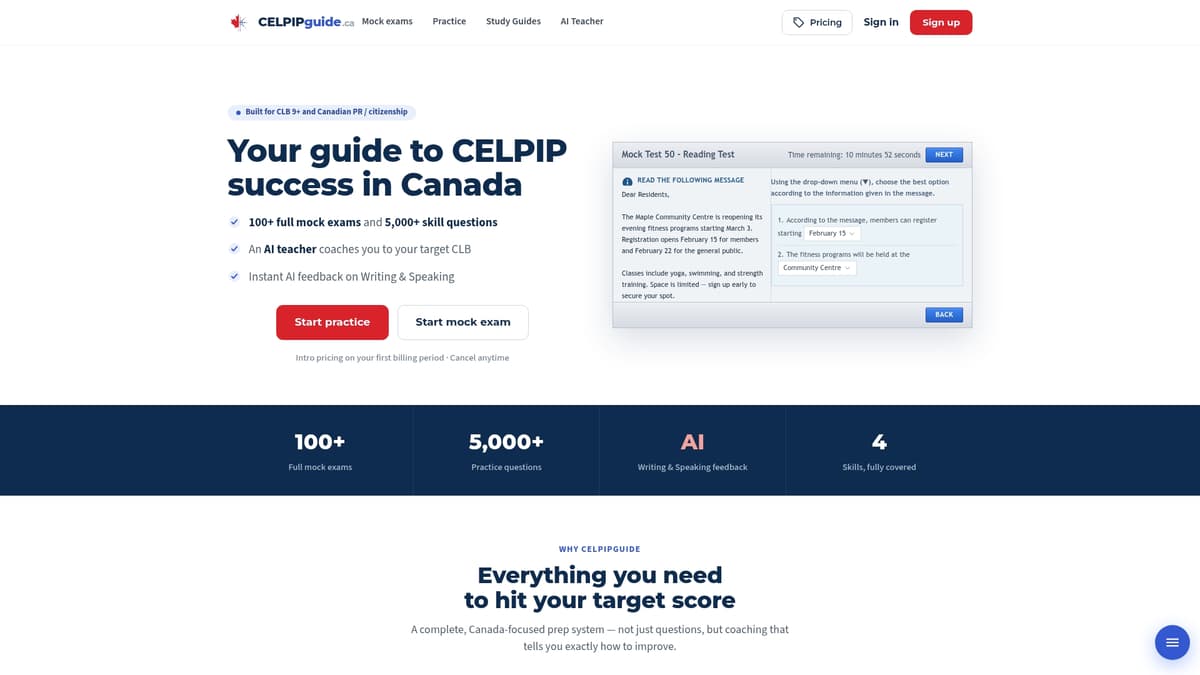
If CLB 9 is your target, treat it like a sprint with checkpoints. Take the diagnostic, build a focused four‑week plan around your weakest skill, then run full mocks to confirm you’re actually ready before you spend money on the official test. The Plus plan is available for a one‑time payment of $29.99, and you can apply code BLG30 for 30% off. Start with a diagnostic, pick your sprint, and book your official CELPIP‑General test once your mock scores are hitting your target consistently.
Official pages worth bookmarking
Verify every rule in this article directly against the source before you book or apply. Start with IRCC’s language test results page for program minimums and validity rules, then check section 102.3 of the Immigration and Refugee Protection Regulations for the legal basis behind CLB equivalency. For test logistics, use CELPIP’s official General test page and book through the Paragon Testing registration portal.
This article is general information, not a substitute for advice from a qualified lawyer. Consult a qualified legal professional about your own circumstances before acting on anything here.
Sources
- Express Entry: Language test results
- Immigration and Refugee Protection Regulations (SOR/2002-227) — section 102.3
- CELPIP registration
FAQ
What CELPIP score is needed for PR?
It depends on your program. FSWP and CEC TEER 0/1 streams require CLB 7 (CELPIP 7) in all four skills, while CEC TEER 2/3 streams accept CLB 5. The Federal Skilled Trades Program uses mixed minimums, typically CLB 5 in speaking and listening and CLB 4 in reading and writing.
Does CELPIP work for PR?
Yes, but only CELPIP‑General, not CELPIP‑General LS. IRCC accepts CELPIP‑General for Express Entry and other PR streams, while the LS version is designed for citizenship applications instead.
Is CELPIP 9 a good score?
CELPIP 9 is a strong score that maps directly to CLB 9, and it’s the level many applicants now target since it meaningfully increases CRS language points compared to CLB 7. It also builds a buffer against natural test‑score variance so a single weak section doesn’t drop you below a program’s minimum.
Is CLB 7 good for PR?
CLB 7 clears the minimum bar for FSWP and CEC TEER 0/1 streams, so it’s genuinely good enough for eligibility. It’s less competitive for maximizing your CRS score, since CLB 9 unlocks noticeably more points and gives you more room if you’re aiming for a strong invitation round.