
CELPIP Blog
CELPIP speaking rubric: 4 teacher drills to fix your weakest skill
CELPIP speaking rubric: 4 teacher drills to fix your weakest skill

The CELPIP speaking rubric is the official score comparison chart that scores every speaking task on four dimensions: content/coherence, vocabulary, listenability, and task fulfillment. Scores run from level 1 to level 12, and each level maps directly to a Canadian Language Benchmark (CLB), which is what immigration and credentialing bodies actually check. If you want to see exactly what separates a 7 from a 9, start with the score descriptors, then compare your own recordings against annotated sample responses.
TL;DR:
- Improving listenability should be the priority when time is limited, as it responds fastest to daily shadowing practice and has a quick impact on overall scores.
- Candidates often score lower when responses are brief, poorly organized, or contain repetitive vocabulary, emphasizing the need for structured content planning.
- Focusing on the weakest rubric dimension—content, vocabulary, listenability, or task fulfillment—and practicing the specific skill through timed mock exams accelerates progress.
- Scores between levels 5 and 7 are common for most test-takers, but reaching CLB 9 requires consistent, controlled responses with wider vocabulary and better structure.
- Analyzing annotated sample responses helps identify key differences between bands, guiding targeted practice to close specific skill gaps.
Table of Contents
- Celpip speaking rubric: the four scoring dimensions explained
- CELPIP speaking levels 1 to 12: what each band actually sounds like
- How CELPIP speaking scores map to CLB and which target to choose
- How examiners apply the rubric and produce your final score
- Rubric-linked practice: drills for each scoring dimension
- Annotated sample responses: what separates each band
- Realistic timelines and where to focus when time is short
- How Celpipguide helps you practise against the rubric
- Sources
- FAQ
Celpip speaking rubric: the four scoring dimensions explained
Every examiner listens for the same four things, in the same order, on every task. Once you know what each dimension actually rewards, you stop guessing and start practising the right skill at the right time.
Content/coherence measures whether your ideas are relevant to the prompt and whether they connect logically. A candidate who answers the question but jumps between three unrelated points loses marks here, even if every sentence is grammatically perfect. Strong responses have a clear beginning, a developed middle, and a conclusion that ties back to the question. Weak responses often trail off or repeat the same idea in different words because the speaker ran out of things to say.
Vocabulary covers range, accuracy, and how naturally you combine words. Examiners are listening for collocations (“raise a concern,” “come to a decision”) rather than isolated vocabulary lists memorized the night before. A response stuffed with advanced words used incorrectly scores lower than a simpler response where every word choice fits.
Listenability is pronunciation, stress, rhythm, and fluency combined into one practical question: how much effort does it take to understand you? This is not about sounding like a native speaker. It’s about minimizing the moments where a listener has to rewind mentally to catch what you meant. Frequent fillers, long pauses, and flat intonation all hurt listenability even when your grammar is fine.
Task fulfillment asks whether you did what the task actually required. If the prompt asks you to compare two options and give a recommendation, and you only describe the two options without recommending one, you have not fulfilled the task, regardless of how fluent you sounded.
Examiner notes tend to cluster around a few recurring phrases:
- “Response is relevant but underdeveloped” — usually a content/coherence flag, meaning the idea needed one more supporting detail.
- “Limited range of vocabulary” — a sign the same three or four adjectives are doing all the work.
- “Frequent hesitation affects flow” — a listenability comment tied to fluency, not pronunciation accuracy.
- “Task only partially addressed” — task fulfillment, often because the candidate ran out of time before answering the full prompt.
CELPIP speaking levels 1 to 12: what each band actually sounds like
The official level descriptors span 12 bands, but you do not need to memorize all twelve to know where you stand; this explanation of writing proficiency levels can help you understand how to read and think about levels effectively. Grouping them into four practical bands makes the scale far easier to use for self-assessment.
-
Levels 1 to 4: foundational and inconsistent. Responses at this range are often off-topic or too short to develop an idea. Vocabulary is basic and repeated heavily. Pronunciation and pacing create real strain for the listener, and task fulfillment is partial at best, since candidates frequently run out of things to say before the time limit. The fix at this stage is almost never grammar. It’s building enough vocabulary and sentence structures to sustain 60 to 90 seconds of relevant speech.
-
Levels 5 to 7: functional but uneven. This is where most test takers land on their first attempt. Ideas are relevant but not fully developed, vocabulary is adequate for everyday topics but strains under abstract or opinion based prompts, and listenability is generally fine except when the speaker gets nervous and speeds up or trails off. Task fulfillment is usually complete, but responses often answer the question narrowly rather than exploring it. A CLB 7 speaker communicates competently in most work and study situations but still makes noticeable errors under pressure.
-
Levels 8 to 10: strong and controlled. Content is well organized, with a clear structure that a listener can follow without effort. Vocabulary range widens to include idiomatic expressions and precise word choices rather than generic ones. Listenability is smooth, with natural stress and intonation patterns and only occasional hesitation. Task fulfillment is complete and often exceeds the minimum requirement, addressing nuance in the prompt rather than just the surface question. This band represents genuinely fluent, professional-level communication.
-
Levels 11 to 12: near-native command. Responses at this level show sophisticated idea development, precise and varied vocabulary, virtually effortless listenability, and complete task fulfillment with subtlety most candidates never attempt, like acknowledging a counterargument before dismissing it. Very few test takers need this range for immigration purposes, and pushing for it when a lower level already meets your goal is often a poor use of study time.
The diagnostic question to ask after every practice attempt: which dimension pulled my score down the most? If your ideas were sound but your delivery was choppy, drill listenability. If you spoke smoothly but ran out of content, drill idea generation and organization. Moving up one band rarely requires fixing all four dimensions at once. Usually it means fixing whichever one dimension is currently your weakest link, because the rubric scores holistically but examiners notice the outlier.
How CELPIP speaking scores map to CLB and which target to choose
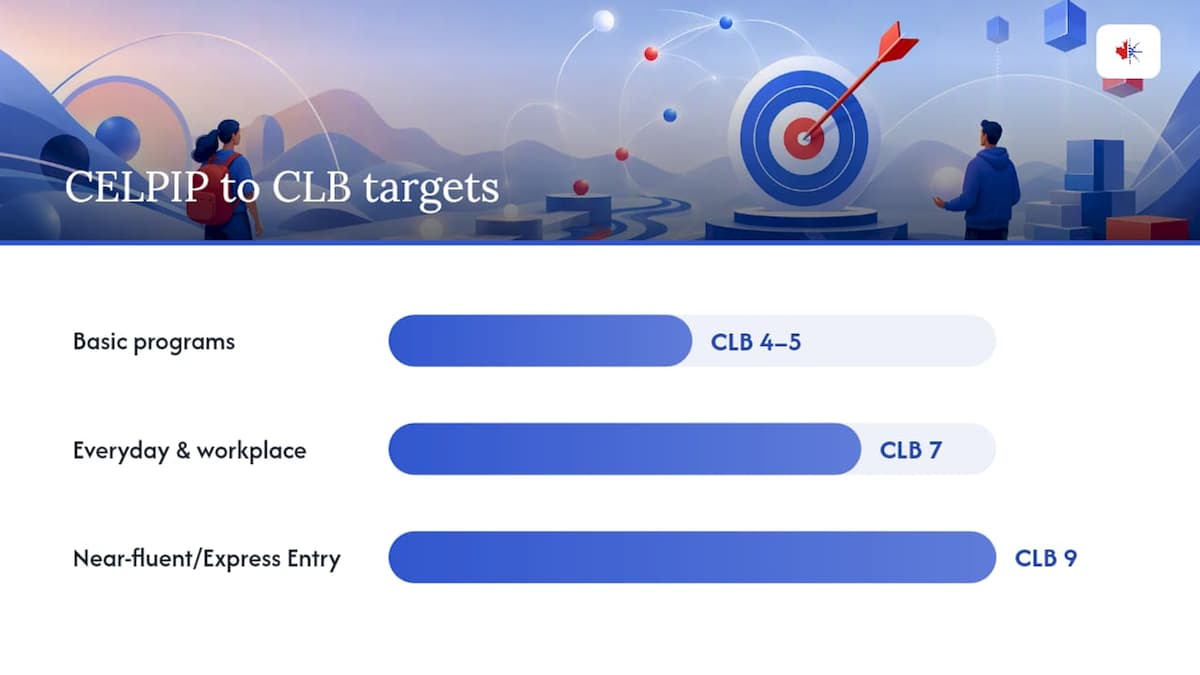
CELPIP levels convert directly to Canadian Language Benchmarks, and this conversion is what actually matters for immigration, licensing, and citizenship applications. The Government of Canada uses CLB equivalencies across its selection systems, so a CELPIP speaking score is meaningful mainly through what CLB level it represents.
Here is what the common target bands mean in practice:
- CLB 7 means you can handle most everyday and workplace conversations, including moderately abstract discussions, but you still make errors that a listener notices, and unfamiliar or highly technical topics can trip you up.
- CLB 9 means near fluent communication across a wide range of topics, including expressing opinions with nuance and handling unexpected turns in a conversation without losing coherence.
- CLB 4 or 5 is the floor for many basic programs, representing functional but limited communication, sufficient for routine tasks but not for complex professional interactions.
Your target score should follow your goal, not a general sense of “higher is better.” Express Entry candidates chasing Comprehensive Ranking System points often need CLB 9 or higher across all four skills to maximize points, while some provincial nominee streams or study permits accept CLB 7. Professional licensing bodies set their own thresholds, sometimes higher than immigration minimums. Check the Citizenship and Immigration Canada requirements for your specific program before deciding how many bands you actually need to climb, because overshooting your target by two bands can cost weeks of study time you did not need to spend.
How examiners apply the rubric and produce your final score
CELPIP raters go through structured training built around the same descriptor set you can access publicly, and Paragon testing’s instructional materials describe the kind of calibration exercises used to keep scoring consistent across raters and test sessions. That training matters to you directly: it means the rubric is applied the same way whether you test in one city or another, which is why studying the descriptors pays off.
Each speaking task is scored individually against the four dimensions, and your final speaking level reflects performance across all eight tasks combined, not just your best or worst answer. A single weak task will not sink your score if the rest of your responses are solid, but a pattern of the same weakness across multiple tasks (say, consistently underdeveloped content) will pull your overall level down because it shows a genuine skill gap rather than a one-off nervous moment.
Recurring assessor notes worth knowing before test day:
- Candidates frequently lose marks for answering too briefly, leaving unused time on tasks that reward development.
- Memorized templates get flagged when they clearly don’t fit the specific prompt, which hurts task fulfillment even if the language itself is fluent.
- Rushed responses in the final ten seconds of a task often introduce errors that a calmer pace would have avoided.
- Long unfilled pauses cost more on listenability than a filler word does, since silence breaks the listener’s attention more than a stumble.
Pro Tip: Record yourself answering a practice prompt, then listen back and mark every point where you would have to ask “sorry, what?” if a stranger said that to you. Those are your real listenability weak points, and they’re rarely the ones you’d guess.
Rubric-linked practice: drills for each scoring dimension
Generic speaking practice wastes time because it doesn’t tell you which dimension you’re actually improving. Rubric-linked practice fixes that by tying each drill to one specific scoring criterion.
-
For content/coherence, spend 30 seconds before you speak sketching a three-part structure: a direct answer, one supporting reason with an example, and a short conclusion. Practising this planning habit on paper first, then aloud, builds the instinct to organize ideas even when you can’t plan on the real test.
-
For vocabulary, drill collocations and lexical chunks rather than single words. Instead of memorizing “important,” practise phrases like “a pressing concern,” “a key factor,” and “worth considering.” Language reinforce this chunk-based approach to proficiency practice, since natural-sounding phrases score better than a string of correct but disconnected words.
-
For listenability, shadow short audio clips: play a native speaker’s sentence, pause, and repeat it matching their stress and rhythm exactly. Do this for five minutes daily rather than thirty minutes once a week; consistency changes muscle memory for intonation faster than long, occasional sessions.
-
For task fulfillment, practise parsing prompts before you answer. Underline the actual question inside the prompt (comparison? recommendation? description?) and check off each part as you speak, so you never leave half the task unanswered.
-
Combine drills with full mock tests on a weekly cycle. Isolated drills build the skill, but only a timed mock test under real pressure reveals whether that skill holds up when the clock is running. A structured CELPIP speaking practice test lets you apply all four drills in one sitting and see which one falls apart first under time pressure.
Pro Tip: After every mock test, score yourself against just one dimension at a time instead of trying to judge everything at once. Your brain catches more mistakes when it’s only hunting for one type of problem.
The order matters less than the loop: drill, test, identify the weakest dimension, drill that dimension specifically, retest. Most learners see faster gains by cycling through this loop weekly than by doing scattered general practice for the same number of hours.
Annotated sample responses: what separates each band
Reading a transcript rarely teaches as much as seeing how a specific answer would be scored against all four dimensions side by side. Below are three short responses to the same prompt (describing a memorable trip) at three different bands.
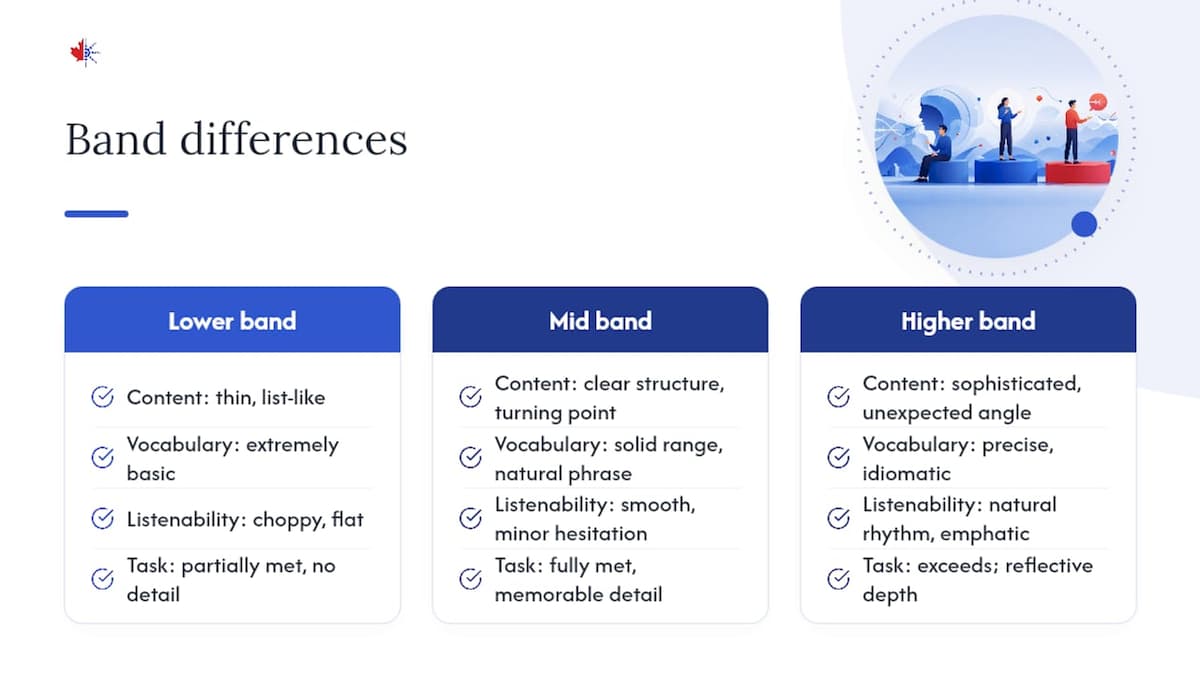
Lower band sample: “I go to Vancouver. It was good. I see mountain and I eat food. It was nice trip. I like it very much.” Content/coherence: thin, no development beyond a list of activities. Vocabulary: extremely basic, repeated “good” and “nice.” Listenability: choppy, flat delivery with no connecting phrases. Task fulfillment: partially met; describes the trip but offers no detail a listener would remember. Practice task: rewrite the same answer adding one specific sensory detail per sentence (what did the mountain actually look like?).
Mid band sample: “Last summer I visited Vancouver with my family. The highlight was hiking up to a viewpoint where you could see the whole harbour. What made it memorable was that it was unexpectedly foggy, so we almost missed the view entirely, but it cleared up right as we reached the top.” Content/coherence: clear structure with a specific turning point. Vocabulary: solid range, natural phrase “cleared up right as.” Listenability: smooth with minor hesitation. Task fulfillment: fully answered, with a memorable detail that directly serves the prompt. Practice task: try adding a brief reflection at the end (“that trip taught me to always bring a rain jacket”) to push toward the next band.
Higher band sample: “The trip that stands out most was actually a work conference in Vancouver, oddly enough, because a colleague and I ended up stranded downtown during a transit strike and had to improvise an entire day on foot. What struck me was how the disruption turned into the best part of the trip, since we discovered a part of the city we’d never have bothered visiting otherwise.” Content/coherence: sophisticated structure with an unexpected angle and a clear insight. Vocabulary: precise and idiomatic (“stands out,” “improvise,” “bothered visiting”). Listenability: natural rhythm with appropriate emphasis on key words. Task fulfillment: exceeds the base requirement by adding reflective depth. Practice task: practise finding the unexpected angle in a routine prompt before you start speaking; it’s the habit that separates competent answers from memorable ones.
According to the official score comparison chart, studying annotated exemplars against the descriptors is one of the highest-leverage ways to understand what separates adjacent bands, since it shows you the gap in real language rather than abstract description. You can compare more full-length examples on Celpipguide’s speaking samples page to calibrate your own practice recordings against responses scored at different levels.
Realistic timelines and where to focus when time is short
Most learners gain a moderate improvement over several weeks of consistent, rubric-focused practice targeting specific weak dimensions rather than general conversation. Larger score jumps usually take longer, often several months, because they require rebuilding vocabulary range and fluency habits rather than just polishing existing skills.
If your test date is close and time is limited, prioritize listenability first. It’s the dimension that affects how examiners perceive everything else you say, and it responds fastest to focused shadowing practice, often within one or two weeks of daily repetition. Content and vocabulary gains tend to compound more slowly because they depend on genuinely absorbing new language, not just adjusting delivery.
The biggest mistake I see in rubric-focused study plans is treating all four dimensions as equally urgent. They’re not. Fix your single weakest dimension first, retest, and let the score tell you what to fix next. Consistency beats intensity here. Fifteen focused minutes a day for three weeks outperforms one exhausting five-hour cram session, mostly because pronunciation and fluency habits need repetition spaced over days to actually stick.
How Celpipguide helps you practise against the rubric
Understanding the rubric is only half the work. Closing the gap between where you score now and where you need to land takes structured, repeated practice against real conditions, which is exactly what a self-study plan without feedback struggles to deliver.
An online platform builds its speaking tools directly around these four scoring dimensions instead of generic conversation practice. The full mock exams simulate real timing and task formats so you can measure task fulfillment under actual pressure, not in a relaxed practice setting. Task-by-task feedback flags weak vocabulary range, choppy delivery, or underdeveloped content immediately after recording, so you’re not waiting days to learn what an examiner would have flagged. A personalized study plan generator then sequences your practice around whichever dimension is actually holding your score down, rather than making you guess. If you haven’t tested your current level yet, the free CELPIP practice test is a low-pressure way to see where you stand before committing to a plan.
Sources
The official CELPIP score comparison chart is the primary reference for every level descriptor discussed above, including the downloadable breakdown across all four speaking dimensions. For how those scores translate into immigration eligibility, the Government of Canada’s language benchmark resources explain how CLB equivalencies factor into selection systems, and Citizenship and Immigration Canada outlines which programs require which minimum benchmarks.
For continued practice aligned to these descriptors, Celpipguide’s speaking guide walks through task-by-task strategy, and the CELPIP exam practice hub offers full-length mock exams for readers who want to test their current band before adjusting their study plan.
FAQ
What is the CELPIP score chart for speaking?
The CELPIP score comparison chart lists descriptors for levels 1 through 12 across content/coherence, vocabulary, listenability, and task fulfillment, and maps each level to a corresponding CLB.
What is 32 out of 38 in CELPIP listening?
CELPIP listening scores are converted from raw correct answers into a scaled level rather than a simple percentage, so a specific raw score does not translate to a fixed level on its own. The official score comparison chart is the only reliable source for checking your converted level once your results are released.
How do I score high in CELPIP speaking?
Focus on the weakest of the four rubric dimensions first, whether that’s underdeveloped content, narrow vocabulary, choppy delivery, or incomplete task fulfillment, and drill that specific skill with timed mock practice and feedback rather than general conversation. Tools like Celpipguide’s task-by-task AI feedback help identify which dimension is actually capping your score.
What does a CLB 7 score mean in CELPIP?
A CLB 7 speaking score means you can handle most everyday and workplace conversations, including moderately abstract topics, though you still make noticeable errors and can struggle with unfamiliar or highly technical subjects.
How many speaking tasks does CELPIP include, and how are they scored?
CELPIP speaking includes eight tasks, and your final speaking level reflects performance combined across all eight rather than any single task, so consistent strength across tasks matters more than one standout answer.