
CELPIP Blog
Target CLB 9 in 4 Weeks: Task Based CELPIP Vocabulary Playbook
Target CLB 9 in 4 Weeks: Task Based CELPIP Vocabulary Playbook

The single biggest lever for jumping from CLB 7 to CLB 9+ isn’t a longer word list. It’s using fewer, sharper words correctly in context, every time. CLB descriptors reward precision, natural collocations, and register over sheer vocabulary size, so your practice needs to prioritize contextual use over memorization. Below you’ll find task-specific examples, high-utility connectors, common mistakes to fix, and a 4-week plan to make it stick.
TL;DR:
- Focusing on accurate, natural word choices and correct collocations is more effective for CLB 9 than memorizing large vocab lists.
- Using task-specific clusters and controlled connectors in speech or writing helps demonstrate automatic language control and register mastery.
- A structured four-week training plan, combining thematic drills, timed practice, and real-time feedback, significantly improves collocation accuracy and confidence.
- Choice of words should pass filters for precision, natural collocation, appropriate register, and ease of correct retrieval under pressure.
- Starting with a diagnostic helps tailor targeted practice, making measurable progress toward CLB 9 and maximizing language point gains.
Table of Contents
- Why CLB vocabulary scoring rewards precision over range
- Transition words and connectors you can use right away
- Which words move the needle on each CELPIP task?
- How do you pick the right word under pressure?
- What vocabulary mistakes actually cost you CLB points?
- How do you build a 4-week vocabulary practice plan?
- How CELPIPguide turns this plan into daily practice
- Where should you practise vocabulary beyond the exam?
- Why measurable practice beats memorizing word lists
- Start with a diagnostic, then practise with a plan
- Sources
- FAQ
Why CLB vocabulary scoring rewards precision over range
Raters don’t hand out points for big words. They’re checking whether your vocabulary choices are accurate, natural, and appropriate for the situation, and that distinction is exactly where most CLB vocabulary CELPIP prep goes wrong.
At CLB 7, you can communicate clearly with some hesitation and occasional word-choice slips that don’t block meaning. At CLB 9, raters expect a noticeably wider range of vocabulary, correct collocations most of the time, and language that sounds relatively natural rather than translated or memorized. The jump to CLB 10 and beyond asks for something harder to fake: consistent idiomatic use, near-automatic accuracy, and vocabulary that fits the register of the task without you having to think about it. According to FlexiLingo’s breakdown of CLB scoring, the gap between CLB 9 and CLB 10 is mainly about consistency and naturalness, not about knowing rarer words.
CLB target check: Immigration, Refugees and Citizenship Canada uses the Canadian Language Benchmarks as the official 12-level scale for reporting English proficiency, and CLB 9 is the level most Express Entry candidates aim for because it maximizes Comprehensive Ranking System language points. Missing CLB 9 by even one skill can cost hundreds of CRS points.
Here’s the part learners underestimate: register mismatch quietly drags scores down even when grammar is flawless. Using a stiff, formal connector in a casual Speaking Task 1 response, or a chatty phrase in Writing Task 2, signals that your vocabulary control isn’t yet automatic. That’s a CLB 7 pattern dressed up in CLB 9 words. Other major English tests follow the same logic. IELTS scores lexical range, precision, and collocation as separate criteria, which tells you this isn’t a CELPIP quirk. It’s how proficiency actually gets measured.
Transition words and connectors you can use right away
Connectors do more work than most learners realize. They signal to a rater that you can organize ideas logically, which is a separate scoring dimension from vocabulary itself, but weak or robotic connectors drag your vocabulary score down too. Group them by function and you’ll reach for the right one under time pressure instead of freezing.
Adding information
- “On top of that, the new schedule cuts our commute time significantly.” (natural, works in speech)
- “In addition to lowering costs, the plan improves flexibility.” (slightly more formal, better for writing)
Contrasting ideas
- “That said, the downtown location comes with a higher rent.” (conversational, ideal for Speaking)
- “Whereas the first option saves money, the second saves time.” (clean for Writing Task 2 comparisons)
Cause and result
- “As a result, attendance dropped by half.” (works in both modes)
- “Given the delays, we decided to postpone the launch.” (sounds natural in a spoken explanation)
Concession
- “Even though the price is steep, the quality justifies it.” (common, safe for Speaking)
- “Granted, the process takes longer, but it’s more thorough.” (slightly higher register, good for Writing)
Emphasis
- “What really stands out is how quickly the team adapted.” (fronting for emphasis, sounds natural spoken)
- “Notably, satisfaction scores rose across every department.” (better suited to Writing Task 2)
Sequencing
- “To begin with, I’d check the budget before committing.” (Speaking Task 1 opener)
- “Once the details are confirmed, we can move forward.” (transitional, works in both skills)
Pro Tip: Read your connector out loud before you commit to it in a Speaking response. If it sounds like something you’d write in a report rather than say to a colleague (“furthermore,” “henceforth,” “thusly”), swap it for the conversational version. Formality mismatch is one of the fastest ways to expose that a phrase was memorized rather than understood.
Don’t rotate through all six categories in a single response just to prove you know them. One well-placed contrast connector and one cause-result connector will read as more controlled than five different transitions crammed into 90 seconds.
Which words move the needle on each CELPIP task?
Generic “advanced vocabulary” lists fail because CELPIP tasks each reward a different register and function. What lifts your band in Task 1 can sound stiff in Task 5. Build clusters by task instead.
- Speaking Task 1 (Giving Advice): weigh the options, worth considering, a practical alternative, in the long run. Model line: “Given the circumstances, I’d say the online course is worth considering over the in-person one.”
- Speaking Task 2 (Personal Experience): a turning point, looking back, caught me off guard, ended up + gerund. Model line: “Looking back, that experience ended up shaping how I approach deadlines now.”
- Speaking Task 3 (Describing a Scene): positioned near, appears to be, in the foreground/background, seems to be engaged in. Model line: “In the foreground, a woman appears to be reviewing some documents.”
- Speaking Task 4 (Making Predictions): is likely to, it wouldn’t be surprising if, chances are, could go either way. Model line: “It wouldn’t be surprising if the second option led to fewer complaints.”
- Speaking Task 5 (Comparing and Persuading): outweighs, a stronger case, when it comes down to it, the more practical choice. Model line: “When it comes down to it, the benefits outweigh the extra cost.”
- Speaking Task 6 (Difficult Situations): the fairest approach, taking everyone into account, a reasonable compromise, address the issue directly. Model line: “The fairest approach would be to address the issue directly with both parties.”
- Speaking Task 7 (Opinion): I’d argue that, from my perspective, a valid point, but on balance. Model line: “I’d argue that flexibility matters more, but on balance, both factors count.”
- Speaking Task 8 (Unusual Situation): my first instinct would be, under the circumstances, it’s worth trying, as a last resort. Model line: “Under the circumstances, my first instinct would be to ask for an extension.”
- Writing Task 2 (Survey Response): a compelling reason, strikes a balance, contributes significantly to, outweighs the drawback of. Model line: “This option strikes a balance between cost and convenience, which contributes significantly to team morale.”
The lexical moves that separate CLB 9 responses from CLB 7 ones aren’t rare words. They’re hedging (“it wouldn’t be surprising if” instead of a flat prediction), evaluative adjectives used precisely (“compelling,” “practical,” “reasonable” rather than “good” or “nice”), and modal nuance (“could go either way” instead of “maybe”). Raters notice control, not vocabulary that sounds imported from a thesaurus. Practising these clusters inside timed practice tasks by skill is what turns them into instinct instead of a script you’re visibly recalling.
How do you pick the right word under pressure?
Every strong CELPIP response passes four quick filters: precision, collocation, register, and usability. Run new vocabulary through this checklist before you trust it in a timed response.
- Precision: Does the word mean exactly what you intend, or just something close? “Substantial” and “big” aren’t interchangeable in every context.
- Collocation: Does it pair naturally with the words around it? English speakers say “make a decision,” not “do a decision.”
- Register: Does it match the task’s formality? A word that’s perfect for Writing Task 2 can sound stilted in a casual Speaking response.
- Usability: Can you produce it correctly under 30 seconds of pressure, or does it require a pause to retrieve? If you have to think hard, it isn’t ready for exam day yet.
Before: “The situation is bad and it will affect a lot of things.” (vague, no collocation, low precision) After: “The delay could have a ripple effect on the entire project timeline.” (precise, natural collocation, appropriately formal)
Before: “I think this is a good idea because it’s helpful for people.” (flat, repetitive vocabulary) After: “This approach seems practical because it addresses the concern directly, without adding extra steps.” (evaluative, specific, controlled)
Pro Tip: During timed practice, give yourself a literal 30 seconds after drafting a sentence to run it through all four filters. If a word fails even one, you’ll know instantly, because you’ll hesitate on it, and that hesitation is exactly what raters hear too.
What vocabulary mistakes actually cost you CLB points?
Most vocabulary errors that hurt CELPIP scores aren’t grammar mistakes. They’re precision and fit problems that sound almost right, which makes them harder to self-catch.
- Incorrect collocations: “make a research” instead of “conduct research,” or “do a mistake” instead of “make a mistake.” Fix by learning verbs and nouns as fixed pairs, not separately.
- Register mismatch: Using “henceforth” or “thusly” in Speaking, or “gonna” and “kinda” in Writing Task 2. Fix by matching formality to task type, every time, without exception.
- Overusing idioms: Forcing in “hit the nail on the head” or “the ball is in your court” when a plain sentence would sound more controlled. One well-placed idiom beats three crammed in.
- Misused near-synonyms: Treating “significant” and “considerable” as identical when context calls for one over the other. Fix by checking a learner’s collocation dictionary before adopting a new synonym.
If it doesn’t sound like something you’d actually say, replace it with a simpler, safer word you know cold.
How do you build a 4-week vocabulary practice plan?
Passive recognition doesn’t help you on exam day. You need active retrieval under time pressure, which is why a 4-week structured plan built around daily, measurable drills outperforms open-ended list studying.
- Week 1, Foundation: Learn 8 to 10 collocations per day from one thematic group (work, education, community). Each evening, produce three original sentences per collocation using vocabulary tracker drills. End the week with one untimed Speaking Task 1 and 2 response using at least five new collocations.
- Week 2, Contextual drilling: Shift to timed practice. Complete two timed Speaking tasks daily, targeting one task-specific cluster from the list above per session. Add sentence mining: pull three useful phrases from any reading or listening source and log them the same day you encounter them.
- Week 3, Active production: Run role-play sessions where you respond to Speaking prompts as if talking to an examiner, recording yourself. Do one full Writing Task 2 daily, self-scoring collocation accuracy against the checklist above. Add spaced repetition review of Week 1 and 2 vocabulary every second day.
- Week 4, Simulation and retest: Complete two full timed mock sessions using full-length mock exams to get a simulated CLB estimate. Compare your collocation accuracy rate and self-rated confidence against Week 1 to measure real gains.
Track three numbers weekly: correct collocation usage count, self-rated accuracy out of 10, and your simulated CLB estimate from mock testing. Test-prep research from Pearson PTE confirms that timed simulation with feedback builds fluency and manages test pressure more effectively than untimed study, which is exactly why Week 4 has to feel like the real exam, not a relaxed review session.
How CELPIPguide turns this plan into daily practice
Following a 4-week plan on your own is doable. Following it with instant feedback on every response is faster, because you stop guessing which words actually landed.
- The vocabulary tracker organizes words thematically and by task, matching the clusters described above.
- An AI teacher gives instant, rubric-based feedback on Speaking and Writing responses, catching collocation errors and register mismatches in real time.
- Over 100 full mock exams and 5,000 practice questions let you retest weekly and watch your simulated CLB estimate move.
.
Where should you practise vocabulary beyond the exam?
Vocabulary drilling works best when you pair timed exam practice with lighter, contextual exposure that reinforces the same words in a different setting.
- Use the vocabulary tracker for daily spaced-repetition review of collocations you’ve already logged.
- Use the Writing Task 2 guide for templates that show where evaluative vocabulary fits naturally in a structured response.
- For lighter reading exposure between drills, graded short stories reinforce new collocations in context without the pressure of a timed task.
Match the resource to the drill: timed tasks for production under pressure, spaced repetition for retention, graded reading for passive reinforcement between sessions.
Why measurable practice beats memorizing word lists
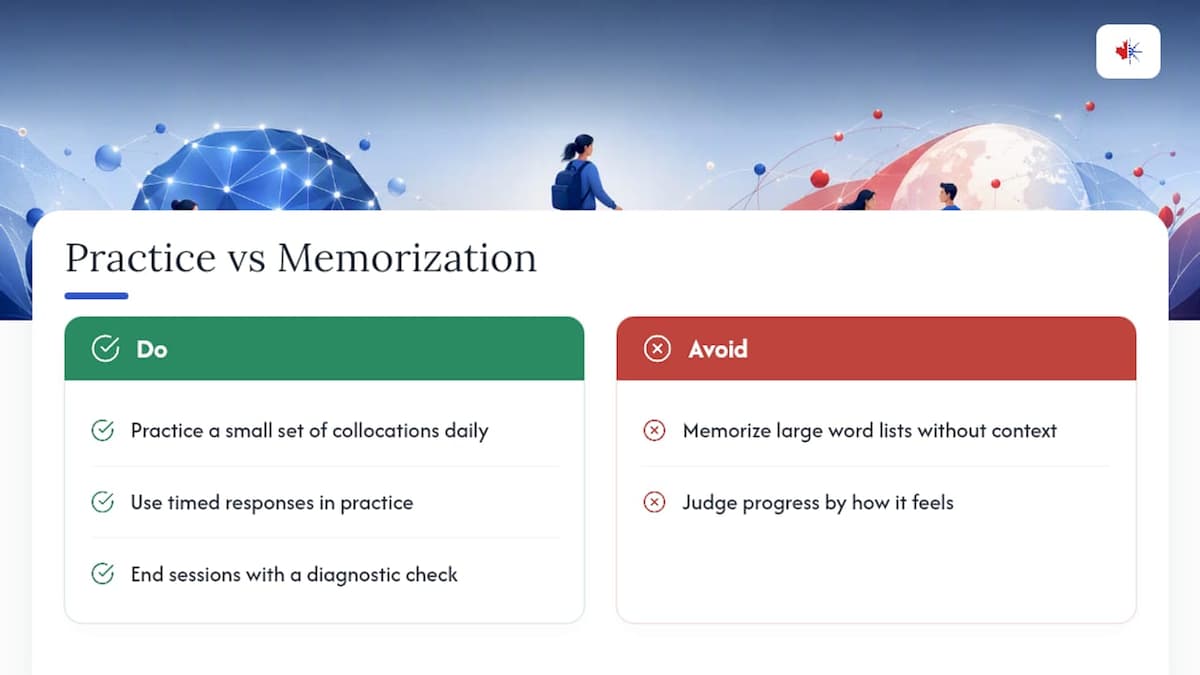
I’ve seen learners memorize five hundred “advanced” words and still plateau at CLB 7, because a long list without context doesn’t teach you when to use any of it. What actually moves the needle is a small, well-chosen set of collocations, practised daily inside timed responses, until they come out without a pause.
If you only build one habit from this article, make it this: end each practice session by checking your work against a diagnostic, not against a feeling. Measurable weak spots close faster than vague ones.
— Reza
Start with a diagnostic, then practise with a plan
You’ve seen the framework: precision over size, task-specific clusters, and a measurable 4-week plan. Turning that into results is faster with a system built for exactly this. A structured alternative to studying from scattered word lists and YouTube tips ties a readiness diagnostic directly to targeted vocabulary drills, instant feedback, and full-length mock exams, so you always know which collocations to fix next instead of guessing.
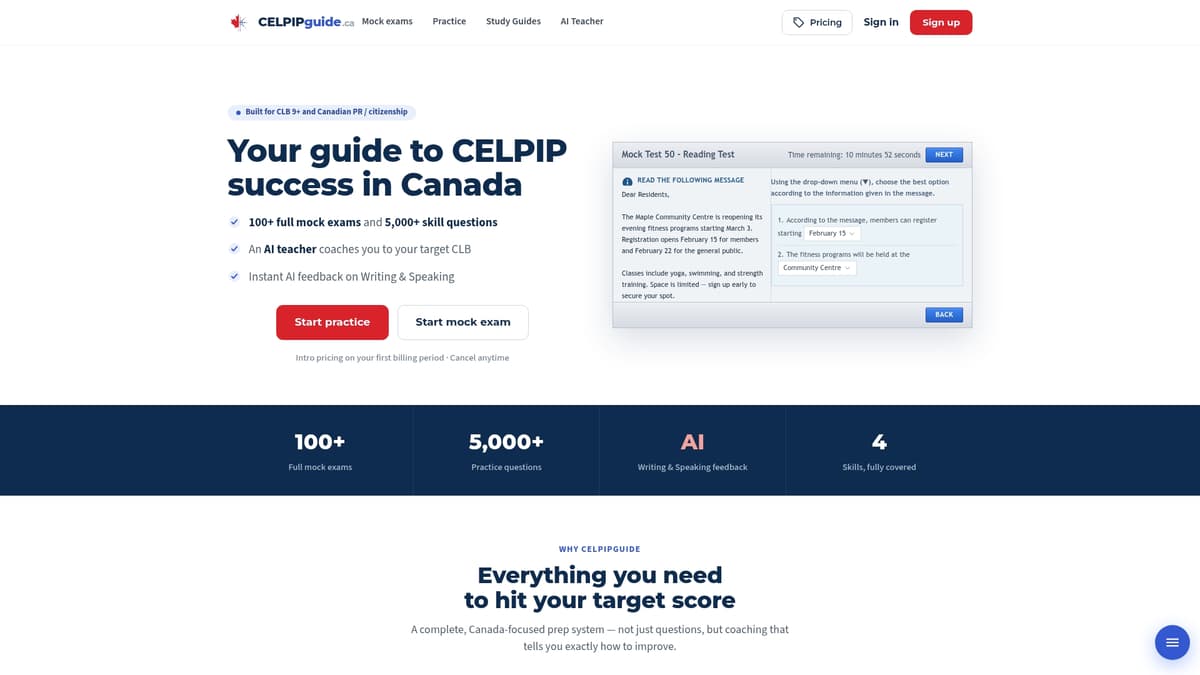
Start with the CELPIP Readiness Check to find your weakest vocabulary skill in minutes, then let the study plan generator build your 4-week schedule automatically. When you’re ready to test under real conditions, book a session on the full-length mock exams page.
Sources
- Immigration, Refugees and Citizenship Canada
- CELPIP CLB Scoring Decoded: What 9, 10, and 11 Actually Require | FlexiLingo
FAQ
What CLB level do most CELPIP vocabulary strategies target?
Most focused vocabulary strategies target CLB 9, since IRCC’s Canadian Language Benchmarks make CLB 9 the common threshold for maximizing Express Entry language points.
How is CLB 9 vocabulary different from CLB 7?
CLB 7 allows occasional word-choice slips without blocking meaning, while CLB 9 requires a wider vocabulary range, accurate collocations, and language that sounds relatively natural, according to FlexiLingo’s CLB scoring breakdown.
Should I memorize long vocabulary lists for CELPIP?
No. Thematic grouping, collocations, and contextualized practice build active vocabulary faster than rote memorization, per pedagogical guidance for CELPIP prep.
How long does it take to raise vocabulary scores?
A focused 4-week plan with daily, measurable drills can produce noticeable gains in collocation accuracy and simulated CLB estimates, especially when paired with a diagnostic-driven study plan.
Can CELPIPguide help me identify weak vocabulary areas?
Yes. The CELPIP Readiness Check diagnoses weak skills first, then routes you to targeted vocabulary practice and AI feedback through the platform’s tracker and mock exams.