
CELPIP Blog
Why vocabulary matters for your CLB performance
Why vocabulary matters for your CLB performance

TL;DR:
- Vocabulary is the strongest predictor of CLB success across all four language skills, accounting for at least 50% of the variance in test scores. Improving active, precise vocabulary tailored to CLB levels significantly boosts comprehension, speaking, and writing performance, especially at higher bands. Systematic instruction, active processing, and real-context practice can efficiently close vocabulary gaps and enhance overall language proficiency.
Vocabulary is the single strongest predictor of CLB success across all four language skills. Research confirms that vocabulary knowledge accounts for at least 50% of the variance in learners’ listening and reading test scores. That is not a minor factor. It is the foundation everything else sits on.
If you are preparing for the CELPIP exam and aiming for CLB 9 or higher, vocabulary is where your time pays off most. Here is what the evidence tells us:
- Vocabulary breadth directly predicts how well you comprehend spoken and written English on CLB assessments.
- Active vocabulary use, not just recognition, drives your speaking and writing scores.
- Vocabulary functions as a catalyst for grammar understanding, not the other way around.
- CLB 9 to 11 improvements depend heavily on vocabulary precision and naturalness, not grammar drills alone.
- Receptive vocabulary (what you understand) and productive vocabulary (what you can use) affect CLB competencies differently.
How vocabulary shapes language development and CLB testing
Vocabulary is not just one component of language. It is the driver of the whole system. Vocabulary knowledge enables students to access discourse and clarify grammar, serving as a catalyst for overall language development. Put simply, when you know more words, grammar starts to make sense faster.
Receptive vs. productive vocabulary
There is a real gap between the two, and it matters for your CLB score. Receptive vocabulary is what you understand when you read or listen. Productive vocabulary is what you can actually use when you speak or write. Research shows that productive vocabulary size often limits writing and speaking scores even when receptive vocabulary is larger. You might understand a passage perfectly but still struggle to express your ideas with precision. That gap is exactly what CLB assessors see.
How vocabulary breadth affects each skill
- Listening and reading: Wider vocabulary directly improves comprehension. The CLB framework at the advanced stage (CLB 9–12) requires learners to handle abstract, technical, and nuanced language across a wide range of contexts.
- Speaking: At CLB 9, assessors expect a range of vocabulary including less common words. By CLB 10, idiomatic and advanced choices must appear naturally, not forced.
- Writing: Vocabulary range and register are scored explicitly. At CLB 9, choices like “crucial” or “endorsed” signal readiness. At CLB 10, advanced collocations appear naturally throughout.
The passive exposure myth
Many learners assume that reading widely is enough to build vocabulary. It is not. Research estimates that a typical learner retains fewer than one word per 1,000 words read without deliberate study. Incidental learning alone simply cannot build the productive vocabulary CLB assessors are looking for.
Deep word knowledge
Knowing a word fully means knowing its form, meaning, behaviour, and use, including phonological, morphological, and syntactic dimensions. A learner who knows “recover” only as a basic verb will not naturally produce “cognitive recovery” in a CLB 11 writing task. That depth is what separates bands.
Effective strategies to build vocabulary and improve your CLB score
The good news is that vocabulary can be taught and learned systematically. You do not need to wait years for it to accumulate. Here is what actually works.
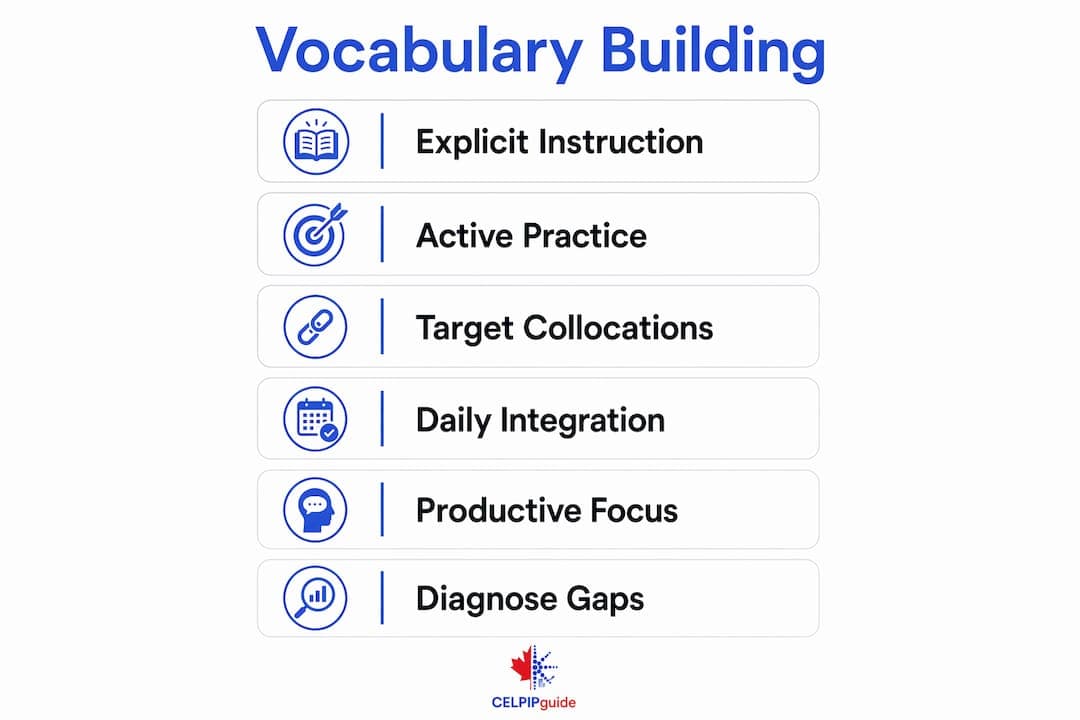
1. Prioritise explicit, systematic instruction
Explicit vocabulary instruction yields faster gains than passive exposure. Learners who study words deliberately, with attention to meaning, context, and use, retain and apply them far better than those who rely on reading alone. Systematic study means targeting high-frequency word families first, then moving into academic and professional vocabulary relevant to CLB tasks.

2. Practise active processing
Active processing means manipulating words, not just reading them. Try these techniques:
- Write your own sentences using a new word in two different contexts.
- Identify collocations: what words naturally appear beside it? (“make a decision” not “do a decision”)
- Replace a word with three synonyms and notice the register shift.
- Use the word in a speaking response and record yourself.
This kind of active vocabulary processing builds the flexible knowledge that CLB assessors reward.
3. Target collocations and idiomatic usage
Moving from CLB 9 to CLB 10 is largely about naturalness. At CLB 10, vocabulary “feels chosen, not displayed.” Collocations like “raise concerns,” “draw a conclusion,” or “on the heels of” signal fluency. Study them in clusters, not in isolation. Resources like the Celpipguide vocabulary builder are designed specifically for this.
4. Integrate vocabulary into daily Canadian English practice
Read Canadian news sources, listen to CBC Radio, and notice how vocabulary is used in real contexts. When you encounter an unfamiliar word, do not skip it. Look it up, write it down, and use it within 24 hours. Connecting new words to Canadian cultural and professional contexts makes them stick faster and prepares you for the real-world tasks CLB assessments simulate.
5. Focus on productive vocabulary for speaking and writing
For productive skills, research suggests coverage of a broad range of word families is necessary for strong speaking and writing performance. Build toward that by studying word families together: “analyse,” “analysis,” “analytical,” “analytically.” One family gives you four usable forms.
6. Diagnose your weakest vocabulary dimension
After each practice test, identify whether your vocabulary gaps are in range, register, or collocations. A learner with wide range but poor register (using casual words in a formal writing task) will lose points even with a large vocabulary. Targeted diagnosis beats general study every time.
Pro Tip: If you are already at CLB 9 grammar level, more grammar drills produce diminishing returns. Shift your preparation to vocabulary range, collocations, and tone calibration. These move CLB bands faster. You can explore CLB 9+ speaking and writing strategies to see exactly what assessors look for.
How Celpipguide supports your vocabulary development
Celpipguide was built specifically for CELPIP candidates aiming for high CLB scores in Canadian immigration and academic contexts. The platform combines research-backed pedagogy with AI-driven personalisation so you are not just studying harder. You are studying the right things.
Here is what Celpipguide offers to build your vocabulary and lift your CLB performance:
- AI teacher with personalised study plans: The AI analyses your diagnostic test results and identifies your weakest vocabulary dimensions, then builds a study plan around them. If your writing vocabulary is strong but your speaking register is off, the plan reflects that.
- Vocabulary builder: Celpipguide’s vocabulary tracker targets exam-relevant words aligned with CLB levels and CEFR standards. You learn words in context, with collocations and usage examples, not just definitions.
- Over 100 full mock exams: Practice at scale matters. With more than 5,000 practice questions, you encounter vocabulary repeatedly across varied contexts, which is exactly what research shows accelerates retention.
- Instant feedback on writing and speaking: The AI flags vocabulary issues in your responses, including weak word choice, register mismatches, and missing collocations. You see the gap immediately and can correct it.
- CLB-aligned assessment: Every task maps to specific CLB benchmarks, so you always know which band your vocabulary use is hitting and what it would take to move up.
Pro Tip: Use Celpipguide’s diagnostic test first. It tells you exactly where your vocabulary is holding you back before you spend a single hour studying. Then let the AI plan guide your sessions. That is the fastest route to a higher CLB score.
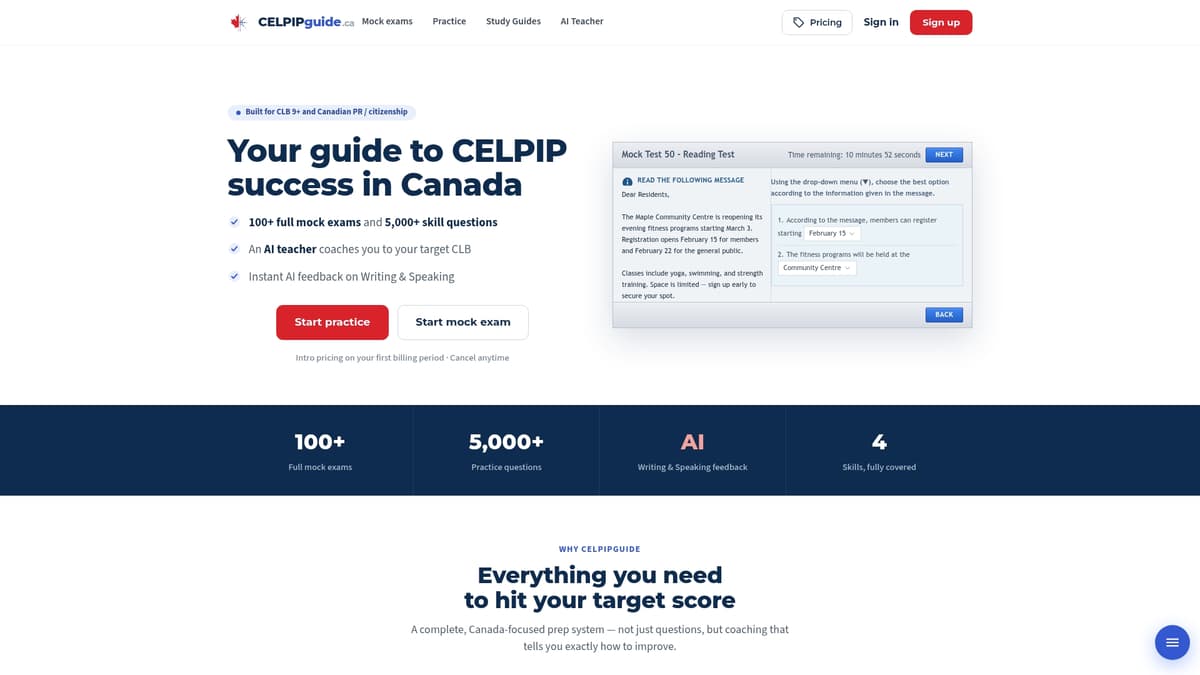
Ready to close the vocabulary gap? Celpipguide’s CELPIP practice tests are aligned to CLB levels and designed to build the vocabulary precision that moves your score. Start your diagnostic today and find out exactly where to focus.
Key takeaways
Vocabulary is the most powerful lever you have for improving your CLB score, and systematic study beats passive exposure every time.
| Point | Details |
|---|---|
| Vocabulary predicts comprehension | Vocabulary accounts for at least 50% of variance in listening and reading CLB test scores. |
| Productive vocabulary drives scores | The gap between receptive and productive vocabulary directly limits speaking and writing CLB bands. |
| Active processing beats passive reading | Manipulating words through collocations, synonyms, and contextual use builds retention far faster than reading alone. |
| CLB 9 to 11 requires vocabulary precision | Advanced collocations and natural idiomatic usage are the key differentiators at the top CLB bands. |
| Celpipguide targets your specific gaps | The AI teacher, vocabulary builder, and mock exams work together to address your weakest vocabulary dimensions. |
FAQ
How much does vocabulary affect CLB listening and reading scores?
Vocabulary knowledge accounts for at least 50% of the variance in learners’ listening and reading test scores, making it the single strongest predictor of CLB comprehension performance.
What is the difference between receptive and productive vocabulary for CLB?
Receptive vocabulary is what you understand when reading or listening; productive vocabulary is what you actively use in speaking and writing. CLB speaking and writing scores depend heavily on productive vocabulary, which is typically smaller than receptive vocabulary.
Why is passive reading not enough to build CLB vocabulary?
Research shows that learners retain fewer than one word per 1,000 words read without deliberate study. Explicit, systematic instruction is demonstrably more effective than incidental learning, especially for the productive vocabulary CLB assessors evaluate.
What vocabulary level do I need for CLB 9 speaking and writing?
At CLB 9, assessors expect a range of vocabulary including less common words and some advanced choices. By CLB 10, advanced collocations and idiomatic expressions must appear naturally throughout your responses.
How does Celpipguide help with vocabulary for CLB preparation?
Celpipguide’s AI teacher builds a personalised study plan based on your diagnostic results, while the vocabulary builder and over 100 mock exams provide repeated exposure to CLB-aligned words in varied contexts, accelerating both retention and productive use.