
CELPIP Blog
Role of vocabulary builder in test prep: 2026 guide
Role of vocabulary builder in test prep: 2026 guide

TL;DR:
- A vocabulary builder improves test performance by developing precise, functional words that reduce processing time during exams.
- It is most effective when introduced after mastering reading and grammar, focusing on high-utility transition and structural words through active, spaced repetition techniques.
A vocabulary builder is a structured study tool that teaches test-relevant words through spaced repetition, contextual sentences, and active recall. The role of vocabulary builder test prep is not to memorise rare words. It is to build a precise, functional vocabulary that reduces processing friction during timed exams. For CELPIP test takers, this distinction matters enormously. Vocabulary affects every section of the exam: reading comprehension, writing coherence, speaking fluency, and listening accuracy. The good news is that vocabulary is one of the most trainable skills in language proficiency, and the right method produces measurable gains faster than most test takers expect.
How does a vocabulary builder improve test performance?
Vocabulary is a hidden lever in test performance. When you know a word instantly, your brain does not pause to decode it. That saved processing time adds up across an entire reading passage or listening task. The result is faster comprehension, fewer careless errors, and more mental energy left for analysis and writing.

The specific vocabulary categories that matter most are not obscure literary terms. Structural and transition words account for roughly 50% of reading comprehension test questions. Words like “nevertheless,” “consequently,” and “in contrast” signal argument structure. Knowing them instantly changes how quickly you understand a passage’s logic.
Here is what a vocabulary builder does for each test section:
- Reading: You decode passages faster and spend more time on inference questions.
- Writing: You choose precise words that match the register expected by CELPIP rubrics, which directly affects your CLB score.
- Speaking: You avoid filler words and hesitations by having the right word ready when you need it.
- Listening: You catch meaning in fast speech because familiar words require less active processing.
Pro Tip: Focus your first vocabulary sessions on transition and relationship words. They appear constantly across all four CELPIP sections and give you the highest return per hour of study.
The cognitive science behind this is called depth of processing. Encountering words in memorable contexts is far more effective than rote repetition. A vocabulary builder that shows you a word in a sentence, then asks you to recall it later, builds the kind of deep memory that holds under exam pressure.
What are the most effective vocabulary improvement strategies?
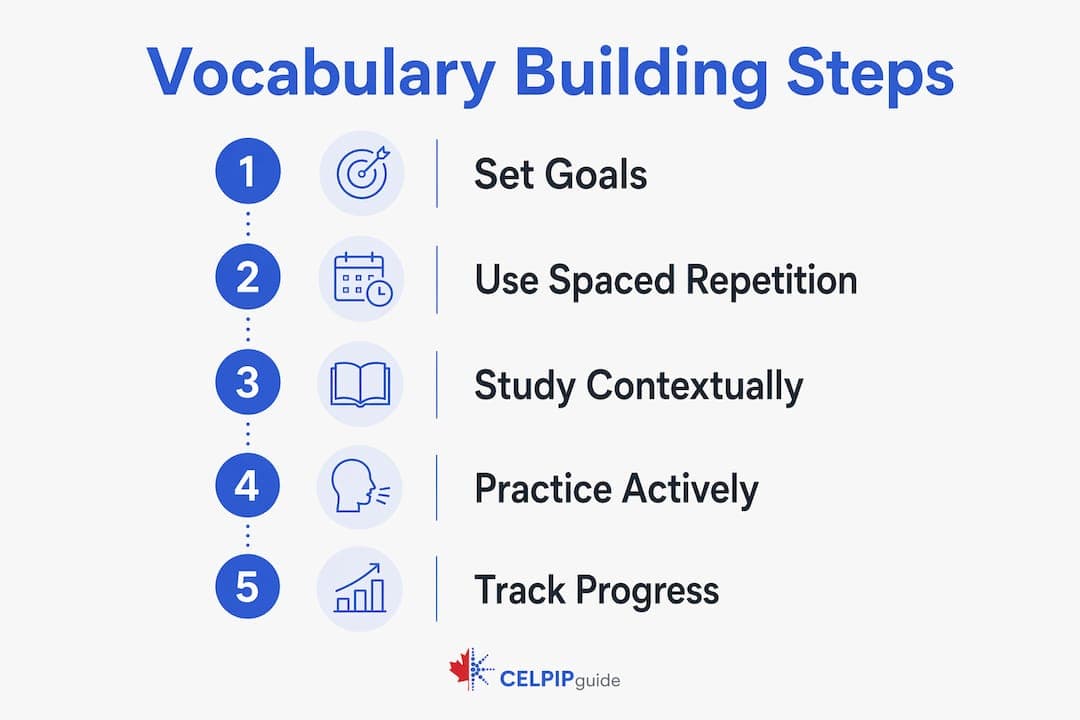
The best vocabulary improvement strategies share one feature: they force your brain to work actively with new words, not just recognise them passively. Here are the methods with the strongest research support.
-
Spaced repetition. Review new words at increasing intervals: one day later, then three days, then a week. Spaced repetition apps show strong scientific support for vocabulary retention. Apps that gamify words without spaced repetition produce weaker results. The spacing effect forces retrieval, which strengthens memory each time.
-
Contextual learning over word lists. Learners who encounter new words through audio stories or natural conversation retain them 3 to 5 times longer than those who memorise isolated lists. Context gives the word meaning, sound, and association. All three make it stick.
-
Sentence mining. When you find a new word, record the full sentence, not just the definition. Sentence mining preserves collocation and meaning shifts that a dictionary definition cannot capture. For example, “raise” means something different in “raise a concern” than in “raise a child.” The sentence shows you which meaning applies.
-
Active recall. Cover the definition and try to produce it from memory. Active retrieval and producing vocabulary in speech or writing significantly improves retention over passive rereading. After you recall a word, use it in a sentence you write yourself.
-
Active output within 24–48 hours. Using a new word within 24–48 hours of learning it moves it from recognition to productive use. Write a sentence with it. Say it aloud in a practice speaking response. This step is what most test takers skip, and it is why their vocabulary stays passive.
Pro Tip: Set a daily target of 10–15 new words with multiple exposures each. Research shows that words need 10–15 exposures in varied contexts before they persist reliably in long-term memory. Fewer words studied deeply beats more words studied shallowly every time.
The Celpipguide vocabulary tracker is built around these exact principles. It tracks your exposures, flags words due for review, and surfaces them in exam-relevant sentences.
When should you add vocabulary building to your study plan?
Timing matters as much as method. Adding intensive vocabulary study too early can distract you from foundational skills that carry more weight at lower CLB levels.
The recommended sequence looks like this:
- Weeks 1–3: Focus on reading and grammar foundations. Understand how CELPIP passages are structured. Build comfort with question types.
- Weeks 4–6: Introduce vocabulary building at 10–15 words per day. Use the CELPIP vocabulary tracker to set daily targets and monitor progress.
- Weeks 7 onwards: Integrate vocabulary with timed exam simulation. Apply new words in practice writing and speaking tasks.
Experts advise delaying extensive vocabulary study until foundational reading and grammar skills are in place. Vocabulary then acts as a score polisher, lifting you from a CLB 8 to a CLB 9, or from a CLB 9 to a CLB 10.
Practical tips for balancing vocabulary with the rest of your prep:
- Keep vocabulary sessions to 20–30 minutes daily. Longer sessions produce diminishing returns and mental fatigue.
- Do vocabulary review in the morning when recall is sharpest, and save full practice tests for afternoons.
- After each CELPIP practice test, pull out words you did not know and add them to your tracker immediately.
- Never study new vocabulary the day before your exam. Use that day for light review of familiar words only.
Good time management across CELPIP sections depends partly on vocabulary fluency. When you know words automatically, you spend less time on decoding and more time on the higher-order tasks that earn top CLB scores.
Which vocabulary building method works best?
No single method wins for every learner or every situation. The most effective approach combines two or three methods based on your schedule and learning style.
App-based spaced repetition is the most efficient method for building recognition speed. Apps schedule reviews automatically, which removes the guesswork from spacing. The weakness is that apps can become passive if you tap through cards without genuinely retrieving the answer. Always cover the answer and attempt recall before revealing it.
Physical flashcards give you more control over the review process and work well for learners who retain information better through handwriting. The limitation is that manual scheduling is less precise than an algorithm. You tend to review cards you already know and avoid the ones you find difficult.
Immersive learning through audio stories, podcasts, and reading while listening is the most powerful method for moving vocabulary from recognition to natural use. Combining reading and listening on the same topics accelerates acquisition and durability. This method works best during commutes or low-focus time when you cannot sit at a desk.
| Method | Best for | Limitation |
|---|---|---|
| App-based spaced repetition | Recognition speed, daily consistency | Can become passive without active recall effort |
| Physical flashcards | Learners who retain through writing | Manual scheduling is less precise |
| Immersive learning | Natural use, register, and fluency | Slower for building specific test vocabulary |
| Sentence mining | Nuance, collocation, and register | Time-intensive to set up |
Pro Tip: Use an app for daily spaced repetition, sentence mining for new words from practice tests, and audio content during commutes. These three methods cover recognition, depth, and fluency without requiring extra study hours.
High-frequency words combined with short example sentences and spaced repetition produce the fastest vocabulary gains. Start with the words that appear most often in CELPIP reading passages, then expand outward.
Key takeaways
A vocabulary builder works best when it combines spaced repetition, contextual sentences, and active output, targeted at high-utility structural words, and integrated into your study plan after foundational reading and grammar skills are in place.
| Point | Details |
|---|---|
| Target structural vocabulary first | Transition and relationship words account for roughly 50% of reading comprehension questions. |
| Use spaced repetition consistently | Apps with spaced repetition outperform passive review; aim for 10–15 words with multiple daily exposures. |
| Add vocabulary after foundations | Introduce intensive vocabulary study once reading and grammar basics are solid, typically weeks 4–6. |
| Apply new words within 48 hours | Using a word in writing or speech within 24–48 hours moves it from passive recognition to active use. |
| Combine methods for best results | Pair app-based repetition with sentence mining and immersive audio for recognition, depth, and fluency. |
Vocabulary builders work, but most people use them wrong
I have spoken with hundreds of CELPIP test takers over the years, and the pattern is almost always the same. They open a vocabulary app, study 50 words in one sitting, and wonder why none of them show up when they need them in a speaking task. The problem is not the tool. The problem is the approach.
Breadth is not the goal. Strategic depth is. I would rather you know 200 words so well that you can use them confidently in writing and speaking than have a passive recognition of 1,000 words you cannot produce under pressure. The CELPIP rubric rewards precise, appropriate word choice. It does not reward volume.
The other mistake I see constantly is treating vocabulary as a separate subject. Vocabulary is not a subject. It is a multiplier. When your vocabulary is strong, your reading speed increases, your writing becomes more precise, and your speaking flows more naturally. Every hour you invest in vocabulary pays dividends across all four test sections. That is the real role of vocabulary builder test prep: not to add one more thing to your study list, but to make everything else on that list work better.
Start with the words that appear in your practice tests. Mine them for sentences. Review them with spaced repetition. Use them in your writing tasks the same week. That cycle, repeated consistently, is what separates test takers who plateau from those who keep climbing.
— Reza
How Celpipguide supports your vocabulary preparation
Celpipguide is built specifically for CELPIP test takers who want to improve their CLB scores through structured, targeted practice.
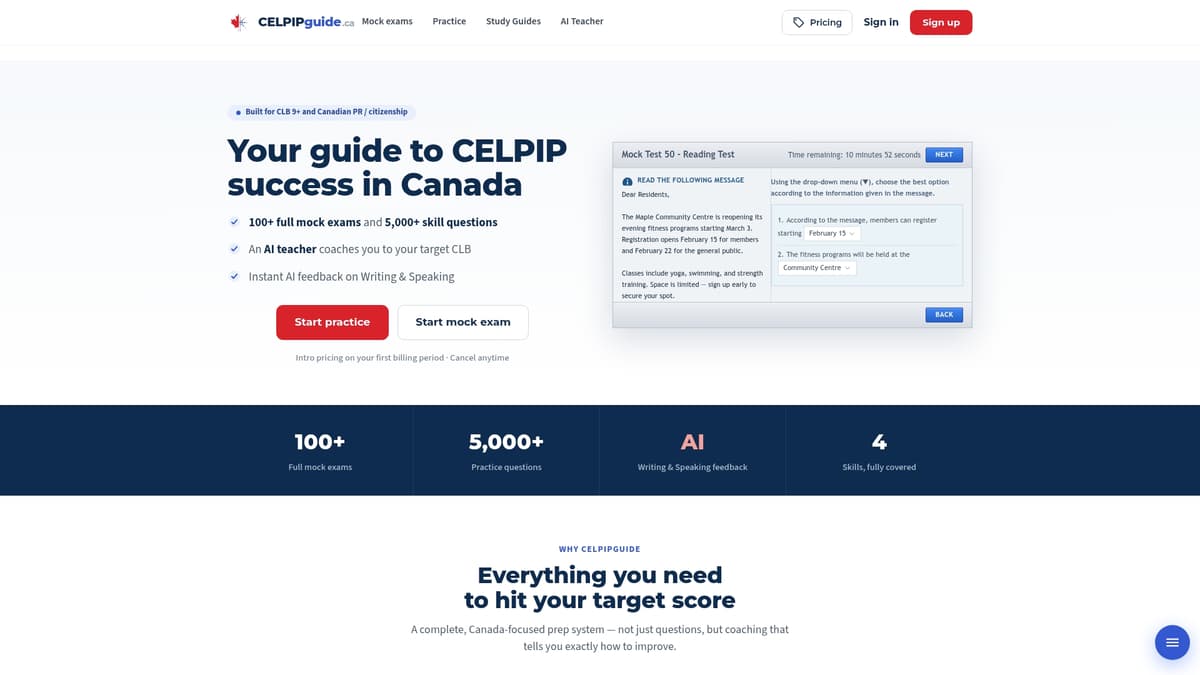
The CELPIP exam preparation hub brings together vocabulary tools, full mock exams, and skill-specific practice tasks in one place. The built-in vocabulary tracker applies spaced repetition to CELPIP-relevant words and tracks your exposure count so you know exactly which words are ready for active use. Pair it with the full-length mock exams to practise applying your vocabulary under real timed conditions. Celpipguide’s AI teacher reviews your writing and speaking responses and flags vocabulary gaps directly, so your study time targets the words that will actually move your score.
FAQ
What is the role of a vocabulary builder in test prep?
A vocabulary builder develops precise, functional vocabulary through spaced repetition and contextual learning, reducing processing friction during timed exams and improving performance across reading, writing, speaking, and listening sections.
How many new words should I study per day for CELPIP?
A daily target of 10–15 new words with multiple exposures in varied contexts is the recommended range for reliable long-term retention without cognitive overload.
Is spaced repetition better than traditional flashcards?
App-based spaced repetition uses algorithms to schedule reviews at optimal intervals, producing stronger retention than manually managed flashcards. The key is to practise active recall rather than passively reading through cards.
When should I start vocabulary building in my CELPIP prep?
Build foundational reading and grammar skills first, then introduce intensive vocabulary study around weeks 4–6 of your preparation. Vocabulary works best as a score polisher once core skills are in place.
Does vocabulary affect the CELPIP speaking and writing sections?
Vocabulary directly affects both sections. Precise word choice improves your CLB score on writing rubrics, and a strong active vocabulary reduces hesitation and filler words in speaking responses.