
CELPIP Blog
CLB 7 skills checklist for students: 2026 guide
CLB 7 skills checklist for students: 2026 guide

TL;DR:
- Achieving CLB 7 in all four skills is essential for Canadian immigration eligibility. Going beyond CLB 7, especially to CLB 9, boosts your CRS score and competitiveness. Using a structured checklist for self-assessment helps identify and improve specific language weaknesses.
The CLB 7 skills checklist students need is a skill-by-skill evaluation tool that matches official Canadian Language Benchmark criteria across listening, speaking, reading, and writing. CLB 7 is the minimum English proficiency level required for major Canadian immigration programs, including the Federal Skilled Worker Program and the Canadian Experience Class. Every skill must meet the threshold independently. This guide breaks that requirement into a clear, measurable checklist so you can assess exactly where you stand and what to fix before test day.
1. What are the official CLB 7 benchmarks?
CLB 7 defines the point at which a test-taker can function independently in English across all four language skills. The Immigration, Refugees and Citizenship Canada (IRCC) sets this as the minimum for key federal immigration streams.

The score equivalencies differ by test. For IELTS General Training, CLB 7 requires a 6.0 in each skill. For CELPIP-General, a score of 7 in each skill equals CLB 7 directly. The CELPIP to CLB mapping is a clean 1-to-1 ratio, which removes the conversion errors that sometimes trip up IELTS applicants.
| Skill | IELTS General Training | CELPIP-General |
|---|---|---|
| Listening | 6.0 | 7 |
| Reading | 6.0 | 7 |
| Writing | 6.0 | 7 |
| Speaking | 6.0 | 7 |
One critical rule: all four skills must pass independently. Scoring CLB 8 in three skills but CLB 6 in one means you do not qualify. There is no averaging. This is the rule that catches the most students off guard.
2. How to use a CLB 7 skills checklist to self-assess
Structured assessment using specific criteria is more effective than vague proficiency goals. A checklist converts the broad idea of “being good at English” into discrete, trackable targets for each skill.
Start by running a diagnostic test under real exam conditions. Score yourself on each skill separately. Then log those scores in a simple table with the date. This gives you a baseline and shows you exactly which skill needs the most attention.
Use this process consistently:
- Take a timed practice test for each skill at least twice a week.
- Log your score per skill after every session.
- Identify your lowest-scoring skill and allocate extra study time there.
- Review your errors by category (vocabulary, grammar, task completion).
- Repeat the diagnostic every two weeks to track progress.
Pro Tip: Do not wait until you feel “ready” to take a full practice test. Take one on day one. Your first score is your most honest baseline, and it tells you exactly where to focus.
Consistency matters more than intensity. Thirty focused minutes daily beats a four-hour cramming session once a week. Use official practice materials aligned to the actual exam format so your scores reflect real test conditions.
3. What are the essential components of a CLB 7 language proficiency checklist?
A solid language proficiency checklist breaks each skill into specific, verifiable behaviours. Here is what CLB 7 looks like in practice for each area.
Listening
- Understand the main idea of a conversation at moderate speed.
- Identify specific details, instructions, and opinions in audio clips.
- Follow multistep directions without needing repetition.
- Distinguish between factual information and the speaker’s attitude.
Speaking
- Respond to prompts with clear, complete answers.
- Use varied vocabulary without long pauses or filler words.
- Maintain grammatical accuracy in sentences of moderate complexity.
- Stay on topic and complete the task within the time limit.
Reading
- Identify the main idea and supporting details in moderately complex texts.
- Use skimming and scanning to locate specific information quickly.
- Understand vocabulary in context without needing a dictionary.
- Recognise the writer’s purpose and tone.
Writing
- Write clear, grammatically correct sentences and paragraphs.
- Organise ideas logically with an introduction, body, and conclusion.
- Respond fully to the prompt without going off topic.
- Use appropriate vocabulary and sentence variety.
Work through each item and mark it honestly. If you cannot do something consistently under timed conditions, it is not yet mastered. That gap is your study target.
4. How does meeting CLB 7 improve your immigration and education chances?
CLB 7 is the minimum threshold for the Federal Skilled Worker Program and the Canadian Experience Class for TEER 0 and TEER 1 occupations. Meeting it opens the door. Exceeding it builds your competitive edge.
The Comprehensive Ranking System (CRS) rewards higher CLB scores directly. Each skill at CLB 7 earns 17 CRS points, totalling 68 points across all four skills. Reaching CLB 9 earns 31 points per skill, for a total of 124 points. That 56-point gap is significant in Express Entry draws, where a few points can separate an Invitation to Apply from a missed round.
Treating CLB 7 as a finish line is one of the most common and costly mistakes students make. It qualifies you, but it rarely makes you competitive. The students who receive Invitations to Apply are usually scoring at CLB 9 or higher. Aim for CLB 7 as your floor, not your ceiling.
Meeting CLB 7 also unlocks access to Post-Graduation Work Permits and several provincial nominee streams. For students in Canadian colleges and universities, it confirms the language proficiency level that many academic programmes require for admission or continued enrolment.
Watch out for these common pitfalls:
- Relying on an average score across skills instead of checking each skill independently.
- Submitting a test result that has expired after two years, which requires a full retest.
- Stopping preparation once you hit CLB 7 instead of pushing toward CLB 9.
- Underestimating the writing or speaking components because they feel more subjective.
Check the CLB scores and CRS points breakdown to understand exactly how your score translates into immigration profile strength.
5. What are the best preparation practices for the CLB 7 student skill evaluation?
Effective preparation requires using specific test formats, practising all four skills daily, and working under timed conditions. Generic English study does not prepare you for the exam format. You need to practise the actual task types.
Here are the preparation practices that produce results:
- Simulate test day conditions every time you practise. Use the same timing, no pauses, and no looking up words.
- Focus extra time on your weakest skill, but do not neglect the others. All four must pass.
- Record your speaking responses and listen back critically. Most students are surprised by what they actually sound like.
- Review your writing samples against the CLB 7 rubric criteria, not just your own sense of quality.
- Use full-length mock exams at least once a week to build stamina and pacing.
Pro Tip: Poor time management is one of the top reasons students lose points on speaking and writing. Practice ending your responses on time, not just starting them well.
Avoid the common mistakes students make like leaving speaking tasks incomplete or writing off-topic responses under pressure. These errors are preventable with deliberate, structured practice.
Pro Tip: Study with a partner or a small group at least once a week. Hearing how others approach the same task reveals gaps in your own responses that solo practice misses.
Key takeaways
Meeting CLB 7 in all four skills independently is the non-negotiable minimum for Canadian immigration eligibility, and aiming for CLB 9 is the most effective way to stay competitive.
| Point | Details |
|---|---|
| All four skills must pass independently | One skill below CLB 7 disqualifies your application, regardless of other scores. |
| CELPIP maps 1-to-1 to CLB levels | A CELPIP score of 7 in any skill equals CLB 7 with no conversion needed. |
| CLB 9 adds 56 CRS points over CLB 7 | Higher scores significantly increase your chances of receiving an Invitation to Apply. |
| Test scores expire after two years | Track your result expiry date and plan retesting before submitting an immigration application. |
| Structured checklists improve results | Breaking proficiency into discrete skill targets produces more measurable and consistent progress. |
Why the CLB 7 checklist changed how I think about exam prep
I have worked with many students who came to their first practice test convinced they were “almost ready.” They had been studying English for years. They spoke confidently. And then their writing score came back at CLB 5, or their listening score sat at CLB 6, and the whole picture shifted.
That is the real value of a skills checklist. It replaces a vague feeling of readiness with actual evidence. When you can tick off every item in the listening section under timed conditions, you know you are ready. When you cannot, you know exactly what to fix. There is no guessing.
What I have seen work consistently is treating each skill as a separate exam. Students who practise listening separately from reading, and speaking separately from writing, build stronger individual skills than those who do general English study. The checklist forces that separation.
The mental side matters too. Students who track their progress with a checklist feel less anxious on test day because they have proof of their preparation. That confidence is not arrogance. It is earned. Build it deliberately, one skill at a time, and CLB 7 becomes a realistic and achievable target rather than an intimidating standard.
— Reza
How Celpipguide supports your CLB 7 preparation
Celpipguide is built specifically for students targeting CLB 7 and beyond on the CELPIP exam.
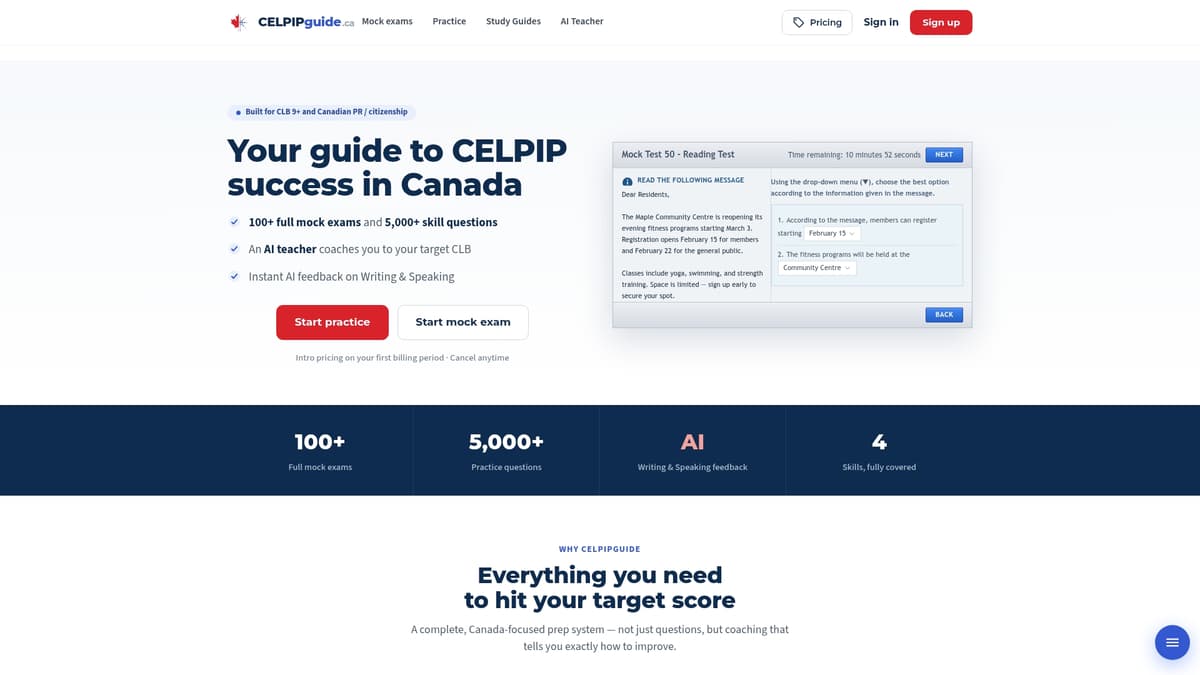
The platform offers over 100 full-length mock exams and 5,000 practice questions, all aligned to the same skill categories in this checklist. An AI teacher reviews your writing and speaking responses and delivers instant feedback, so you know exactly where you lost points and why. The CELPIP practice exam hub organises practice by skill, making it straightforward to target your weakest area first. Whether you need full-length mock test practice or focused skill-specific tasks, Celpipguide gives you the structured, measurable practice that the CLB 7 standard demands.
FAQ
What is CLB 7 and why does it matter for immigration?
CLB 7 is the minimum English proficiency level required for the Federal Skilled Worker Program and the Canadian Experience Class. Every skill, listening, reading, writing, and speaking, must independently meet this threshold.
Can I average my CLB scores to meet the CLB 7 requirement?
No. IRCC requires each skill to meet CLB 7 independently. A CLB 6 in one skill disqualifies your application even if your other three skills are at CLB 9.
Which test is easiest to use for hitting CLB 7?
CELPIP-General maps directly to CLB levels at a 1-to-1 ratio, so a score of 7 in any skill equals CLB 7 without any conversion calculation. This reduces the risk of conversion errors compared to IELTS.
How long are CLB test scores valid for immigration?
Language test scores are valid for two years from the test date. Submitting an expired score requires a full retest, so track your expiry date carefully as part of your preparation plan.
Is CLB 7 enough to be competitive in Express Entry?
CLB 7 meets the eligibility minimum but rarely produces a competitive CRS score. Each skill at CLB 9 earns 31 CRS points versus 17 at CLB 7, a difference of 56 total points that significantly increases your chances of receiving an Invitation to Apply.