
CELPIP Blog
Build academic vocabulary for CELPIP: fast, task-driven methods
Build academic vocabulary for CELPIP: fast, task-driven methods

TL;DR:
- Building academic vocabulary for CELPIP requires a context-based, active usage routine involving daily reading, themed word banks, and timed practice. Consistent application of this method yields faster score improvements than memorizing word lists alone.
The fastest way to build academic vocabulary for CELPIP is a context-first, active-usage routine: read Canadian sources daily, organise words into themed banks with collocations, review them through spaced repetition, and practise every new word inside a real CELPIP task format. That combination, done consistently, produces measurable score gains faster than any word-list memorisation approach.
Start here — your TL;DR:
- Weeks 1–2: You will notice fewer word repetitions in your writing drafts and a small but real improvement in your ability to recall topic-specific phrases during Speaking tasks.
- Weeks 3–5: Your Writing Task 2 responses will read as more precise and varied; Reading comprehension on dense passages improves as you recognise more academic verbs and connectors in context.
- Week 6+: Mock test scores begin to reflect the gains. Vocabulary range and precision, two of the dimensions raters assess, show consistent improvement when you combine spaced repetition practice with timed task drills.
Three things to do right now:
- Select three topic banks to study this week (community and society, work and education, environment and health are the highest-yield CELPIP themes).
- Open Anki or Quizlet and create your first five cards using the collocation-first format described in Section 4.
- Run one timed writing or speaking drill using a prompt from Celpipguide’s practice hub before you go to bed tonight.
Table of Contents
- Why does vocabulary affect your CELPIP score so much?
- Which word categories give you the biggest CELPIP gains?
- What study methods actually make vocabulary stick under test pressure?
- How do you practise vocabulary in actual CELPIP task formats?
- What vocabulary mistakes hurt CELPIP scores the most?
- What does a realistic 6-week vocabulary study plan look like?
- How do you know when your vocabulary is strong enough to book the CELPIP?
- Key takeaways
- One thing most guides get wrong about vocabulary prep
- Celpipguide gives you the feedback loop your vocabulary plan needs
- Useful sources and tools
- FAQ
Why does vocabulary affect your CELPIP score so much?
Vocabulary is not just one component of your CELPIP score. It runs through every skill. Raters assess your range (how many different words you use), your precision (whether you choose the right word for the context), your appropriacy (formal vs. conversational register), and your control (whether collocations sound natural). A response that repeats “good,” “bad,” and “important” signals a limited range, even if the grammar is perfect.
The tasks where vocabulary maps most directly to CLB levels are Writing Task 2 (opinion and persuasive essays), Speaking Tasks 3 and 4 (personal experience and opinion), and the higher-level Reading passages that use academic and professional register. In those tasks, a single well-chosen academic verb or connector can shift a response from CLB 7 to CLB 9 territory.
Vocabulary range and precision are what separate a CLB 6 response from a CLB 9+ response in Writing. A focused list of academic words and collocations significantly improves Writing Task 2 performance—not because examiners count words, but because precision and variety signal genuine language control.
The practical implication: you do not need to learn thousands of words. You need to learn the right words deeply, meaning with their collocations, register notes, and at least one example sentence each. That is the approach this guide is built around.

Which word categories give you the biggest CELPIP gains?
Contextual vocabulary learning outperforms rote list memorisation for CELPIP because the exam tests usage, not recognition. The categories below are ranked by how often they appear across CELPIP tasks and how much they lift your score when used correctly.
Transitions and connectors
These are the words that hold your argument together. Raters notice when they are absent and when they are overused.

| Connector type | Examples | Register |
|---|---|---|
| Addition | furthermore, in addition, moreover | Formal (writing) |
| Contrast | nevertheless, on the other hand, whereas | Formal |
| Cause/effect | consequently, as a result, therefore | Both |
| Concession | admittedly, granted that, while it is true that | Formal |
| Emphasis | above all, in particular, notably | Both |
CELPIP-style example: “While remote work offers flexibility, it can, nevertheless, erode team cohesion over time.”
Academic verbs and opinion/hedging phrases
These verbs signal that you can discuss ideas at a professional level. Pair each one with its natural object.
- Analyse, assess, evaluate, examine (use with: data, evidence, outcomes, implications)
- Implement, establish, address, propose (use with: a policy, a solution, an issue, a framework)
- Suggest, indicate, demonstrate, reveal (use with: that + clause)
- Tend to, appear to, seem to (hedging — essential for opinion tasks)
CELPIP-style example: “The data suggests that urban green spaces tend to reduce stress levels among residents.”
Workplace and community vocabulary
CELPIP prompts frequently involve workplace scenarios, community issues, and civic decisions. These collocations appear constantly:
- implement a policy, address a concern, meet a deadline, collaborate with colleagues, raise awareness, allocate resources
Cause/effect and comparison lexicon
- Cause/effect: contribute to, stem from, lead to, give rise to, result in
- Comparison: in contrast to, compared with, similarly, by the same token
Degree and emphasis words
Replace weak intensifiers (“very,” “really”) with: considerably, substantially, markedly, to a great extent, by a significant margin.
Pro Tip: Learn word families together, not in isolation. If you learn “assess,” also learn “assessment,” “assessable,” and “reassess.” One entry in your flashcard deck gives you four usable words.
For writing, prioritise transitions, academic verbs, and hedging phrases. For speaking, focus on opinion phrases and cause/effect connectors that you can deploy quickly. For reading, recognise degree words and academic verbs in dense passages so you can answer inference questions accurately.
What study methods actually make vocabulary stick under test pressure?
Knowing a word is not the same as being able to use it in 26 minutes during Writing Task 2. The gap between recognition and production is where most test-takers lose points. These four methods close that gap.
The core workflow
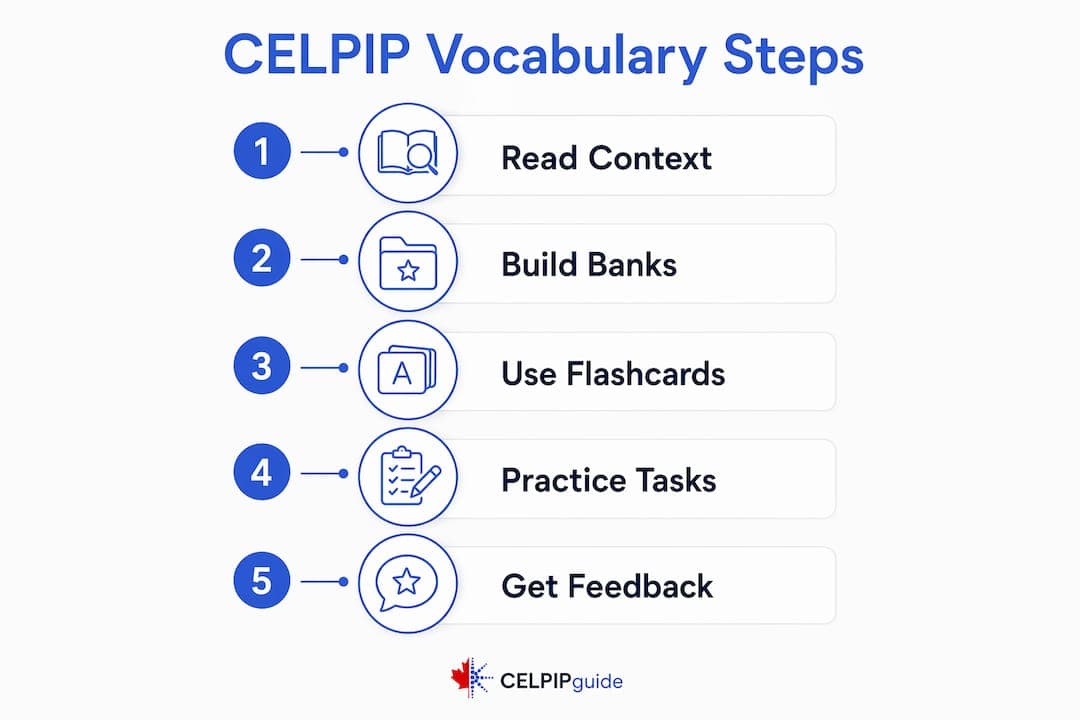
- Read contextually every day. Spend 20 minutes reading CBC or The Globe and Mail. When you encounter an unfamiliar word or a phrase that sounds distinctly professional, note it with its surrounding sentence, not just the definition.
- Build themed flashcards with collocations. In Anki or Quizlet, each card should have four fields: the word or phrase, its most common collocation, a short CELPIP-style example sentence, and a register note (formal/conversational). Isolated definitions are nearly useless for production.
- Run daily SRS sessions. Fifteen minutes per day in Anki or Quizlet, using active recall (answer before flipping), beats a two-hour cramming session once a week. Spaced repetition schedules reviews at the exact moment you are about to forget, which is what builds long-term retention.
- Do word-replacement drills. Write a short paragraph on a CELPIP topic using your natural vocabulary. Then go back and replace every weak or repeated word with a stronger, more precise alternative. Read the revised version aloud. If it sounds natural, the substitution works.
Four reproducible practice drills
- Word bank sentence creation. Choose five words from your themed bank. Write one original sentence for each, using the collocation you noted on the card. Time yourself: 60 seconds per sentence.
- Timed substitution drill. Take a paragraph from a past writing response. Highlight every instance of “good,” “bad,” “important,” “big,” and “get.” Replace each one with a more precise word. Aim to finish in under five minutes.
- Collocation chaining. Start with one academic verb (e.g., address). Write three collocations (address a concern, address an audience, address a gap). Then write one sentence using each. This trains you to think in phrases, not words.
- Spoken mini-monologue. Pick a CELPIP Speaking topic (e.g., “Should cities invest more in public transit?”). Speak for 60–90 seconds, then play it back. Count how many times you used a filler word (“like,” “you know,” “um”) and how many academic phrases you used. Aim to flip the ratio over two weeks.
Pro Tip: Before your exam, build a topic-specific phrase bank for the five most common CELPIP Speaking themes (community issues, workplace situations, personal experiences, environment, technology). Practise retrieving phrases from each bank in under three seconds. That retrieval speed is what prevents long pauses during Speaking tasks.
For Anki setup: download the free desktop app, create a deck called “CELPIP Vocabulary,” and use the Basic (and reversed card) note type so you practise both recognition and production. For Quizlet: use the “Write” and “Spell” modes rather than just flashcard flipping, as they force active recall. You can also find vocabulary acquisition activities adaptable to CELPIP preparation that complement your SRS routine.
How do you practise vocabulary in actual CELPIP task formats?
Reading a word list is passive. Using a word inside a timed CELPIP task is active. These drills are designed to be completed in 10–30 minutes and align directly with how the exam is scored.
Writing Task 2 drill (20 minutes)
Prompt: “Some people believe that employees should be allowed to work from home permanently. Others feel that working in an office is more productive. Which view do you agree with and why?”
Steps:
- Spend two minutes brainstorming. Write your position and two supporting reasons using only point-form notes.
- Write your response in 18 minutes. Aim for 150–200 words.
- After the timer stops, highlight every connector, academic verb, and hedging phrase you used.
- Count them. If you used fewer than five distinct academic expressions, revise the response and add them naturally.
Task checklist:
- Did you match the formal register throughout (no contractions, no slang)?
- Did you use at least two different connectors (not just “however” twice)?
- Did you include one hedging phrase to qualify your opinion?
- Did you use at least one collocation from your themed bank?
Speaking task drill (10 minutes)
Prompt: “Describe a time when you had to adapt to a significant change at work or school.”
Use the CELPIP speaking guide to review the task format, then record yourself for 60–90 seconds. Play it back and check:
- Did you use any academic verbs (adapt, navigate, implement, evaluate)?
- Did you avoid filler words for at least 80% of the response?
- Did your response have a clear structure (situation, challenge, action, outcome)?
Reading vocabulary drill (15 minutes)
Choose a feature article from CBC or The Globe and Mail on a civic or workplace topic. Read it once for comprehension. Then go back and underline every word or phrase you would not use naturally in speech. Look up the ones you do not know, note their collocations, and add three of them to your Anki deck before closing the article.
What examiners look for: In Writing and Speaking, vocabulary range means you are not repeating the same words. Precision means the word fits the context exactly. A response that uses “considerable” where “big” would have appeared shows control, and control is what pushes scores past CLB 8.
What vocabulary mistakes hurt CELPIP scores the most?
The most common error is not using too few advanced words. It is using advanced words incorrectly, which actively lowers your score by making your response harder to follow.
Common errors and corrections:
-
✗ “The government should utilize more parks.” (wrong collocation — you build, create, or develop parks) ✓ “The government should develop more green spaces.”
-
✗ “This issue is very detrimental for society.” (register mismatch — “detrimental” is formal but “very” is casual; they clash) ✓ “This issue poses a considerable threat to social cohesion.”
-
✗ “I implemented my friend’s advice.” (wrong collocation — you implement a policy or strategy, not advice) ✓ “I followed my friend’s advice.” or “I acted on my friend’s suggestion.”
The pattern behind all three errors is the same: the writer chose a word for its level rather than its fit. Forced vocabulary reduces clarity and signals to raters that the writer does not fully control the language.
The replace-and-read test: After substituting a higher-level word, read the sentence aloud. Ask yourself: would this phrase appear naturally in a CBC news feature or a Globe and Mail opinion column? If it sounds odd, choose a closer collocation instead. This one habit catches most forced-word errors before they reach your final response.
Under time pressure, choose the safer word. A precise, natural CLB 7 word beats a forced, unnatural CLB 9 word every time. Clarity is always scored above ambition.
Proofread checklist for writing:
- No word repeated more than twice in the same paragraph
- Every connector is appropriate for its position (not “however” at the start of a supporting point)
- No casual contractions or slang in formal tasks
- Every advanced word passes the replace-and-read test
What does a realistic 6-week vocabulary study plan look like?
This plan assumes 45–60 minutes of study per day. Adjust the daily time to fit your schedule, but keep the structure: new acquisition, active use, and regular testing must all appear every week.
| Week | Daily focus | Time split | Checkpoint |
|---|---|---|---|
| 1 | Diagnostic + themed word banks (community, work) | 15 min SRS, 30 min reading + card creation | Complete diagnostic test on Celpipguide; note weakest vocabulary areas |
| 2 | Academic verbs + connectors; Writing Task 2 drills | 15 min SRS, 30 min timed writing | Write two Task 2 responses; count academic expressions used |
| 3 | Opinion/hedging phrases + Speaking drills | 15 min SRS, 30 min speaking practice | Record three spoken responses; review for filler words and phrase variety |
| 4 | Cause/effect + comparison lexicon; Reading drills | 15 min SRS, 30 min reading + substitution drill | Complete one full mock exam; review vocabulary feedback |
| 5 | Collocations + word families; mixed task practice | 20 min SRS, — | Submit a writing response to Celpipguide’s AI writing checker; review flagged words |
| 6 | Full simulation + error analysis | 20 min SRS, 40 min mock test | Complete a second full mock; compare scores to Week 4 baseline |
Daily routine in practice:
- Morning (15–20 min): SRS review in Anki or Quizlet. Active recall only — answer before flipping.
- Evening (25–40 min): One timed task drill, followed by a five-minute error review. Note every word you wanted to use but could not retrieve.
- Weekly (Sunday, 20 min): Review your error log. Add missed words to your deck. Adjust next week’s theme bank if a category is consistently weak.
How Celpipguide fits in:
- Week 1: Use the diagnostic test to identify which skill areas show the weakest vocabulary control.
- Weeks 2–5: Use the AI writing checker after each weekly essay to get feedback on vocabulary range and precision.
- Weeks 4 and 6: Use full-length mock exams as checkpoint tests, not practice. Treat them like the real exam.
Scale up test simulation (more mocks, less acquisition) once your SRS retention rate stays above 80% and your weekly writing responses consistently include five or more distinct academic expressions per response.
How do you know when your vocabulary is strong enough to book the CELPIP?
Progress in vocabulary is measurable if you track the right signals. Gut feeling is not one of them.
Metrics to track:
- SRS retention rate: If Anki shows you are retaining more than 80% of your cards at each review interval, your long-term memory is consolidating the words.
- Basic-word frequency: Count how many times “good,” “bad,” “important,” “get,” and “very” appear in a timed writing response. That number should drop week over week.
- Collocation use: Count distinct collocations per 150 words of writing. Aim for at least four to five by Week 4.
- AI and examiner feedback trends: If Celpipguide’s writing checker flags fewer vocabulary issues each week, that is a concrete signal of improvement.
- Mock test score trends: Two consecutive mock tests at or above your target CLB level, across all four skills, is the strongest readiness signal.
Decision checklist before booking:
- Mock test scores are consistently at or above your target CLB level across at least two full simulations.
- Speaking responses use academic phrases without noticeable pauses for word retrieval.
- Writing Task 2 responses pass your own proofread checklist (no forced words, no register slips, five or more distinct academic expressions).
- Reading comprehension on dense passages feels manageable, not overwhelming.
Regular re-testing matters. Run a full mock every two weeks during the study plan, and use the results to decide whether to continue acquisition or shift to test simulation. Mock tests and AI feedback make the learning loop measurable: they show you exactly where vocabulary gaps are still costing you points.
Tracking progress objectively is what separates test-takers who plateau from those who keep improving. Use your mock scores and AI feedback as your compass, not your confidence level on any given day.
Key takeaways
Building academic vocabulary for CELPIP works fastest when you combine contextual reading, collocation-first flashcards, daily spaced repetition, and timed task practice inside real CELPIP formats.
| Point | Details |
|---|---|
| Context beats memorisation | Learn words from CBC and The Globe and Mail articles, always with their collocations and a register note. |
| Collocations are the priority | A word used in the wrong collocation lowers your score; learn how words pair, not just what they mean. |
| SRS daily, not weekly | Fifteen minutes in Anki or Quizlet every day outperforms longer, infrequent sessions for long-term retention. |
| Task practice closes the gap | Use every new word inside a timed CELPIP drill; recognition without production does not transfer to test scores. |
| Celpipguide accelerates the loop | The diagnostic test, AI writing checker, and full mock exams give you measurable checkpoints throughout the 6-week plan. |
One thing most guides get wrong about vocabulary prep
Most vocabulary guides for CELPIP treat word acquisition as a front-loaded phase: learn words first, then practise tasks. That sequence is backwards. The words you learn in isolation, without ever using them in a timed task, are the words you will blank on during the actual exam.
The research is clear on this. Iterative substitution — draft, review, replace, practise aloud — is the most reliable route to progress because it builds retrieval cues, not just recognition. And practising with AI or peer groups improves access speed for Speaking tasks specifically, because it mirrors the unpredictability of real prompts.
What I would tell any test-taker who is two months out from their exam: stop adding new words until you can use the ones you already know fluently under time pressure. Depth beats breadth at every CLB level above 7. A response that uses “consequently” and “address the issue” naturally and correctly will outscore one that attempts “notwithstanding” and stumbles.
The other thing worth saying plainly: register awareness is the skill most test-takers underestimate. Knowing that “utilize” and “use” are synonyms is not enough. Knowing that “utilize” sounds forced in most CELPIP contexts, and that a rater will notice, is what actually protects your score.
Celpipguide gives you the feedback loop your vocabulary plan needs
Vocabulary study without feedback is slow. You can spend six weeks building word banks and running drills, and still not know whether your substitutions sound natural to a trained rater. That is the gap Celpipguide closes.
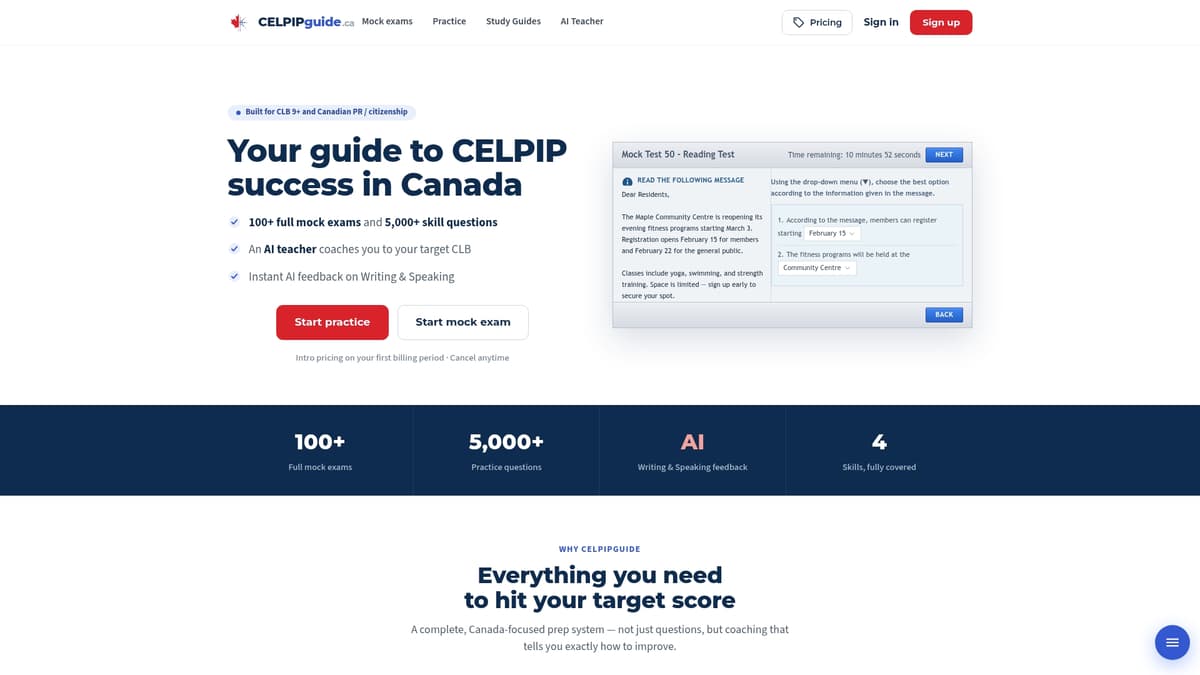
The AI writing checker reads your Task 2 responses and flags vocabulary range issues, unnatural collocations, and register mismatches — the exact errors that cost points. The diagnostic test in Week 1 tells you which skills need the most vocabulary work, so you are not studying blind. And the full mock exams at Weeks 4 and 6 give you a real CLB score to measure against your target, not just a feeling of progress.
Celpipguide works best for test-takers who want structured, measurable preparation rather than open-ended self-study. If you are aiming for CLB 9+ and need to know exactly where your vocabulary is holding you back, the personalised study plan generator builds a week-by-week schedule around your diagnostic results. Start there, and you will know within 48 hours exactly which word categories to prioritise first.
Useful sources and tools
Canadian news sources for contextual reading:
- CBC — Canada’s public broadcaster; features, news, and opinion pieces written in the register CELPIP tasks mirror. Read civic and workplace stories for the highest-yield vocabulary.
- The Globe and Mail — National newspaper with strong opinion and analysis sections; excellent for academic verbs, formal connectors, and hedging phrases in natural context.
SRS and flashcard tools:
- Anki (free, desktop and mobile) — Best for long-term retention. Use the Basic (and reversed card) note type; include collocation, example sentence, and register note in each card.
- Quizlet (free and paid tiers) — Faster to set up; use Write and Spell modes for active recall. Good for themed sets you want to share with a study partner.
- Wordbyword — Vocabulary practice tool with a focus on retention; useful as a supplementary resource alongside Anki or Quizlet.
Celpipguide resources that support the plan:
| Resource | When to use it |
|---|---|
| Diagnostic test | Week 1 — identify weakest vocabulary areas before building your word banks |
| AI writing checker | Weeks 2–5 — get feedback on range, precision, and collocation after each timed essay |
| Full mock exams | Weeks 4 and 6 — measure CLB score against your target; treat as real exam conditions |
| CELPIP vocabulary tracker | Ongoing — curated academic word sets organised by CELPIP task theme |
| Writing practice tests | Weekly — timed Task 2 drills with instant scoring and feedback |
Official and reference sources:
- CELPIP official site (celpip.ca) — Official guidance on vocabulary expectations and scoring descriptors.
- Celpipguide’s complete study guide — Integrates vocabulary work with all four skills for a full preparation plan.
FAQ
How long does it take to see vocabulary gains on CELPIP?
Most test-takers notice measurable improvement in writing variety and speaking fluency within three to four weeks of daily contextual reading and spaced repetition practice. Mock test score gains typically appear by Week 5–6 of a structured plan.
How many words do I need to learn for CELPIP?
A focused set of at least 150 academic words and collocations is enough to significantly improve Writing Task 2 performance. Quality and correct usage matter far more than raw quantity.
Is Anki or Quizlet better for CELPIP vocabulary?
Anki’s spaced repetition algorithm makes it more effective for long-term retention, especially for collocations and word families. Quizlet is faster to set up and works well for short-term themed review sets; many test-takers use both.
What is the biggest vocabulary mistake on CELPIP?
Using advanced words in the wrong collocation or the wrong register. A forced word that sounds unnatural lowers your score more than a simpler, correctly used word would. Always apply the replace-and-read test before finalising a substitution.
Can Celpipguide help me identify specific vocabulary weaknesses?
Yes. The diagnostic test pinpoints which skill areas show the weakest vocabulary control, and the AI writing checker flags collocation errors and register mismatches in your Task 2 responses, giving you a precise list of what to fix each week.