
CELPIP Blog
Pass CELPIP for Immigration: Section Tactics and a 4 Step Study Cycle
Pass CELPIP for Immigration: Section Tactics and a 4 Step Study Cycle

This guide covers the CELPIP-General test, the computer-delivered exam most immigration and citizenship applicants take, and gives you a section-by-section map for navigating it. The test runs in a single sitting across four skills: listening, reading, writing, and speaking. IRCC accepts CELPIP-General results as proof of language ability, and those results stay valid for two years from your test date.
TL;DR:
- Reading gives you about 55 to 60 minutes for 38 questions, or under two minutes each; flag difficult items and return if time remains.
- For writing, spend two minutes planning each response and reserve the final three minutes for proofreading; speaking offers about 30 seconds to plan each task.
- Speaking is recorded through a headset, with about 30 seconds to plan each task, and you cannot record a response again once it is complete.
- CELPIP scores range from 1 to 12 and stay valid for two years; citizenship applicants need at least level 4 in listening and speaking.
Table of Contents
- Quick reference map: section order, duration, and question counts
- Navigate listening, reading, writing, and speaking: task types, pacing, and tactics
- How scores are reported and how they map to CLB targets
- How to book, what to prepare, and how to retrieve results
- Most frequent mistakes and a pre-test checklist
- Building a study cycle around diagnostics and full mock exams
- A step-by-step walkthrough of the on-screen interface
- Managing time inside each section using the on-screen clock
- Handling technical issues or distractions during the exam
- How to review or change your answers before submitting
- The one habit that changed how I take this test
- Study smarter with CELPIPguide Plus
- FAQ
- Sources
Quick reference map: section order, duration, and question counts
Knowing the shape of the test before you sit down removes a huge chunk of anxiety. CELPIP-General runs all four skills in one computer-delivered session, and speaking is recorded rather than conducted as a live interview, so there’s no separate appointment to schedule.
Here’s the order you’ll move through on test day, with approximate timing for each part:
| Section | Approximate duration | Approximate question count |
|---|---|---|
| Listening | approximately forty-five to fifty-five minutes | approximately thirty-six questions |
| Reading | approximately fifty-five to sixty minutes | approximately thirty-eight questions |
| Writing | approximately fifty-three to sixty minutes | 2 tasks |
| Speaking | approximately fifteen to twenty minutes | 8 tasks |
We budget our practice sessions around these numbers because pacing is the real skill being tested alongside English itself. A reader who knows listening gives them roughly 47 to 55 minutes for 36 questions can calculate, in advance, how long each item should take and build that rhythm into practice weeks before the real test.
The speaking section happens last and is fully recorded, so you’ll speak into a headset microphone while a monitor times each prompt. There’s no proctor sitting across from you asking questions, which takes pressure off some test-takers and unsettles others who prefer a human exchange. Either way, knowing it’s coming means you can rehearse talking to a screen instead of a person, which is its own skill.

Navigate listening, reading, writing, and speaking: task types, pacing, and tactics
Each section rewards a slightly different kind of navigation. Here’s how to move through them without losing time or focus.
Listening breaks into four parts: everyday conversations, announcements or instructions, a longer dialogue, and an extended discussion or news-style clip. The audio plays once, so shorthand note-taking matters more than perfect grammar in your notes. Jot down names, numbers, and contrasting opinions as you hear them, since questions often hinge on who said what rather than exact wording. A common trap is listening for an answer that sounds “right” out of context instead of tracking the actual question asked before the clip starts.
Reading splits into tasks that test skimming and tasks that reward close focus. Diagrams and correspondence passages usually move fast if you scan for structure first, headings, bullet points, or a letter’s opening line, then hunt for the specific detail a question asks about. Viewpoint passages need slower, closer reading because the questions often ask you to infer tone or compare two opinions. Budget roughly 10 to 12 minutes per reading task and watch the clock rather than your sense of how much you’ve read.
Writing has two tasks: an email response and a survey-style opinion piece. Spend the first two minutes planning, not writing. Sketch three points for the opinion task or confirm the purpose and tone for the email before typing a single sentence. Use vocabulary that matches the task’s register, formal for a complaint letter, conversational for a message to a friend, and leave the last three minutes for a read-through that checks verb tense, article use (a, the), and whether you actually answered the prompt.

Speaking gives you a short planning window, usually 30 seconds, before each task’s recording begins. Use it to jot one keyword per point you plan to make rather than full sentences, since you won’t have time to read a script. Speak clearly into the microphone and treat each task as a mini-speech with an opening line, two supporting points, and a closing sentence, even when the prompt feels casual.
A short planning routine works across the whole section:
- Read or listen to the prompt fully before deciding your angle.
- Note one keyword per idea rather than full sentences.
- Open with a direct statement, then support it, then close.
Common fixes worth building into practice:
- Record yourself on a phone and listen back for pacing and filler words.
- Time every practice response with a stopwatch, not a guess.
- Read instructions twice before touching the keyboard or microphone.
Pro Tip: Say the task’s purpose out loud in one sentence before you answer. If you can’t state the purpose, you’re not ready to respond yet.
How scores are reported and how they map to CLB targets
CELPIP scores each ability, listening, reading, writing, and speaking, on a scale from 1 to 12. Those numbers translate directly into Canadian Language Benchmark (CLB) levels, which is the language IRCC actually uses when assessing applications.
- Citizenship applicants need listening and speaking results of at least CELPIP level 4, for tests taken on or after April 1, 2014.
- Official CLB mapping tables convert your CELPIP score into the CLB level used for Express Entry points and citizenship proof.
- Many Express Entry applicants aim for CLB 7, 8, or 9 depending on the program stream and the points they need.
- Results stay valid for two years from the test date, so align your test timing with your application deadline.
Check the current mapping table before you set a target score, since the CLB level you need depends on the specific program you’re applying through, not a single universal number.
How to book, what to prepare, and how to retrieve results
Booking early and knowing the logistics removes most of the stress that has nothing to do with English skill.
- Register through official CELPIP channels and confirm your test centre location and date well ahead of any application deadline.
- Bring valid government-issued photo identification that matches the name on your registration exactly.
- Arrive within the test centre’s specified check-in window, since late arrival can mean losing your seat entirely.
- Expect a computer workstation with a headset for listening and speaking, and a mouse or keyboard for reading and writing responses.
- Results are typically released within a set number of business days after your test date, delivered through your online account.
- Contact CELPIP directly if a score report goes missing or you need a replacement copy for an application.
Most frequent mistakes and a pre-test checklist
A lot of score loss has nothing to do with English ability. It comes from navigation errors that are entirely preventable.
The top mistakes we see repeated: skimming instructions and missing a task’s actual requirement, running out of time on one section because an earlier task ate the clock, and answering what a question “probably” means instead of what it says.
- Two days before: review your notes on task types for each section, not new material.
- One day before: confirm your test centre address, start time, and ID.
- The morning of: eat something, arrive early, and avoid cramming new content.
- During the test: read every instruction twice before answering the first question in a new task type.
- After each section: take the short break offered to reset focus before the next skill.
Fix the instruction-skimming habit by reading prompts aloud during practice. Fix the time-management habit by timing every practice task with a visible clock, not a mental guess.
Building a study cycle around diagnostics and full mock exams
Timed, repeated practice is what actually builds pacing, not reading about the test format. A study cycle that moves from diagnostic to drill to mock exam mirrors how test-day navigation actually feels.
- Start with a diagnostic test to find which section drags your overall pace down.
- Follow with focused drills on that specific skill, listening notes or writing structure, for example.
- Sit a full-length, timed mock exam to rebuild stamina across all four sections in one sitting.
- Review every writing and speaking response against a rubric, since general grammar fixes rarely address the specific weakness a rubric reveals.
High-volume, timed repetition is what turns unfamiliar pacing into muscle memory by test day.
A step-by-step walkthrough of the on-screen interface
Each section opens with instructions displayed on screen before the clock starts, and you move through questions using on-screen “Next” buttons rather than paper pages. In listening, audio plays automatically once per item, and a progress indicator shows how many questions remain in that part.
Reading and writing use a split-screen layout: the passage or prompt sits on one side, your answer options or text box on the other, so you never scroll away from the source material while answering. Writing tasks include a running word count visible at all times, which helps you judge whether you’re under or over a reasonable length without manual counting.
Speaking tasks show the prompt on screen with a countdown timer for your planning period, followed by a separate recording timer once you start speaking. A microphone-level indicator confirms your voice is being picked up before each task begins, which is worth checking during the headset test at the start of the session.
Practising with any full-length, timed mock exam before test day means this layout won’t be the thing competing for your attention when you need to focus on content instead.
Managing time inside each section using the on-screen clock
Every section displays a running timer in a fixed corner of the screen, and that number should guide your pacing more than your instinct about how far you’ve progressed. In listening, the timer matters less since audio paces itself, but in reading, writing, and speaking, checking it every few questions keeps you from overspending on one difficult item.
A practical tactic: divide each section’s total time by its question or task count before you start, so you have a rough per-item target in mind. For reading’s 38 questions across roughly 55 to 60 minutes, that works out to under two minutes per question on average, though some tasks naturally take longer than others.
If you notice you’re behind pace partway through a section, make a decision immediately rather than drifting. Skip a stubborn question, flag it mentally, and move on, since one unanswered question costs less than three unanswered questions caused by one unresolved one eating your remaining time. Writing tasks benefit from a hard internal deadline for finishing a first draft, leaving the last few minutes strictly for review rather than new composition.
Handling technical issues or distractions during the exam
Test centres run on shared computer systems, and occasional technical hiccups, a frozen screen, audio that doesn’t play, a headset that cuts out, do happen. If anything like this occurs, raise your hand and alert the test centre supervisor immediately rather than trying to troubleshoot it yourself or continuing to guess at a question you can’t actually see or hear properly.
Supervisors are trained to log technical interruptions and can often pause or adjust your section timing to account for lost time, but only if you flag the issue as it happens, not afterward. Staying calm here matters more than it sounds: a frozen screen for thirty seconds feels much longer in the moment than it actually is.
For general distractions, other test-takers typing, a cough across the room, treat noise-cancelling awareness as part of your preparation. Practising mock exams in a slightly imperfect environment, rather than total silence, builds tolerance for the real test centre’s ambient noise so it doesn’t throw off your focus on exam day.
How to review or change your answers before submitting
CELPIP allows you to move backward and forward within a section using on-screen navigation, and you can change a multiple-choice answer any time before that section’s timer runs out. Once you move to a new section, though, you typically cannot return to a previous one, so review happens within each section’s own time window, not after the fact.
For reading and listening, use any remaining time at the end of a section to revisit flagged questions rather than reviewing answers you already felt confident about. Flagging a tough question as you go, then circling back if time allows, prevents a single hard item from draining minutes meant for the rest of the section.
Writing tasks let you edit your text freely until the section timer ends, so build a habit of a final read-through in the last few minutes to catch tense errors, missing articles, or a word count that’s too short. Speaking tasks are different: once you finish recording a response, you cannot re-record it, which is exactly why the brief planning window before each task matters so much.
The one habit that changed how I take this test
Before answering anything, I say the task’s purpose out loud in my head: inform, persuade, describe. That single habit cut my wasted time dramatically, and it’s the cheapest fix in this entire guide.
— Reza
Study smarter with CELPIPguide Plus
We offer a Plus plan that follows a study cycle: diagnostic first, focused drills next, full mock exams to build stamina, then rubric feedback to close the gap.
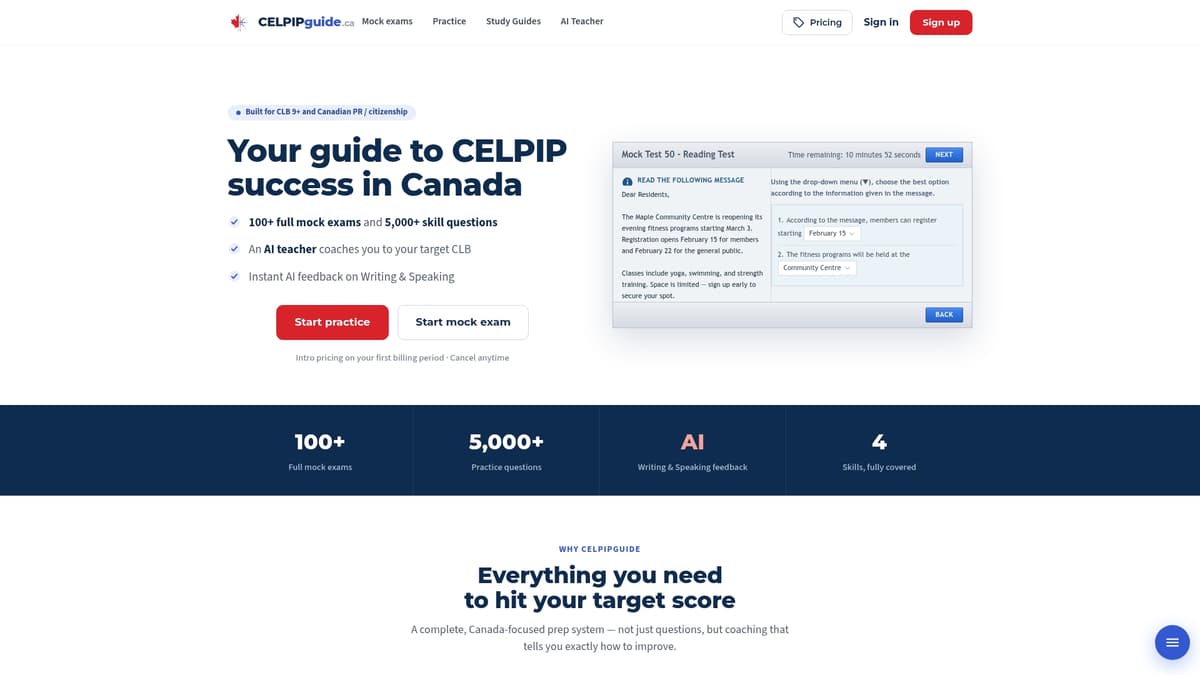
Our Plus plan includes many full-length mock exams and practice questions, along with an AI teacher that scores writing and speaking against exam rubrics, helping identify specific weaknesses beyond general grammar.
| What you get | How it fits the cycle |
|---|---|
| Diagnostic test | Finds your weakest section first |
| high-volume full-length mock exams | Builds pacing and stamina for test day |
| thousands of practice questions | Targets focused drills between mocks |
| AI feedback on writing and speaking | Replaces guesswork with rubric-based review |
- Get the Plus plan and use code BLG30 for 30% off on top of any other discount available.
- Pair full mock exams with real conversation practice through a language-exchange resource for extra speaking reps outside the platform.
If you’re ready to turn a study plan into a test-day result, start with a diagnostic and build from there.
FAQ
Is it hard to get 7 in CELPIP?
Reaching CLB 7, which corresponds to specific CELPIP score ranges per skill, is achievable with consistent timed practice but does require solid control across all four skills, not just one strong area. Many applicants find writing and speaking the hardest sections to push past CLB 7 because they’re scored on structure and clarity, not just vocabulary.
What is 34 out of 38 in CELPIP listening?
CELPIP reports listening results as a CELPIP band score, not a raw percentage, so raw counts don’t map to one fixed, publicly stated CLB level. Official CLB mapping tables convert your reported score, so check your official score report against that table directly.
Can I prepare for CELPIP in 3 days?
Three days is enough time to review the test format, task types, and timing if you’ve already built underlying English skills over a longer period. It’s not realistic to build new language ability in that window, so a short timeline works best for format familiarization and light mock-exam practice rather than skill-building from scratch.
Is CELPIP harder than IELTS?
Neither test is inherently harder since both assess the same four skills, but CELPIP’s fully computer-delivered format, including recorded speaking rather than a live interview, suits some test-takers better than others. The better question is which format matches your strengths: typing versus handwriting, and speaking into a microphone versus speaking with a live examiner.