
CELPIP Blog
CELPIP progress tracker: map scores to CLB before the two year expiry
CELPIP progress tracker: map scores to CLB before the two year expiry

A CELPIP progress tracker records your scores across listening, reading, writing, and speaking, then shows how those scores line up against the Canadian Language Benchmark (CLB) levels IRCC uses for immigration applications. The single most useful action we recommend is tracking each skill separately against your target CLB level, not just watching your overall average climb. Some online CELPIP preparation platforms build this kind of skill-by-skill view directly into a study dashboard.
TL;DR:
- Tracking each CELPIP skill against your target CLB level provides clearer direction than monitoring only the overall score, which can mask weak areas.
- Progress trend lines that steadily rise indicate effective study routines, while flat or declining lines suggest that changes are necessary before retaking the test.
- For immigration applications, it is crucial to record official test dates and expiry since results are only valid for two years, and each ability is scored separately for points.
- A proper CELPIP tracker should include CLB mapping for all four skills, question-level analytics, rubric-based scoring, and scheduling reminders for effective planning.
- Using a comprehensive platform with instant AI scoring, full mock exams, and detailed feedback helps focus practice on weak abilities and avoid overpractising already strong skills.
Table of Contents
- What a progress tracker actually shows you
- How to use a progress tracker to reach your CELPIP target
- Tracking progress for immigration and CLB-based pathways
- What to look for in a CELPIP progress tracker
- A practical note on tracking progress well
- How CELPIPguide fits into your tracking plan
- FAQ
- Sources
What a progress tracker actually shows you
A real tracker does more than store a score. It breaks your results into pieces you can act on, so you know exactly where to spend your next study hour.
- Skill-by-skill scores and timelines: separate score lines for listening, reading, writing, and speaking, charted over time.
- Estimated CELPIP/CLB level: a running estimate of your current level per skill, with a trend graph showing whether you’re climbing, plateauing, or slipping.
- Diagnostic results and next-task suggestions: a starting assessment that feeds a personalized study plan rather than a generic one.
- Instant scoring and rubric-style feedback: writing and speaking responses scored against the same criteria official raters use, with comments tied to specific weaknesses.
- Error review and flagged vocabulary: question-level analytics that show which grammar patterns, word choices, or listening traps trip you up repeatedly.
Platforms built for CELPIP prep commonly combine instant AI scoring with progress reports across all four skills, which is what separates a tracker from a simple practice test archive. That combination matters because writing and speaking are the two skills most test-takers struggle to self-assess. You can tell if you understood a listening passage, but you can’t easily tell if your writing response hit CLB 8 or CLB 9 without a rubric behind it. A tracker that scores those tasks instantly and explains why gives you something a plain practice test never does: a reason for the number.
The trend graph matters almost as much as the score itself. A single high score on one mock test tells you little. A line that climbs steadily across five attempts tells you your study plan is working, and a flat or dropping line tells you to change approach before you waste another week on the same routine.
How to use a progress tracker to reach your CELPIP target
Treat your tracker as a planning tool, not just a scoreboard. Here’s the sequence that gets the most out of it.
- Set skill-level targets first. Decide the CLB level you need for each ability using the government CLB mapping tables, then enter those as your targets rather than chasing a generic “good score.”
- Take a diagnostic and log your baseline. Record the date, and if your results will support an immigration application, note the official test date and expiry alongside it.
- Prioritize your weakest skill. Pull targeted practice sets for that one ability and re-test on a weekly or biweekly cadence so you can see movement without over-testing.
- Turn rubric feedback into small tasks. If feedback flags weak paragraph structure, practise topic sentences alone for a few days. If it flags pronunciation, drill isolated sounds before attempting full speaking responses again.
- Watch the trend before booking. Book your official test once your estimated level holds steady at or above target across two or three consecutive attempts, not after a single lucky score.
Pro Tip: Re-test the same skill under timed conditions every time. A score without the clock running is a different exercise, and it will mislead your trend line.
This approach also keeps you from over-practising your strongest skill, which is tempting because it feels productive but does nothing to move the ability actually holding your application back.
Tracking progress for immigration and CLB-based pathways
If your CELPIP result is going toward an immigration application, your tracker needs to hold more than scores. IRCC requires that language-test results used for immigration be less than two years old, so the test date and expiry belong in your tracker alongside your scores, not in a separate email you’ll forget to check.
Express Entry and similar pathways score each ability on its own, which means a strong writing score cannot cover for a weak speaking score. IRCC’s Express Entry language tables assign points per ability, so meeting your target in three skills and missing it in one still costs you points that skill was supposed to earn.
| CLB level | Approx. Express Entry points per ability |
|---|---|
| CLB 7 | 4 points |
| CLB 8 | 5 points |
| CLB 9 | 6 points |
| CLB 9+ | 6 points |
Those figures come from the Express Entry language test mapping, and they’re why a single average score can be misleading. A 7.5 average built from a CLB 9 reading score and a CLB 6 speaking score scores worse under Express Entry rules than four even CLB 7s.
Once your tracker shows you meeting target across every skill, preserve the evidence: save or export your official results, keep the test date visible, and book your next official attempt with the two-year validity window in mind rather than waiting until the last month.

What to look for in a CELPIP progress tracker
Not every tracker gives you what an immigration timeline actually needs. Before you commit to one, check it against this list.
- Covers all four skills with CLB mapping, not just a composite score.
- Offers a realistic diagnostic and enough full mock tests to build a trustworthy trend line.
- Scores writing and speaking against rubric criteria, with specific, actionable comments rather than a bare number.
- Provides question-level analytics and export options, so you can review errors and keep copies of your history.
- Includes scheduling or milestone reminders, since a tracker that only shows the past won’t help you plan your next test date.
- States its pricing and free-trial terms clearly, so you know what you’re committing to before test day gets close.
A tracker that checks every box here gives you a planning tool, not just a score archive, and that distinction is what determines whether your study time actually closes the gap to your target CLB.
A practical note on tracking progress well
The mistake we see most often is treating the overall average as the goal. CLB thresholds are assessed skill by skill, so a rising average can hide a stalled speaking score for months. We’ve also found that two focused 20-minute sessions beat one exhausted two-hour marathon, because rubric feedback only sticks when you’re alert enough to apply it to the next attempt.
— Reza
How CELPIPguide fits into your tracking plan
We built our platform around the same checklist above: a diagnostic test, a large number of full mock exams, thousands of practice questions, and an AI teacher that grades writing and speaking against rubric criteria the moment you submit a response. The progress dashboard maps each skill to an estimated CLB level so you can identify which ability needs the next hour of work.
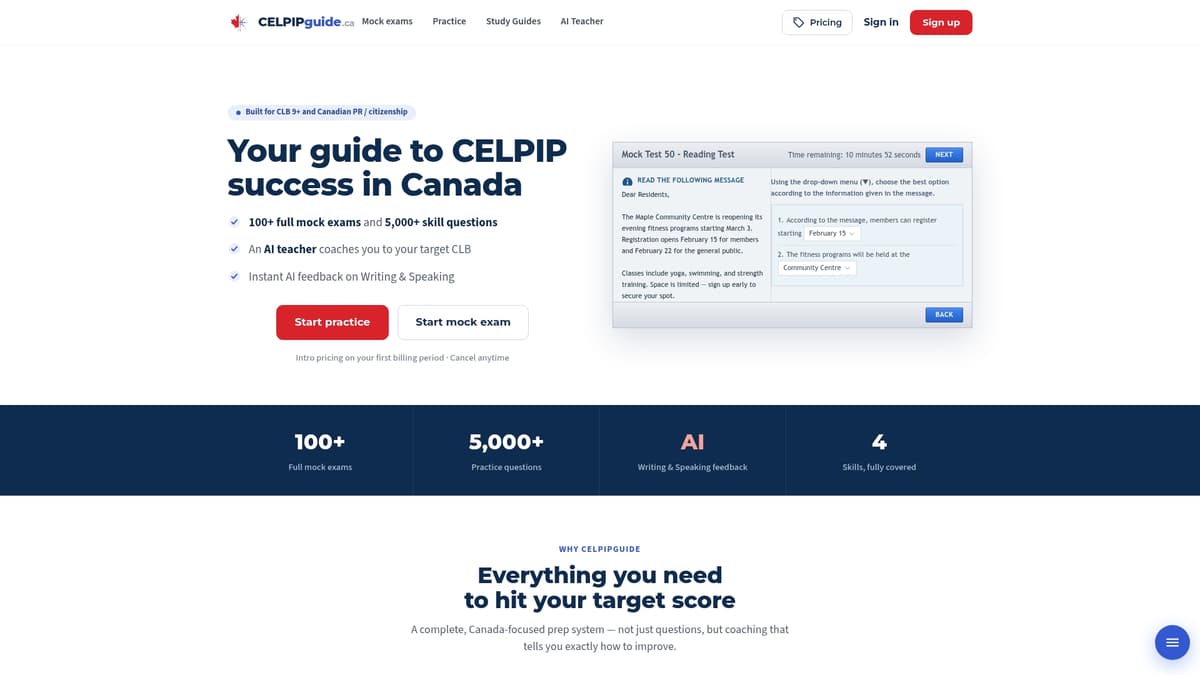
- Diagnostic and CLB mapping: see your estimated level per skill from day one.
- Rubric-style AI feedback: instant, specific comments on writing and speaking tasks.
- Progress dashboard: trend charts across all four skills so you know when you’re ready to book.
| Tracker checklist item | What CELPIPguide provides |
|---|---|
| Full skill coverage with CLB mapping | Diagnostic test plus skill-by-skill CLB estimates |
| Mock test volume | 100+ full mock exams, 5,000+ practice questions |
| Writing/speaking feedback quality | AI teacher with rubric-based instant feedback |
If you’re ready to put a real tracker behind your study plan, our Plus plan is available for a one-time fee, with a discount code BLG30 for 30% off. It’s a practical next step once you’ve decided which skill needs your attention first.
FAQ
How long will CELPIP results take?
CELPIP result timelines vary by test centre and format, so check your official results portal directly for your specific timeline rather than relying on a general estimate. Once results arrive, log the date in your tracker right away since it starts the two-year validity clock for immigration applications.
What is 34 out of 38 in CELPIP listening?
CELPIP raw scores convert to a CLB level through the official government mapping tables rather than a simple percentage, so the exact CLB equivalent depends on which version of the table applies to your test. Check your official score report, which states the CLB level directly, instead of calculating it from the raw number alone.
Is 7 a good CELPIP score?
A CELPIP score of 7 maps to CLB 7, which meets or exceeds the requirement for many immigration pathways, though some programs and higher-points categories call for CLB 9 or above in each ability. Whether it’s “good” depends entirely on the CLB level your specific pathway requires, which is why tracking against a target beats chasing a generic benchmark.
How can I check my CELPIP test results?
You can check your official CELPIP results through the account portal you used to register for the test. Once you have them, record the score and test date in a progress tracker so you can monitor the two-year validity window IRCC applies to language-test results used for immigration.
Sources
If language skills are part of a broader job search, our partner guide on writing a career summary that impresses Canadian recruiters covers how to present your CLB level on a resume.