
CELPIP Blog
Trust Your CELPIP Speaking Self Score: Rubric for All Eight Tasks
Trust Your CELPIP Speaking Self Score: Rubric for All Eight Tasks

Simulate all 8 speaking tasks under real timing, record every answer, score each one against the official CELPIP performance standards, then build drills around your weakest rubric area. That loop, done consistently, gives you a self-score you can trust instead of a guess. Cross-check it once with model answers or rubric-based AI feedback, and you’ll know exactly where you stand.
TL;DR:
- Rehearsing all eight speaking tasks under timed conditions helps identify weak areas and build targeted drills to improve task-specific scores.
- Consistent self-recording using the official response times and detailed scoring checklists can reveal precise strengths and weaknesses across relevance, structure, vocabulary, grammar, and fluency.
- Focusing on fixing the lowest-scoring dimension in each task, rather than trying to perfect everything at once, yields measurable progress in overall band scores.
- Utilizing rubric-based AI feedback and full mock exams accelerates skill development by providing objective, tailored evaluations aligned with CELPIP standards.
- Tracking progress over weeks and comparing recordings helps ensure steady improvement in speaking ability rather than relying on one-off practice sessions.
Table of Contents
- CELPIP speaking format and scoring you need to know
- Task-by-task self-assessment checklist
- How to simulate, record and review your speaking test at home
- Scoring rubric explained: what raters actually listen for
- Common weaknesses in CELPIP speaking and how to fix them
- Sample task walkthroughs: scoring a real response
- How Celpipguide’s tools support and validate self-evaluation
- A short note on realistic progress
- Celpipguide Plus for rubric-based feedback and mock exams
- FAQ
- Direct links to the official rubric, practice tests and the publisher page
- Sources
CELPIP speaking format and scoring you need to know
Before you can score yourself, you need to know what you’re scoring and against what. The CELPIP speaking test has 8 tasks, and the whole thing runs about 15 minutes. That’s tight, so part of your self-assessment is simply noticing whether you used your prep time well or froze when the clock started.
Here’s what the 8 tasks ask you to do:
- Task 1, giving advice: respond to a scenario with a clear recommendation and reasoning.
- Task 2, personal experience: describe a real or invented experience with detail and sequence.
- Task 3, describing a scene: narrate what’s happening in an image with specific vocabulary.
- Task 4, making predictions: speculate about what happens next in a picture sequence.
- Task 5, comparing and persuading: choose between two options and justify the choice.
- Task 6, dealing with a difficult situation: navigate an awkward or tricky scenario diplomatically.
- Task 7, expressing opinions: take a stance on a topic and defend it.
- Task 8, describing an unusual situation: explain something odd or unexpected clearly.
These dimensions roll up into a single score per task, and those scores average into your CLB band.
That matters for self-scoring because a strong answer on vocabulary can’t rescue a response that ignores the question. Raters weigh relevance and task fulfilment heavily, so your first checkpoint on every recording should always be, “did I actually answer what was asked?”
Task-by-task self-assessment checklist
Grading your own voice is awkward at first, but it gets easier once you have a repeatable method. Use a simple 0 to 4 scale per checklist item (0 meaning absent, 4 meaning strong and consistent), then add up the totals to estimate where you land.
For each task type, run through this sequence:
- Relevance check: did you address every part of the prompt, not just the easy part?
- Structure check: does your answer have a clear beginning, middle and end, with signposting like “first” or “the main reason is”?
- Vocabulary check: did you use specific words instead of vague ones like “nice” or “stuff”?
- Grammar check: did you vary your sentence structures, and were your tenses consistent?
- Listenability check: did you speak at a steady pace with natural pauses, or did you rush and trail off?
Here’s how that plays out across task types:
- Advice and difficult situation tasks lean hardest on tone and relevance. A weak answer gives generic advice; a strong one acknowledges the specific scenario and offers a reasoned, situation-matched solution.
- Personal experience and describing a scene tasks reward vocabulary range and coherence. Weak answers repeat the same three adjectives; strong ones layer in sensory and sequencing detail.
- Predictions and comparing/persuading tasks test your grammar flexibility, since you’re often using conditionals and comparatives. Weak answers stick to simple present tense throughout; strong ones shift tense and structure naturally.
- Opinion and unusual situation tasks hinge on completeness. Weak answers state an opinion with no support; strong ones give at least two developed reasons.
Once you’ve scored all 8 tasks, average your totals. A consistent high score across dimensions tends to track with the higher CLB bands, while a pattern of 2s on vocabulary or grammar usually flags the specific area holding your overall band down. The goal isn’t a perfect number. It’s a clear signal of where to practise next.
How to simulate, record and review your speaking test at home
Your self-score is only as good as the recording it’s based on, so the setup matters more than people expect. You don’t need a professional studio, but you do need consistency.
Start with the basics:
- Microphone: a phone or laptop mic is fine, as long as it’s the same one every time so your recordings are comparable.
- Room: pick a quiet space with no echo, ideally the same room each session.
- Timer: use the exact prep and response times listed in the official task descriptions, not rounded estimates.
Run the test using real prompts, start the timer the second your prep window begins, and speak until the response time ends, even if you stall. That stalling moment is data. It tells you where your fluency breaks down under pressure.
For recording habits, keep it simple:
- Name each file with the date and task number so you can track patterns over weeks.
- Record in a single take, no edits, no retries mid-response.
- Keep the raw audio file even after you’ve scored it, since you’ll want to compare it against a recording from a month later.
- Jot a timestamp next to any moment you hesitate, lose your thread, or mispronounce a word, so scoring your recording later is faster.
Pro Tip: Record a full 8-task mock test weekly, but do short, focused one-task drills on your weakest area 3 or 4 times in between.
That split keeps you from burning out on full simulations while still giving your weak spots daily attention.
Scoring rubric explained: what raters actually listen for
Rubric language can feel abstract until you hear it in action. Here’s what each term sounds like in a real recording.
Cohesion means your ideas connect logically, often signalled by linking words. A cohesive answer says “I’d recommend the first option because it’s more flexible, and that matters since my schedule changes often.” A disjointed one lists facts with no connective thread at all.
Listenability is about rhythm, pace and clarity, not accent. Shadowing native speakers at normal speed, rather than drilling isolated sounds, tends to improve this faster.
Vocabulary range shows up as word choice precision. Saying “the weather was bad” is weaker than “the weather turned stormy with heavy wind,” even though both are grammatically correct.
A minor error is something like a dropped article (“I went to store” instead of “I went to the store”). It barely dents your score if the rest of the response is strong. A major error is one that blocks understanding entirely, like a wrong verb tense that confuses the timeline of your story, or a vocabulary mix-up that changes the meaning. Raters tend to penalize major errors more heavily because they interrupt communication, while minor ones are noted but don’t derail the score.
Here’s a worked example: say you score yourself on Task 2 (personal experience) using the 0 to 4 checklist. You rate relevance at 4, structure at 3, vocabulary at 3, grammar at 2 (a tense mix-up midway through), and listenability at 3. That’s 15 out of a possible 20, a solid but not flawless response, roughly in line with a mid-range CLB band once averaged against your other 7 tasks.

Research consistently flags one detail: the official performance standards treat task fulfilment and relevance as foundational, meaning no amount of polished grammar compensates for an answer that misses the actual question.
Common weaknesses in CELPIP speaking and how to fix them
Most learners fall into one of four patterns, and each has a specific fix rather than a vague “practise more.”
Short, underdeveloped answers. If you’re running out of things to say before the time’s up, try a timed expansion drill: take any Task 7 opinion prompt and force yourself to give 3 reasons instead of 1, filling the entire response window.
Weak organisation. If your answers wander, practise the “point, reason, example” structure out loud until it becomes automatic, then apply it to a new prompt every day for a week.
Limited vocabulary range. Build a lexical set list around common CELPIP themes (work, travel, community, technology) and commit to using 3 new words from that list in every practice response for 2 weeks.
Pronunciation and pacing issues. Shadowing is the most direct fix here: play a short native-speaker clip, pause it every sentence, and repeat it matching pace and intonation, not just the words.
Pro Tip: Re-record the same prompt a week after your first attempt, not the next day. A week gives the drill time to actually change your habits instead of just your memory of that one answer.
To measure progress, compare your checklist totals on the same task type across two sessions spaced at least a week apart. A jump of even 2 or 3 points on your weakest dimension is a real signal, not noise.
Sample task walkthroughs: scoring a real response
Seeing the checklist applied to an actual answer makes the method click faster than any explanation.
Walkthrough 1, Task 1 (giving advice). A learner is asked to advise a friend who’s unhappy at work. Sample response: “I think you should talk to your manager first, since switching jobs right away is risky. If the conversation doesn’t help within a month, then start looking elsewhere, but give the current situation a fair chance.” Self-score: relevance 4, structure 4, vocabulary 3, grammar 4, listenability 3. Reviewer note: the pacing dipped slightly on “doesn’t help within a month,” the one spot the speaker visibly hesitated. Drill: a one-task fluency drill repeating that exact sentence 5 times at a steady pace until the hesitation disappears.
Walkthrough 2, Task 4 (making predictions). Response: “I think the man will probably miss his flight because he’s still stuck in traffic and the departure board shows boarding has already started.” Self-score: relevance 4, structure 3, vocabulary 3, grammar 2 (tense slip from “will” to “shows” without a clear shift marker), listenability 4. Reviewer note: the grammar inconsistency is the one weakness worth isolating. Drill: a grammar-focused drill using 10 prediction prompts, each forced into “will probably” plus a reason clause, repeated until the structure is automatic.
Walkthrough 3, Task 7 (expressing opinions). Response: “I believe remote work is good for most people.” Self-score: relevance 3, structure 1, vocabulary 2, grammar 3, listenability 3. Reviewer note: the answer stops after one sentence, the classic underdeveloped-response pattern. Drill: the timed expansion drill from the previous section, forcing 2 additional supporting reasons before the response window ends.
In each case, fixing the single lowest-scoring dimension, not everything at once, is what moves the needle. A jump from a 2 to a 3 on grammar across several tasks can shift your estimated CLB band upward even if every other dimension stays flat, because the rubric rewards consistency across categories rather than a single standout strength.

How Celpipguide’s tools support and validate self-evaluation
Self-scoring with a checklist gets you most of the way, but it has a ceiling: you’re still your own rater, and blind spots are hard to catch alone. That’s where rubric-based AI feedback earns its place in a study plan. An online CELPIP preparation platform offers full mock exams and practice questions, with AI-based tools that review Speaking and Writing responses instantly and build personalized study plans around users’ weaknesses.
If you’re a DIY learner who’s comfortable with the checklist method above, that’s a solid starting point. If you want a second opinion to confirm your self-score, or you’re aiming for a specific CLB band and need a study plan that adapts as you improve, diagnostic-driven tools close that gap faster than guesswork alone.
A short note on realistic progress
Speaking skills move in weeks, not days, so judge yourself on trends, not single sessions. I’d suggest a simple logbook: date, task type, score, and one specific note on what changed. Keep a before and after recording every 2 to 3 weeks and listen to both back to back. That contrast tells you more than any single score ever will.
— Reza
Celpipguide Plus for rubric-based feedback and mock exams
Once your self-assessment flags a clear weak spot, the fastest way to confirm it and fix it is a second set of eyes that knows the rubric cold. A Plus plan offers access to full mock exams, AI feedback on Speaking and Writing, and personalized study plans built around individual gaps instead of a generic syllabus.
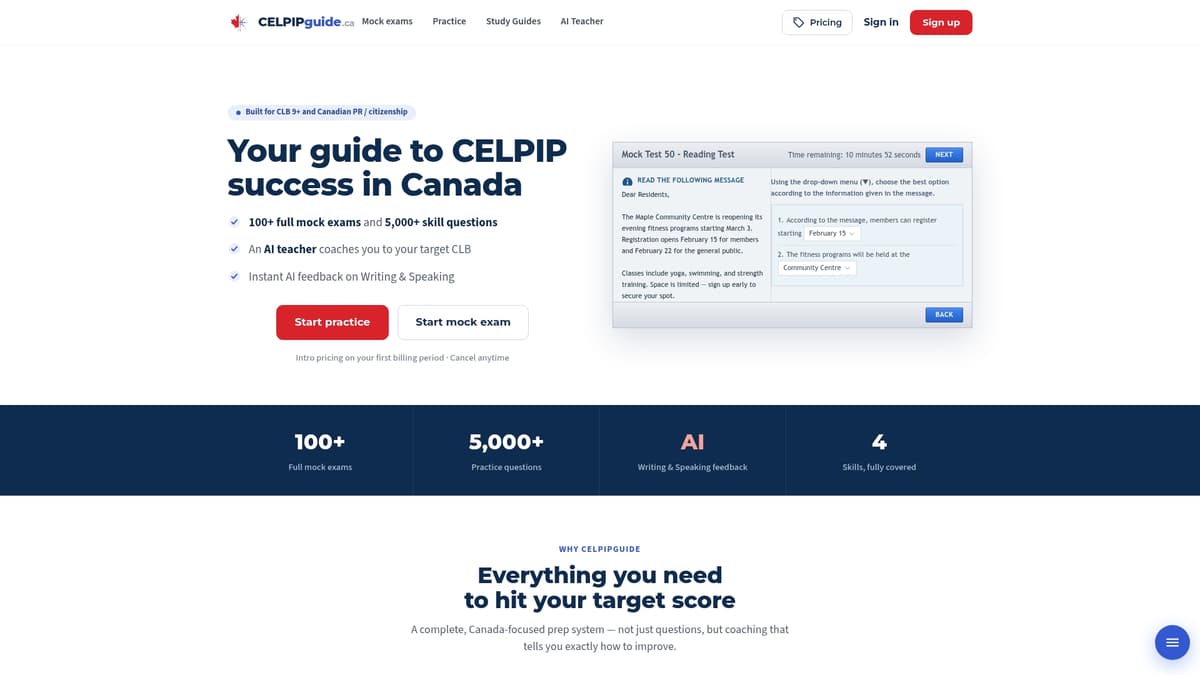
It’s a one-off purchase available on the Plus plans page. If you’ve been scoring yourself with the checklist in this guide and want a rubric-aligned check on whether your self-score matches reality, that’s exactly what the plan is built to do.
FAQ
Can I reevaluate my CELPIP speaking test results?
Yes, CELPIP offers an official re-evaluation service for a fee if you believe your speaking score doesn’t reflect your performance, though it’s typically used after reviewing your results against the official rubric. Self-assessment before requesting a re-evaluation helps you decide whether the request is likely worth the cost.
What is 33 out of 38 in CELPIP listening?
CELPIP listening scores are converted to CLB bands rather than reported as a direct percentage, with the official performance standards providing the band breakdown tied to your test version. Check the official performance standards for the exact band breakdown tied to your test version.
How to score high in CELPIP speaking?
Scoring high means hitting every rubric dimension consistently: answering the full prompt, organizing your response clearly, using varied vocabulary and grammar, and speaking at a steady, listenable pace. Recording and self-scoring your practice against the official standards, then drilling your weakest dimension, is the most direct route to raising your band.
How is CELPIP speaking evaluated?
CELPIP speaking is evaluated across dimensions including relevance, completeness, coherence, vocabulary range, grammar accuracy, and pronunciation or listenability, with each of the 8 tasks scored individually. Those task scores are then averaged into an overall CLB band for speaking.
Direct links to the official rubric, practice tests and the publisher page
- CELPIP speaking performance standards (official PDF)
- Celpipguide Plus plans
- TESTUNO verbal reasoning test