
CELPIP Blog
CELPIP for Express Entry Applicants: Hit CLB 9 to Maximize Your CRS
CELPIP for Express Entry Applicants: Hit CLB 9 to Maximize Your CRS

Yes, Immigration, Refugees and Citizenship Canada (IRCC) accepts CELPIP‑General for Express Entry, and it maps directly to Canadian Language Benchmark (CLB) levels. You need to hit specific per‑ability CLB thresholds for your program (Federal Skilled Worker, Canadian Experience Class, or the Federal Skilled Trades Program), enter each score into your profile, and keep results valid until you submit your permanent residence application. No single score guarantees an invitation, since your Comprehensive Ranking System (CRS) total depends on your whole profile.
TL;DR:
- CELPIP-General is required for IRCC Express Entry applications; CELPIP-LS is not accepted and only tests listening and speaking.
- Achieving CLB 7 in all abilities is mandatory for FSWP, while lower thresholds apply for CEC and FSTP, depending on the job type.
- Scores above CLB 9 significantly increase CRS points, especially due to better skill transferability and higher overall rankings.
- CELPIP results are valid for two years at both profile creation and application submission; retesting closer to deadlines is recommended if scores expire.
- Candidates often mistake booking the wrong test or underestimate required ability scores, risking delays or disqualification; precise planning and tracking are essential.
Table of Contents
- Which CELPIP test does IRCC accept for Express Entry?
- What CLB score do you need for each Express Entry program?
- How do CELPIP scores translate into CRS points?
- How long are CELPIP results valid for Express Entry?
- Your step‑by‑step Express Entry language checklist
- How should you prioritize your CELPIP prep?
- CELPIP vs. IELTS: which test should you take for Express Entry?
- What mistakes do candidates most often make with CELPIP for Express Entry?
- Do CELPIP scores affect eligibility beyond your CRS total?
- How often can you retake CELPIP, and how should you approach a retest?
- Language scores are one piece of a bigger CRS puzzle
- Build your CLB target with structured CELPIP prep
- Official IRCC pages and tools worth bookmarking
- Sources
- FAQ
Which CELPIP test does IRCC accept for Express Entry?
IRCC requires CELPIP‑General specifically, not CELPIP‑General LS. That distinction trips up more candidates than you’d expect, because both tests share the CELPIP brand and get mentioned in the same breath online.
CELPIP‑General LS was built for Canadian citizenship applications and only tests listening and speaking. It has no roles in Express Entry. If you book it by mistake, you’ll have wasted your test fee and your prep time, and you’ll need to book CELPIP‑General from scratch.
CELPIP‑General tests all four abilities:
- Listening
- Reading
- Writing
- Speaking
You book CELPIP‑General directly through the official CELPIP website, where you’ll also find test date availability and delivery locations across Canada. Results typically arrive within 4 to 6 business days for the computer‑delivered format, and you’ll receive an official report with a unique certificate number and test PIN. Both details matter later when you fill out your Express Entry profile, so don’t lose that report.
What CLB score do you need for each Express Entry program?
Your required CLB level depends entirely on which program you’re using to enter the pool, and the thresholds are stricter than a lot of candidates assume going in.
The three main programs under Express Entry set these minimums:
- Federal Skilled Worker Program (FSWP): CLB 7 in all four abilities, no exceptions.
- Canadian Experience Class (CEC): CLB 7 for TEER 0 or 1 jobs, CLB 5 for TEER 2 or 3 jobs.
- Federal Skilled Trades Program (FSTP): CLB 5 for speaking and listening, CLB 4 for reading and writing.
CELPIP ability scores map one‑to‑one onto CLB levels. A CELPIP score of 7 in speaking equals CLB 7 in speaking, and the same logic applies straight across listening, reading, and writing. There’s no conversion table to puzzle through, no rounding, no ambiguity.
Here’s the part that catches people off guard: IRCC assesses each ability on its own. A CELPIP 9 in speaking does nothing to rescue a CELPIP 6 in writing if your program needs CLB 7 across the board. If you’re also claiming points for a second official language, French scores follow their own CLB conversion table through a different test, but the same per‑ability logic applies there too.
How do CELPIP scores translate into CRS points?
Higher CLB bands don’t just clear the eligibility bar. They add real weight to your CRS total, and the jump between bands is bigger than most people expect.
IRCC’s CRS criteria award points per ability, not as a bundled language score. Your CRS total tops out at 1,200 points overall, split between a core human capital score (worth up to 600) and additional factors like provincial nominations or job offers (worth up to another 600).
Pro Tip: CLB 9 is the number worth aiming for if you’re flexible on timing. The jump in points from CLB 8 to CLB 9 is bigger than the jump from CLB 7 to CLB 8, and CLB 9 also opens the door to stronger skill‑transferability combinations if you’re pairing language with a Canadian degree or skilled work experience.
A few things to keep in mind as you plan around this:
- Points scale up incrementally through CLB 6, 7, 8, 9, and 10 or higher, with the biggest gains concentrated in the upper bands.
- Skill transferability factors combine your language score with education or work experience, which can unlock points beyond the base language score alone.
- CRS cut‑offs shift from round to round, so a score that clears one draw might miss the next.
Run your numbers through the CRS calculator before you commit to a target. A CLB score breakdown can also help you see exactly where the point jumps happen across bands.
How long are CELPIP results valid for Express Entry?
Your CELPIP results are only good for two years, and that clock applies at two separate moments: when you first submit your Express Entry profile, and again when you submit your permanent residence application after receiving an invitation.
That second checkpoint is where people get caught out. You might create your profile with results that are eight months old, sit in the pool for a year and a half waiting for a draw, and suddenly your language test has expired right when your invitation arrives.
If your results are set to expire before you expect to submit:
- Retest early if you can see the expiry date approaching and you’re still in the pool.
- Apply before expiry if you’ve already received your invitation and the window is tight.
- Decline and retest if timing genuinely won’t work, then re‑enter the pool with fresh results.
When you enter your scores into your profile, IRCC wants exact details: the test name (CELPIP‑General), the test date, your certificate or report number, and your test PIN. Keep that original report somewhere safe, because manual entry mistakes on any of those fields can delay processing.
Your step‑by‑step Express Entry language checklist
Working through this in order saves you from the two most common and most costly mistakes: booking the wrong test, or letting a valid result expire while you wait in the pool.
- Confirm your program. Figure out whether you qualify under FSWP, CEC, or FSTP, since your CLB minimum depends entirely on this.
- Model your CRS impact. Plug your current or target CELPIP scores into the CRS calculator to see how they shift your total.
- Book with a buffer. Schedule your CELPIP‑General test with enough lead time that your results stay valid through the full application timeline, not just profile creation.
- Save your report immediately. The moment results arrive, record the certificate number, test PIN, and test date somewhere secure.
- Enter scores right away. Don’t sit on your results. Add them to your Express Entry profile as soon as you have them.
- Monitor draws and retest if needed. Keep an eye on CRS cut‑offs, and if your score isn’t competitive or your results are aging out, plan your retest window accordingly.
Pro Tip: Run your CRS scenario twice, once with your actual current scores and once with a realistic improvement target. Seeing the point gap in black and white makes it much easier to decide whether three more months of focused writing practice is worth the effort.
A CELPIP score calculator built specifically around CRS estimates can shortcut step 2 if you want a faster read on where you stand.
How should you prioritize your CELPIP prep?
Fix your weakest ability first. That’s not a motivational line, it’s just how the scoring works: IRCC checks each ability against the minimum independently, so a strong score in one area never compensates for a weak one elsewhere.
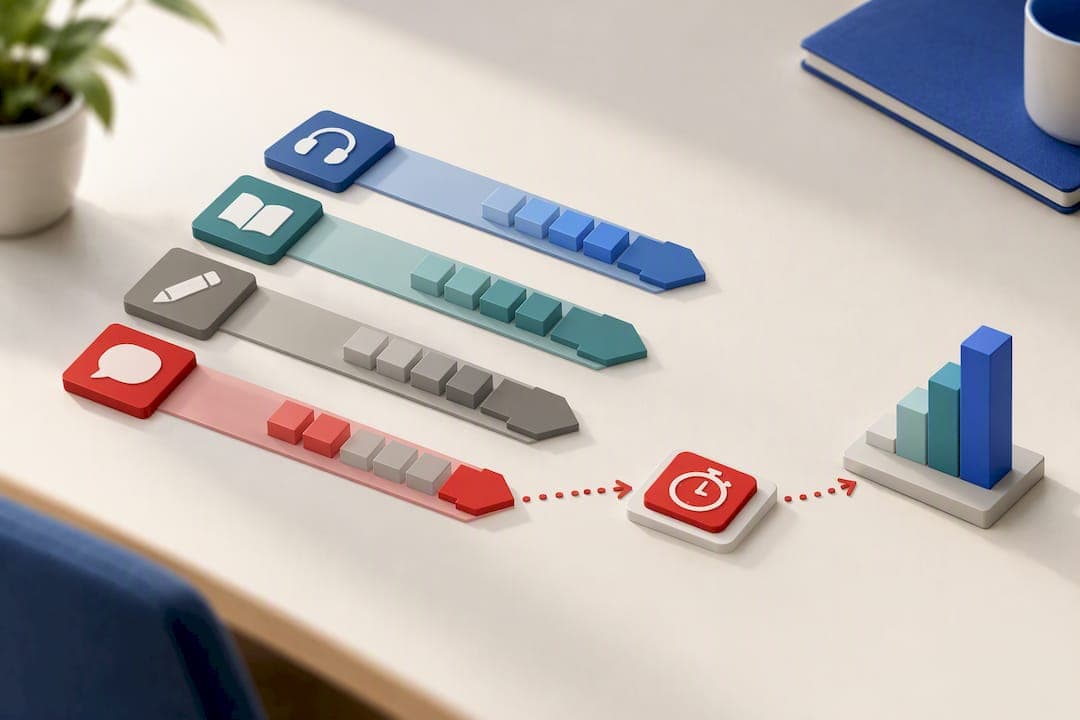
Start by identifying which of the four abilities sits lowest against your target CLB. If your speaking is at CLB 6 and everything else is at CLB 8, speaking is where your study hours belong, full stop.
From there, structure your prep around the actual test format:
- Listening and Reading benefit from timed, computer‑delivered practice, since the pacing on test day catches people who’ve only studied from books.
- Writing improves fastest with structured feedback against CLB descriptors, because vague self‑assessment rarely catches the specific gaps holding your score down.
- Speaking needs repetition under time pressure, since CELPIP gives you a strict response window with no do‑overs.
A diagnostic test is worth taking before you build a study schedule, because it tells you exactly where your CLB gaps sit instead of leaving you guessing; consider taking an English Accent Test: A Strategic Diagnostic for Professional Clarity to pinpoint your pronunciation and clarity challenges. From there, full-length mock exams under real timed conditions matter more than scattered drills, since they train you to manage the clock the way test day actually demands.
Pro Tip: If you’re stuck between two abilities that both feel weak, test under real exam timing first. A lot of candidates discover their “reading problem” is actually a pacing problem, which changes what you need to practise.
Tools that give instant, rubric‑based feedback on writing and speaking tasks cut down the guesswork considerably, since you’re not waiting days to find out whether your response would have scored a CLB 7 or a CLB 8. An AI‑driven study plan that adapts to your diagnostic results can also help you avoid spending equal time on all four skills when one of them is doing all the damage to your CRS total.
CELPIP vs. IELTS: which test should you take for Express Entry?
Both CELPIP‑General and IELTS General Training are accepted by IRCC for Express Entry, and neither one carries an inherent scoring advantage. The choice comes down to format fit, not test difficulty.
CELPIP is fully computer‑delivered, Canadian in its content and accent exposure, and scored using a direct CLB conversion with no additional table to consult. IELTS uses a mix of computer or paper delivery depending on location, includes a face‑to‑face speaking interview with a live examiner, and requires converting its band scores into CLB equivalents through a separate IRCC conversion chart.
If you’re more comfortable typing than handwriting, and you’d rather speak into a headset than sit across from a stranger, CELPIP tends to feel more natural. If you’ve studied extensively with IELTS materials already, or you prefer a live conversational speaking format, IELTS might suit you better.
Neither test rewards test‑specific tricks over genuine English proficiency, so the honest answer is to pick whichever format matches how you naturally perform under pressure. Availability matters too. Check test date openings near you, since one test may have significantly shorter wait times in your city than the other, and a faster booking can matter more than a marginal format preference if your Express Entry timeline is tight.
What mistakes do candidates most often make with CELPIP for Express Entry?
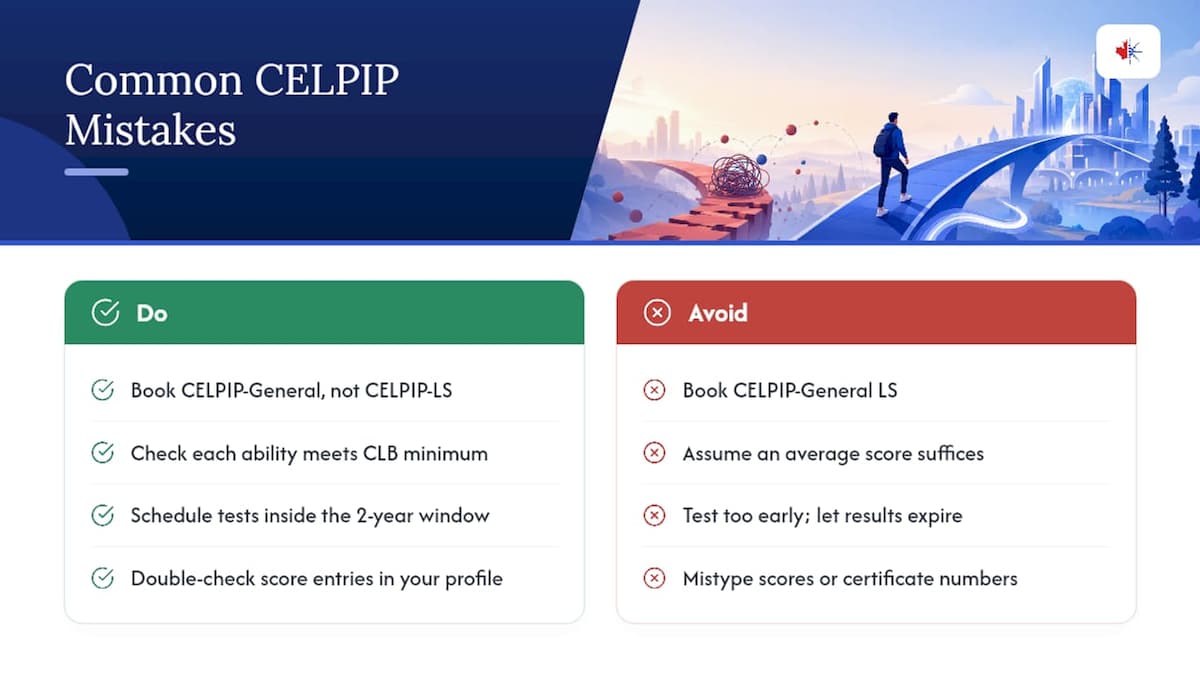
The single most common mistake is booking CELPIP‑General LS by accident, thinking it’s a shorter or easier version of the full test. It isn’t accepted for Express Entry at all, and discovering that after you’ve already tested means starting over.
The second mistake is treating an average score as good enough. Candidates sometimes see an overall impression of “CLB 8 ish” and assume they’re covered, without checking whether their lowest individual ability actually clears the program minimum. IRCC doesn’t average, it checks each ability on its own.
A third mistake is timing the test too early relative to the application timeline. Some candidates test right when they start researching Express Entry, sit in the pool for over a year, and end up submitting an application with expired results because they never tracked the two‑year window against their likely invitation date.
Fourth, some applicants under‑enter their scores. Manual data entry errors, a mistyped certificate number, a wrong test date, create processing delays that are entirely avoidable if you double check the official report against what you’ve entered in your profile.
Finally, a lot of candidates study broadly instead of targeting their weakest ability. If your CRS math shows writing is the ability holding back your CLB and CRS score, spending equal hours on listening (where you’re already strong) is time that could have gone toward the score that actually needs to move.
Do CELPIP scores affect eligibility beyond your CRS total?
Your CELPIP score does more than add points. It can determine whether you’re eligible for a program at all, independent of how competitive your overall CRS total looks.
Each Express Entry program sets its own hard minimum CLB thresholds, and falling short in even one ability disqualifies you from that specific program, regardless of how many CRS points you’d otherwise have. A candidate with a stellar job offer and years of skilled Canadian work experience still can’t enter under CEC if one ability sits below CLB 5 for a TEER 2 or 3 role.
This is where the eligibility question and the points question genuinely diverge. You could have a CRS total that would place well in a recent draw, but if your language scores don’t clear your program’s threshold, you’re not even in the pool for consideration under that pathway. Some candidates who narrowly miss FSWP’s CLB 7 requirement in one ability might still qualify under CEC’s lower CLB 5 threshold for certain job categories, so it’s worth checking every program you might be eligible for rather than assuming one CLB shortfall rules you out entirely.
The practical takeaway is to treat your CLB minimum as a gate, not a target. Clear the gate first for your intended program, then focus on raising your CRS total from there.
How often can you retake CELPIP, and how should you approach a retest?
CELPIP doesn’t impose a mandatory waiting period between attempts the way some other exams do, so you can rebook as soon as a test date is available near you. That flexibility is useful, but it also means candidates sometimes retest impulsively without changing anything about their prep.
Before you rebook, look honestly at why your last score fell short. If one ability was clearly weaker than the rest, generic re‑study rarely moves the needle much. Targeted practice against the specific CLB descriptor you’re missing tends to produce a bigger jump than repeating the same broad review.
Give yourself enough runway between attempts to actually implement changes. Retesting a week later with the same study habits usually produces a similar score. A few weeks of focused work on your weakest ability, backed by timed practice under real exam conditions, gives you a genuine shot at moving up a CLB band rather than just hoping for a better day.
Keep your two‑year validity window in mind when you’re deciding how many attempts to plan for. If you’re retesting to chase CLB 9 for the CRS point bump, make sure your final accepted result still has enough runway left to cover your profile submission and your eventual PR application, not just your invitation date.
Language scores are one piece of a bigger CRS puzzle
CELPIP prep tends to swallow people’s attention because it’s the most concrete, most controllable part of an Express Entry application. You can drill writing tasks and see your score move. You can’t control when the next draw happens or what the cut off will be.
That’s exactly why I’d encourage you to model your language target alongside your education, work experience, and spouse or common‑law partner factors, not in isolation. A CLB 9 that pushes you from a CRS total of 470 to 490 matters a lot less if the last few draws cut off at 520. Run the CRS calculator with your full profile before you decide how hard to chase an extra CLB band.
Keep your official report, certificate number, and test PIN organized from day one. It sounds like a small administrative detail until you’re the one scrambling to find a document during a PR application deadline.
— Reza
Build your CLB target with structured CELPIP prep
Once you know your target CLB and the ability that’s holding back your CRS total, the harder part is turning that target into a study plan that actually moves the needle before your next draw. The platform offers a high volume of practice for CELPIP prep, with many full mock exams and thousands of practice questions built around real CLB benchmarks, so you’re training against the same standards IRCC uses to score you.
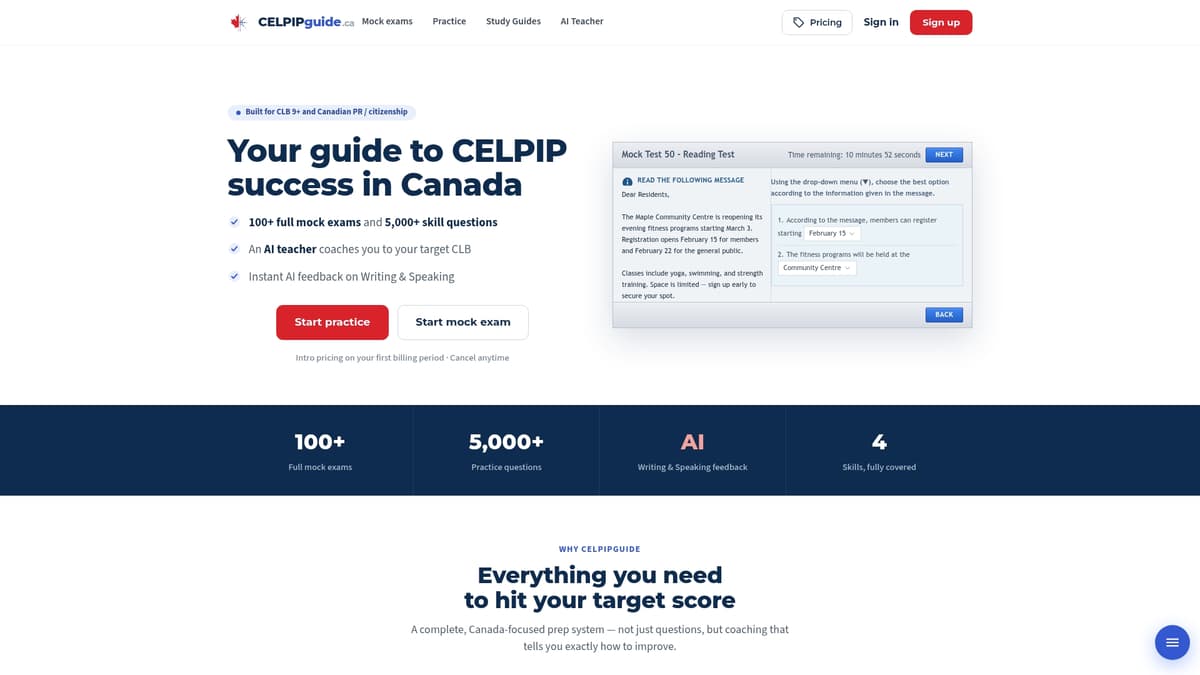
An AI teacher builds a personalized study plan from your diagnostic results and gives instant, rubric‑based feedback on writing and speaking tasks, the two abilities where vague self‑assessment costs candidates the most CRS points. Instead of guessing whether your response would land a CLB 7 or CLB 8, you get feedback mapped directly to the benchmark you’re targeting. Full‑length mock exams simulate the actual computer‑delivered format, so test day pacing stops being a surprise.
Use code BLG30 for a discount, and check out the Plus plan to get started.
Official IRCC pages and tools worth bookmarking
- Express Entry: Language test results
- Express Entry: Check your CRS score
- CELPIP official test information
Sources
FAQ
What CELPIP score is needed for Express Entry?
It depends on your program: FSWP requires CLB 7 in all four abilities, CEC requires CLB 7 (TEER 0/1) or CLB 5 (TEER 2/3), and FSTP needs CLB 5 for speaking and listening, CLB 4 for reading and writing. Your CRS total then depends on how far above those minimums your scores sit.
Can I use CELPIP for PR in Canada?
Yes, CELPIP‑General is one of the tests IRCC accepts for both Express Entry and, separately, citizenship applications (via CELPIP‑General LS). For permanent residence through Express Entry, you must use CELPIP‑General specifically, not the LS version.
Is CLB 7 enough for Express Entry?
CLB 7 clears the minimum for FSWP and for CEC candidates in TEER 0 or 1 jobs, so it’s enough for eligibility in those cases. It won’t maximize your CRS points, though, since higher CLB bands like 9 and 10 add meaningfully more to your total.
Which CELPIP score is good for PR?
A CELPIP score of 9 or higher across all four abilities is a strong practical target, since it clears every program’s minimum comfortably and unlocks a bigger jump in CRS points than the CLB 7 to 8 range. There’s no single “magic” score, though, because your final CRS ranking depends on your whole profile, not language alone.
What does Celpipguide cost?
The Plus plan is available for $29.99 as a one‑time purchase, giving you access to the full mock exam library, practice questions, and AI feedback tools.