
CELPIP Blog
Master Canadian Spelling for CELPIP in 3–4 Weeks with 20 Key Words
Master Canadian Spelling for CELPIP in 3–4 Weeks with 20 Key Words

Use Canadian-preferred spellings when they’re clear, and otherwise pick one variety and stay consistent. CELPIP accepts both British and American spellings, but mixing them within the same response can hurt clarity and cohesion. Pick one anchor, such as the Language Portal of Canada or the Canadian Oxford, and practise it exclusively before test day.
TL;DR:
- Using a consistent Canadian spelling system before the exam helps avoid mixing British and American forms, which can lower your score.
- Memorizing six key spelling patterns and twenty high-frequency words ensures you write accurately and avoid obvious inconsistencies.
- Practicing with real feedback tools and timed responses solidifies your spelling habits more effectively than passive study.
- Setting your device’s spell check to Canadian English and keeping a personal reference sheet improves your accuracy during practice and the test.
- Recognizing Canadian-specific idioms and references allows for more natural responses, but avoid overusing unfamiliar slang to maintain proper tone.
Table of Contents
- Canadian vs American spelling for CELPIP: which one wins?
- Core Canadian spelling patterns you need memorized
- Quick cheat sheet: high-frequency CELPIP words to drill
- Formality and tone for CELPIP workplace writing
- Your CELPIP spelling practice routine, week by week
- How Canadian spelling differs from British and Australian English
- Tips for building Canadian spelling into your CELPIP prep
- Canadian idioms and phrases that show up in CELPIP tasks
- Dictionaries and tools for mastering Canadian spelling
- Picking your anchor and moving forward
- Practise your Canadian spelling with real feedback, not guesswork
- Where to double check Canadian spelling rules
- Sources
- FAQ
Canadian vs American spelling for CELPIP: which one wins?
Canadian English is not a simplified version of British or American English. It is a genuine hybrid, and that matters more than most test takers realize when they sit down to write.
Canadians write “colour” and “centre” the British way, but they write “organize” and “realize” the American way, with the -ize ending. This split isn’t random. It reflects how Canadian dictionaries actually list preferred forms, often putting the -ize spelling first for verbs even while keeping British -our and -re patterns elsewhere. CELPIP graders are trained to accept both British and American spelling conventions, so writing “colour” or “color” won’t cost you marks on its own. The problem shows up when a single essay contains both “colour” and “color”, or “organise” in one paragraph and “organize” in the next.
Here’s the practical approach that keeps you safe:
- Pick one spelling system before you walk into the exam, not while you’re writing under pressure.
- Default to Canadian-preferred forms when you know them. They read naturally to Canadian graders and signal local fluency.
- Use a Canadian dictionary as your reference point during practice, since it lists the preferred form first in most entries.
- Never switch mid-response, even if you’re unsure which form is “more correct.” Consistency beats perfection here.
This is the single highest-leverage habit for the spelling side of your CELPIP writing tasks.
Core Canadian spelling patterns you need memorized
Six pattern groups cover almost every spelling decision you’ll face in a CELPIP response. Learn these as pairs, not as isolated words, and the exceptions stop feeling random.
- -our vs -or: colour/color, favour/favour, honour/honour, neighbour/neighbour, labour/labour
- -re vs -er: centre/centre, theatre/theatre, metre/meter, litre/litter
- -ize vs -ise: organize/organise, realize/realise, recognize/recognise (Canadian English favours -ize, like American English)
- -yse vs -yze: analyze/analyse (Canadian and American English use -yze; British English uses -yse)
- Doubling the final l: travelling/traveling, cancelled/canceled, modelling/modeling (Canadian English doubles the l, following British convention)
- ae/oe vs e: encyclopedia (not encyclopaedia), maneuver (not manoeuvre in most Canadian usage, though both appear)
Notice that Canadian English doesn’t pick one parent consistently. It borrows the British doubled-l rule and the American -ize ending in the same paragraph, which is exactly why writing “cancelled” alongside “organize” is correct, not contradictory.
Pro Tip: Build a single page with these six patterns and ten example words each, then read it aloud once a day for a week. Saying the words engages a different memory pathway than silent reading, and it’s the fastest way to catch yourself defaulting to a spelling you learned from American media.
Quick cheat sheet: high-frequency CELPIP words to drill
A short list of frequently tested words does more for your score than a long list of obscure ones. These twenty show up constantly in workplace emails, opinion essays, and survey responses, the bread and butter of CELPIP writing tasks.
- -our group: colour, favour, neighbour, honour, labour, behaviour
- -re group: centre, metre, theatre, litre
- -ize group: organize, realize, recognize, apologize
- Everyday nouns: cheque (banking), licence (noun form), practice (noun) vs practise (verb)
- Doubling group: travelling, cancelled, counselling, modelling
Written discourse scoring on CELPIP rewards clarity and cohesion, and spelling consistency is one of the quieter factors feeding into that score. A grader who spots “colour” in paragraph one and “color” in paragraph three isn’t just noticing a typo. They’re seeing a pattern that suggests the writing wasn’t reviewed carefully, and that impression bleeds into how the whole response reads.
Drill these on a timer: five minutes, write each word three times from memory, then check against your reference list. Repeat this three times a week and the patterns stop requiring conscious thought by test day.
Formality and tone for CELPIP workplace writing
CELPIP Task 1 usually asks for a semi-formal to formal email, and the salutation you choose sets the tone for everything that follows.
- Open with “Dear [Name]” or “Hello [Name]” depending on the stated relationship in the prompt.
- Keep your sign-off consistent with the opening: “Sincerely” or “Best regards” for formal contexts, “Thanks” or “Best” for casual ones.
- State your purpose in the first two sentences. Canadian workplace writing tends toward polite directness rather than lengthy preamble.
- Scan your draft in the final two minutes for three things: spelling consistency, matching salutation and sign-off tone, and punctuation.
Pro Tip: Read your closing sentence and your opening salutation back to back before submitting. If the tone doesn’t match, that’s often the fastest tell that your register drifted somewhere in the middle.
Your CELPIP spelling practice routine, week by week
A focused three to four week routine beats scattered review. Week one: learn the six spelling patterns and drill the twenty high-frequency words daily. Week two: write timed responses using CELPIP Writing Task 2 samples as models, checking every submission against your chosen spelling anchor.
Week three: take a diagnostic test to surface which patterns you’re still mixing, since most learners don’t notice their own inconsistencies without outside feedback. An AI feedback tool that flags spelling drift instantly is far more useful here than proofreading your own work, since you already know what you meant to write. Week four: full mock exams under timed conditions, treating spelling consistency as one item on your final scan checklist alongside grammar and task completion.
How Canadian spelling differs from British and Australian English
Canadian spelling isn’t just “American minus a few British holdovers.” It has its own quirks that separate it from both British and Australian English, and these trip up learners who studied one of those varieties first.
Australian English follows British conventions almost universally: colour, centre, organise, and analyse all keep their British forms. Canadian English breaks from that pattern specifically at the -ize/-ise fork, favouring the American -ize ending while keeping British spellings almost everywhere else. An Australian writer moving to Canadian conventions has to relearn just one major pattern group. An American writer has to relearn several.
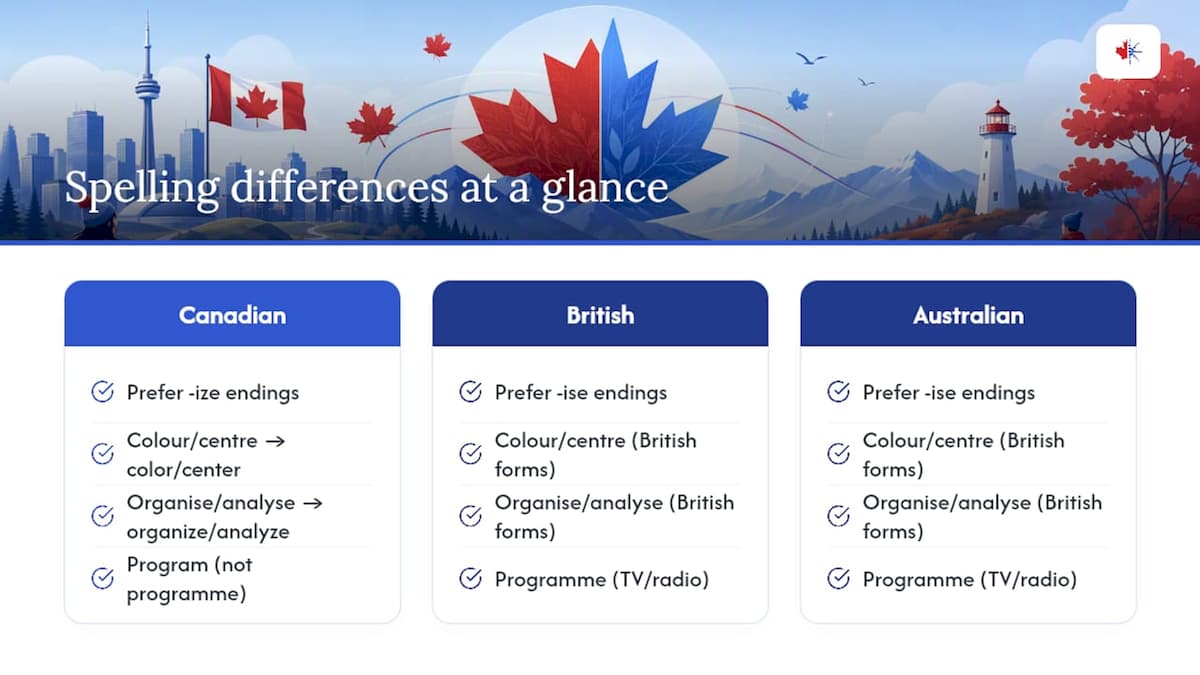
British English also differs from Canadian usage in smaller, specific words. British spells “programme” for a television or radio show but Canadian and American English use “program” in nearly every context, including computer programs. British English often prefers “manoeuvre” while Canadian usage splits between that form and the simplified “maneuver,” depending on the publication.
The doubling-of-l rule is another split point. British and Canadian English double the final l in words like “travelling” and “cancelled” before adding a suffix, while American English typically drops the second l, giving “traveling” and “canceled.” Australian English matches the British and Canadian doubling pattern here, so this rule is one place where Canada aligns with both its Commonwealth cousins rather than sitting apart.
Knowing these specific fork points, rather than memorizing three entire spelling systems, is the efficient way to keep your CELPIP writing consistent.
Tips for building Canadian spelling into your CELPIP prep
Treat spelling as a discrete skill you train, not something that happens automatically as your English improves. Fluent speakers still mix spelling conventions constantly, especially if they’ve consumed a lot of American media or studied British English formally.
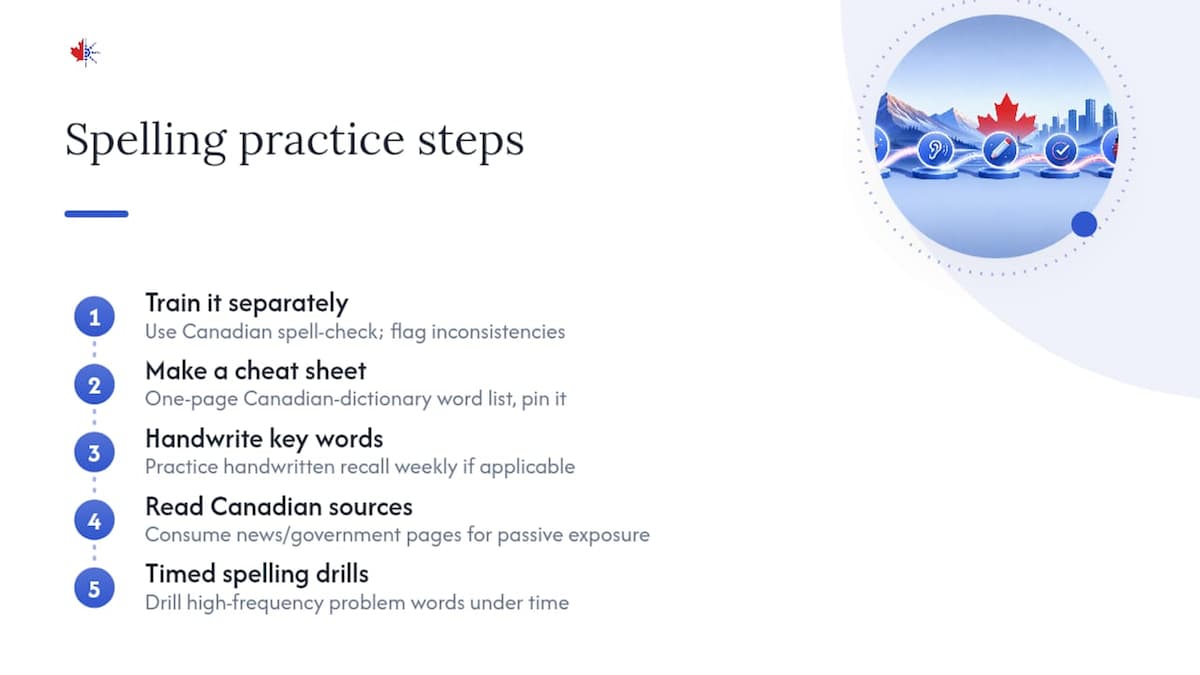
Start by changing your device’s spell check to Canadian English (available in Microsoft Word, Google Docs, and most browsers) so that autocorrect stops fighting your practice instead of supporting it. Every time you type a practice response, let the spell checker flag inconsistencies in real time.
Second, build your own reference sheet rather than relying on memory. A first-choice list from a Canadian dictionary kept as a one-page cheat sheet is a genuinely practical, test-ready strategy that writers use well beyond exam prep. Pin it near your practice space.
Third, practise handwriting a handful of your trickiest words weekly if your test format includes any handwritten component, since typing and handwriting engage spelling recall differently. Fourth, read Canadian news sources or government pages during your prep weeks. Exposure to real Canadian writing reinforces the patterns passively, alongside your active drilling.
Finally, treat every timed practice essay as a spelling check, not just a content check. Building a small memorized list of high-frequency problem words and drilling them under timed conditions is the single most effective habit for eliminating mixing errors before they show up on test day.
Canadian idioms and phrases that show up in CELPIP tasks
CELPIP speaking and writing prompts sometimes include everyday Canadian phrasing, and recognizing it helps you respond naturally instead of pausing to parse unfamiliar wording.
Phrases like “give it a shot” (try something), “the whole nine yards” (everything included), or “keep an eye on” (monitor) appear in casual prompt scenarios and are safe to use in your own responses when the tone calls for it. Canadian speakers also favour softer hedging phrases such as “I was wondering if” or “would it be possible to,” which fit naturally into the polite, semi-formal register CELPIP Task 1 rewards.
You’ll also see workplace-specific expressions: “loop someone in” (include them in communication), “touch base” (check in briefly), and “circle back” (revisit later). These are common enough in Canadian professional writing that using one or two naturally, rather than forcing several into a short response, can make an email response read more authentically local without sounding scripted.
Avoid overusing slang or idioms you’re not fully comfortable with. One well-placed, natural phrase reads better than three idioms crammed into a paragraph where the tone starts to feel unnatural rather than fluent.
Dictionaries and tools for mastering Canadian spelling
The Canadian Oxford Dictionary remains the standard reference for first-choice Canadian spellings, listing preferred forms ahead of acceptable variants. If you don’t own a physical copy, the Language Portal of Canada offers free guidance on spelling tendencies and is a solid daily-use substitute.
University style guides are surprisingly useful for exam prep, even though they’re built for academic publishing. Both the Ryerson Open Textbook Authoring Guide and the York University style guide publish first-choice Canadian spelling lists with troublesome word examples, and they’re free to browse online.
For daily practice, set your word processor and browser spell check to “English (Canada)” rather than the default “English (US).” This single setting change means every practice essay you write gets checked against Canadian conventions automatically, catching inconsistencies you’d otherwise miss. Most learners never adjust this setting and end up training themselves against the wrong spelling system for months without realizing it.
Combine a dictionary reference with a tool that gives you immediate feedback on full responses, since spotting an isolated word is different from catching inconsistency across an entire essay under timed conditions.
Picking your anchor and moving forward
Pick Canadian-preferred spellings where the choice is clear, and where it isn’t, choose one system and never look back mid-response. That single discipline solves most of the spelling problems I see in practice essays. It’s not about memorizing every rule perfectly. It’s about removing the unconscious switching that happens when your brain has absorbed spelling from three different English varieties at once.
Run a diagnostic check early in your prep, then build fifteen minutes of daily drilling around whatever it reveals.
— Reza
Practise your Canadian spelling with real feedback, not guesswork
Reading about spelling patterns only gets you halfway there. The gap between knowing the -our/-or rule and actually writing consistently under exam pressure closes through repetition with real feedback, not another article.

Celpipguide’s Free CELPIP Writing Checker gives instant rubric-based feedback on your writing, flagging spelling inconsistencies the moment they happen instead of days later when a tutor gets around to your submission. Pair that with the CELPIP Readiness Check, a diagnostic that builds you a personalized prep plan based on exactly where your spelling, grammar, and task completion stand today. From there, full-length mock exams let you test your Canadian spelling anchor under real timed conditions before test day arrives.
Start with the readiness check today and see exactly what your spelling habits are costing you.
Where to double check Canadian spelling rules
- Language Portal of Canada: explains Canadian spelling tendencies and hybrid patterns
- Canada.ca design guide: official style guidance for workplace and publication writing
- York University style guide: troublesome word lists and Canadian preferences
Sources
CELPIP prompts often drop in Canadian-specific references, and recognizing them quickly saves you from wasting time decoding context instead of writing your response.
- Canadian, British and American: It’s all English, but the spelling is different – The Our Languages blog
- Canada.ca design guide
- Canadian Spellings – Ryerson Open Textbook Authoring Guide
- Canadian spellings — York University brand/style guide
You don’t need deep cultural knowledge to respond well. If a prompt mentions a health card renewal or a hockey tournament schedule conflict, treat it like any other scenario: identify the task, respond directly, and use “cheque” instead of “check” if payment comes up naturally.
FAQ
Is a CELPIP score of 7 good?
A CELPIP scores correspond to CLB levels, which meet many economic immigration and professional licensing thresholds in Canada. Whether it’s “good enough” depends entirely on the specific program or job requirement you’re applying under.
Which CELPIP test is for Canadian permanent residence?
CELPIP General is the version accepted for Express Entry and most permanent residence applications, as opposed to CELPIP General LS, which serves citizenship purposes only. Always confirm the exact version required by checking the specific immigration program you’re applying to.
Is CLB 10 the same as a CELPIP score of 7?
No. CELPIP scores typically align to CLB levels, with each of the four skills scored separately, so your CLB level depends on your lowest skill score.
How much does it cost to write CELPIP in Canada?
CELPIP exam fees are set by the official test provider and are subject to change, so confirm current pricing directly through the official CELPIP registration site before booking. Preparation costs, separate from the exam fee itself, vary depending on whether you use free resources or a paid platform like Celpipguide’s practice exam hub.