
CELPIP Blog
CELPIP writing tasks: formats, timing, and scoring explained
CELPIP writing tasks: formats, timing, and scoring explained

The CELPIP writing section has two tasks: an email (about 27 minutes, 150 to 200 words) and a survey response, often called an essay (about 26 minutes, 150 to 250 words). The single strategy that moves scores is this: plan for one minute, write with a tight template, hit every part of the prompt, then review for two minutes. That sounds almost too simple, and yet most test takers lose points not because their English is weak, but because they skip the plan or ignore half the prompt.
Two things anchor everything that follows. First, the CELPIP scoring rubric, which grades your response on four axes rather than one overall impression. Second, tools like CELPIPguide’s diagnostic test and AI writing checker, built specifically to show you which of those axes is dragging your score down before test day arrives.
Here’s what to memorize before you touch a practice prompt:
- Task 1 (email) typically allows about a half hour, with recommended word ranges for clear, focused responses, always presenting a request, complaint, or suggestion scenario.
- Task 2 (survey/essay) also allocates about half an hour, suggesting a word count range that supports developing and defending a clear position.
- Both tasks are typed, not handwritten, so typing speed and comfort with a keyboard actually affect your score.
- The most effective ways to improve your score often involve focusing on structure and fully covering the prompt rather than expanding vocabulary alone.
Pro Tip: Write your closing sentence first if you’re stuck. Knowing where you’re headed makes the middle paragraphs almost write themselves.
Key Takeaways
Improving CELPIP writing scores comes down to structured templates, full prompt coverage, and timed practice with honest feedback, not raw vocabulary or grammar study alone.
| Point | Details |
|---|---|
| Know your timing | Task 1 runs about 27 minutes (150 to 200 words); Task 2 runs about 26 minutes (150 to 250 words). |
| Cover every bullet | Missing even one prompt bullet caps your task fulfilment score regardless of sentence quality. |
| Use fixed templates | A repeatable email and essay skeleton frees up mental space to focus on content, not structure. |
| Fix repeated errors first | Target your top two or three recurring grammar mistakes instead of reviewing grammar broadly. |
| Practise under real conditions | CELPIPguide’s mock exams, writing checker, and study plan generator build the timed, typed, feedback-driven practice that transfers best to test day. |
Where to verify official details and keep practising
Official test rules occasionally shift, so cross-check anything time-sensitive directly with CELPIP’s own pages.
- CELPIP registration and test information confirms current test structure and administrative steps.
- Paragon’s instructional products pages list official test materials and administration details.
- CELPIPguide’s Task 1 email samples and Task 2 survey samples offer annotated practice material aligned to the templates above.
- Check official CELPIP pages before test day for any procedural updates, since timing and format details are occasionally revised.
Table of Contents
- What are the CELPIP writing task formats?
- How is CELPIP writing scored?
- How do you structure a CELPIP Task 1 email?
- How do you write a strong CELPIP Task 2 essay?
- What mistakes lower CELPIP writing scores?
- What does a 4-week CELPIP writing practice plan look like?
- How should you manage time during the writing test?
- Turn this plan into practice with CELPIPguide’s writing tools
- Sources
- FAQ
What are the CELPIP writing task formats?
Task 1 gives you a scenario and asks you to write an email. The three prompt types repeat predictably: you’re asking for something (a refund, a schedule change, information), you’re complaining about a service or situation, or you’re suggesting an idea to a group or organization. Each requires a different tone. A request to a landlord stays polite and slightly formal. A complaint to a company needs firm but professional language, never aggressive. A suggestion to a community group can be warmer and more collaborative.
Every Task 1 prompt gives you three to four bullet points you must address. Missing even one bullet caps your task fulfilment score regardless of how polished your sentences are. Sign off appropriately: “Sincerely” or “Best regards” for formal emails, something lighter like “Thanks” only when the scenario is genuinely casual (writing to a friend or neighbour, for instance).
Task 2 asks you to respond to a survey question, which is really an opinion essay in disguise. The prompt forms fall into three patterns:
- A direct opinion question (“Which option would you choose and why?”).
- A pros-and-cons comparison where you pick a side.
- A problem-and-solution scenario where you propose and defend an approach.
In every case, you state your position early, usually by the end of your first sentence or two, then spend the bulk of your word count supporting it with two developed reasons. The official CELPIP registration portal confirms the writing component’s structure and timing, so it’s worth a quick read if you want to see the format described in the test-maker’s own words.
One detail that trips up test takers who learned English mostly through reading and speaking: the entire test is delivered on computer, with no option to write by hand. If you’re not used to typing full paragraphs quickly and accurately, that alone can cost you five or six of your available minutes before you’ve written a complete thought.
How is CELPIP writing scored?
Raters mark your writing against four main criteria, and understanding what each one actually measures lets you target practice instead of vaguely “getting better at English.”
- Content and coherence (often called task fulfilment): did you address every bullet point in the prompt, and does your response flow logically from idea to idea? Skipping a bullet, even a minor one, is the single most common way strong writers lose points they shouldn’t.
- Vocabulary: are your word choices precise and varied, or do you repeat the same three adjectives in every paragraph? Raters notice when “good,” “bad,” and “important” carry your entire argument.
- Readability: does your writing move at a natural pace, with sentences that vary in length and connectors that guide the reader between ideas?
- Task-specific grammar: are your verb tenses, articles, and sentence structures accurate enough that errors don’t interrupt meaning?
Quick drills map directly onto each axis. For task fulfilment, practise rewriting prompts as a checklist before you draft. For vocabulary, keep a running list of synonyms for overused words like “good,” “important,” and “problem.” For grammar, isolate your three most frequent error types (article misuse and subject-verb agreement are the most common across CELPIP writing samples) and drill only those, rather than reviewing grammar broadly.
Pro Tip: In your last two minutes, don’t reread for meaning. Scan specifically for one thing: did you answer every bullet point in the prompt? That single check recovers more points than a full grammar pass.
How do you structure a CELPIP Task 1 email?
A reliable template removes the guesswork under time pressure. Use this shape for nearly any Task 1 prompt:
- Greeting: “Dear [Name/Title],” matched to the formality of the scenario.
- Purpose sentence: state why you’re writing in one clear sentence.
- Paragraph 1: address the first one or two bullet points with a specific detail (a date, a number, a name).
- Paragraph 2: address the remaining bullet points, again with concrete specifics rather than vague statements.
- Closing and sign-off: a polite closing line plus an appropriate sign-off.
Here’s an annotated sample responding to a prompt about a delayed furniture delivery, with notes on why each part earns points:
Dear Ms. Alvarez,
I am writing to follow up on the dining table and chairs I ordered on March 3, which were scheduled to arrive last week. (Purpose sentence stated immediately, addresses the “explain the situation” bullet.)
The tracking information still shows the order as “processing,” and I have not received any update from your team. This delay is becoming a problem because I have guests arriving this weekend and no table to host them. (Specific detail: “guests arriving this weekend” gives the rater concrete content instead of generic complaint language.)
Could you confirm the new expected delivery date, and let me know whether expedited shipping is available at no extra cost given the delay? I would appreciate a response by Thursday if possible. (Directly answers the “make a request” bullet with two clear, specific asks.)
Thank you for your attention to this matter.
Sincerely, Jordan Lee
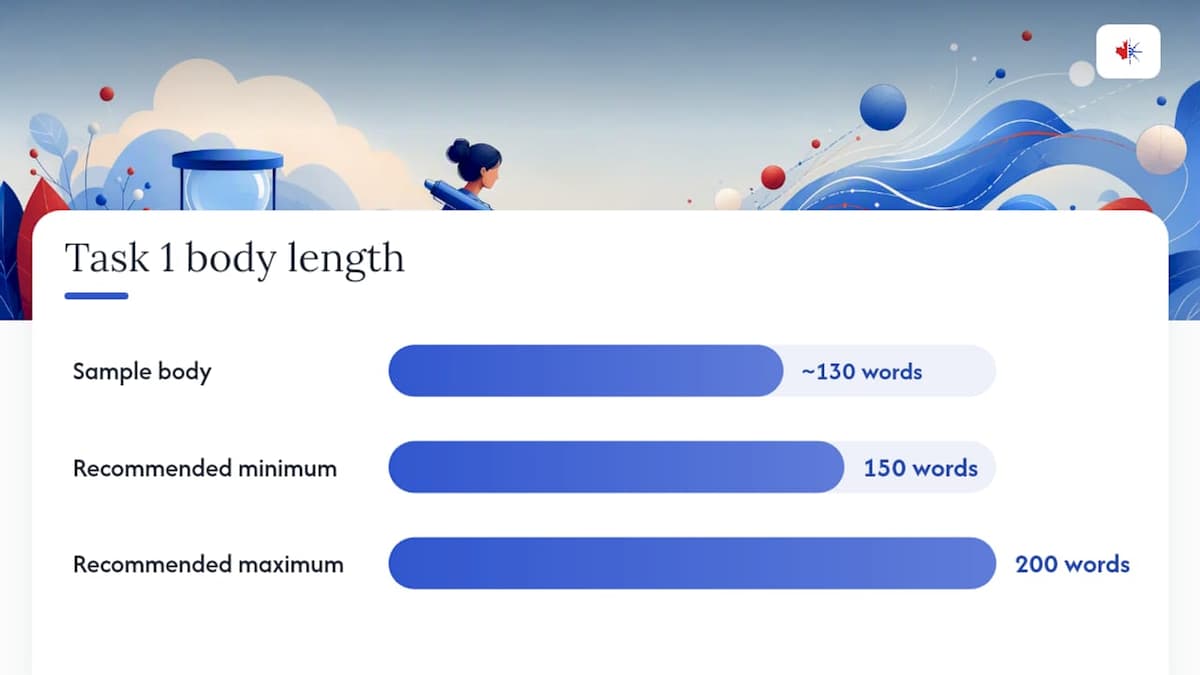
That sample runs about 130 words in the body; padding it to the 150 to 200 word range usually means adding one more specific detail per paragraph, not more sentences of throat-clearing.
Two quick variations matter. For a request prompt, keep the tone cooperative and end with a specific, answerable question. For a complaint prompt, state the problem plainly in paragraph one, avoid emotional language (“this is unacceptable” reads worse than “this has caused a significant inconvenience”), and still end with a solution-oriented request rather than just venting. The most common pitfall in both cases is tone mismatch: writing a complaint email in an overly casual register or a request email that sounds demanding rather than polite. Browse more annotated email examples to see how the template adapts across different scenarios.
How do you write a strong CELPIP Task 2 essay?
Task 2 rewards a predictable skeleton more than creative structure. Use this:
- Position sentence: state your choice or opinion clearly in sentence one or two.
- Reason 1 + example: a developed point with a specific, concrete illustration.
- Reason 2 + example: a second, distinct point, ideally addressing a different angle than reason one.
- Optional brief counterpoint: one sentence acknowledging the other side, if the prompt invites comparison.
- Concluding sentence: restate your position without repeating your opening sentence word for word.
Here’s an annotated sample responding to a survey asking whether cities should invest more in public parks or public transit:
I believe cities should prioritize investment in public transit over parks, because transit access has a more direct effect on daily quality of life. (Clear position stated immediately, satisfies content/coherence from sentence one.)
First, reliable transit reduces commute stress and traffic congestion. In my own city, a new bus rapid transit line cut my commute from 50 minutes to 20, which gave me back nearly five hours a week. (Specific personal example beats a vague generalization like “transit helps people save time.”)
Second, transit investment benefits a wider range of residents, including those who cannot afford a car or do not live near a park. A senior citizen without a vehicle depends on a bus route far more than they depend on a nearby green space. (Second, distinct reason, showing breadth of thinking.)
Of course, parks offer real health and community benefits, and a balanced city budget should not ignore them entirely. (Brief counterpoint, one sentence, does not derail the main argument.)
Still, given limited public funds, transit should come first because its impact reaches more residents, more often. (Conclusion restates position with new phrasing, not a copy of the opening line.)
That runs close to 200 words, comfortably inside the 150 to 250 word range. Notice the examples are specific (a bus rapid transit line, a senior citizen without a vehicle) rather than generic claims like “transit is good for everyone.” Under time pressure, the fastest way to generate a specific example is to think of one real person, even a hypothetical one, rather than reaching for an abstract argument. On depth versus breadth: two well-developed reasons consistently score higher than four shallow ones, because raters reward coherence and development over sheer quantity of points. Explore more Task 2 survey samples to see how the skeleton holds up across opinion, pros-and-cons, and problem-solution prompts.
What mistakes lower CELPIP writing scores?
Most score-costing errors repeat across thousands of test takers, which makes them easy to fix once you know what to look for.
- Off-topic content. A test taker asked to recommend a solution instead spends two paragraphs describing the problem. Fix: underline the actual instruction verb (recommend, explain, describe) before drafting, and check your final paragraph answers that verb directly.
- Tone mismatch. Writing “Hey there!” to a formal email prompt, or writing an overly stiff essay response that reads like a legal document. Fix: match your greeting and sign-off to the relationship described in the prompt; read your first line aloud and ask if you’d actually say it to that person.
- Repeated simple grammar errors. The same article mistake (“I go to store” instead of “I go to the store”) appearing five times in one response. Fix: after drafting, scan specifically for your one or two most frequent error types instead of rereading for general accuracy.
- Poor paragraphing. One giant block of text with no visual breaks, which makes coherence harder for a rater to follow quickly. Fix: force a paragraph break at each new idea, even if the response feels short as a result.
A focused 10 to 15 minute drill works well here: take three of your own past responses, and instead of rewriting them fully, just circle every instance of your top error type and correct it in place. Repetition on your own real mistakes fixes patterns faster than generic grammar review.
Pro Tip: Keep a running “error log” of your three most repeated mistakes. Before every practice session, read that log first. Prevention beats correction once you already know your pattern.
What does a 4-week CELPIP writing practice plan look like?
A short, structured plan beats open-ended “practise every day” advice, because it tells you exactly what to do and when to stop.
- Week 1: Diagnose. Start with a full diagnostic test to identify your weak axis (task fulfilment, grammar, vocabulary, or coherence). Spend 20 to 30 minutes daily on typing practice and targeted grammar diagnostics, especially if you’re not used to composing full paragraphs on a keyboard under time pressure.
- Week 2: Drill and template. Practise the Task 1 and Task 2 templates in isolation, without a timer at first, until the structure feels automatic. Run daily 20 to 40 minute drills: one timed email, one focused grammar exercise on your weakest pattern, and a short vocabulary list built around common CELPIP topics (housing, work, community, technology).
- Week 3: Full timed mocks. Shift to complete, timed writing sections using a full mock exam that mirrors the real 53-minute writing window. This is the stage where practice under real time pressure matters most, since timed, typed conditions transfer to test-day performance far better than untimed drafting.
Log your progress week over week, even informally: word count consistency, time remaining at submission, and which rubric axis the AI checker flags most often. That log becomes your evidence of what’s actually improving, rather than a vague sense that you’re “getting better.”
How should you manage time during the writing test?
A workable minute split for Task 1 looks like 2 minutes planning, 20 minutes writing, 5 minutes reviewing, inside your 27-minute window. Task 2 follows a similar rhythm: 2 to 3 minutes planning your position and two reasons, 18 to 19 minutes writing, 4 to 5 minutes reviewing, inside your 26-minute window.
On word count, aim for the lower end of the range on your first draft, roughly 150 to 170 words, then use your review time to add specific detail rather than padding with filler sentences. Monitoring word count as you write, rather than guessing, is one of the habits that separates consistent scorers from inconsistent ones.
Before you sit down for the actual test, run through this checklist:
- Confirm your typing setup and keyboard comfort in advance; the test is fully computer-delivered with no handwriting option.
- Check spelling manually; CELPIP’s typing interface has limited autocorrect support.
- Confirm you’ve responded to every bullet point in both prompts before submitting.
- Leave your final minute for a bullet-point check, not a full reread.
A realistic look at how CELPIP writing scores improve
Most students improve organization before they improve grammar, and that order matters more than people expect. A response with three grammar mistakes but a clear structure and full prompt coverage almost always outscores a grammatically clean response that wanders off-topic or ignores a bullet point. In my experience reviewing how test takers progress, the students who plateau are usually the ones who keep polishing sentence-level English while ignoring whether they actually answered the question asked.
Realistic timelines vary, but two to four weeks of focused, template-driven practice tends to produce a visible jump for most learners, provided the practice includes timed conditions and honest feedback, not just casual writing. Consistency beats intensity here. Fifteen focused minutes daily outperforms one unfocused three-hour session the weekend before your test.
— Reza
Turn this plan into practice with CELPIPguide’s writing tools
Reading a template is one thing; getting honest feedback on whether your own writing actually follows it is another. CELPIPguide closes that gap with tools built specifically around the plan above, so you’re not guessing whether your Task 1 email or Task 2 essay would score well with a real rater.
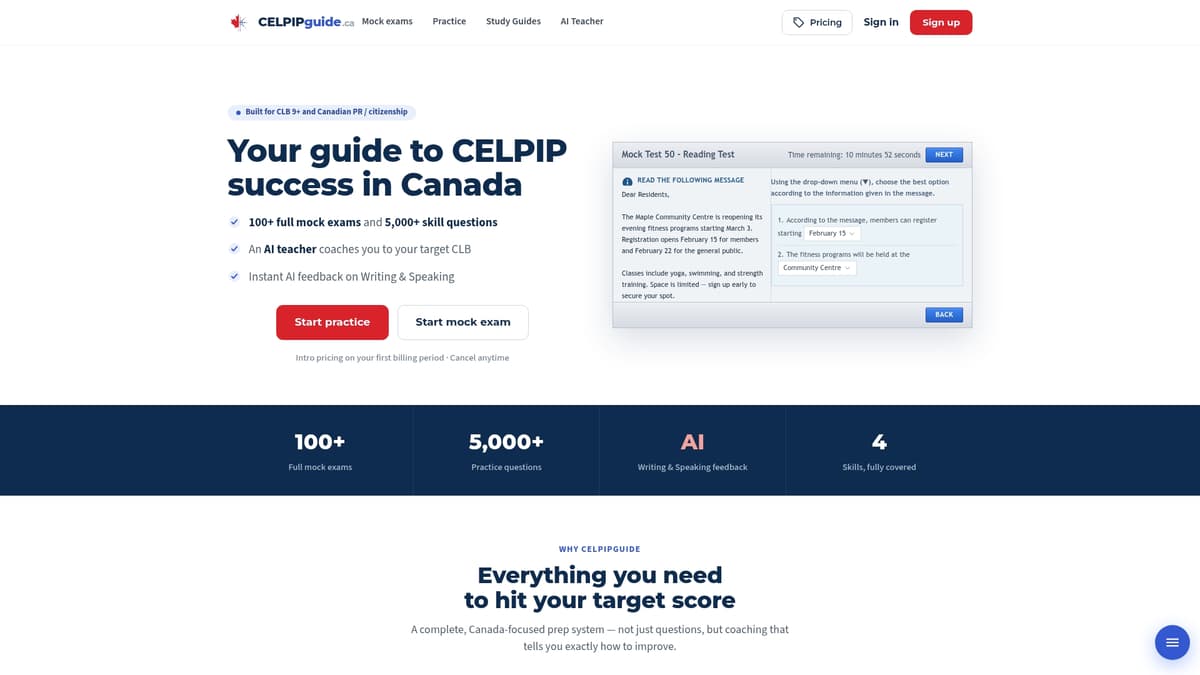
Start with the diagnostic and readiness check to find out which rubric axis needs the most attention before you commit study hours. From there, the Study Plan Generator turns the 4-week structure into a week-by-week schedule built around your own weak points, rather than a generic calendar. When you’re deep in Week 2 and Week 3 drills, run every practice response through the AI writing checker for instant, rubric-based feedback instead of waiting days for human review. And when it’s time for full timed mocks, the CELPIP Exam Practice Hub gives you the complete test conditions your Week 3 practice needs to actually transfer to test day.
Head to the practice hub and build your first mock test today.
Sources
FAQ
How do I practise for CELPIP writing?
Combine timed template practice with real feedback: draft Task 1 and Task 2 responses under test conditions, then run them through a tool like CELPIPguide’s AI writing checker to see which rubric axis needs work.
How do I get a 10 in CELPIP writing?
A top score requires full prompt coverage, well-organized paragraphs, varied and precise vocabulary, and accurate grammar with almost no repeated errors; consistent, timed practice with honest feedback is the most reliable path there, though a CLB 10 is a high bar that takes sustained effort to reach.
Is CELPIP writing harder than IELTS?
Neither is inherently harder; CELPIP writing is typed and computer-delivered with everyday, practical prompts, while IELTS often includes more formal or academic topics, so the better fit depends on your comfort typing under time pressure versus handwriting.
Is it okay to go over 230 words in CELPIP writing?
Going somewhat over the recommended range is generally fine as long as your response stays focused and coherent, but padding with unnecessary content to hit a higher word count can hurt coherence and cost more than it gains.