
CELPIP Blog
Your CELPIP study plan: 4 weeks to a higher score
Your CELPIP study plan: 4 weeks to a higher score

If you have four weeks, here is your plan: spend the first week on a diagnostic and skill-building, the second on targeted practice by section, the third on full mock exams, and the fourth on review and test-day readiness. Start today with these three actions:
- Take a free CELPIP practice test to establish your baseline score across all four skills.
- Set a specific CLB target (CLB 7 for most PR streams, CLB 9 for citizenship).
- Book your test date so your preparation has a fixed deadline to work backward from.
If four weeks is not your reality, the timelines below scale down to one week or up to eight. Pick the one that fits, then run the diagnostic first. Everything else follows from what that test reveals.
Key takeaways
A structured CELPIP study plan built around a diagnostic, targeted skill practice, and regular mock-test review is the most reliable path to a higher CLB score.
| Point | Details |
|---|---|
| Start with a diagnostic | Take a free practice test first to identify your weakest skills before spending a single study hour. |
| Match your timeline to your gap | A 1-week plan suits near-target candidates; a 4-week plan fits most; 8 weeks is right for a two-level jump. |
| Review every mock carefully | Log error types and timing gaps after each mock; a score alone tells you almost nothing about what to fix. |
| Prioritise Writing and Speaking feedback | These two skills require rubric-based external feedback to improve; self-review alone is rarely enough. |
| Celpipguide personalises the plan | The AI study plan generator and 100+ mock exams give you a feedback loop that free materials cannot match. |
Table of Contents
- How to start your CELPIP study plan with a diagnostic
- Four ready-made CELPIP study timelines
- Skill-by-skill tactics that actually move your score
- How to use mock exams to raise your score
- What are the best CELPIP study materials?
- Registering for CELPIP and preparing for test day
- How long do you need, and what is a realistic target score?
- A verified 4-week day-by-day study schedule you can start today
- What most candidates get wrong about CELPIP preparation
- Celpipguide gives you the feedback loop that free practice cannot
- Sources
- FAQ
How to start your CELPIP study plan with a diagnostic
The single biggest mistake candidates make is jumping straight into practice questions without knowing where they actually stand. A diagnostic tells you which skills are already close to your target and which ones need the most work. That knowledge shapes every hour you spend studying.
Here is how to run an effective diagnostic:
- Use the official free sample test. Paragon Testing provides a free CELPIP sample test that covers all four components. Treat it exactly like a real exam: sit at a desk, use headphones, and do not pause.
- Simulate real test conditions. Set a timer for each section. Use the same type of computer and microphone you plan to use on test day. Distractions during a diagnostic produce misleading results.
- Record your responses for Writing and Speaking. Do not just submit and move on. Save your written responses and, if possible, record your speaking answers so you can review them against the official scoring rubrics.
- Log your timing per section. Note where you ran out of time, where you finished early, and where you felt uncertain. Timing gaps are often as revealing as wrong answers.
- Map results to CLB levels. CELPIP scores run from 1 to 12 and correspond directly to CLB benchmarks. A score of 7 in each component equals CLB 7, which meets most Express Entry requirements. Compare your diagnostic scores to your target and calculate the gap.
Once you have your results, rank your four skills from weakest to strongest. Your weakest skill gets the most study time in Week 1. Your strongest skill gets maintenance practice only.
Pro Tip: If your Writing score is more than two points below your target, prioritise it immediately. Writing improvements tend to be the most template-driven and therefore the fastest to gain, especially when you have rubric-based feedback to guide your revisions.
Four ready-made CELPIP study timelines
Choosing the right timeline depends on two things: how many hours per day you can realistically study, and how far your diagnostic score sits from your target.
- 1-week plan: You are already near your target score (within 1 CLB level) and need format familiarity and confidence. Expect 3–4 hours per day.
- 2-week plan: You have a modest gap and solid English foundations. Expect moderate daily study time.
- 4-week plan: You have a moderate gap or limited daily study time. This timeline balances distributed practice with repeated mocks and is popular among candidates.
- 8-week plan: You are starting from a lower baseline or need significant Writing and Speaking improvement. This longer timeline accommodates gradual progress with manageable daily study.
1-week crash plan
| Day | Focus | Daily time | Key activity |
|---|---|---|---|
| Day 1 | Diagnostic + format review | 2–3 hours | Full sample test, score all four skills |
| Day 2 | Writing templates | 2–3 hours | Draft and revise two email tasks, one survey |
| Day 3 | Speaking structures | 2–3 hours | Record all eight speaking tasks, self-review |
| Day 4 | Listening and Reading drills | 2–3 hours | Timed section practice, note-taking |
| Day 5 | Full mock exam | 4 hrs | Simulate test day, log errors |
| Day 6 | Targeted review | 3 hrs | Fix top three error patterns from mock |
| Day 7 | Light review + rest | 1.5 hrs | Skim templates, confirm logistics |
Short crash courses can produce rapid gains in format familiarity, but they rely on intensive repetition and templates rather than deeper language development. One week is enough to close a small gap; it is not enough to rebuild a weak skill from scratch.
2-week plan
- Week 1: Diagnostic, skill-by-skill targeted practice (Writing and Speaking first), one full mock on Day 7.
- Week 2: Error review from the mock, focused drills on your two weakest skills, a second full mock on Day 13, final review and test-day prep on Day 14.
Daily time budget: 2–3 hours. Aim for one scored writing sample and two recorded speaking responses per day.
4-week plan (recommended)
A four-week cadence is popular because it balances distributed practice with repeated full mocks and gives you enough time to see measurable improvement between tests. The 4-week framework is well-documented by educators and is the basis for the detailed day-by-day schedule in Section 9.
| Week | Focus | Daily time | Mock test? |
|---|---|---|---|
| Week 1 | Diagnostic + skill foundations | 1.5–2 hrs | No |
| Week 2 | Targeted skill practice (weakest skills) | 1.5–2 hrs | Full mock on Day 14 |
| Week 3 | Full mocks + error analysis | 2 hrs | Two full mocks |
| Week 4 | Review, speed drills, test-day prep | 1–1.5 hrs | One final mock |
8-week plan
- Weeks 1–2: Diagnostic, grammar review, vocabulary building, and foundational skill practice.
- Weeks 3–4: Skill-by-skill targeted work with rubric-based feedback on Writing and Speaking.
- Weeks 5–6: Full mock exams every five days, detailed error logging.
- Weeks 7–8: Speed drills, final mocks, test-day logistics, and confidence building.
Daily time budget: 1–1.5 hours. This plan suits candidates who are working full-time or managing other commitments alongside preparation.
Skill-by-skill tactics that actually move your score
Listening
The CELPIP Listening section tests your ability to follow conversations, news items, and instructions in real time. You cannot rewind. That means your note-taking system matters as much as your comprehension.
- Use a two-column note format: left column for the main idea, right column for details and numbers.
- Practice with Canadian English audio. The test uses Canadian accents, idioms, and references. Podcasts like CBC Radio or Canadian news broadcasts are useful daily listening material.
- On multiple-choice questions, eliminate the two most obviously wrong answers first. CELPIP distractors often use words from the audio in misleading ways.
- Watch your timing. Each Listening part has a set pace. If you miss a question, move on immediately rather than losing time on one item.
Pro Tip: Record yourself summarising a one-minute audio clip immediately after listening. If you can reproduce the main idea and two supporting details without replaying, your active listening is strong enough for the test.
Reading
Reading rewards candidates who skim strategically rather than read every word. The section includes correspondence, diagrams, and longer passages, each with different question types.
- Read the questions before the passage. This tells you what to look for and prevents you from reading sections that will not be tested.
- For “viewpoint” questions, look for the author’s opinion words: “should,” “must,” “unfortunately,” “clearly.” These signal the position the question is asking about.
- Practice time management per section rigorously. Candidates who run out of time on Reading almost always spent too long on the first two parts.
- Build a personal vocabulary list from every practice passage. Focus on words that appear in formal Canadian contexts: policy documents, workplace communications, and news articles.
Writing
CELPIP Writing has two tasks: an email and a survey response. Both are scored on content, coherence, vocabulary, and grammar. Templates are your best friend here, but they need to be flexible enough to adapt to any prompt.
- Email task template: Opening acknowledgement (1 sentence) → Purpose statement (1 sentence) → Three supporting points (one sentence each) → Closing request or action (1 sentence). Aim for 150–200 words.
- Survey task template: Clear position statement → Reason 1 with example → Reason 2 with example → Concession + rebuttal → Conclusion. Aim for 200–250 words.
- After every practice response, review it against the official rubric categories: content relevance, organisation, vocabulary range, and grammatical accuracy. Ask yourself: does each paragraph serve the task?
- Revise every draft at least once before submitting in practice. On test day, leave two minutes for a final read-through.
Speaking
Speaking is where candidates lose the most points to nerves and poor structure. The eight tasks range from giving advice to describing a scene to expressing an opinion. Each has a preparation time and a response time.
- Use the preparation time to write three bullet points: your main point, one supporting detail, and a closing sentence. Do not try to script full sentences.
- Fluency matters more than perfection. A smooth response with one grammar error scores higher than a halting, over-corrected one.
- Record every practice response and play it back. Listen for filler sounds (“um,” “uh”), incomplete sentences, and responses that run short. A response that ends early signals low vocabulary range to the scorer.
- For the speaking tasks, use a consistent three-part structure: position → reason → example. This works across nearly every task type.
How to use mock exams to raise your score
Mock tests are not just practice. They are diagnostic tools. A mock you do not review carefully is a missed opportunity.
Recommended mock-test cadence
- 1-week plan: One full mock on Day 5, light review on Day 6.
- 2-week plan: One mock at the end of Week 1, one mock two days before the test.
- 4-week plan: One mock at the end of Week 2, two mocks in Week 3, one final mock in Week 4.
- 8-week plan: One mock every five days starting in Week 5.
Simulating test-day conditions
Sit at a desk. Use the same computer and headphones you will use on test day. Do not pause the test, check your phone, or look up words. The goal is to replicate the cognitive load of the real exam, not just to answer questions in a comfortable setting. Candidates who practice under relaxed conditions often underperform on test day simply because the environment feels different.
Post-mock review checklist
After every mock, complete this review before moving on:
- Log your score per section and compare it to your previous mock.
- Identify your three most common error types (e.g., missed inference questions, weak email openings, Speaking responses that ran short).
- Note which sections you ran out of time on.
- For Writing and Speaking, compare your response to the rubric and mark the specific criterion where you lost points.
- Build a targeted drill session for your top two error types before the next mock.
A simple tracking template helps you see patterns across multiple mocks:
Fill in your scores after each test. When a score stagnates across two consecutive mocks, that section needs a targeted drill session, not another full mock.
What are the best CELPIP study materials?
Official resources
Paragon Testing publishes official CELPIP instructional products including the CELPIP Study Guide and official sample tests. These are the most accurate representation of the real exam’s format, difficulty, and scoring. Use the official sample test as your first diagnostic. Use the guidebook to understand task instructions and scoring criteria before you start practising.
Paragon also runs official webinars and publishes study tips through its channels. These are worth attending, particularly for Writing and Speaking, where hearing an examiner explain the rubric directly is more useful than reading about it secondhand.
Free options
- Official free sample test: Covers all four skills and gives you a score estimate. Use it once as your diagnostic, not repeatedly.
- CBC Radio and Canadian news podcasts: Daily listening practice in authentic Canadian English, which is the register the test uses.
- The CELPIP Study Guide on Celpipguide: Task-by-task strategies for all four skills, free to read.
When to move to paid, guided practice
Free materials are enough to get familiar with the format. They are not enough to close a gap of two or more CLB levels, because they do not give you feedback on your actual responses.
The signal to upgrade is clear: if your Writing or Speaking scores are not improving after two mock tests, you need rubric-based feedback on your specific responses, not more generic tips. A platform that scores your writing against the actual rubric and flags your recurring grammar patterns will move your score faster than any amount of self-study.
Learner profile guide:
- Beginner (CLB 4–5): Start with official materials and free tasks. Build vocabulary and grammar foundations before attempting full mocks.
- Intermediate (CLB 6–7): Move to guided practice with AI feedback on Writing and Speaking. Full mock exams with detailed error analysis.
- Near-target (CLB 8+): Focus on full mocks under strict test conditions and targeted review of your one or two weakest sub-tasks.
Registering for CELPIP and preparing for test day
Book your test date before you start studying. Having a fixed deadline makes every study session feel purposeful. Use the official CELPIP registration page to find available test dates and locations across Canada.
What to bring:
- One piece of government-issued photo ID (passport is strongly recommended).
- No notes, phones, or electronic devices are permitted in the test room.
- Arrive at least 30 minutes early for check-in and biometric verification.
For computer-based test takers, check these before test day:
- Browser compatibility (CELPIP uses a specific browser environment; confirm the requirements on the official site).
- Microphone and headphone function (test your audio input with a recording app the night before).
- Stable internet connection (wired is more reliable than Wi-Fi for remote proctored sessions).
- Laptop power (plug in; do not rely on battery).
- Quiet, well-lit space with no interruptions for remote sessions.
Test-day nerves are real, but most of them come from uncertainty about logistics. Sorting out the practical details a week in advance frees your mental energy for the actual test.
How long do you need, and what is a realistic target score?
Preparation time by goal
| Target | Typical CLB needed | Estimated prep time | Recommended plan |
|---|---|---|---|
| Express Entry (Federal Skilled Worker) | CLB 7 in all skills | 3–6 weeks from CLB 5–6 | 4-week plan |
| Canadian Experience Class | CLB 7 or CLB 5 | 2–4 weeks from near-target | 2- or 4-week plan |
| Citizenship application | CLB 4 | 1–2 weeks if English is strong | 1- or 2-week plan |
| Professional licensing (nursing, teaching) | CLB 9 | 8–12 weeks from CLB 7 | 8-week plan |
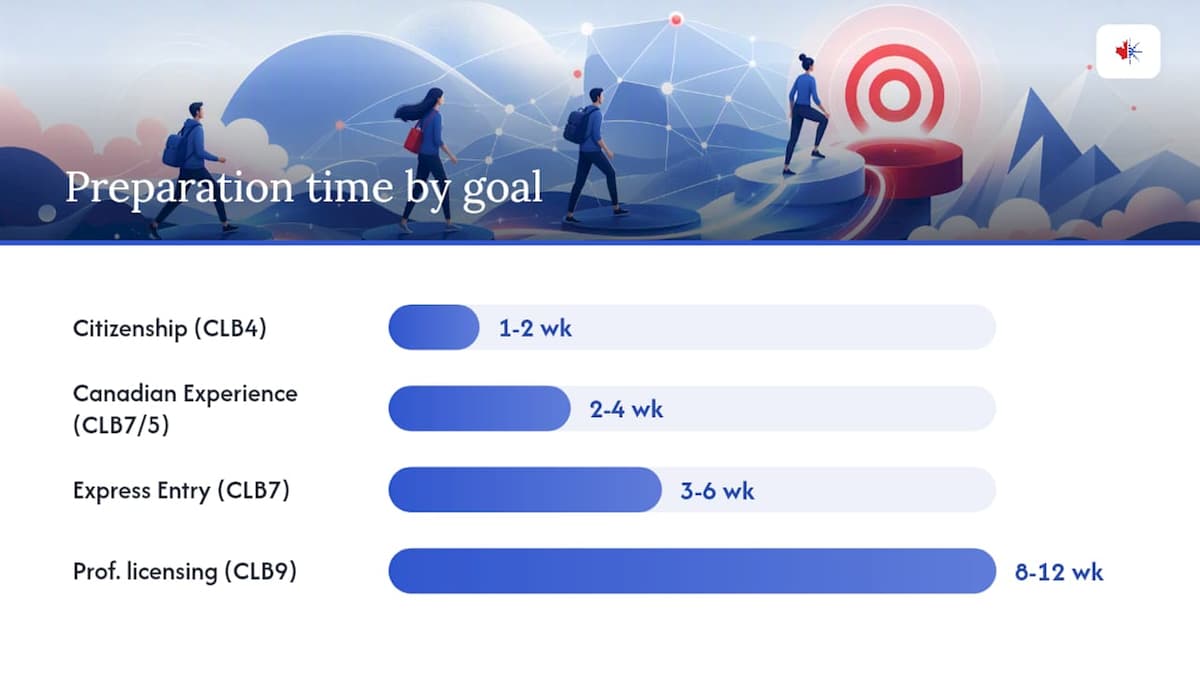
These are cautious estimates, not guarantees. Your actual preparation time depends on your starting score, daily study hours, and how consistently you review mock results.
Quick answers to common questions
- Can you prepare in one week? Yes, if you are already near your target score. One week of intensive format practice and template drilling can close a one-level gap. It cannot build language skills from scratch.
- Is a score of 7 good? CLB 7 meets the minimum requirement for most Express Entry streams and many provincial nominee programmes. It is a solid, functional score. If your goal is professional licensing or citizenship, you likely need CLB 9 or higher.
- Is a 9 hard to get? CLB 9 requires consistent, near-native performance across all four skills. Most candidates need 8–12 weeks of structured preparation to reach it from CLB 7. The candidate community consistently reports that diagnostic-first workflows and weekly mock tests produce the clearest path to CLB 9.
A verified 4-week day-by-day study schedule you can start today
This schedule assumes 1.5–2 hours of study per day and a starting score of CLB 6–7. Adjust the daily tasks up or down based on your diagnostic results.
Week 1: Diagnostic and skill foundations
| Day | Skill focus | Time | Task |
|---|---|---|---|
| Monday | Diagnostic | 2 hrs | Full sample test, score all four skills |
| Tuesday | Writing | 1.5 hrs | Study email task rubric, draft one email |
| Wednesday | Speaking | 1.5 hrs | Record all eight task types, self-review |
| Thursday | Listening | 1.5 hrs | Two timed Listening parts, note-taking drill |
| Friday | Reading | 1.5 hrs | Two timed Reading parts, question-type review |
| Saturday | Writing | 2 hrs | Draft survey response, revise against rubric |
| Sunday | Rest or light review | 30 min | Skim vocabulary list |
Week 2: Targeted skill practice
Week 3: Full mocks and error analysis
Week 4: Review, speed drills, and test-day readiness
Adapting the schedule: If you have only one hour per day, cut each session to one skill task and move the mock exams to weekends. If you have three hours, add a second skill drill each afternoon and increase mock frequency in Week 3 to three full tests.
What most candidates get wrong about CELPIP preparation
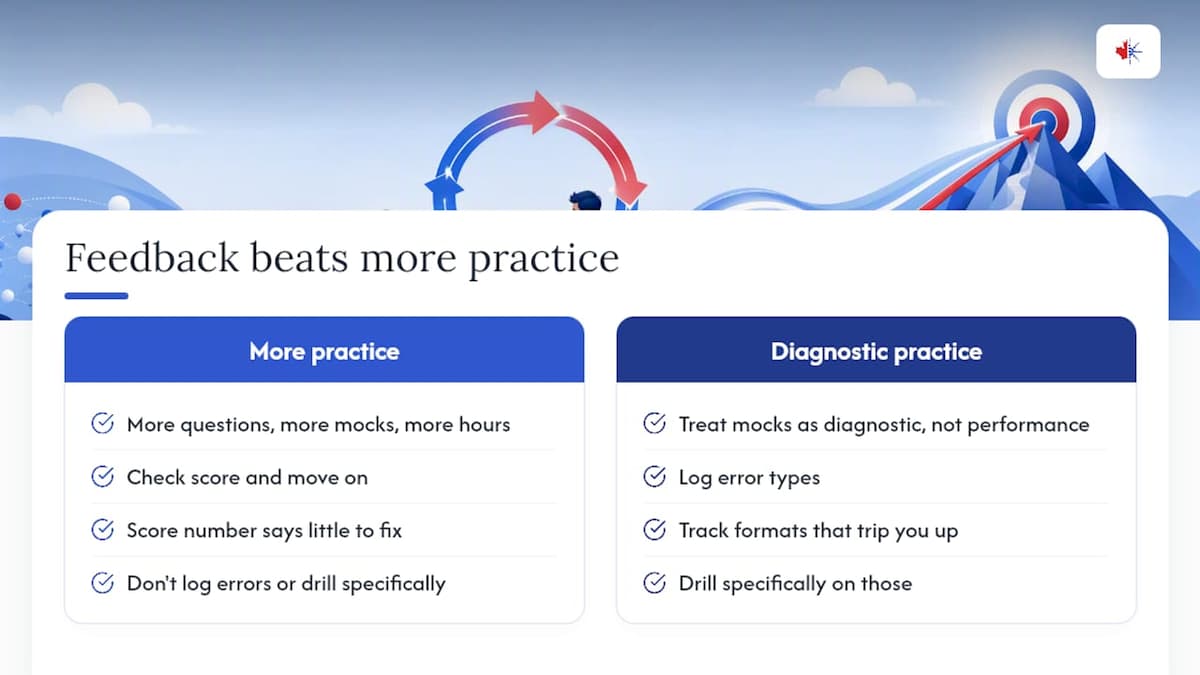
The conventional advice is to practice as much as possible. More questions, more mocks, more hours. That sounds right, but it misses the actual problem.
Most candidates who plateau are not practising too little. They are practising without feedback. They complete a mock, check their score, feel relieved or disappointed, and move on. The score number tells them almost nothing about what to fix. Two candidates can both score a 7 on Writing for completely different reasons: one has strong content but weak grammar, the other has clean grammar but thin vocabulary. The same score, opposite problems, opposite solutions.
The candidates who improve fastest are the ones who treat every mock as a diagnostic, not a performance. They log their error types, track which question formats trip them up, and drill specifically on those. They also get external feedback on Writing and Speaking, because self-evaluation of your own language output is genuinely difficult. You cannot always hear your own grammar errors or notice that your Speaking responses are consistently 20 seconds short.
One practical tip that most guides skip: set a score target for each individual skill, not just an overall average. If you need CLB 7 overall, you might be tempted to let a strong Listening score compensate for a weak Writing score. CELPIP does not work that way. Each skill is scored independently, and immigration programmes typically require a minimum in every component. A 9 in Listening and a 5 in Writing do not meet a CLB 7 requirement. Know your floor for each skill and track it separately.
Celpipguide gives you the feedback loop that free practice cannot
Studying with free materials gets you familiar with the format. What it rarely gives you is the feedback loop that actually closes the gap between your current score and your target.
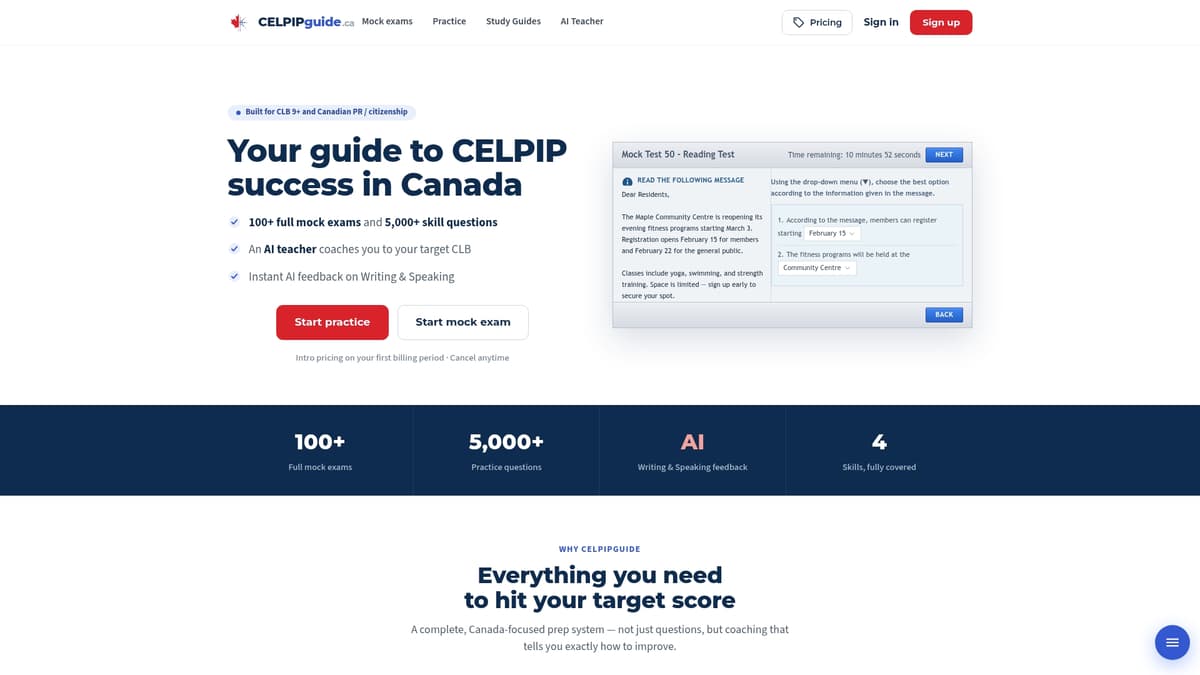
Celpipguide is built specifically for that gap. The platform’s AI study plan generator creates a personalised, week-by-week schedule from your diagnostic results, so you are not guessing which skills to prioritise. The mock exam bank includes over 100 full-length practice tests and 5,000 practice questions, all scored against the same rubric criteria used on the real CELPIP. Writing and Speaking responses receive instant, rubric-based AI feedback that tells you exactly which criterion cost you points and what to fix.
Plans are available weekly, monthly, and quarterly. A free trial gives you access to sample tasks before you commit.
Sources
FAQ
Can I prepare for CELPIP in one week?
Yes, if your current score is already within one CLB level of your target. One week of intensive format practice, template drilling, and one full mock exam can close a small gap. It is not enough time to build language skills from a low baseline.
Is 7 a good score in CELPIP?
CLB 7 meets the minimum requirement for most Express Entry streams and many provincial nominee programmes, so it is a meaningful and practical target. If you are applying for professional licensing or citizenship, you will likely need CLB 9 or higher.
Is it hard to get a 9 in CELPIP?
CLB 9 requires consistent, near-native performance across all four skills. Most candidates starting at CLB 7 need 8–12 weeks of structured preparation, with regular mock exams and rubric-based feedback on Writing and Speaking, to reach that level reliably.
What are the best study materials for CELPIP?
Start with the official Paragon Testing sample test and guidebook for format accuracy. For feedback-driven practice, Celpipguide’s mock exam bank and AI study plan generator give you rubric-based scoring and a personalised schedule that free materials cannot replicate.