
CELPIP Blog
Build your everyday Canadian English vocabulary fast
Build your everyday Canadian English vocabulary fast

Focus on the top 1,000–3,000 high-frequency words, one short daily routine, and one structured workbook or spaced-repetition tool — and you can handle most everyday Canadian English situations in weeks, not years. That is the core of any solid vocabulary builder for everyday Canadian English use.
Two resources to open right now: the free Canada, which gives you 24 structured lessons with exercises, plus Celpipguide’s vocabulary tracker and diagnostic tools for guided, exam-aware practice. For a frequency list, EF’s top-3,000 words is a reliable starting point.
In the next 10 minutes, do this:
- Open the Canada.ca workbook and read through Lesson 1’s word list and example sentences.
- Write three sentences using words from that list that describe your own daily life.
- Bookmark the Celpipguide readiness check to take a short diagnostic and see where your vocabulary gaps actually are.
Key takeaways
The most effective approach to building everyday Canadian English vocabulary is combining frequency-based word selection, a structured workbook or SRS tool, and a consistent daily routine of 10–30 minutes.
| Point | Details |
|---|---|
| Start with frequency | The first 1,000 word families cover 78–85% of everyday text; 3,000 families give 95%+ coverage. |
| Use a workbook structure | Canada.ca’s 24-lesson workbook moves from word lists to exercises that build active use, not just recognition. |
| Keep routines short and daily | A 10–30 minute daily habit with SRS review and one contextual activity beats long, infrequent sessions. |
| Measure production, not just recognition | Track how often you use new words in speaking and writing, not only how many you’ve seen. |
| Celpipguide for guided progress | The diagnostic, vocabulary tracker, and mock exams connect daily vocabulary work to real CLB outcomes. |
Table of Contents
- What should you learn first to get the biggest return?
- How does a workbook-style approach actually work?
- What does a practical daily routine look like?
- Which memory techniques give you the best results?
- A 4-week study plan that works with Celpipguide tools
- How do you know if you’re actually improving?
- What working with newcomers actually taught me
- Celpipguide gives you a structured path, not just a word list
- Useful resources to go next
- Sources
- FAQ
What should you learn first to get the biggest return?
The answer is frequency. Not grammar rules, not idioms, not slang. The words that appear most often in spoken and written English give you the fastest, most practical gains.
Research on trialled 1,000-word frequency lists shows that the first 1,000 high-frequency word families cover roughly 78%–85% of common running text and speech. EF’s top-3,000 resource puts it plainly: knowing 2,500–3,000 frequent words lets you understand around 90% of everyday spoken and written English.
Coverage snapshot: 1,000 words → ~78–85% of everyday text; 3,000 words → 95%+ coverage for most texts.
That gap between 1,000 and 3,000 is where most newcomers stall. They learn greetings and basic phrases, then plateau. The fix is to keep moving through themed vocabulary sets that match your actual daily life.
Prioritise these core themes in order:
- Greetings, introductions, and small talk (transit, weather, weekends)
- Shopping, banking, and Canadian money (toonies, loonies, debit, HST)
- Healthcare and pharmacy phrases (walk-in clinic, prescription, coverage)
- Workplace communication (meeting, deadline, shift, benefits)
- Public services and civic language (SIN, PR card, Service Canada)
For CLB-level newcomers, the Helpful English topic lists for CLB 1–4 organise exactly these themes into beginner-friendly sets. A realistic daily target is 10–20 new word encounters per day, with 10–30 minutes of focused practice. That pace is sustainable and keeps retention high.
How does a workbook-style approach actually work?
A workbook gives you structure when self-study feels shapeless. The lesson moves in a clear sequence: word list with part-of-speech labels → definitions → example sentences → exercises. That sequence matters because it takes you from recognition to active use in one sitting.
The Canada.ca vocabulary building workbook follows exactly this model across 24 lessons. Each lesson introduces a themed word set, shows the words in context, and then tests you through several exercise types.
The exercise types and what each one builds:
| Exercise type | Learning aim | Ideal session length |
|---|---|---|
| Matching meanings | Passive recognition, word-definition links | 5 minutes |
| Use the right word | Active retrieval in sentence context | 7–10 minutes |
| Relating meanings | Synonyms, antonyms, word families | 5 minutes |
| Reading comprehension | Vocabulary in connected text | 10–15 minutes |
| Crossword | Spelling and recall under mild pressure | 5–8 minutes |
| Sentence writing | Production and personalisation | 10 minutes |
The exercises build on each other. Matching is passive and easy — good for warming up. “Use the right word” forces active retrieval, which is where real learning happens. Sentence writing at the end locks the word into your own language.
For self-study, time each exercise with a phone timer. For pair practice, one person reads the sentence aloud while the other fills in the blank from memory. Short dictation works well too: a partner reads an example sentence once, you write it, then compare.
Pro Tip: Don’t skip the sentence-writing exercise, even when you’re tired. Writing one sentence that connects a new word to your own life (your job, your neighbourhood, your routine) is the single most effective thing you can do to move a word from “I’ve seen this” to “I use this.”
What does a practical daily routine look like?
Consistency beats intensity every time. Three short routines cover most schedules.
10-minute micro routine (commute or break)
- Review 5 flashcards from yesterday’s words using an SRS app (Anki works well).
- Read one example sentence aloud for each card.
- Write or say one new sentence using the word in your own context.
20-minute commute routine
- Listen to a short, level-matched audio story or podcast clip (5 minutes).
- Note 3–5 new words you heard; look them up quickly.
- Review those words with an SRS app and add them to your tracker.
- Read one workbook passage aloud on the way home.
30-minute focused session (evening)
- Complete one Canada.ca workbook lesson (word list + two exercises): 15 minutes.
- Add new words to your Celpipguide vocabulary tracker with a personal example sentence: 5 minutes.
- Do a short active recall drill: cover definitions and test yourself on all words from the past three days: 10 minutes.
Stacking methods — combining audio stories, SRS review, and reading-while-listening in a single session — produces better long-term retention than any one method alone. Even the 10-minute routine stacks two methods (flashcard review plus speaking aloud).
For Canadian-specific vocabulary, weave in phrases you’ll actually use: “I need to renew my health card,” “Which bus goes to Scarborough Town Centre?” or “Do you accept debit?” These aren’t textbook sentences. They’re the ones that matter on a Tuesday afternoon.

Pro Tip: Schedule your practice at the same time every day, even if it’s only 10 minutes. Habit research consistently shows that a fixed trigger (right after breakfast, on the subway, before bed) removes the decision fatigue that kills most study plans.
Which memory techniques give you the best results?
Rote lists don’t work well for most adults. Reading a word 20 times in a row produces shallow encoding. What works is spacing, retrieval, and context.
Spaced repetition systems (SRS) schedule each word to reappear just before you’d forget it. Anki is the most widely used free tool. The spacing algorithm means you spend less time on words you know and more time on the ones that keep slipping. Digital flashcards with SRS plus contextual sentences consistently outperform static word lists for long-term retention.
Active recall means testing yourself before you feel ready. Cover the definition and try to produce the word. Cover the word and try to produce the definition. Better still, produce a sentence. This retrieval effort is what builds durable memory.
Contextual methods are where Canadian English gets specific. Sentence mining means pulling real sentences from things you read or hear — a transit announcement, a pharmacy sign, a work email — and adding them to your flashcard deck. Reading-while-listening (following along with a transcript while audio plays) is especially effective because it links the sound of a word to its written form simultaneously.

Pro Tip: When you add a new word to your SRS deck, write your own example sentence rather than copying the dictionary’s. Make it about your life: your city, your job, your family. That personal connection is what makes the word stick.
A three-phase daily routine — morning exposure, afternoon active recall, evening review — can make learning up to 30 new words per day achievable when each encounter is contextualised. You don’t need to hit 30 every day. Ten well-contextualised words beats 30 half-remembered ones.
A 4-week study plan that works with Celpipguide tools
This plan works for 15, 30, or 60 minutes a day. Adjust the volume, not the structure.
Week 1: Diagnose and build the base
Daily tasks:
- Take the Celpipguide readiness check on Day 1 to identify your weakest vocabulary areas.
- Complete Canada.ca workbook Lessons 1–2 (greetings, everyday objects).
- Add 10 new words per day to your SRS deck with personal sentences.
Weekly checkpoint: Can you use this week’s 50–70 words in spoken sentences without looking?
Week 2: Expand into daily-life themes
Daily tasks:
- Work through workbook Lessons 3–6 (shopping, transport, health).
- Review all Week 1 words via SRS (takes about 5 minutes by now).
- Listen to one short audio story or Canadian radio clip; note new words.
Weekly checkpoint: Handle a simulated pharmacy or transit conversation using only this week’s vocabulary.
Week 3: Workplace and services vocabulary
Daily tasks:
- Complete workbook Lessons 7–10 (workplace, services, civic language).
- Use the Celpipguide vocabulary tracker to flag words you keep getting wrong.
- Take one free reading practice test to see how new vocabulary performs in comprehension tasks.
Weekly checkpoint: Write a short paragraph (5–7 sentences) about a workplace situation using only words from Weeks 1–3.
Week 4: Consolidate and test
Daily tasks:
- Review all flagged words from Weeks 1–3 in your SRS deck.
- Complete one full CELPIP practice exam to measure real progress.
- Identify 10 words you still miss consistently; write three sentences each.
Weekly checkpoint: Compare your Week 4 practice test score against your Week 1 readiness check baseline.
For exam preparation, add Celpipguide’s AI-generated speaking and writing feedback in Weeks 3–4. For everyday conversation goals, keep the focus on the workbook themes and SRS review without the mock test component.
How do you know if you’re actually improving?
Progress in vocabulary is easy to feel but hard to measure without a system. Here’s a simple one.
Weekly vocabulary quiz: Take 20 words from the past week. Cover the definitions and write a sentence for each from memory. Score yourself on accuracy and speed.
Speaking checklist: Record yourself describing your day in two minutes. Count how many of this week’s new words you used naturally. If the number is zero, you’re reviewing but not producing.
Comprehension checkpoint: Read one short article or listen to a 3-minute audio clip. Note how many words you understood without stopping. This number should grow week over week.
Goal examples tied to real outcomes:
- CLB 5 target: handle a doctor’s appointment, follow a work meeting, read a lease agreement.
- CLB 7 target: give a short presentation, write a professional email, understand a news broadcast.
Tracking tools to use:
- Celpipguide diagnostic and vocabulary tracker for structured progress data.
- A simple spreadsheet with columns: word, date learned, date reviewed, accuracy score.
- Weekly speaking recordings saved to your phone for comparison.
Understanding why vocabulary directly affects your CLB performance helps you set goals that connect daily practice to real exam and life outcomes, not just word counts.
What working with newcomers actually taught me
Most learners I’ve seen struggle not because they lack motivation, but because they try to learn too many words at once with too little context. A learner who adds 50 words to a list on Monday and reviews them once will remember fewer than 10 by Friday. A learner who adds 10 words, writes a sentence for each, and reviews them three times across the week will remember 8 or 9 of them a month later.
The other pattern I see constantly: learners skip the production step. They read, they listen, they recognise. But they never speak or write the word until they’re in a real situation and suddenly blank. The fix is low-stakes production every single day — even one sentence per word, spoken aloud to no one, makes a measurable difference.
Habit formation matters more than study volume. A 15-minute daily routine that you actually do beats a 2-hour session you do twice a month. Set the bar low enough that skipping feels harder than doing it.
Celpipguide gives you a structured path, not just a word list
Frequency lists and workbooks are free and genuinely useful. What they don’t give you is feedback, personalisation, or a way to know whether your vocabulary is actually exam-ready.
Celpipguide fills that gap. The diagnostic pinpoints your weakest CLB vocabulary areas on Day 1. The AI teacher then builds a personalised study plan around those gaps, so you’re not guessing which words to prioritise. The vocabulary tracker logs every word you’ve studied, schedules SRS reviews automatically, and flags the ones you keep missing. When you’re ready to test under real conditions, 100+ full mock exams and 5,000+ practice questions show you exactly how your vocabulary performs in listening, reading, speaking, and writing tasks.
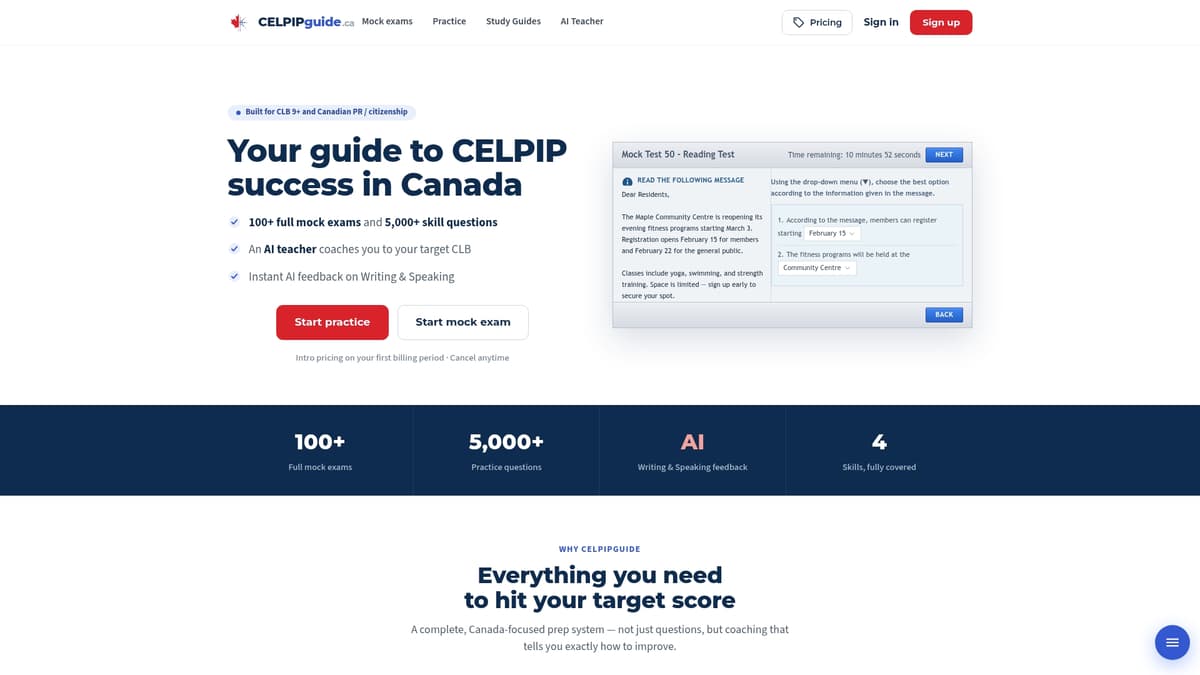
For readers who want guided vocabulary work tied directly to CLB outcomes, the CELPIP readiness check is the right first step. It’s free, takes about 10 minutes, and gives you a personalised next-step plan.
Useful resources to go next
- Canada — 24 free lessons with structured exercises; the best starting point for workbook-style self-study.
- EF top-3,000 words — a practical, browsable frequency list covering roughly 90% of everyday English; use it to audit gaps in your current vocabulary.
- Helpful English CLB 1–4 topic lists — themed beginner sets covering shopping, transit, Canadian money, and health; ideal for newcomers at lower CLB levels.
- Celpipguide practice exams — full-length mock tests to measure how vocabulary holds up under real exam conditions.
- Nation (2006) frequency research — the academic basis for prioritising the first 1,000–3,000 word families.
Sources
- Canada
- Nation (2006) — trialling 1,000‑word family lists (BNC)
- EF — 3000 most common words in English
- Rhythm Word — How to learn 30 new English words every day
- Memfy — The 9 best ways to learn vocabulary
FAQ
How do I improve my vocabulary every day?
Practice in short, consistent sessions of 10–30 minutes using a spaced repetition tool, one workbook lesson, and at least one production task (writing or speaking a sentence). Daily contact with new words in context builds retention far faster than occasional long study sessions.
What are some common Canadian English words and phrases?
Everyday Canadian expressions include “toque” (knit hat), “loonie” and “toonie” (one- and two-dollar coins), “double-double” (coffee with two creams and two sugars), “hydro” (electricity), and “washroom” (restroom). Civic terms like “SIN” (Social Insurance Number), “PR card,” and “Service Canada” are also essential for newcomers.
Can I memorise 100 words in a day?
Memorising 100 words in a single day is possible but not practical for long-term retention. A spaced three-phase routine of morning exposure, afternoon recall, and evening review makes 30 contextualised words per day achievable with high retention; that pace is more sustainable and effective than cramming.
How can I learn English vocabulary every day without burning out?
Set a fixed, low-friction trigger (same time, same place) and keep the session short enough that skipping feels harder than starting. Stacking two methods, such as audio stories combined with SRS review, keeps sessions varied and reduces the monotony that causes most learners to quit.
Does Celpipguide help with everyday vocabulary, not just exam prep?
Yes. Celpipguide’s vocabulary tracker and AI-personalised study plans are built around CLB-level word sets that map directly to everyday Canadian life situations, including workplace communication, healthcare, and public services, as well as CELPIP exam tasks.