
CELPIP Blog
Speaking practice for citizenship prep: a practical guide
Speaking practice for citizenship prep: a practical guide

Consistent speaking practice is the single most effective method for building the communication skills needed to pass your Canadian citizenship interview. The role of speaking practice in citizenship prep goes beyond vocabulary drills. It trains your brain to retrieve words and form sentences in real time, under real pressure. Assessments during the citizenship interview evaluate your ability to understand questions and respond clearly, targeting roughly an A2 to B1 level on the CEFR scale. Overall pass rates for naturalization sit at 95.7%, yet speaking remains the skill most candidates underestimate during preparation.
Why does speaking practice matter more than passive study?
Passive study, reading textbooks or listening to recordings, builds recognition. It does not build production. Reading and listening differ cognitively from speaking, so active retrieval practice is necessary for fluency under interview pressure. That distinction matters enormously when you are sitting across from an officer and need to answer a question you have never heard before.
Merrill Swain’s Output Hypothesis explains this clearly. When you attempt to speak, you notice gaps between what you want to say and what you can say. That noticing triggers real language growth. Silent study does not create that trigger.

Speaking practice also reveals weaknesses that silent study hides. You might recognise the word “permanent resident” on a page but freeze when asked to use it in a sentence. Active speaking exercises expose those gaps early, giving you time to fix them before the interview.
A common myth is that you need near-native fluency to pass. That is not true. Officers assess clarity and understanding, not perfect grammar or accent. Minor errors are acceptable as long as your meaning is clear. The goal is confident, clear communication, not perfection.
- Speaking activates different brain pathways than reading or listening
- Active retrieval builds vocabulary recall under pressure
- The Output Hypothesis confirms that attempting to speak accelerates language growth
- Clarity matters more than accent or flawless grammar
- Speaking reveals gaps that silent study cannot
Pro Tip: Record yourself answering a simple question like “Where were you born?” and play it back. You will immediately notice hesitations and filler words you never caught during live speech.
How do you build a daily speaking routine for citizenship prep?
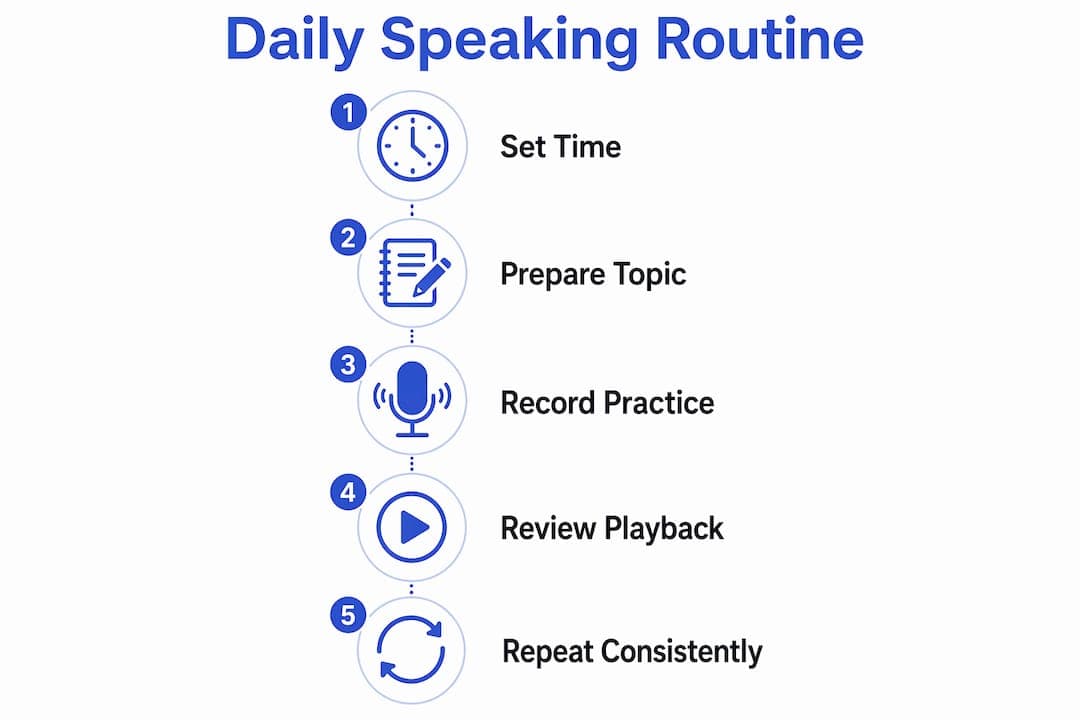
Structure and consistency beat long, infrequent sessions every time. Experts recommend 15 to 30 minutes of daily speaking practice over 3 to 6 months for most candidates. If you already hold conversational English ability, a focused 30-day plan can be enough to sharpen your interview readiness.
Here is a practical daily routine you can follow:
-
Warm up with personal information (5 minutes). Say your name, address, date of birth, and immigration history aloud. This mirrors the opening of most citizenship interviews and builds automatic recall for basic facts.
-
Answer randomised practice questions (10 minutes). Pull questions from a shuffled list covering civics, personal history, and community topics. Randomising prevents you from memorising a fixed script, which can trip you up when an officer rephrases a question.
-
Record and review one answer (5 minutes). Self-recording is a high-impact method for identifying hesitation, filler words, and clarity issues you miss during live speech. Listen back and note one specific thing to improve tomorrow.
-
Vocabulary review tied to speaking (5 minutes). Use a vocabulary tracker to review five citizenship-related words and use each one in a spoken sentence. Connecting words to speech, not just recognition, builds active recall.
-
Peer or teacher feedback session (2 to 3 times per week). A conversation partner or tutor gives you feedback you cannot give yourself. Even a 10-minute exchange with a study partner builds real-time response skills.
Consistency is the key variable. Active retrieval practice reduces hesitation and improves vocabulary retrieval noticeably within 4 to 6 weeks. Missing three days in a row breaks the retrieval habit you are building.
Pro Tip: Set a specific time each day for speaking practice, the same way you would a work meeting. Treat it as non-negotiable. Candidates who practise at a fixed daily time build habits faster than those who practise whenever they find a spare moment.
What challenges come up in speaking practice, and how do you handle them?
Test anxiety is the most common barrier. The citizenship interview feels high-stakes, and that pressure can cause even fluent speakers to freeze. Mock interviews simulate interview conditions and reduce anxiety by making the format familiar. The more you practise under simulated pressure, the less the real interview feels like a threat.
Here are the most common challenges and how to address each one:
- Script memorisation. Memorising fixed answers can cause confusion when an officer asks a follow-up or rephrases a question. Practise meaning-based responses instead. Understand the answer, not just the words.
- Hesitation and filler words. Words like “um,” “uh,” and “you know” signal uncertainty to an officer. Active retrieval practice, where you force yourself to answer without pausing to think in your first language, reduces these over time.
- Fear of pronunciation errors. Officers are trained to assess understanding, not accent. Focus on speaking clearly and at a moderate pace rather than trying to sound like a native speaker.
- Avoiding difficult topics. Many candidates skip practising questions that feel hard. Those are exactly the questions to practise most. Discomfort during practice means growth.
- Lack of feedback. Practising alone without feedback creates blind spots. Pair self-recording with at least occasional input from a teacher, tutor, or study partner.
Pro Tip: Simulate real interview pressure by setting a timer for each answer. Give yourself 10 to 15 seconds to begin speaking after hearing a question. This trains your brain to respond without long pauses.
How does speaking practice connect to your other language skills?
Language skills are not separate boxes. They reinforce each other. Speaking practice strengthens reading, listening, and writing at the same time, because it forces you to pull from all of those inputs simultaneously.
The table below shows how each skill supports speaking preparation for the citizenship interview.
| Language skill | How it supports speaking practice |
|---|---|
| Reading aloud | Builds pronunciation, rhythm, and sentence fluency simultaneously |
| Listening to interviews | Trains your ear to understand questions phrased in different ways |
| Writing practice answers | Organises your thoughts before you speak them aloud |
| Vocabulary study | Expands the words available to you during real-time responses |
| Civics content review | Gives you the knowledge base to answer interview questions confidently |
Reading aloud is particularly underused. When you read a passage from the Discover Canada study guide aloud, you practise pronunciation and sentence structure at the same time as civics content. That is three skills in one exercise.
Dictation exercises also build speaking ability indirectly. When you listen to a sentence and write it down, you train your ear to catch word boundaries and sentence rhythm. Those same skills help you process and respond to interview questions faster. Well-rounded fluency across all four language domains reduces surprises on interview day. You can explore speaking samples and task tips to see how integrated skill practice looks in a structured format.
Preparing specifically for the Canadian citizenship interview
The Canadian citizenship interview is a face-to-face conversation with an officer from Immigration, Refugees and Citizenship Canada (IRCC). Speaking proficiency is assessed throughout the conversation, not in a single isolated test. That means every exchange counts, from confirming your name to explaining a gap in your travel history.
Effective preparation for this format includes:
- Practise answering open-ended questions. Questions like “Tell me about your community involvement” require more than a yes or no. Practise giving two to three sentence answers that are clear and direct.
- Use virtual mock interviews. Online full-length mock exams simulate timed, structured speaking conditions. They build the mental readiness that casual conversation practice does not.
- Set milestones. Track your progress weekly. A simple goal like “reduce filler words by half in my recordings by week four” gives you a measurable target and keeps motivation high.
- Practise with a range of question types. Cover personal background, Canadian history, rights and responsibilities, and community topics. Variety prevents you from being caught off guard.
- Focus on response structure. A clear answer follows a simple pattern: direct answer, one supporting detail, and a brief closing statement. Practise this structure until it feels natural.
The CELPIP speaking practice test is a useful tool for building this response structure. Even though CELPIP and the citizenship interview are different assessments, the speaking skills they develop overlap significantly.
Key takeaways
Speaking practice is the most direct path to confident, clear communication during the Canadian citizenship interview, and consistency over weeks beats any single intensive session.
| Point | Details |
|---|---|
| Active practice beats passive study | Speaking activates retrieval pathways that reading and listening alone cannot build. |
| Daily 15–30 minutes is the target | Consistent short sessions over 3–6 months build fluency more effectively than infrequent long ones. |
| Clarity matters more than perfection | Officers assess understanding, not accent or flawless grammar. |
| Mock interviews reduce anxiety | Simulating interview conditions makes the real conversation feel familiar and manageable. |
| All language skills connect | Reading aloud, listening, and vocabulary study all reinforce speaking ability directly. |
What I have learned from watching candidates prepare
Speaking practice is the one area where I see the biggest gap between what candidates think they need and what actually helps them. Most people spend the bulk of their preparation time reading the Discover Canada guide. That is useful for civics knowledge, but it does not prepare your mouth or your mind for a live conversation.
The candidates who walk into their citizenship interview with real confidence are the ones who have heard their own voice answering hard questions dozens of times. They have listened to their recordings, cringed a little, and improved. They have done mock interviews until the format feels boring. That boredom is the goal.
One thing I want to say clearly: do not wait until your speaking feels perfect before you practise with another person. Imperfect speaking practice with a real human is worth ten times more than perfect silent preparation alone. The discomfort of being heard is exactly what prepares you for the interview room.
Speaking skills built during citizenship prep do not disappear after the interview. They carry into your workplace, your neighbourhood, and your daily life in Canada. That is the real return on the time you invest now.
— Reza
How Celpipguide supports your speaking preparation
Celpipguide is built for candidates who want structured, feedback-driven speaking practice that goes beyond reading a study guide.
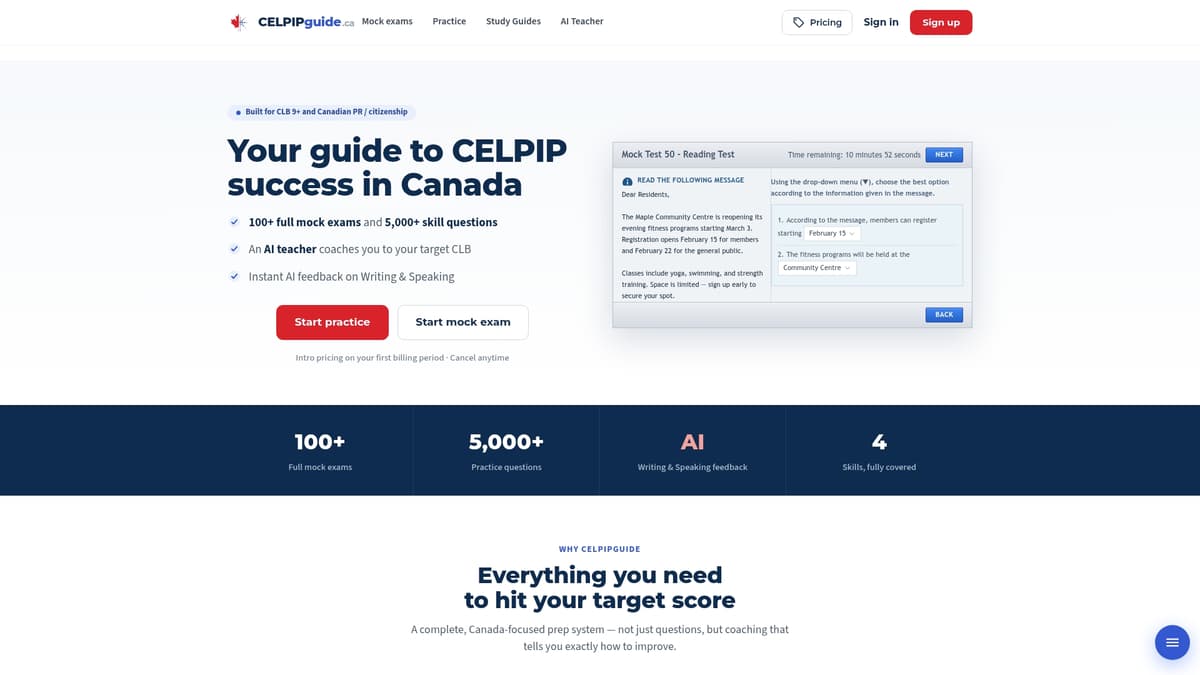
The platform offers over 100 full mock exams and 5,000 practice questions aligned to CEFR language standards, including dedicated speaking practice tasks with instant AI feedback. You can identify exactly where your speaking breaks down, whether it is vocabulary retrieval, sentence structure, or response length, and target those areas directly. The CELPIP exam preparation hub brings together mock tests, vocabulary tools, and speaking samples in one place, so your preparation stays organised and measurable. If you are preparing for your Canadian citizenship interview, this is where structured practice meets real results.
FAQ
What speaking level do I need for the citizenship interview?
The citizenship interview targets roughly an A2 to B1 level on the CEFR scale. You need to understand questions and respond clearly, not speak at a native level.
How long should I practise speaking each day?
Experts recommend 15 to 30 minutes of daily speaking practice. Conversational English speakers may be ready within 30 days of focused daily practice.
Will grammar mistakes fail me in the citizenship interview?
Minor grammar errors will not cause failure if your meaning is clear. Officers assess understanding and communication, not perfect grammar or accent.
Is memorising answers a good strategy?
Memorising fixed answers is not recommended. Officers may rephrase questions or ask follow-ups, and a memorised script can leave you unable to respond flexibly.
How do mock interviews help with speaking practice?
Mock interviews simulate real interview conditions, which reduces anxiety and trains you to respond confidently under pressure. Familiarity with the format is one of the strongest predictors of interview success.