
CELPIP Blog
Language proficiency in a professional context: your 2026 guide
Language proficiency in a professional context: your 2026 guide

TL;DR:
- Language proficiency in a professional context measures the ability to use language accurately and independently in work tasks, not casual fluency. Canadian employers and immigration programs rely on frameworks like CLB, CEFR, and ILR, with tests such as CELPIP and IELTS providing proof, and they emphasize the importance of matching your current level to job requirements. Reaching CLB 7–8 enables independent participation in workplace conversations and documentation, while CLB 9–12 signifies mastery for demanding professional communication.
Language proficiency in a professional context means your ability to use a language accurately, appropriately, and independently across speaking, listening, reading, and writing for real work tasks. It is not the same as casual fluency. Canadian employers and immigration programs measure it using recognised frameworks, and they expect documented evidence.
Three things to know right away:
- The main frameworks are the Canadian Language Benchmarks (CLB), the Common European Framework of Reference (CEFR), and the Interagency Language Roundtable (ILR) scale. They map to each other, and Canadian workplaces lean heavily on CLB.
- The tests Canadian employers and immigration accept most are CELPIP and IELTS General Training, both of which produce CLB-equivalent scores.
- Your immediate next step: identify your current level on the CLB scale, match it to what your target role or immigration stream requires, and gather test evidence that proves it.
Table of Contents
- What does “professional working proficiency” actually mean?
- How do CLB, CEFR, and ILR map to workplace ability?
- What can you actually do at each professional level?
- How do Canadian employers and immigration use proficiency levels?
- Which tests does Canada accept, and how do scores map?
- How to improve your language proficiency for Canadian workplace goals
- Key takeaways
- The skill you improve last is the one that costs you the most
- Celpipguide gives you a clear path to your target CLB
- Useful sources
- FAQ
What does “professional working proficiency” actually mean?
The phrase “professional working proficiency” has a precise meaning that goes well beyond being able to hold a conversation. ILR Level 3 defines it as the ability to speak with sufficient structural accuracy and vocabulary to participate effectively in most formal and informal conversations on practical, social, and professional topics. You rarely search for words. You handle unfamiliar topics without needing support.
For Canadian workplaces, that translates to four practical features:
- Task range: You can attend and contribute to meetings, write professional emails and reports, read technical documentation, and negotiate or present without a language barrier slowing you down.
- Accuracy and register: You adjust your tone between a casual team chat and a formal client proposal. You do not confuse registers.
- Comprehension of technical material: You follow industry-specific language in your field, even when it is dense or uses discipline-specific vocabulary.
- Pragmatic appropriateness: You understand what is implied, not just what is said, and you respond in a way that fits the professional situation.
One distinction matters here. ACTFL assessment guidance draws a clear line between proficiency and performance. Performance is task-limited: you can write one specific type of report because you have practised it. Proficiency is transferable: you can handle a new, unscripted situation you have never encountered before. Employers test for proficiency precisely because it predicts how you will perform in situations nobody prepared you for.
“Professional working proficiency does not require native-level grammar or the absence of an accent. It requires reliable performance on work tasks, including comprehension of technical material and appropriate register.” — Corporate Finance Institute
Pro Tip: On your résumé, replace vague terms like “fluent” or “conversational” with a framework label and test score. Write “CLB 8 — all four skills; CELPIP overall 8” or “CEFR B2 — reading and writing; IELTS General Training 6.5.” Hiring managers know what those numbers mean; “fluent” tells them nothing measurable.
How do CLB, CEFR, and ILR map to workplace ability?
Three frameworks dominate professional and Canadian contexts. Here is how they line up, what each level means at work, and which test scores correspond to each band.

| ILR level | CEFR level | CLB range | Plain-language description | Typical workplace tasks | Common test evidence |
|---|---|---|---|---|---|
| 0–1 | A1–A2 | CLB 1–4 | Basic user; handles simple, predictable exchanges | Greetings, simple forms, short instructions | CELPIP 3–4 / IELTS 4 |
| 2 | B1 | CLB 5–6 | Limited working proficiency; manages routine tasks with some support | Emails on familiar topics, team meetings with preparation | CELPIP 5–6 / IELTS 5 |
| 3 | B2 | CLB 7–8 | Professional working proficiency; independent contributor | Meetings, reports, client calls, technical reading | CELPIP 7–8 / IELTS 6.5 |
| 4 | C1 | CLB 9–10 | Full professional proficiency; handles complex and sensitive topics | Negotiations, policy writing, presentations, leadership | CELPIP 9–10 / IELTS 7.5 |
| 5 | C2 | CLB 11–12 | Mastery / near-native; operates at the highest professional register | Legal drafting, executive communication, academic publishing | CELPIP 11–12 / IELTS 9 |
A few things worth noting about this table:
- ILR 3 = CEFR B2 = CLB 7–8. Reaching this band is the milestone that moves a professional from supported tasks to independent participation in meetings and technical work. Most skilled-worker immigration streams target this range or above.
- CLB 9–12 is Stage III in the Canadian Language Benchmarks system, reserved for demanding, professional, complex communication where accuracy, register control, and comprehension of technical material are all required. The CLB reference document describes this stage as the benchmark for roles where language itself is a core professional tool.
- “Fluent” is not a framework label. Indeed Canada’s career guidance notes that recruiters prefer CLB, CEFR, or ILR labels because they are measurable. “Fluent” can mean anything from B1 to C2 depending on who is writing it.
What can you actually do at each professional level?
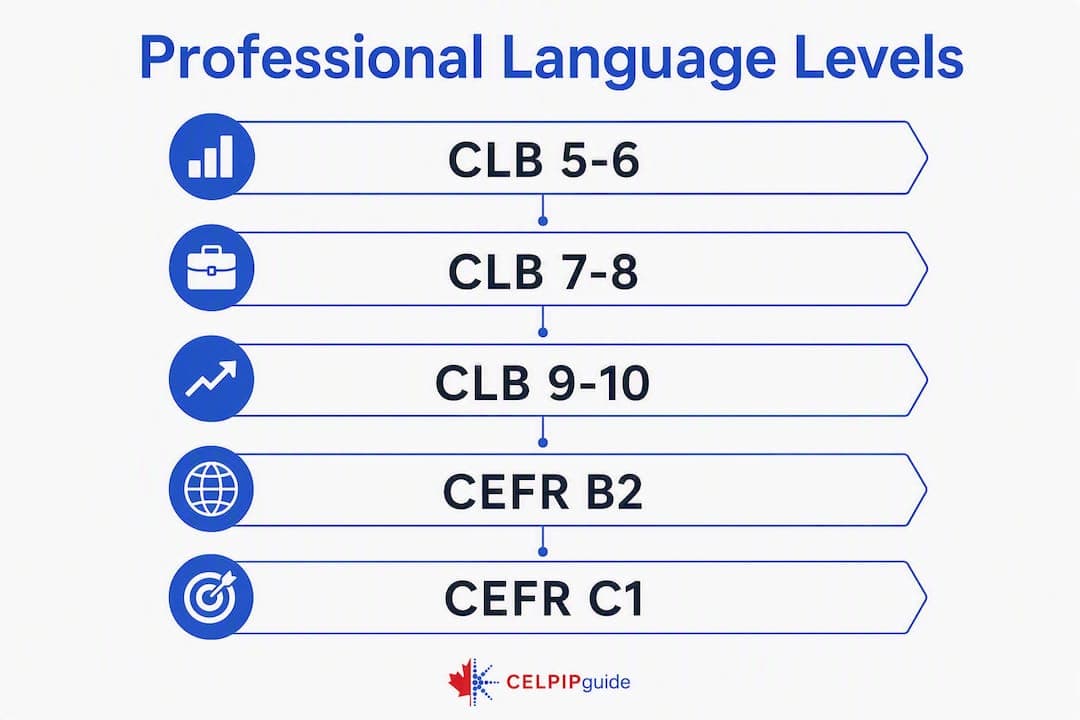
Abstract level descriptions only go so far. Here is what they look like in a real Canadian workplace.

Entry-level working proficiency (CLB 5–6 / CEFR B1 / ILR 2)
You can manage routine, predictable communication with some preparation. In practice:
- You write clear emails about familiar topics but struggle with unexpected requests.
- You follow team meetings when the topic is known in advance, but fast-moving discussions with multiple speakers are difficult.
- You read standard workplace documents but need extra time with dense technical text.
- You can answer direct questions in an interview but find open-ended or hypothetical questions harder to handle.
Professional working proficiency (CLB 7–8 / CEFR B2 / ILR 3)
This is the level most skilled roles require. Western University’s language proficiency guide describes Level 3 as the ability to discuss special fields with reasonable ease. In the workplace, that means:
- You contribute actively to meetings without needing topics pre-shared.
- You write reports and proposals that colleagues can act on without editing your language.
- You handle client calls, including complaints or unexpected questions.
- You read and summarise technical documents in your field.
Full professional proficiency (CLB 9–10 / CEFR C1 / ILR 4)
Western University’s guide describes Level 4 as fluent and accurate use of language on all levels pertinent to professional needs. At this stage:
- You lead meetings, present to senior stakeholders, and negotiate contracts.
- You write policy documents, formal reports, and sensitive correspondence.
- You understand nuance, humour, and implication in professional conversations.
Self-assessment checklist for CLB 7–8 (professional working proficiency):
- Can you attend a meeting on an unfamiliar work topic and contribute a relevant point?
- Can you write a professional email that requires no language editing from a colleague?
- Can you read a two-page technical report in your field and summarise the key points?
- Can you handle a phone call where the other person speaks at a normal pace?
If you answered yes to all four, you are likely at or near CLB 7–8. If two or three feel uncertain, CLB 5–6 is a more honest starting point.
How do Canadian employers and immigration use proficiency levels?
Federal public service
The Government of Canada uses its own A/B/C coding system for bilingual positions. Treasury Board qualification standards define the levels this way: Level A is basic, Level B covers factual and work-related texts, and Level C handles sensitive or unfamiliar topics. Code P applies to specialised technical language needs. Federal job postings list these codes directly, and managers must assign them based on actual job duties, not convenience.
Private-sector and skilled-worker hiring
Most private employers do not use A/B/C coding. They reference CLB or CEFR informally, often through job-posting language like “strong written and verbal English required” or “bilingual (English/French) an asset.” In practice, a role that involves client-facing communication, report writing, or team leadership typically requires CLB 7 or above. Roles in regulated professions (nursing, engineering, law) often set CLB 8–10 as a minimum through their licensing bodies.
Immigration streams
Express Entry and most Provincial Nominee Programs set minimum CLB thresholds by skill. A CLB score breakdown for Express Entry shows how each band translates into Comprehensive Ranking System points, with CLB 9 in all four skills earning the maximum language points available.
Résumé phrasing templates:
French: CEFR B2 (all skills) — TEF Canada, tested [month, year]
Always include the skill-level breakdown, not just the overall score. Employers and immigration officers care about individual skill scores, especially writing and speaking.
CLB Stage III (CLB 9–12) is the benchmark the Canadian Language Benchmarks system designates for demanding, professionally complex communication. Most senior professional roles and high-points immigration categories sit in this range.
Which tests does Canada accept, and how do scores map?
Accepted tests
- CELPIP (Canadian English Language Proficiency Index Program): — Fully computer-based, Canadian-accented, and directly mapped to CLB. Accepted by Immigration, Refugees and Citizenship Canada (IRCC) and many employers. Results in 4–8 business days.
Score mapping table
| CLB level | CELPIP score (per skill) | IELTS General Training (per skill) | CEFR equivalent | ILR equivalent |
|---|---|---|---|---|
| CLB 4 | 4 | 4 | A2 | 1 |
| CLB 5 | 5 | 4 | B1 | 2 |
| CLB 6 | 6 | 5 | B1+ | 2 |
| CLB 7 | 7 | 6.5 | B2 | 3 |
| CLB 8 | 8 | 6.5 | B2+ | 3 |
| CLB 9 | 9 | 7.5 | C1 | 4 |
| CLB 10 | 10 | 7.5 | C1+ | 4 |
| CLB 11 | 11 | 9 | C2 | 5 |
| CLB 12 | 12 | 9 | C2 | 5 |
What to look for on your score report:
- Skill-level breakdowns matter more than the overall band. A CLB 8 overall with a CLB 6 in writing will flag a gap for employers in writing-heavy roles.
- CELPIP reports show a score of 1–12 per skill, each directly corresponding to a CLB level. That one-to-one mapping is one reason many Canadian immigration applicants prefer it.
- IELTS reports show band scores per skill (0–9). Use the table above to convert each skill band to its CLB equivalent.
Quick rules of thumb for choosing a test:
- Applying through IRCC (Express Entry, PR, citizenship)? Both CELPIP and IELTS General Training are accepted. CELPIP results arrive faster and are already in CLB format.
- Applying for a job or professional licence? Check whether the employer or licensing body specifies a test. Many accept either; some regulated professions specify one.
- Short on time? CELPIP’s computer-based format is available at more Canadian test centres and delivers results faster than the paper IELTS.
For a deeper look at how reading skill scores translate into real CLB outcomes, the reading comprehension CLB score guide breaks it down skill by skill.
How to improve your language proficiency for Canadian workplace goals
Step 1: Run a diagnostic
Before you practise anything, identify which of the four skills is limiting your professional performance. A writing gap and a speaking gap require completely different practice routines. Take a diagnostic test that scores each skill separately and gives you a CLB-equivalent result.
Step 2: Build a targeted practice routine
Once you know your weak skill, practise it in a workplace context:
- Writing: Draft professional emails and short reports, then compare them against rubric-based feedback. Focus on register, paragraph structure, and precision. For practical guidance on tone and phrasing, how to sound professional in English emails is a useful reference.
- Speaking: Record yourself answering open-ended work questions (describe a project, explain a decision, give an opinion). Listen back and note where you hesitate or lose structure.
- Reading: Work through technical texts in your field. Practise summarising the main argument in two sentences.
- Listening: Watch Canadian workplace content (interviews, panel discussions, podcasts) at normal speed without subtitles.
Step 3: Follow an 8–12 week study plan
- Week 1–2: Take a full diagnostic. Map your current CLB level per skill. Set a target (e.g., move from CLB 7 to CLB 8 in writing).
- Week 3–4: Focus on your weakest skill only. Complete targeted drills daily (30–45 minutes).
- Week 5–6: Introduce full-length timed practice for your weak skill. Review feedback carefully.
- Week 7–8: Rotate to your second weakest skill. Maintain the first with two sessions per week.
- Week 9–10: Take a full mock exam under timed conditions. Compare results to your Week 1 diagnostic.
- Week 11–12: Address any remaining gaps. Take a second full mock exam. Book your official test when two consecutive mocks hit your target CLB.
Pro Tip: Do not practise all four skills equally every week. Concentrated effort on one skill at a time produces faster CLB gains than spreading the same hours across all four.
When targeting CLB 9 or above, the strategies in how to get CLB 9+ in CELPIP speaking and writing are worth working through before your final mock exams.
What to look for in a paid preparation product:
- A diagnostic test that gives CLB-level scores per skill, not just a general band
- Full-length mock exams that replicate actual test timing and task types
- Rubric-based feedback on writing and speaking, not just a score
- A study plan that adapts to your diagnostic results rather than giving everyone the same schedule
- Progress tracking so you can see CLB movement over time
Key takeaways
Language proficiency in a professional context is a measurable, framework-defined ability that Canadian employers and immigration programs assess through CLB, CEFR, or ILR levels, with CELPIP and IELTS as the primary accepted tests.
| Point | Details |
|---|---|
| Define your current level | Take a diagnostic test that scores each skill separately and maps results to CLB. |
| Use framework labels on your résumé | Replace “fluent” with a specific label and test score (e.g., CLB 8, CELPIP overall 8). |
| CLB 7–8 is the professional threshold | This range (ILR 3 / CEFR B2) enables independent contribution to meetings, reports, and client work. |
| CLB 9–12 is Stage III | The Canadian Language Benchmarks designate this range for demanding, professionally complex communication. |
| Celpipguide for targeted prep | Celpipguide’s diagnostic tests, 100+ mock exams, and AI-driven feedback are built for professionals targeting CLB 7–10. |
The skill you improve last is the one that costs you the most
Here is my honest take: most professionals I see preparing for CELPIP or a job application spend their time on the skill they already do best. It feels productive. It is not.
The CLB system scores you on all four skills, and immigration and many employers look at each one individually. A CLB 9 in speaking with a CLB 6 in writing does not average out to CLB 7.5. It flags a gap. Employers in writing-heavy roles will notice it. Immigration officers will score it separately.
Start with the skill that is blocking you, not the one that feels comfortable. If you are not sure which that is, a timed diagnostic under real test conditions will tell you within an hour.
On the question of when to test: if you have a deadline (an Express Entry draw, a job application closing date), work backwards from that date and book your test first. Knowing the date creates the urgency that makes the study plan real. If there is no deadline, wait until two consecutive full mock exams hit your target CLB before booking. Testing early and scoring below your target wastes money and time.
Guided preparation with structured feedback beats self-study for most people at the CLB 6–8 range. Below CLB 6, general language practice matters more than test-specific drilling. Above CLB 9, the gains come from precision, not volume, and targeted feedback on individual responses is what moves the needle.
Celpipguide gives you a clear path to your target CLB
Professionals aiming for CLB 7–10 or immigration applicants who need reliable, documented evidence of their English ability get the most out of Celpipguide. The platform starts with a diagnostic test that scores each of the four skills separately and maps them directly to CLB levels, so you know exactly where you stand before you practise a single question.
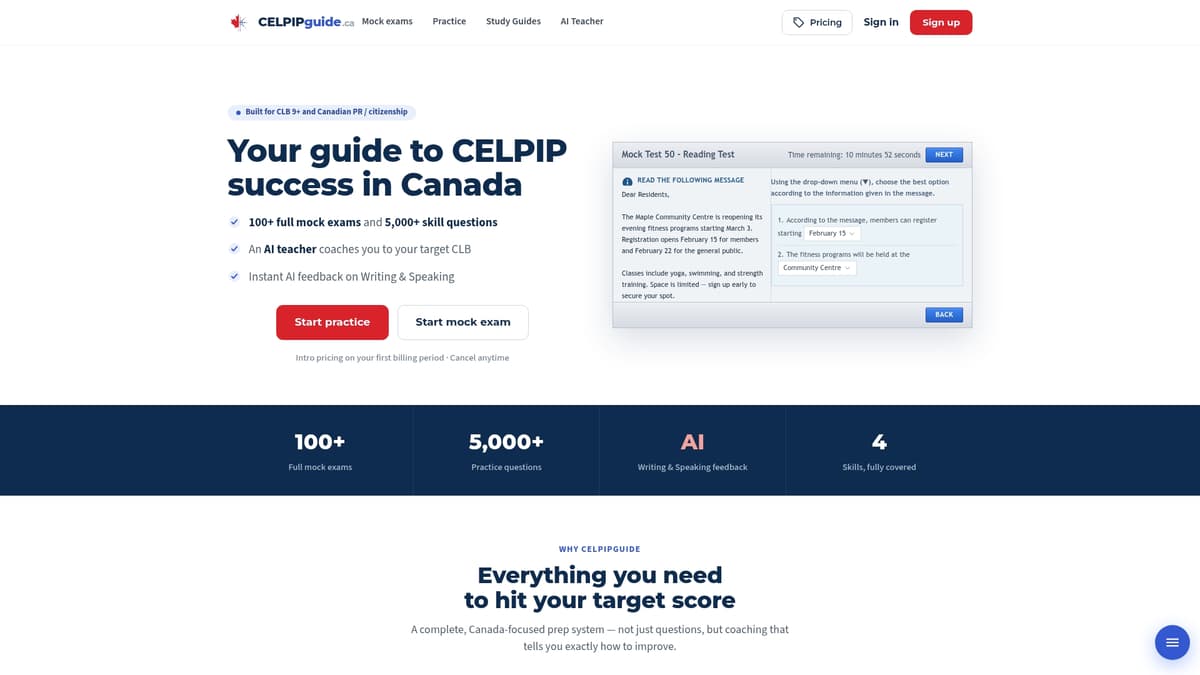
From there, you get access to over 100 full-length mock exams and 5,000+ practice questions, all built to CELPIP task types and timing. The AI-driven study plan adapts to your diagnostic results and updates as your scores change. Writing and speaking tasks get rubric-based feedback instantly, the same type of feedback a human rater would give, so you understand why a response scored the way it did and what to fix.
Start with the CELPIP practice hub or generate a week-by-week study plan matched to your target CLB. Use coupon BLG30 at checkout for 30% off on top of any current discounts.
Useful sources
- Canadian Language Benchmarks (CLB) reference document — official CLB stage and descriptor definitions
- Language requirements for candidates — Canada.ca — federal public service A/B/C language coding
- Qualification standards in relation to official languages — Canada.ca — Treasury Board definitions for bilingual positions
- ILR proficiency levels — International Center for Language Studies — ILR scale definitions including Level 3
- ACTFL oral proficiency workplace poster — proficiency vs. performance distinction
- How to list language levels on your résumé — Indeed Canada — recruiter guidance on framework labels
- Levels of language proficiency — Western University — academic level descriptors for self-assessment
FAQ
What does “professional proficiency” mean in language?
Professional working proficiency (ILR Level 3 / CEFR B2 / CLB 7–8) means you can participate independently in most workplace conversations, write professional documents, and handle technical material in your field without language-related support.
What are the five levels of language proficiency?
The ILR scale runs from 0 (no proficiency) through 1 (elementary), 2 (limited working), 3 (professional working), 4 (full professional), to 5 (native or bilingual). The CEFR uses six bands (A1, A2, B1, B2, C1, C2), and the CLB uses 12 benchmarks grouped into three stages.
What are examples of language proficiency in the workplace?
At CLB 7–8, you attend meetings without pre-shared topics, write reports colleagues can act on without editing, and handle client calls at a normal speaking pace. At CLB 9–10, you lead negotiations, draft policy documents, and present to senior stakeholders.
What is A1, A2, B1, B2, C1, C2 in language proficiency?
These are the six CEFR levels. A1–A2 are basic users, B1–B2 are independent users (B2 equals professional working proficiency), and C1–C2 are proficient users. In Canadian terms, B2 maps to CLB 7–8 and C1 maps to CLB 9–10.
How do I prove language proficiency for a Canadian employer or immigration?
Take CELPIP or IELTS General Training, both of which produce CLB-equivalent scores accepted by IRCC and most Canadian employers. Include the skill-level breakdown (not just the overall score) on your résumé or application, along with the test name and the date you sat it.