
CELPIP Blog
Speaking score in Express Entry: your 2026 CLB guide
Speaking score in Express Entry: your 2026 CLB guide

Your speaking score in Express Entry is not just one of four language abilities — it is one of the fastest CRS levers you can actually move. IRCC converts your speaking result into a Canadian Language Benchmark (CLB) level independently, and that CLB feeds directly into your Comprehensive Ranking System total, through both core human capital points and skill-transferability bonuses. A single CLB jump in speaking can add meaningful points to your profile, and if you are sitting within 20 points of a recent draw cut-off, that improvement alone may be enough to receive an Invitation to Apply (ITA).
Here is what to do right now:
- Check your current speaking CLB. Convert your CELPIP-General or IELTS General Training speaking band to CLB using the official IRCC conversion charts.
- Calculate your point delta. Look up how many CRS points you gain by moving your speaking CLB up by one level — especially the jump from CLB 8 to CLB 9, which unlocks transferability bonuses.
- Decide whether to retake CELPIP. If a targeted speaking retake can close the gap to the cut-off, it is almost always the highest-ROI move available to you.
CLB 9 is the threshold most candidates should target first. It unlocks the higher skill-transferability column, and combined with a qualifying education or work history, it can add up to 50 additional points on top of the core per-ability gains.
Table of Contents
- How does IRCC convert your speaking score to a CLB level?
- How does your speaking CLB affect your CRS total?
- Does your speaking CLB affect program eligibility or just ranking?
- How do you upload speaking results to your Express Entry profile?
- Three scenarios: what a speaking CLB improvement actually does to your CRS
- How do you actually raise your speaking CLB?
- Key takeaways
- Why speaking is the most actionable lever in your Express Entry profile
- Celpipguide helps you target the speaking CLB you actually need
- Useful sources
- FAQ
How does IRCC convert your speaking score to a CLB level?
IRCC scores each of the four language abilities — speaking, listening, reading, and writing — completely independently. There is no averaging. A strong reading score cannot compensate for a weak speaking result. Each ability gets its own CLB level, and each CLB level gets its own CRS points.

For English, two tests are accepted for Express Entry: CELPIP-General and IELTS General Training. CELPIP-General has a particularly clean conversion: CELPIP scores map 1:1 to CLB, so a CELPIP speaking score of 9 equals CLB 9 with no ambiguity. IELTS uses a band-to-CLB table — for speaking, an IELTS band of 7.0 maps to CLB 9, and 7.5 or higher maps to CLB 10.
Test results must be less than two years old at the time you submit your permanent residence application, not just when you create your Express Entry profile. That distinction matters if you are planning a retake. If your current results expire before you receive an ITA, you will need a fresh test.
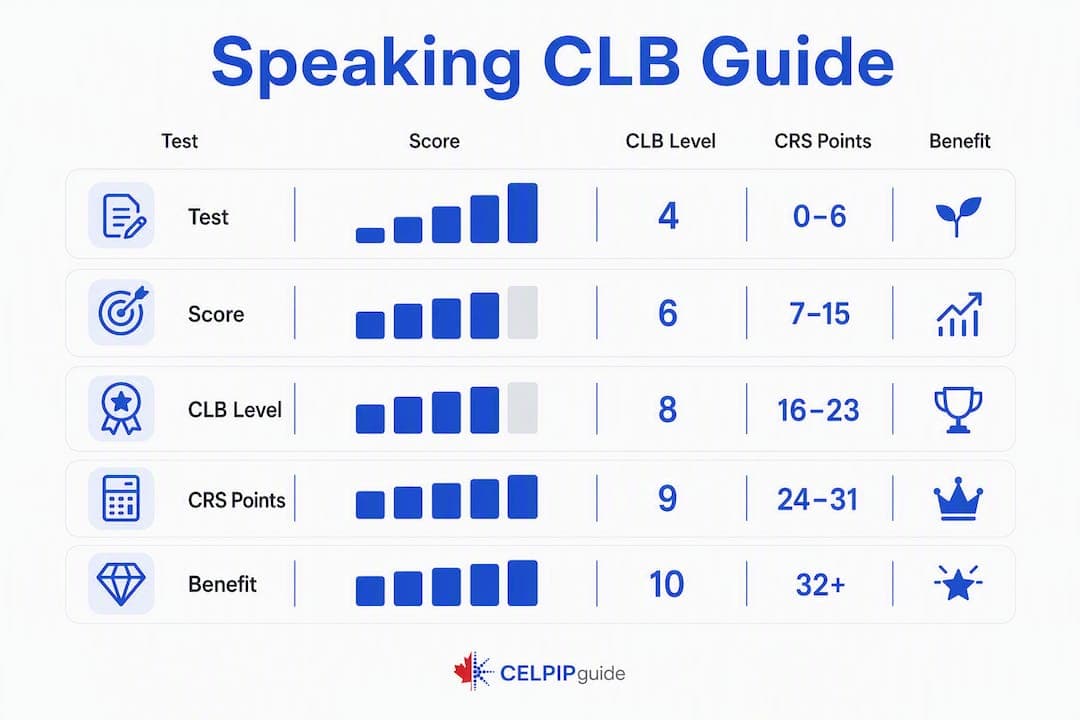
The key CLB milestones to keep in mind for speaking are CLB 7 (program eligibility minimum for most streams), CLB 9 (unlocks the higher transferability column), and CLB 10 (maximum per-ability core points). You can verify your own conversion at any time using the official IRCC language test results page.
Pro Tip: If your CELPIP speaking score is 8 and your other three abilities are already at 9 or 10, a targeted speaking retake is far more efficient than re-sitting the full exam. CELPIP’s 1:1 CLB mapping means you know exactly what score you need before you book.
How does your speaking CLB affect your CRS total?
Language is scored twice in the CRS: once as a core human capital factor and again as part of the skill-transferability calculation. Speaking contributes to both.
Core human capital points per speaking CLB
The table below shows per-ability CRS points for speaking (and each other ability) at each CLB threshold, for single applicants and those with an accompanying spouse or common-law partner.
| CLB level | Points (single applicant) | Points (with spouse/partner) |
|---|---|---|
| Below CLB 7 | 0 | 0 |
| CLB 7 | 17 | 16 |
| CLB 8 | 23 | 22 |
| CLB 9 | 31 | 29 |
| CLB 10+ | 34 | 32 |
These points apply to each of the four abilities separately. So a single applicant with CLB 9 across all four abilities earns 31 × 4 = 124 core language points. Moving speaking alone from CLB 8 to CLB 9 adds 8 points for a single applicant (from 23 to 31).
The transferability bonus: why CLB 9 is the real target
Skill-transferability points require CLB 9 in all four abilities to access the higher bonus column. If even one ability sits at CLB 8, you are locked into the lower column. The combinations that matter most are language paired with a post-secondary credential or with foreign work experience. Moving from CLB 7/8 to CLB 9 across abilities can unlock transferability bonuses potentially worth several dozen points depending on your education and work history.
A worked example: single applicant, speaking CLB 8 → CLB 9
Assume a single applicant with a master’s degree, three years of foreign skilled work experience, and CLB 9 in listening, reading, and writing — but CLB 8 in speaking.
- Speaking core points: 23 (CLB 8)
- Transferability bonus: lower column applies because speaking is below CLB 9
After improving speaking to CLB 9:
- Speaking core points: 31 (+8 points)
- Transferability bonus: higher column now accessible, potentially adding 25–50 points depending on the specific education/work combination
That is a realistic total gain of approximately 33 to nearly 60 CRS points from one targeted speaking improvement. For a candidate sitting near the cut-off, that swing is decisive.
Does your speaking CLB affect program eligibility or just ranking?
Both — and the distinction is worth understanding clearly.
Program minimum CLB requirements for speaking (English):
- Federal Skilled Worker Programme (FSWP): CLB 7 in all four abilities, including speaking.
- Canadian Experience Class (CEC), TEER 0 or 1 occupations: CLB 7 in all four abilities.
- Canadian Experience Class (CEC), TEER 2 or 3 occupations: CLB 5 in all four abilities.
- Federal Skilled Trades Programme (FSTP): CLB 5 in speaking and listening; CLB 4 in reading and writing.
Meeting the minimum gets you into the Express Entry pool. It does not get you an ITA. Invitations go to the highest-ranked candidates in each draw, so a CLB 7 in speaking qualifies you for FSWP but leaves significant CRS points on the table compared to CLB 9 or 10.
The practical implication: if you are already eligible but not receiving ITAs, the problem is almost certainly ranking, not eligibility. Raising your speaking CLB from 7 to 9 adds 14 core points per ability (56 points across all four abilities if you improve all of them), plus the transferability bonus. That is where significant CRS movement happens.
If you have an accompanying spouse or common-law partner, your per-ability points are slightly lower (see the table above), but the transferability thresholds remain the same. Your spouse’s language results can also contribute additional points if they are included in the application.
How do you upload speaking results to your Express Entry profile?
Getting your speaking score into your profile correctly is straightforward, but small errors can delay your CRS recalculation or cause a profile to be flagged.
Step-by-step:
- Log in to your IRCC secure account and open your Express Entry profile.
- Navigate to the language section and select the test you took (CELPIP-General or IELTS General Training).
- Enter your scores for each ability separately — speaking, listening, reading, and writing — using the exact scores from your official test report.
- Enter your test registration or reference number exactly as it appears on your result document.
- Save the profile. Your CRS score recalculates automatically the moment you save updated results.
Common mistakes to avoid:
- Entering your raw IELTS band without checking the CLB conversion — IRCC’s system converts from the band you enter, so entering the wrong band produces the wrong CLB.
- Using results that are more than two years old. The two-year window is calculated from the date of your test, not the date you upload.
- Entering a CELPIP score from a CELPIP-LS (Listening and Speaking only) test — only CELPIP-General is accepted for Express Entry.
- Forgetting to update the profile after a retake. Your CRS does not update until you manually enter the new scores.
Before you save, verify:
- Test name matches exactly (CELPIP-General, not CELPIP-LS).
- Each ability score is entered in the correct field.
- Test reference number is accurate.
- Test date is within the two-year validity window for your expected application date.
Three scenarios: what a speaking CLB improvement actually does to your CRS
These scenarios use the per-ability point values from IRCC and the transferability framework. Assumptions are stated for each.
Scenario A: single applicant with a graduate degree and foreign work experience
Profile: Single applicant, master’s degree, three years of foreign skilled work, CLB 9 in listening/reading/writing, CLB 8 in speaking.
- Speaking core points before: 23
- Speaking core points after (CLB 9): 31 — net gain of +8 points
- Transferability status: moving speaking to CLB 9 completes the CLB 9 requirement across all abilities, unlocking the higher transferability column for the education + language combination
- Estimated additional transferability gain: +25 points (education/language combination, higher column)
- Total estimated CRS gain: approximately 33 to nearly 60 points
A profile with a competitive score typical for a strong single applicant with CLB 9 and a master’s degree could move meaningfully closer to or above recent draw cut-offs with this improvement.
Scenario B: applicant with an accompanying spouse
Profile: Same education and work as Scenario A, but with an accompanying spouse. Per-ability points are lower.
- Speaking core points before: 22 (CLB 8, with spouse)
- Speaking core points after (CLB 9): 29 — net gain of +7 points
- Transferability thresholds remain the same; the CLB 9 requirement still applies to unlock the higher column
- The spouse’s language results can add up to 22 additional points if they also score CLB 9 or above across all abilities
The per-ability gain is slightly smaller, but the transferability unlock is identical. If the spouse’s speaking CLB is also below 9, improving both profiles simultaneously produces the largest combined CRS gain.
Scenario C: candidate near the cut-off
Profile: Single applicant, bachelor’s degree, one year of Canadian skilled work experience, CLB 8 across all four abilities. CRS score sits below the most recent draw cut-off by a margin that could be addressed by improving speaking ability.
- Moving speaking from CLB 8 to CLB 9 adds a meaningful number of core points.
- If the other three abilities also move to CLB 9, additional core points are gained correspondingly.
- Transferability bonus (language + one year Canadian experience): additional points in the higher column
Even improving speaking alone by one CLB level closes a significant portion of a 15-point gap. Improving all four abilities to CLB 9 typically closes it entirely and then some. The CRS recalculates the moment you upload new results, so timing your retake close to a draw period can be decisive.
How do you actually raise your speaking CLB?
The most common mistake candidates make is studying all four skills equally when speaking is the only one holding them back. Targeted practice on your weakest ability produces faster CLB gains than generic preparation.
Start with a diagnostic. Before you build a study plan, take a free CELPIP speaking practice test to identify which task types are costing you the most points — task structure, fluency, vocabulary range, or pronunciation. That diagnosis shapes everything that follows.
An 8-week speaking improvement plan:
- Weeks 1–2: Fluency and task structure. Focus on organising responses clearly within the time limit. Use CLB descriptors from the CLB OSA speaking benchmarks to understand what CLB 9 performance looks like behaviourally.
- Weeks 3–4: Vocabulary and grammar range. CLB 9 requires confident handling of non-routine situations and more sophisticated sentence structures. Practise with varied prompts, not just familiar topics.
- Weeks 5–6: Controlled practice under timed conditions. Record yourself and evaluate against the rubric. Identify recurring errors and correct them deliberately.
- Weeks 7–8: Full mock tests under real test conditions. Review AI or rubric-based feedback after each attempt and track your CLB-equivalent score across attempts.
Pro Tip: Schedule your retake only when your practice mock scores are consistently hitting your target CLB. A premature retake wastes both money and the two-year validity window on a score that does not move your profile.
The CELPIP speaking guide on Celpipguide covers each task type in detail, with sample answers and vocabulary lists that map directly to CLB 9 and CLB 10 performance descriptors. For candidates who want a structured week-by-week schedule rather than building one from scratch, the study plan generator produces a personalised timeline based on your current CLB and target score.
Key takeaways
Your speaking CLB is one of the most controllable variables in your Express Entry profile. Improving it by even one level produces measurable CRS gains, and crossing the CLB 9 threshold unlocks transferability bonuses that can add 25–50 points on top of the core improvement.
| Point | Details |
|---|---|
| CLB 7 is the eligibility floor | CLB 7 in speaking meets the FSWP and CEC (TEER 0/1) minimum, but leaves significant CRS points unclaimed. |
| CLB 9 unlocks transferability | Moving speaking to CLB 9 (alongside the other three abilities) opens the higher skill-transferability column, worth a substantial number of additional points. |
| CLB 10 maximises core points | A single applicant earns 34 core points per ability at CLB 10+, versus 31 at CLB 9 — a gain of 3 points per ability. |
| Upload results promptly | Your CRS recalculates automatically when you save new test scores; timing this close to a draw can make the difference. |
| Celpipguide for targeted prep | Celpipguide’s mock exams, AI speaking feedback, and personalised study plans are built specifically for candidates targeting CLB 9+ in CELPIP. |
Why speaking is the most actionable lever in your Express Entry profile
Most of the factors that drive a CRS score are fixed by the time a candidate enters the pool. Age moves in one direction. Education credentials take years to change. Canadian work experience accumulates slowly. Language is different — and speaking, specifically, tends to be the ability candidates have practised least deliberately.
What I find most striking, looking at how candidates approach their profiles, is how often speaking is treated as a background concern rather than a priority. Candidates will spend months optimising their job description wording or researching provincial nominee programmes, while their speaking CLB sits at 8 when 9 is achievable with six to eight weeks of focused work. The math is straightforward: a CLB 9 speaking score, combined with matching results in the other three abilities, can add more CRS points than most candidates will ever gain from any other single action.
The other thing worth saying plainly: IRCC scores each ability independently, so a weak speaking result cannot hide behind strong reading or writing scores. A single ability below CLB 9 blocks the full transferability bonus for the entire profile. That asymmetry makes speaking improvement not just valuable but, for many candidates, urgent.
My advice is to treat a speaking retake the way you would treat any high-return decision: gather the data first (a diagnostic mock), set a clear target (CLB 9 or CLB 10), practise until your mock scores are consistently there, then book the test. Do not retake speculatively.
Celpipguide helps you target the speaking CLB you actually need
If you have read this far, you already know which CLB level to aim for and roughly how many CRS points are at stake. The next question is how to get there efficiently.
Celpipguide gives you over 100 full-length CELPIP mock exams and 5,000+ practice questions, with AI-driven feedback on your speaking responses that tells you exactly where you lost points and why. The diagnostic test identifies your weakest task types within the first session, so you are not spending weeks practising what you already do well. Study plans are personalised to your current CLB and your target score, with a week-by-week schedule that keeps preparation on track without guesswork.
For candidates targeting CLB 9 in speaking specifically, the CELPIP practice exam hub is the fastest route from diagnosis to test-ready confidence. Use coupon BLG30 at checkout for 30% off, on top of any other active discounts. Start your diagnostic today and know exactly where you stand before you book your next test date.
Useful sources
| Resource | What it covers |
|---|---|
| IRCC CRS criteria (Canada.ca) | Official per-ability CRS point tables and skill-transferability criteria |
| IRCC language test results (Canada.ca) | Official CLB conversion charts for CELPIP-General and IELTS General Training |
| IRCC CRS score calculator (Canada.ca) | Interactive tool to estimate your CRS score by entering test results |
| CLB OSA speaking benchmarks | Behavioural descriptors for each CLB speaking level (CLB 4–10) |
| Celpipguide CLB scores breakdown | Plain-language breakdown of CLB-to-CRS point values with worked examples |
| Celpipguide speaking guide | Task-by-task strategies, sample answers, and vocabulary for CELPIP speaking |
FAQ
What CLB speaking level do I need for Express Entry?
CLB 7 in speaking is the minimum for the Federal Skilled Worker Programme and Canadian Experience Class (TEER 0/1). CLB 9 is the threshold that unlocks the higher skill-transferability bonus column and is the practical target for competitive CRS ranking.
Is CLB 7 enough to get an ITA in Express Entry?
CLB 7 meets the eligibility minimum for most Express Entry programmes, but it rarely produces a CRS score high enough to receive an ITA in competitive draws. Most candidates who receive ITAs have CLB 9 or higher across all four abilities.
Can a 350 or 400 CRS score get me permanent residency?
Draw cut-offs vary by round and programme category. General draws and specific category draws require varying scores depending on the pool of candidates. Check the most recent IRCC draw results for current thresholds.
How many CRS points do I gain by improving speaking from CLB 8 to CLB 9?
A single applicant gains 8 core CRS points per ability (from 23 to 31) by moving from CLB 8 to CLB 9 in speaking. If that improvement also completes the CLB 9 requirement across all four abilities, it can unlock an additional 25–50 transferability points depending on your education and work experience.
Which test is better for Express Entry speaking: CELPIP or IELTS?
Both CELPIP-General and IELTS General Training are accepted. CELPIP-General maps 1:1 to CLB levels, which makes it easier to set a precise target score. Candidates who find IELTS speaking band descriptors less predictable often prefer CELPIP for its transparency in CLB conversion.