
CELPIP Blog
What "adequate knowledge" of a language means for citizenship
What “adequate knowledge” of a language means for citizenship

For Canadian citizenship, “adequate knowledge” of an official language means you can hold short everyday conversations in English or French, understand simple instructions, and use basic grammar and common vocabulary — abilities that correspond to CLB/NCLC level 4 for speaking and listening.
This requirement applies to you if you are between 18 and 54 years old when you sign your citizenship application. If you are under 18 or 55 and older, you do not need to submit language proof.
- Who sets the standard: Immigration, Refugees and Citizenship Canada (IRCC) is the decision-maker.
- How it is measured: Using the Canadian Language Benchmarks (CLB) for English and the Niveaux de compétence linguistique canadien (NCLC) for French.
- What you need to show: Speaking and listening ability at CLB/NCLC level 4 or higher.
Key takeaways
Adequate knowledge of an official language for Canadian citizenship means CLB/NCLC level 4 for speaking and listening — a functional conversational ability, not academic fluency.
| Point | Details |
|---|---|
| CLB/NCLC level 4 is the standard | You must show speaking and listening ability equivalent to level 4 on the Canadian Language Benchmarks or NCLC. |
| Age rule: 18–54 must provide proof | Applicants under 18 or 55 and older are exempt from submitting language evidence. |
| Three accepted proof types | Approved test results, English/French-instruction diplomas or transcripts, and government-funded programme results all qualify. |
| Poor document quality causes returns | Blurry scans, missing translations, and incomplete packages are the most common reasons IRCC returns applications. |
| Celpipguide prepares you efficiently | Diagnostic tests, AI study plans, and full mock exams with rubric feedback target the exact skills citizenship applicants need. |
This article is general information, not a substitute for advice from a qualified lawyer. Consult a qualified legal professional about your own circumstances before acting on anything here.
Table of Contents
- What does adequate knowledge of a language mean officially?
- What CLB/NCLC level 4 actually looks like in everyday life
- Who must meet the requirement, and who is exempt?
- What counts as acceptable proof of language ability?
- How does IRCC review your language proof?
- What are your options if you do not meet the requirement yet?
- A practical preparation plan to reach CLB/NCLC level 4
- Celpipguide gets you to level 4 faster
- Sources
- FAQ
What does adequate knowledge of a language mean officially?
Section 14 of the Citizenship Regulations defines adequate knowledge as the ability to take part in short routine conversations, understand simple instructions, and use basic grammar and vocabulary for routine oral communication. That is the legal text behind the phrase.
In practice, IRCC translates this into measurable terms. The Canada puts it plainly: you can understand someone speaking English or French, and they can understand you. IRCC measures this using the CLB and NCLC frameworks, reviewing the documents you submit and, where needed, observing how you communicate during interactions with citizenship staff or officers.
Citizenship officers make the final call. They look at your submitted proof first, but they can also assess your spoken ability during a citizenship interview if they need to verify your level. This is not a written grammar test — the focus is on real oral communication.
What CLB/NCLC level 4 actually looks like in everyday life
Level 4 is a functional, conversational threshold. Canada.ca describes it as the ability to take part in short everyday conversations, understand simple instructions and directions, use basic grammar, and have enough common words and phrases to answer questions and express yourself.
Here is what that looks like in real situations:
- Answering routine questions at a citizenship interview (“Where do you live?” “How long have you been in Canada?”)
- Following spoken directions to find an office or complete a simple task
- Making a basic appointment over the phone (“I’d like to book a time for next Tuesday”)
- Understanding a short announcement or a simple set of instructions at a community centre
Quick self-assessment checklist before you prepare your proof:
- Can you have a short back-and-forth conversation on a familiar topic without long pauses?
- Do you understand when someone gives you simple directions or instructions?
- Can you ask and answer basic questions about your daily life, work, or neighbourhood?
- Do people generally understand you when you speak, even if your accent is noticeable?
If you answered yes to all four, you are likely at or near level 4. If one or two feel shaky, targeted practice on speaking and listening will close the gap faster than you might expect.
Who must meet the requirement, and who is exempt?
The age rule is straightforward. The CIT 0002 application guide confirms that applicants aged 18–54 at the time they sign the application must submit proof of adequate language knowledge. Applicants under 18 or 55 and older are not required to provide language evidence.
| Age when signing the application | Language proof required? |
|---|---|
| Under 18 | No |
| 18–54 | Yes — CLB/NCLC level 4 for speaking and listening |
| 55 and older | No |
There is also a waiver route for applicants aged 18–54 who cannot meet the requirement due to compassionate grounds, such as a serious medical condition. To request a waiver, you submit Form CIT 0116 (Waiver Request) along with supporting documentation — typically a letter from a medical professional explaining why you cannot demonstrate language ability. IRCC reviews these on a case-by-case basis, so the documentation needs to be specific and thorough.
What counts as acceptable proof of language ability?
Canada.ca lists three main categories of acceptable evidence for applicants aged 18–54:
- Approved third-party test results: Results from a recognised language test showing CLB/NCLC level 4 or higher for speaking and listening. CELPIP (CELPIP-General) and IELTS (General Training) are two tests IRCC accepts. Check the current IRCC list for all approved tests before booking.
- Diplomas, certificates, or transcripts: Documents from a secondary or post-secondary programme taught in English or French. The documentation must clearly show the language of instruction. If you studied in English or French, you may not need to retest at all — your academic records can serve as proof.
- Government-funded language training results: Results from a federally or provincially funded language programme that show you reached at least CLB/NCLC level 4.
Translation rule: Any document not already in English or French must be accompanied by a certified translation. The translator must be a certified member of a provincial or territorial association of translators and interpreters, and their certification details must appear on the translation.
Label each file clearly — for example, “Language_Proof_CELPIP_Results.pdf” — so IRCC reviewers can identify it instantly. Missing pages and low-resolution scans are among the most common reasons applications get returned.*
How does IRCC review your language proof?
IRCC reviews language documents when your application is received. The Canada.ca language proof page is direct about the consequences of poor submissions: IRCC will return your entire application if the language proof is unreadable, missing, or not translated into English or French where required.
Common reasons language evidence gets returned or rejected:
- Scans that are blurry, too dark, or cut off part of the document
- Documents in a language other than English or French without a certified translation
- Test results that show a level below CLB/NCLC 4 for speaking or listening
- Missing pages from a transcript or diploma package
- Unsigned letters or letters without the issuing institution’s letterhead
Beyond the paper review, citizenship officers can assess your spoken ability at any point during the process. IRCC notes that officers observe how you communicate with staff and may assess language level during a citizenship interview if they need to verify your level. Being prepared to speak confidently in English or French on the day of your interview is part of meeting the requirement, not just a formality.
What are your options if you do not meet the requirement yet?
Not meeting CLB/NCLC level 4 right now does not mean your citizenship path is blocked. You have clear options:
- Retake an approved language test. Most approved tests allow you to retest after a short waiting period. Check the specific test provider’s policy — CELPIP, for example, allows retesting after a defined interval. Once you have new results showing level 4 or higher, submit them with your application.
- Enrol in language training. Federally and provincially funded programmes (such as Language Instruction for Newcomers to Canada, known as LINC) are free or low-cost and designed specifically to bring learners to functional CLB levels. Completing a programme that certifies level 4 gives you an accepted proof document.
- Request a compassionate-grounds waiver. If a medical condition prevents you from demonstrating language ability, submit Form CIT 0116 with detailed supporting documentation from a qualified medical professional. IRCC reviews each waiver request individually.
- Wait until age 55. If you are close to 55, the requirement no longer applies once you reach that age at the time of signing. This is a legitimate path for some applicants.
Practical timeline for retesting and resubmitting:
- Allow 4–8 weeks from the decision to retest to receiving official results (booking time, test date, and processing).
- Once you have results, you can submit a new application or, if your original was returned, resubmit with the corrected documents.
- Factor in citizenship test and oath scheduling when planning your timeline — language proof is just one piece of the overall application.
A practical preparation plan to reach CLB/NCLC level 4
Reaching level 4 for speaking and listening is very achievable with a focused plan. Here is a step-by-step approach:
- Take a diagnostic test. Before anything else, find out exactly where you stand. A diagnostic pinpoints whether your gap is in speaking, listening, or both, so you are not wasting time on skills you have already mastered.
- Focus practice on your weak skill. If listening is the gap, work on understanding spoken English or French in varied accents and speeds. If speaking is the issue, practise short responses to everyday questions out loud, not just in your head.
- Simulate real test conditions. Use a microphone for speaking tasks, set a timer, and reduce background noise. Practising in realistic conditions builds the stamina and confidence that matter on test day.
- Take a full-length mock exam. A complete mock reveals pacing issues and gaps that short drills miss. Schedule one at least two weeks before your actual test date so you have time to adjust.
- Review, target, and repeat. After each mock, focus your next study session on the specific task types where you lost the most marks. Rubric-based feedback tells you exactly what to fix.
For speaking and listening specifically, vocabulary depth matters more than most people realise — knowing the right words for everyday situations is what separates a level 3 response from a level 4 one.
Pro Tip: Record yourself answering a simple question — “Tell me about your neighbourhood” — and listen back. If you can follow your own answer easily and it sounds natural, you are close to level 4. If you notice long pauses, repeated filler words, or unclear phrasing, those are the exact points to target in your next practice session.

Celpipguide’s diagnostic test identifies your current CLB level across all four skills in one sitting. From there, its AI study plan generator builds a week-by-week schedule tailored to your gaps, and its full-length mock exams replicate real CELPIP test conditions with rubric-based feedback on every speaking and listening task. For applicants preparing specifically for the citizenship speaking and listening requirement, that combination of diagnosis, targeted practice, and realistic simulation is the most direct path to a confident result.
A note from Reza on building real confidence
One thing I see consistently: applicants who practise speaking out loud every single day — even for ten minutes — build confidence far faster than those who study passively. You do not need a perfect accent or flawless grammar to meet level 4. You need to communicate clearly enough that the person in front of you understands you. Start with topics you know well (your job, your neighbourhood, your daily routine), and the language will follow naturally. Most people who are consistent reach a functional level 4 within a few months of focused practice. You can do this.
Celpipguide gets you to level 4 faster
If you are preparing for the CELPIP-General to meet the citizenship language requirement, Celpipguide gives you the most direct preparation path available.
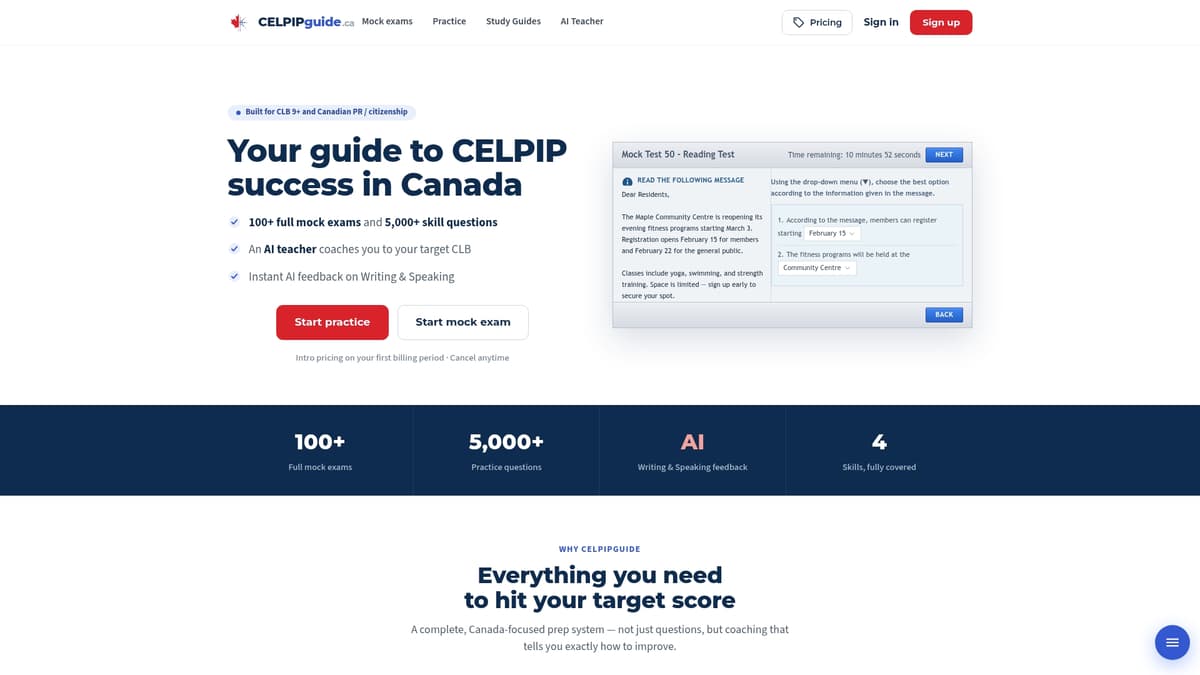
- Diagnostic test: Know your exact CLB level from day one, so you practise what actually needs work.
- AI-personalised study plans: A week-by-week schedule built around your gaps in speaking and listening, updated as you improve.
- 100+ full-length mock exams with rubric feedback: Practise under real test conditions and get instant, specific feedback on every speaking task.
Start with a free practice test today at Celpipguide, and use coupon code BLG30 to get 30% off any subscription plan on top of all other discounts.
Sources
- How do you measure how well I can speak English or French when applying for citizenship? - IRCC
- Laws-lois
FAQ
What does “adequate knowledge” of a language mean for citizenship?
It means you can hold short everyday conversations, understand simple instructions, and use basic grammar and common vocabulary in English or French — the equivalent of CLB/NCLC level 4 for speaking and listening, as defined in Section 14 of the Citizenship Regulations.
What is CLB 4 language proficiency in practical terms?
CLB 4 means you can answer routine questions, follow simple spoken directions, and make yourself understood in familiar everyday situations. You do not need advanced grammar or a wide vocabulary — functional oral communication is the standard.
What is the easiest language test accepted for Canadian citizenship?
IRCC accepts several approved tests, including CELPIP-General and IELTS General Training. Many applicants find CELPIP more straightforward for Canadian contexts since it uses Canadian accents and everyday Canadian scenarios throughout. Check the current IRCC list for all accepted tests before booking.
Do I need a language test if I studied in English or French?
Not necessarily. If you completed a secondary or post-secondary programme taught in English or French, your diploma or transcript may qualify as proof of adequate knowledge, provided the documentation clearly states the language of instruction.
What happens if IRCC returns my application for language proof issues?
IRCC will return your entire application, not just the language document. You will need to correct the issue — whether that means rescanning documents, adding a certified translation, or submitting stronger proof — and resubmit the full package.