
CELPIP Blog
CLB score for university admission: what applicants need to know
CLB score for university admission: what applicants need to know

Most Canadian universities will not accept a CLB-based settlement assessment as direct admission evidence. What they want is a recognised academic test score, typically IELTS Academic, TOEFL iBT, CAEL, or CanTEST. Where CLB equivalents come into play, the typical thresholds for undergraduate programmes lie at moderate to high CLB levels, and graduate or professional programmes usually require even higher proficiency. Your immediate next step: pull up your target programme’s published English-language requirement, then use the official IRCC conversion tables to map your existing test bands to CLB levels before you book or retake any test.
- Most programmes list IELTS Academic or TOEFL iBT minimums, not CLB levels directly.
- CLB equivalents are most relevant when you are also planning an immigration step (PGWP, Express Entry) after graduation.
- CLB-OSA assessments (CLBA, CLBPT) are designed for settlement and training — universities do not accept them for admission.
- Score validity is typically two years; confirm the exact window with your programme.
Pro Tip: Before converting anything, check whether your target programme lists minimum sub-scores alongside the overall band. Many applicants meet the overall minimum but miss a sub-score cutoff in reading or writing.
Table of Contents
- What are the Canadian Language Benchmarks, and why do universities use different tests?
- How do your test scores convert to CLB levels?
- What CLB-equivalent scores do Canadian universities typically require?
- Why admission requirements and immigration CLB thresholds are not the same thing
- What to do when your score falls below the programme requirement
- How to convert and report your scores correctly
- Practical ways to improve the skills that determine your CLB equivalent
- Key takeaways
- The part most guides leave out
- Celpipguide can help you reach your target CLB-equivalent scores
- Useful sources to verify your own situation
- FAQ
What are the Canadian Language Benchmarks, and why do universities use different tests?
The Canadian Language Benchmarks (CLB) is a 12-level national scale that describes English language ability across four skills: listening, speaking, reading, and writing. CLB 1 represents the most basic communication, while CLB 12 reflects near-native fluency. The scale was built primarily for settlement services, workplace training, and immigration programmes, not for measuring the kind of academic language ability a university degree demands.
That distinction matters in practice. Universities need evidence that you can read dense academic texts, write research essays, and follow lectures in a discipline-specific context. Tests like IELTS Academic and TOEFL iBT are designed to measure exactly that. CLB, by contrast, maps to day-to-day and workplace communication, which is why IRCC uses it for immigration thresholds and why CLB-based assessments are not intended for university admission.
Most recognised test results are valid for two years. Always confirm the specific validity window with your programme, because some graduate schools or professional faculties apply stricter timelines.
How do your test scores convert to CLB levels?
IRCC publishes skill-by-skill conversion tables for CELPIP-General, IELTS General Training, TOEFL iBT, and PTE Core. These tables are the authoritative reference for immigration purposes and are widely used as a proxy when applicants or advisors want to express test results in CLB terms.

One critical point: conversions are skill-specific. IRCC does not average across the four skills. If your IELTS listening band converts to CLB 8 but your writing band converts to CLB 6, your CLB level in writing is 6, full stop. Always check the IRCC language results page for the exact cutoffs by skill.
| CLB Level | IELTS General Training (per skill) | CELPIP-General (per skill) | TOEFL iBT (per skill, approx.) | PTE Core (per skill, approx.) |
|---|---|---|---|---|
| CLB 5 | 5.0 | 5 | L: 8 / S: 16 / R: 4 / W: 14 | — |
| CLB 6 | 5.5 | 6 | L: 12 / S: 18 / R: 8 / W: 17 | — |
| CLB 7 | 6.0 | 7 | L: 17 / S: 23 / R: 12 / W: 21 | — |
| CLB 8 | 6.5 | 8 | L: 21 / S: 25 / R: 19 / W: 24 | — |
| CLB 9 | 7.0 | 9 | L: 24 / S: 27 / R: 20 / W: 27 | — |
| CLB 10 | 7.5 | 10 | L: 28 / S: 30 / R: 24 / W: 28 | — |
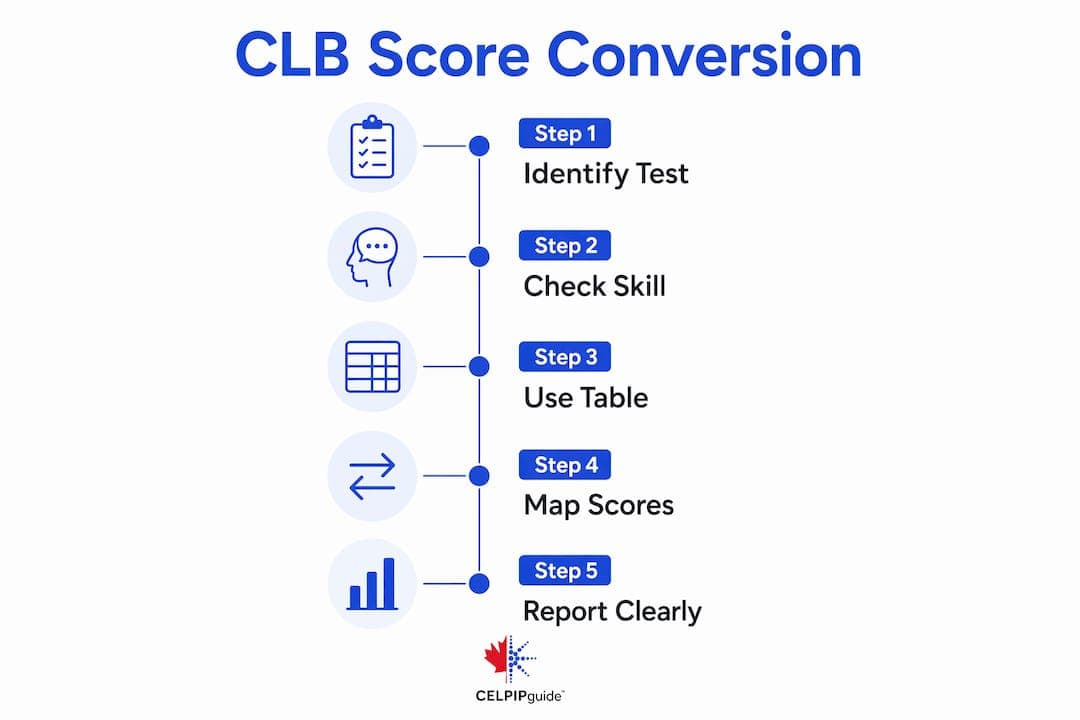
Sources: IRCC official conversion tables. TOEFL iBT and PTE Core ranges are approximate; always verify against the current IRCC page.
What CLB-equivalent scores do Canadian universities typically require?
Universities publish their requirements as IELTS Academic or TOEFL iBT bands, not as CLB levels. When you convert those published minimums using the IRCC tables, most undergraduate programmes land in the CLB 7–8 range, while professional and graduate programmes often sit at CLB 9 or above.
Here is how that plays out across common programme types:
- General undergraduate admission: IELTS Academic 6.5 overall (minimum 6.0 per band) converts to roughly CLB 8 in most skills. Many colleges and universities publish programme-specific CLB minimums_Sept%2013%202016_0.pdf) or equivalents that vary by faculty.
- Humanities and social sciences: Reading and writing sub-scores often carry higher minimums, sometimes IELTS 7.0 in those skills (CLB 9).
- Engineering and sciences: Listening and reading tend to be weighted more heavily; writing minimums may be slightly lower than in humanities streams.
- Graduate and professional programmes (law, medicine, education): IELTS Academic 7.0–7.5 overall is common, mapping to CLB 9–10.
- College diplomas: Minimum CLB for college in Canada typically sits at CLB 5–7 depending on the programme and institution.
Pro Tip: If a programme publishes only an overall minimum band, contact admissions and ask for the minimum sub-score requirement before you assume you qualify. An overall 6.5 with a 5.5 in writing will fail the sub-score cutoff at many institutions.
Why admission requirements and immigration CLB thresholds are not the same thing
This is where a lot of applicants get tripped up. Admission requirements and immigration thresholds use different tests, different CLB mappings, and serve completely different purposes.
For admission, universities want IELTS Academic or TOEFL iBT because those tests measure academic readiness. For immigration, IRCC accepts IELTS General Training, CELPIP-General, or PTE Core, mapped to CLB. The two IELTS versions are not interchangeable: IELTS Academic gets you into university; IELTS General Training is what IRCC accepts for immigration and PGWP purposes.
Since November 1, 2024, PGWP language evidence rules require CLB 7 in all four skills for university graduates and CLB 5 in all four skills for college or diploma graduates. Every skill must meet the threshold independently. A single weak skill blocks eligibility even when the other three are strong.
The practical risk: you sit IELTS Academic for admission, graduate, then discover IRCC does not accept IELTS Academic as PGWP language evidence. You would need to sit IELTS General Training, CELPIP-General, or PTE Core separately. Plan your test choices with both goals in mind from the start. For a deeper look at how CLB scores connect to immigration outcomes, it is worth reviewing the full picture before you commit to a test format.
What to do when your score falls below the programme requirement
Falling short does not mean starting over. There are several practical routes depending on how close you are and what your timeline looks like.
- Conditional admission and EAP pathways: Many universities offer conditional admission for candidates scoring just below the required minimums. You enrol in an intensive academic English programme (EAP) first, then transition to degree-level classes once you meet the language standard. EAP pathways are a common and legitimate route for borderline applicants.
- Retesting: Choose your test version based on your medium-term goals. If you need both admission and PGWP eligibility, consider sitting IELTS Academic for admission and planning a separate IELTS General Training or CELPIP-General attempt for immigration. Book at least six weeks ahead to secure your preferred date.
- Targeted preparation: General study rarely moves the needle as fast as focused skill work. Identify your weakest skill through a diagnostic test, then direct your study time there specifically.
- Timeline planning: Test results are valid for two years for most admissions and immigration applications. Map your test date against your application deadline and your expected graduation date to avoid a validity gap.
Pro Tip: Admissions and immigration rules both treat each skill separately. A gain of half a band in your weakest skill does more for your eligibility than a full band gain in your strongest. Focus there first.
How to convert and report your scores correctly
Converting your scores and presenting them clearly to admissions is a straightforward process when you follow the right steps.

Step 1: Go to the IRCC language results page and locate the conversion table for your test. Map each skill individually. Write down the CLB level for each of the four skills.
Step 2: Prepare your official score report. Admissions offices require official test reports sent directly from the testing organisation (IDP/British Council for IELTS, ETS for TOEFL iBT, Paragon Testing Enterprises for CELPIP, Pearson for PTE Academic). Self-reported scores are generally not accepted for final admission decisions.
Step 3: If a programme lists only CLB levels and you are submitting a test score, attach a screenshot or printed copy of the relevant IRCC conversion table alongside your application. Add a brief note explaining how each skill maps to the listed CLB requirement. Then confirm with the admissions office that this format is acceptable before you submit.
One thing worth knowing: if you are using academic English tutoring to close a gap before retesting, resources like academic English support can help you target the specific sub-skills that hold your score back.
Practical ways to improve the skills that determine your CLB equivalent
The fastest gains come from knowing exactly where you are weak before you start studying. That sounds obvious, but most test-takers skip the diagnostic step and spend weeks practising skills they already perform well.
- Start with a diagnostic test that scores each skill separately and shows you the gap between your current level and your target CLB equivalent.
- Use full-length mock exams under timed conditions. Simulating real test conditions reduces anxiety and builds the stamina that timed academic tests demand.
- Get written feedback on your writing tasks. A score alone does not tell you whether your grammar, coherence, or task response is the limiting factor. Instant AI-scored feedback on writing tasks, like what Celpipguide provides, pinpoints the specific issue.
- Review speaking samples with model responses. Listening to high-scoring responses and comparing them to your own recordings is one of the most efficient ways to close a speaking gap.
- Follow a structured, week-by-week study plan that adjusts based on your diagnostic results rather than a fixed syllabus.
For applicants targeting CLB 7 specifically, the CLB 7 skills checklist breaks down exactly what each skill requires at that level, which makes it easier to self-assess before a retest.
Pro Tip: Scheduled, score-led practice with regular diagnostic retests yields faster band improvements than indiscriminate study. Set a retest date first, then work backwards to build your study schedule.
Key takeaways
Most Canadian universities require academic test scores for admission, not CLB certificates. Converting your scores to CLB using the official IRCC tables gives you a useful reference point, but the programme’s published requirement is always the binding standard.
| Point | Details |
|---|---|
| CLB is not a university admission test | Universities require IELTS Academic, TOEFL iBT, CAEL, or CanTEST — not CLB-based settlement assessments. |
| Typical admission thresholds | Undergraduate programmes generally equate to CLB 7–8; graduate and professional programmes often require CLB 9 or higher. |
| Skills are assessed individually | A low sub-score in one skill can block admission or PGWP eligibility even when the overall band looks acceptable. |
| Admission and immigration tests differ | IELTS Academic is not accepted for PGWP evidence; plan your test choices to cover both goals from the start. |
| Celpipguide for targeted prep | Celpipguide’s diagnostic tests, AI-personalised study plans, and full mock exams help you target the specific skills that determine your CLB equivalent. |
The part most guides leave out
There is a gap between what the conversion tables show and what actually determines whether you get in or get your permit. Admissions officers and IRCC officers are not looking at the same number. An admissions officer reads your IELTS Academic overall band and your sub-scores. An IRCC officer checks whether each of your four CELPIP or IELTS General Training skills clears the CLB threshold independently.
What I see most often is applicants who treat the overall band as the finish line. They hit 6.5 overall on IELTS Academic, assume they are done, and then discover their writing sub-score was 5.5 and the programme requires 6.0 in every band. Or they graduate, apply for a PGWP, and realise they sat the wrong version of IELTS entirely.
The smarter approach is to treat each skill as its own separate target from day one. Map your weakest skill to its CLB equivalent, set a specific sub-score goal for that skill, and build your study plan around closing that gap. The overall band will follow. Chasing the average while ignoring a weak skill is the single most common reason applicants retest more times than they need to.
Plan your tests so the results are valid for both your admission deadline and any immigration step you expect within two years of graduation. That timing window is tighter than most people realise.
Celpipguide can help you reach your target CLB-equivalent scores
If CELPIP-General is part of your plan, whether for immigration after graduation or as a targeted skill-building route, Celpipguide gives you the tools to prepare with precision rather than guesswork.
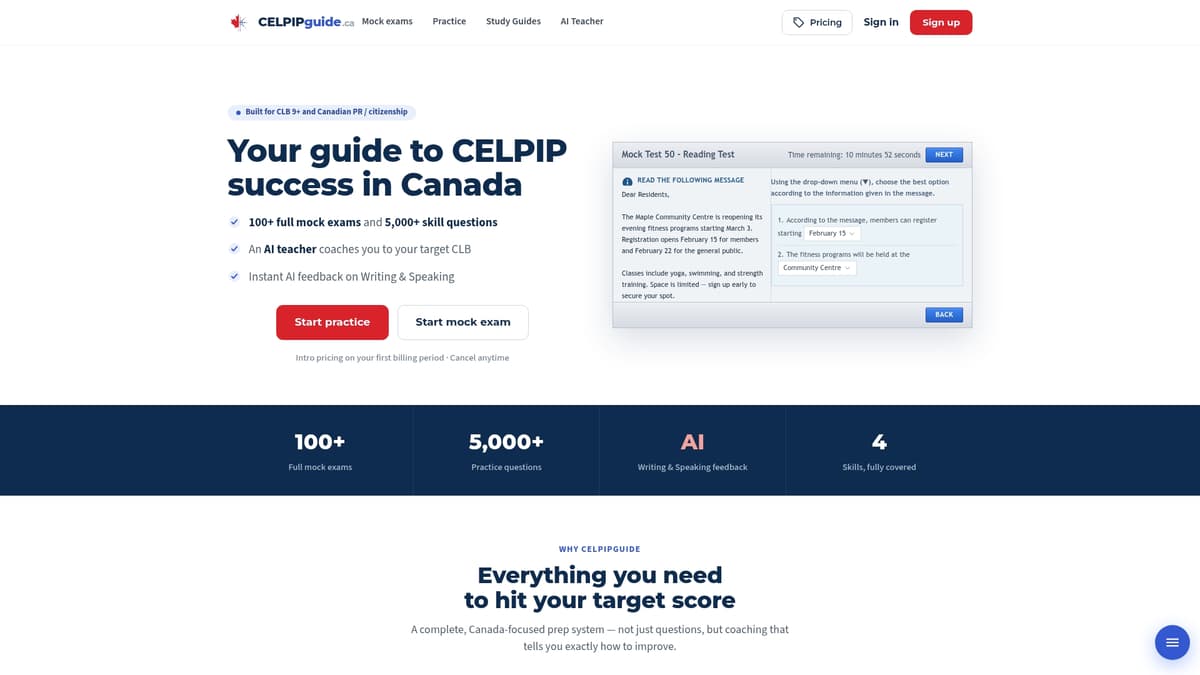
Start with a diagnostic test that scores each of the four skills separately and shows you exactly where your CLB equivalent falls short. From there, an AI-personalised study plan adjusts week by week based on your progress, so you are always working on the skill that moves the needle most. Full-length CELPIP mock exams replicate real test conditions, and instant writing feedback tells you specifically what to fix, not just what your score is. Speaking samples with model responses let you hear the difference between your current level and a high CLB-equivalent response.
One honest note: always confirm with your admissions office that CELPIP-General meets their evidence requirements before you commit to it as your primary admission test. For immigration and PGWP purposes, it is a fully accepted option. For university admission specifically, the programme page is the binding reference.
Ready to close the gap? Use the CELPIP study plan generator to build a week-by-week schedule tailored to your target CLB level and your test date.
Useful sources to verify your own situation
These are the authoritative pages to consult before making any test or application decision.
- IRCC official conversion tables: PGWP language results — Canada.ca — skill-by-skill CLB mappings for CELPIP, IELTS General Training, TOEFL iBT, and PTE Core.
- IRCC PGWP eligibility: Who can apply for a PGWP — Canada.ca — confirms CLB 7 (university) and CLB 5 (college) all-four-skills requirements.
- CELPIP score conversion: Paragon Testing Enterprises / CELPIP — CLB equivalents for CELPIP-General levels.
- IELTS and CLB: IDP IELTS Canada — IELTS vs CLB — explains the difference between IELTS Academic and General Training in the Canadian context.
- CLB-OSA FAQ: Can I use CLB-OSA results for university admission? — confirms settlement assessments are not accepted for admission.
- University programme pages: Always check the specific programme’s English-language requirements page directly; general university minimums do not override faculty or programme-level requirements.
- Celpipguide prep resources: CLB scores and Express Entry breakdown and the CLB 7 skills checklist for targeted preparation guidance.
This article is general information, not professional immigration or admissions advice. Confirm current requirements with the programme’s admissions office or a regulated immigration consultant for your specific situation.
FAQ
Do Canadian universities accept CLB scores directly for admission?
Generally, no. CLB-based assessments like the CLBA and CLBPT are designed for settlement and training, not university admission. Universities require recognised academic tests such as IELTS Academic, TOEFL iBT, CAEL, or CanTEST.
What is a good CLB score for university admission?
Most undergraduate programmes equate to a minimum of CLB 7–8 when you convert their published IELTS Academic or TOEFL iBT requirements. Graduate and professional programmes typically require CLB 9 or higher. The binding number is always the programme’s published test score, not the CLB equivalent.
Is CLB 7 enough for a PGWP after graduation?
Yes, for university graduates. Since November 1, 2024, PGWP rules require CLB 7 in all four skills for university graduates and CLB 5 for college or diploma graduates. Every skill must meet the threshold independently.
Can a low sub-score in one skill block my application?
Yes. A single skill below the minimum — for example, a 5.5 in writing when the programme requires 6.0 — can block admission even when your overall band looks acceptable. The same all-four-skills rule applies to PGWP eligibility.
How do I prepare if my CLB-equivalent score falls short?
Start with a diagnostic test to identify your weakest skill, then focus your preparation there. Celpipguide offers diagnostic tests, AI-personalised study plans, and full mock exams aligned to CLB levels, which makes it practical for applicants targeting CELPIP-General for immigration purposes.