
CELPIP Blog
AI feedback for speaking: Canadian citizenship exam guide
AI feedback for speaking: Canadian citizenship exam guide

TL;DR:
- AI feedback for Canadian citizenship speaking preparation provides instant, criterion-based assessments of fluency, vocabulary, grammar, and pronunciation. Combining AI tools with human practice and tracking progress over time is the most effective approach for achieving success.
AI feedback for speaking in the Canadian citizenship exam is defined as automated, criterion-based assessment that evaluates your fluency, vocabulary, grammar, and pronunciation against the Canadian Language Benchmarks (CLB) used by official examiners. Getting this kind of detailed, instant feedback used to require a trained tutor or a formal mock interview. Now, AI tools deliver it on demand, at any hour, with the consistency that human reviewers cannot always match. If you are preparing for your citizenship interview, understanding how to use AI speaking test feedback effectively is the fastest way to close the gap between where you are and where you need to be.
What speaking skills does the Canadian citizenship exam assess, and how does AI feedback measure them?
The Canadian citizenship interview is not a formal speaking test in the traditional sense. Examiners assess conversational ability throughout the entire interview, not in a separate oral exam section. You must answer 6 out of 10 civics questions correctly, and your spoken English is evaluated as you respond. That means your fluency, vocabulary, grammar, and pronunciation all matter from the moment you walk in.
AI feedback tools mirror this reality by evaluating the same four criteria that examiners use:
- Fluency: How smoothly you speak without long pauses or excessive filler words like “um” and “uh.” AI tools flag these automatically with timestamps so you can hear exactly where you stumble.
- Vocabulary range: Whether you use a variety of words or repeat the same basic terms. AI tools track word frequency and suggest alternatives.
- Grammatical accuracy: Subject-verb agreement, tense consistency, and sentence structure. AI tools highlight errors and explain the rule behind each one.
- Pronunciation: Pronunciation accounts for 25% of speaking scores in formal assessments. AI tools identify issues like flat intonation, incorrect word stress, and missing connected speech that human listeners may not explicitly name but definitely notice.
The CLB Level 4 standard is the minimum required for citizenship. At that level, you need to communicate clearly in everyday situations, handle direct questions, and express basic opinions. AI feedback tools calibrate their scoring to this benchmark, which means the feedback you receive is relevant to the actual standard you are being held to.
Pro Tip: Record your AI practice sessions and listen back without reading the transcript first. You will catch pronunciation and fluency issues that you miss when you are focused on the words on screen.

How to use AI tools effectively to improve your citizenship speaking exam performance
Practising with AI tools without a plan produces slow results. A structured approach makes every session count. Here is a method that works:
-
Set up exam conditions. Practise in a quiet room with a good microphone. Simulate the interview format by responding to civics questions and follow-up prompts within a set time. Memorising scripted answers is less effective than practising conversational responses. AI tools that simulate follow-up questions prepare you far better for the live interview.
-
Allocate your study time deliberately. The recommended study ratio is 60% on your weakest speaking skill and 40% spread across the others. If pronunciation is your weak point, spend most of your session on that. Do not give equal time to everything and expect equal improvement.
-
Review AI transcripts after every session. Read the transcript line by line. Look for repeated errors, not just one-off mistakes. Patterns in your transcript reveal habits that you need to break.
-
Practise spontaneous responses. Ask the AI tool to give you a question you have not seen before. Respond without preparation. This builds the mental agility you need when an examiner asks something unexpected.
-
Expand your vocabulary weekly. Use the vocabulary insights from your AI feedback to build a list of words you misused or avoided. Practise using each word in three different sentences. A vocabulary builder tool can help you track and retain these words systematically.
-
Track your progress over weeks, not days. AI tools that store your session history let you compare your fluency score from week one to week four. Progress in speaking is gradual. Seeing measurable improvement keeps you motivated.
Pro Tip: After each AI session, write down the top three errors flagged. Review that list before your next session. This short habit compounds quickly over a month of practice.
What are common challenges with AI feedback in citizenship speaking practice?
AI feedback is a powerful tool, but it has real limits. Knowing them protects you from over-relying on it or misreading its output.
- Microphone quality affects accuracy. Poor audio input reduces AI feedback accuracy significantly. Background noise, a low-quality microphone, or a strong accent can cause the AI to flag correct pronunciation as an error. Always use a decent headset and practise in a quiet space.
- AI cannot replicate human examiner nuances. Conversational AI lacks nonverbal cues and the natural back-and-forth of a real interview. It cannot read your body language, respond to your hesitation with encouragement, or adjust its tone the way a human examiner does.
- Criterion-based feedback is not a pass/fail verdict. AI tools give you a score on fluency or pronunciation, not a prediction of whether you will pass your interview. Treat the feedback as directional guidance, not a definitive result.
- AI practice alone is not enough. Combine AI sessions with real conversation practice. Join a community English group, practise with a study partner, or book a mock interview with a trained tutor.
“Conversational AI allows scalable, standardised speaking practice but lacks natural nonverbal communication cues, requiring supplementary human interaction.” — IELTS research on AI in speaking assessment
The most effective preparation strategy treats AI feedback as one layer of a broader plan. It gives you data. Human practice gives you confidence.
Which AI tools and resources work best for citizenship speaking exam prep?
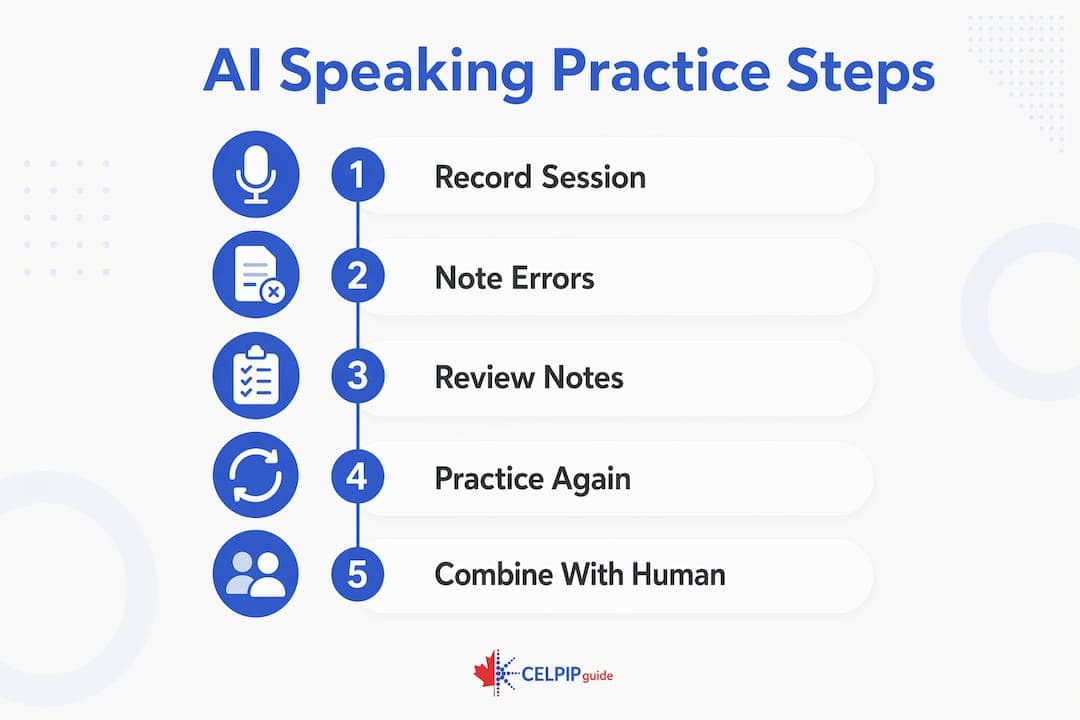
Not all AI speaking tools are built the same. The ones that actually help with citizenship exam preparation share a specific set of features. When you are evaluating any platform, check for these criteria:
Criterion-based feedback aligned to CLB
Generic AI tools give you a fluency score and move on. Quality tools break down your performance by criterion: fluency, coherence, vocabulary, grammar, and pronunciation. Criterion-based feedback helps you understand why a response might confuse an examiner, not just that it was imperfect. This specificity is what drives real improvement.
Realistic interview simulation
The tool should present questions in a format that mirrors the citizenship interview. That means civics questions, follow-up prompts, and time pressure. A tool that only lets you read questions and record a monologue does not prepare you for the live, conversational format of the actual interview.
Pronunciation analytics with error explanations
Look for tools that flag specific pronunciation issues: word stress, intonation patterns, and connected speech. The best tools explain the error and model the correct version. Tracking these patterns over time shows you whether your pronunciation is actually improving or just varying randomly.
| Feature category | What to look for |
|---|---|
| Feedback type | Criterion-based, not just pass/fail |
| Interview simulation | Conversational format with follow-up questions |
| Pronunciation analysis | Intonation, stress, and connected speech flagged |
| Progress tracking | Session history with score trends over time |
| Accessibility | Available 24/7, no scheduling required |
Celpipguide offers structured speaking practice built around the CELPIP format, which aligns closely with the CLB benchmarks used in citizenship assessment. The platform’s AI teacher delivers instant feedback on speaking tasks and personalises your study plan based on your diagnostic results.
Pro Tip: Use official Canadian government study materials alongside your AI tool. The “Discover Canada” guide covers the civics content you will be tested on. AI tools handle the speaking mechanics. You need both.
Why I think most candidates underestimate the conversational element
Many candidates I have spoken with prepare for the citizenship interview as if it were a written test. They memorise facts about Canadian history, practise reciting dates, and feel confident walking in. Then the examiner asks a follow-up question they did not rehearse, and the fluency falls apart.
The speaking portion of the citizenship interview is assessed throughout the entire conversation. Examiners look for clear everyday communication, not formal academic language. That distinction matters more than most candidates realise. AI feedback is genuinely useful here because it trains you to respond naturally, not just accurately.
That said, I have seen candidates over-correct in the other direction. They spend hours on AI sessions, obsess over their pronunciation scores, and then freeze in the actual interview because they have never practised with a real person. Mock interviews with a trained partner reduce this kind of nervousness in a way that AI simply cannot replicate.
My honest advice: use AI feedback to build your baseline and identify your patterns. Use human practice to build your confidence and adaptability. Neither one alone is enough. The candidates who pass with ease are the ones who do both consistently over several weeks, not the ones who cram the night before.
You can also explore the speaking practice guide on Celpipguide for a structured breakdown of how to combine AI and human practice effectively.
— Reza
Celpipguide: structured AI-powered speaking practice for your citizenship prep
Celpipguide is built specifically for candidates preparing for Canadian English proficiency requirements, including the speaking skills assessed during the citizenship interview.
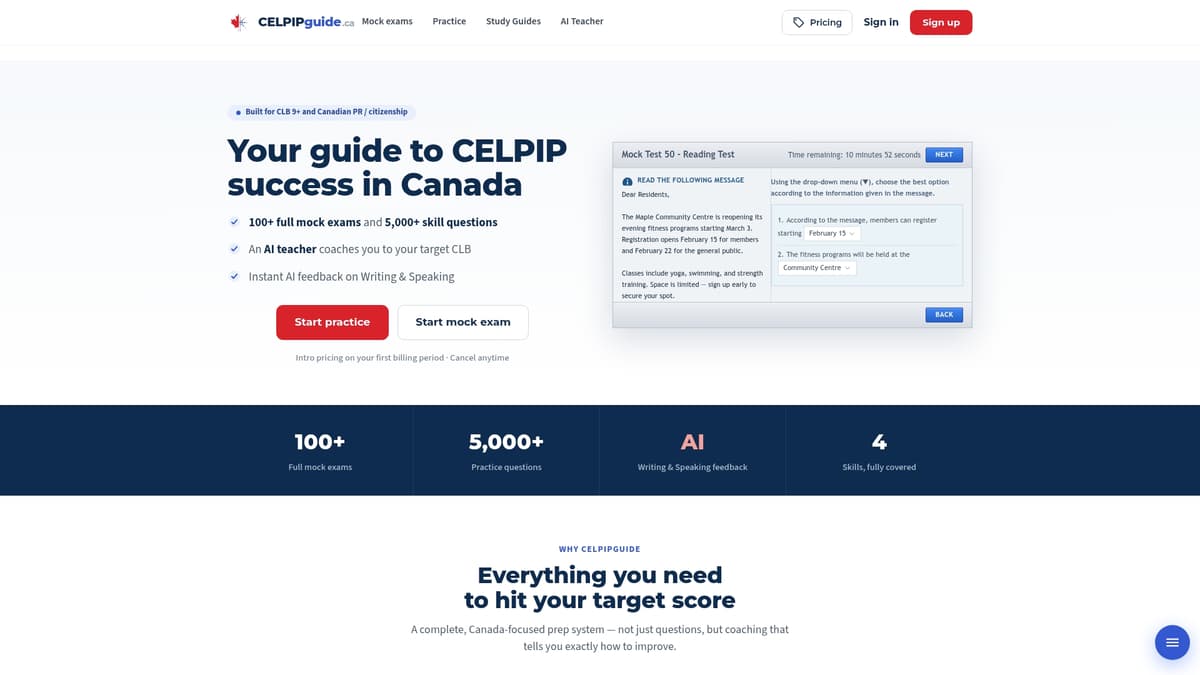
The platform offers over 100 full mock exams and 5,000 practice questions aligned to CEFR and CLB standards. Its AI teacher delivers instant feedback on speaking tasks, flags your specific weaknesses, and adjusts your study plan as you improve. You can start with a diagnostic test to see exactly where you stand, then work through targeted speaking tasks at your own pace. The CELPIP practice hub gives you access to full-length simulated exams with speaking sections that mirror the format and pressure of the real interview. If you want to see your progress before committing, a free practice test is available to get you started.
FAQ
What speaking level do I need for the Canadian citizenship interview?
The Canadian citizenship interview requires a minimum of CLB Level 4, which means you can communicate clearly in everyday situations and answer direct questions in English.
Does AI feedback actually improve speaking for citizenship exams?
Yes. Structured AI-assisted practice builds conversational fluency and reduces nervousness, both of which directly affect your performance in the citizenship interview.
How accurate is AI pronunciation feedback?
AI pronunciation feedback is reliable when audio quality is good, but poor microphone input reduces accuracy. Treat AI pronunciation scores as guidance and validate them with human feedback when possible.
Can I pass the citizenship interview using only AI practice?
AI practice builds strong foundations, but AI lacks the nonverbal cues of a real interview. Combining AI sessions with human mock interviews gives you the best preparation.
How much time should I spend on speaking practice each week?
Allocate at least three to four sessions per week, with 60% of each session focused on your weakest speaking skill. Consistent weekly practice over four to six weeks produces measurable improvement.
Key takeaways
AI feedback for speaking in the Canadian citizenship exam works best when combined with human practice, aligned to CLB Level 4 standards, and used consistently over several weeks rather than in last-minute sessions.
| Point | Details |
|---|---|
| Know what is assessed | Examiners evaluate conversational English throughout the interview, not in a separate speaking test. |
| Use criterion-based AI feedback | Choose tools that score fluency, vocabulary, grammar, and pronunciation separately for targeted improvement. |
| Follow the 60/40 study ratio | Spend 60% of practice time on your weakest skill and 40% across the others. |
| Combine AI with human practice | AI builds your baseline; mock interviews with real people build confidence and adaptability. |
| Track progress over weeks | Review session history and transcript patterns weekly to confirm improvement is happening. |