
CELPIP Blog
CELPIP reading skills citizenship test: your 2026 guide
CELPIP reading skills citizenship test: your 2026 guide

If you’re preparing for Canadian citizenship, the CELPIP reading skills citizenship test is one of the most concrete hurdles you’ll face. It’s a timed, computer-based, multiple-choice exam covering multiple questions across four distinct reading tasks. Immigration, Refugees and Citizenship Canada (IRCC) accepts it as proof of English language ability, and your score gets mapped directly to the Canadian Language Benchmark (CLB) scale.
Here’s what the reading section covers at a glance:
- Reading Correspondence: 11 questions based on emails, letters, or messages
- Reading to Apply a Diagram: 8 questions using charts, schedules, or visual information
- Reading for Information: 9 questions drawn from articles, reports, or factual texts
- Reading for Viewpoints: 10 questions on opinion pieces or persuasive writing
- Format: all multiple-choice, computer-delivered, fixed question order
- Test version: only the CELPIP General test includes reading; the CELPIP General LS covers listening and speaking only
How the CELPIP reading section is structured
The CELPIP General Test runs about three hours total, covering Listening, Reading, Writing, and Speaking. The CELPIP General LS runs about one hour and focuses exclusively on listening and speaking, making it unsuitable if citizenship is your goal and reading is being assessed.
The reading section sits as its own block within the General test. You work through each question in order on screen, selecting answers by mouse click. You cannot skip ahead or return to a previous question once you’ve moved on, so pacing is important.
Each of the four parts tests a different reading skill:
- Reading Correspondence puts you in a realistic scenario, like reading a neighbour’s complaint email or a workplace memo, and asks you to identify tone, purpose, or specific details.
- Reading to Apply a Diagram pairs a visual (a bus schedule, a floor plan, a chart) with a short text and asks you to cross-reference both to answer questions.
- Reading for Information uses longer factual passages, such as a news article or a government notice, and tests your ability to locate and interpret specific information.
- Reading for Viewpoints presents opinion-based writing and asks you to identify the author’s position, supporting arguments, or implied meaning.
Some questions in the section are unscored practice items used for test development. You won’t know which ones they are, so treat every question as if it counts.
What reading score do you need for citizenship?
Your raw score out of 38 converts to a CELPIP level, which maps directly to a CLB level. IRCC generally requires a minimum of CLB 4 for citizenship, though most applicants aim for CLB 7 or higher to demonstrate solid proficiency. The score conversion works like this:
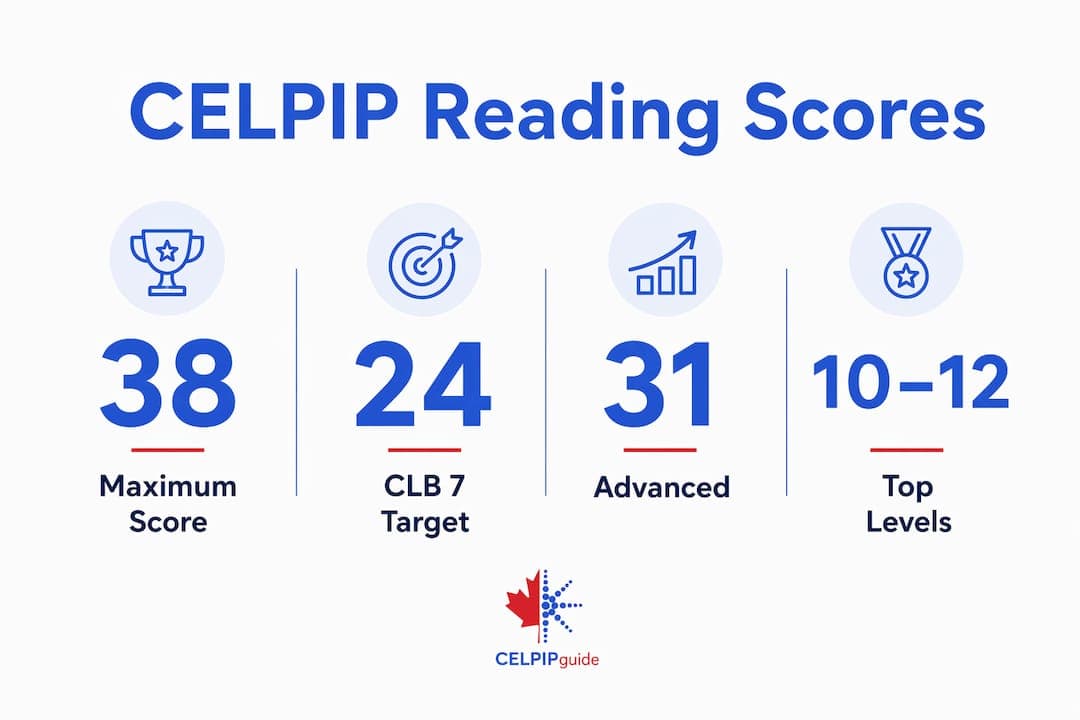
| Raw score (out of 38) | CELPIP level | CLB equivalent |
|---|---|---|
| 33–38 | 10–12 | CLB 10–12 |
| 31–33 | 9 | CLB 9 |
| 28–31 | 8 | CLB 8 |
| 24–28 | 7 | CLB 7 |
| 19–25 | 6 | CLB 6 |
| 15–20 | 5 | CLB 5 |
| 10–16 | 4 | CLB 4 |
| 8–11 | 3 | CLB 3 |
| 0–7 | M (below benchmark) | Below CLB 3 |
Achieving the score required for CLB 7 is the target most citizenship applicants set for themselves. Knowing exactly where each raw score lands helps you set a concrete study goal rather than just “doing your best.” For a deeper breakdown of what your CLB reading score actually signals to IRCC, the CELPIP four skills scoring guide walks through each level in plain language.
Preparation strategies that actually move your score
The single biggest mistake candidates make is reading passively. The CELPIP reading section rewards active, targeted comprehension, not general familiarity with English.
- Practise under timed conditions from day one. Sitting with a passage for as long as you like feels comfortable, but it won’t prepare you for the real test. Use a timer every time you practise.
- Skim first, then scan. Read the passage quickly to grasp the main idea, then go back and scan for specific answers. This two-pass approach saves time on longer informational texts.
- Practise each question type separately. Diagram-based questions trip up many candidates because they require cross-referencing visual and written information simultaneously. Spend dedicated sessions on that format alone.
- Build vocabulary through real reading. Canadian newspapers like the Globe and Mail, government notices on canada.ca, and opinion columns all mirror the register and topics you’ll see on test day.
- Review your answers if time permits. The fixed question order means you can’t return to earlier items, but within the time allotted for each part, use any remaining seconds to double-check your selection.
- Use free CELPIP reading practice tests to get comfortable with the computer interface and question phrasing before test day.
Pro Tip: Track your accuracy by question type across every practice session. If you’re consistently losing points on Reading for Viewpoints but scoring well on Correspondence, you’ve found your priority. Targeted practice on one weak area moves your score faster than general review.
For a full breakdown of how to pace yourself across all four test sections, the time management guide for CELPIP covers section-by-section strategies in detail.

How Celpipguide supports your reading preparation
Celpipguide is built specifically for CELPIP candidates, and the reading section gets serious attention on the platform. Here’s what you get:
- Over 100 full mock exams and 5,000 practice questions aligned with official CELPIP standards and CEFR benchmarks
- AI-powered diagnostic tests that pinpoint exactly which reading task types are pulling your score down
- Personalized study plans that adjust based on your diagnostic results, so you’re not wasting time on skills you’ve already mastered
- Integrated vocabulary builders targeting the word knowledge you need for informational and viewpoint passages
- Free reading practice tests available without a subscription, so you can try the platform before committing
Celpipguide users who work through the platform’s structured practice consistently report score improvements and stronger confidence going into test day. The combination of volume (mock exams and practice questions) and personalisation (AI-driven feedback) is what separates deliberate preparation from simply reading more.
Why the reading tasks mirror real citizenship scenarios
The CELPIP reading section isn’t testing abstract academic literacy. Every passage type connects directly to the kind of reading a new Canadian resident does in daily life.
Reading Correspondence reflects the emails and letters you’d receive from a landlord, an employer, or a government office. Reading to Apply a Diagram mirrors the transit schedules, workplace charts, and community notices you’d encounter in any Canadian city. Reading for Information draws on the factual texts you’d read to understand your rights, community services, or current events. Reading for Viewpoints represents the opinion pieces and editorials that shape public conversation in Canada.
IRCC designed the language proof requirement around functional literacy, not test-taking ability. Scoring at CLB 7 or higher signals that you can read and understand the written English you’ll actually encounter as a Canadian citizen, from a lease agreement to a community newsletter.
Sample reading questions with explanations
Getting familiar with how CELPIP questions are worded is half the battle. Here are examples of each type with brief explanations of what the question is really asking.
Reading Correspondence example: You receive an email from your building manager saying the elevator will be out of service from Monday to Wednesday for maintenance. The question asks: “What is the main purpose of this email?” The answer is to inform residents of a temporary service disruption. The key skill here is identifying the author’s intent, not just the surface content.
Reading to Apply a Diagram example: A bus schedule shows Route 12 departing at 8:15 AM, 9:00 AM, and 9:45 AM. The question asks: “If you need to arrive at City Hall by 9:30 AM and the ride takes 20 minutes, which bus should you take?” You need to work backwards: 9:30 minus 20 minutes means boarding by 9:10 AM at the latest. The 9:00 AM departure is the right answer. This type rewards careful cross-referencing, not reading speed.
Reading for Information example: A passage about Canadian recycling programmes explains that blue bins accept plastics numbered 1 and 2 but not 3 through 7. The question asks: “Which plastic type is NOT accepted in the blue bin?” The answer requires locating a specific detail in a longer text, which is exactly where skimming and scanning saves you time.
Reading for Viewpoints example: An opinion column argues that remote work benefits urban planning by reducing commuter traffic. The question asks: “What does the author suggest about remote work?” You’re identifying the author’s position, not your own opinion. Candidates who read too quickly often miss the distinction between what the author states and what the passage implies.
Practising with downloadable reading comprehension resources can help you build the close-reading habits these question types demand, especially for diagram and viewpoint tasks.
Celpipguide: your reading prep, sorted
If you’ve read this far, you know exactly what the CELPIP reading section demands. Celpipguide gives you the tools to meet that demand without guessing at what to study next. The platform’s AI diagnostic identifies your weakest reading task type on day one, then builds a study plan around closing that gap. With over 100 full mock exams and 5,000 practice questions calibrated to CLB standards, you’re not just practising more. You’re practising the right things.
Start with a free diagnostic test on Celpipguide today and find out exactly where your reading score stands before test day.
FAQ
What CELPIP score is needed for citizenship?
IRCC requires a minimum of CLB 4 across all tested skills, though most applicants target CLB 7 or higher. On the reading section, a raw score of 24–28 out of 38 corresponds to CLB 7.
What is 33 out of 38 in CELPIP reading?
A raw score of 33–38 maps to CELPIP Level 10–12, which corresponds to CLB 10–12, well above the citizenship minimum.
How do you pass the CELPIP reading test?
Practise under timed conditions, use skimming and scanning techniques, and focus on each of the four question types separately to address specific weaknesses before test day.
What is the CELPIP test for citizenship?
The CELPIP General Test is an IRCC-approved English language assessment covering Listening, Reading, Writing, and Speaking. It runs approximately three hours and is accepted as proof of language ability for Canadian citizenship applications.
Key takeaways
The CELPIP reading section requires a raw score of at least 24 out of 38 to reach CLB 7, the proficiency level most citizenship applicants target.
| Point | Details |
|---|---|
| Test format | 38 questions across four parts, completed in a timed session |
| Score target for citizenship | A raw score of 24–28 maps to CLB 7, the standard most applicants aim for |
| Four reading task types | Correspondence, Diagram, Information, and Viewpoints each test a distinct skill |
| Top preparation strategy | Practise each question type separately under timed conditions to close specific gaps |
| Celpipguide advantage | Over 100 mock exams and AI-driven diagnostics help you target weak reading areas efficiently |