
CELPIP Blog
English evidence for citizenship: your IRCC checklist
English evidence for citizenship: your IRCC checklist

IRCC accepts four types of English language evidence for a Canadian citizenship application: a third-party test result (CELPIP, IELTS General Training, or PTE Core), proof of secondary or post-secondary education in English, a certificate from a government-funded language programme (LINC or CLIC), or an approved provincial language certificate. If none of these applies because of a medical condition or disability, a formal exemption is available. You submit only one piece of evidence, and it must be legible and translated into English or French if the original is in another language.
- Third-party test result (CELPIP-General, CELPIP-General LS, IELTS General Training, PTE Core)
- Diploma, transcript, certificate, or report card showing instruction in English
- LINC or CLIC certificate showing CLB 4 or higher in speaking and listening
- Approved provincial certificate (BC ELSA, Ontario provincial certificate, Nova Scotia PENS, Saskatchewan CFR)
- Exemption via form CIT 0116 with supporting medical evidence
Key takeaways
Submit one qualifying piece of English evidence with your citizenship application, confirm it meets CLB 4 for speaking and listening, and verify it is legible and translated if needed.
| Point | Details |
|---|---|
| Age rule | Applicants aged 18–54 must prove CLB 4 or higher in speaking and listening only. |
| Four evidence types | Accepted options are a third-party test, education proof, LINC/CLIC certificate, or approved provincial certificate. |
| Test score minimums | PTE Core requires minimum scores meeting CLB 4 standards in listening and speaking; CELPIP and IELTS General Training require CLB 4 equivalents. |
| Translation required | Foreign-language education documents need a certified translation and a school letter confirming English instruction. |
| Returned applications | IRCC returns the entire application if language proof is unreadable or cannot be verified. |
Table of Contents
- What types of English evidence for citizenship do you need to provide?
- Which third-party tests does IRCC accept, and what scores do you need?
- Can you use your education as proof of English language ability?
- Which government-funded language programme certificates does IRCC accept?
- What if you cannot provide language proof because of deafness or a disability?
- How do you prepare and submit your language evidence correctly?
- Common mistakes with language evidence and how to fix them
- How focused CELPIP preparation helps you meet the CLB 4 bar
- A practical note on preparation
- Sources
- FAQ
What types of English evidence for citizenship do you need to provide?
IRCC requires applicants aged 18–54 to submit proof of speaking and listening at Canadian Language Benchmark (CLB) Level 4 or higher. If you are under 18 or 55 and older, the language requirement does not apply to you.
Two points that surprise many applicants:
- Only speaking and listening are assessed. Reading and writing are not part of the citizenship language requirement, so your evidence only needs to cover those two skills.
- A citizenship officer can assess your language ability at the interview. According to the IRCC Help Centre, the officer’s assessment is the final authority on whether you meet the standard, regardless of what documents you submitted.
CLB 4 represents basic conversational independence. Think of it as the ability to follow and participate in everyday conversations without needing constant repetition or simplification. That is the bar you need to clear, and the evidence you submit is your first chance to demonstrate it.
Which third-party tests does IRCC accept, and what scores do you need?
IRCC accepts four test options as third-party proof of English language ability. Each has a specific minimum score for listening and speaking that maps to CLB 4.
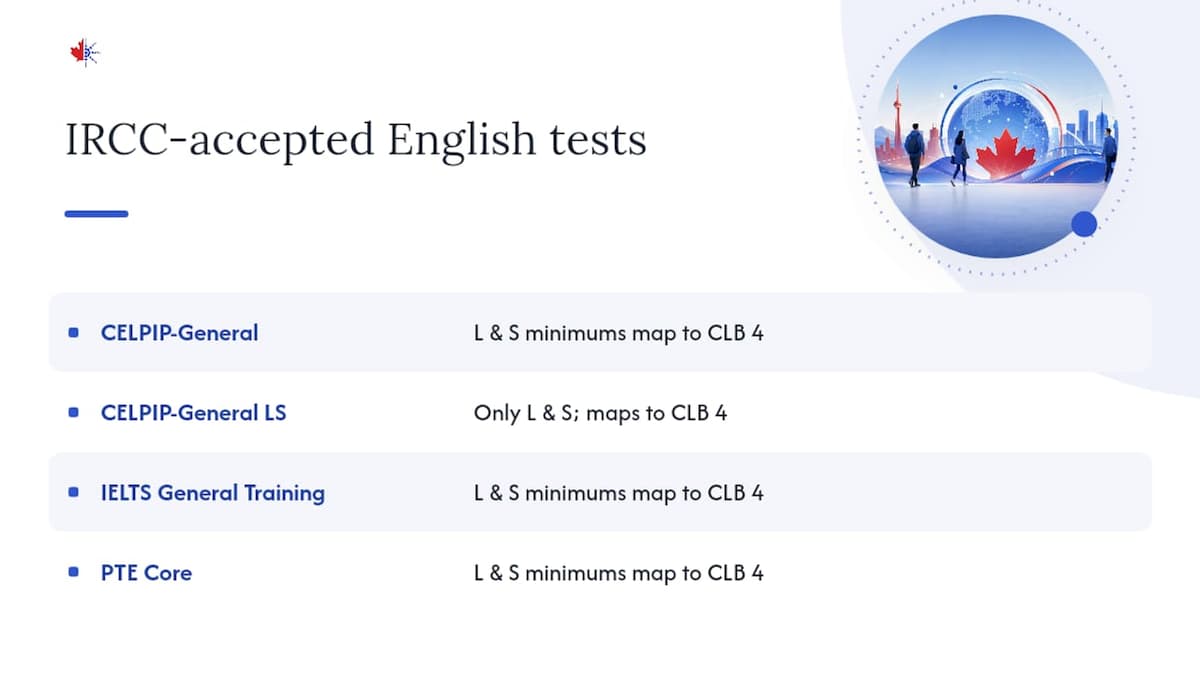
A note on expired results: IRCC accepts expired CELPIP and IELTS General Training results for citizenship in many cases, which means you may not need to retest if your scores already meet the minimums. Always verify the exact rule for your test version on the official IRCC page before booking a new test.
Pro Tip: If you are taking a test specifically for your citizenship application, the CELPIP-General LS is worth considering. It covers only listening and speaking, which are the only two skills assessed for citizenship, so you are not paying for or preparing four full skills when two will do.
Can you use your education as proof of English language ability?
Yes, and this option works for more people than you might expect. You do not need a university degree. IRCC accepts any of the following documents from a secondary or post-secondary programme taught in English:
- Official diploma
- Official transcript
- Certificate of completion
- Report card
The document must clearly show that the language of instruction was English. Canadian institutions usually include this automatically. Foreign institutions sometimes do not, which is where applicants run into trouble.
If your education document does not explicitly state the language of instruction, include a letter from the school confirming that English was the language of instruction, along with the school’s contact details so IRCC can verify it.
For documents originally issued in a language other than English or French, a certified translation is required. A certified translation is not the same as a Google Translate printout. It must come from a professional translator who attests to its accuracy, and you include both the original and the translation in your application package.
A few practical notes on education proof:
- Education can be from Canada or abroad, as long as instruction was in English.
- If you studied in Canada and your transcript is in English, you likely need nothing extra.
- If your institution no longer exists, contact the relevant provincial ministry of education for a replacement document or verification letter.
Which government-funded language programme certificates does IRCC accept?
Completing a government-funded language programme is a legitimate and often overlooked path to meeting the citizenship language requirement. The two national programmes are LINC (Language Instruction for Newcomers to Canada) and CLIC (Cours de langue pour les immigrants au Canada, the French equivalent). A certificate from either programme qualifies if it shows you reached CLB 4 or higher in speaking and listening.
Provincial programmes add more options. Here is a summary of the accepted certificates by province:
- British Columbia: English Language Services for Adults (ELSA) certificate showing CLB 4 or higher in speaking and listening
- Ontario: Provincial language training certificate confirming CLB 4 or higher
- Nova Scotia: Provincial English for Newcomers (PENS) certificate
- Saskatchewan: Canadian Framework of Reference (CFR) statement based on EAL training, with a B1 equivalency that maps to CLB 4
Date and format rules vary. Some older certificates predate the automatic CLB reporting systems that programmes use today, which means the CLB level may not appear on the document itself.
Pro Tip: If your LINC, CLIC, or provincial certificate was issued before your programme started reporting CLB levels automatically, include your report card or a statement from the programme administrator confirming your CLB level. IRCC may request this verification anyway, so including it upfront saves time.
IRCC’s LINC/CLIC guidance page lists the specific accepted certificates and any date-based rules that apply to your province.
What if you cannot provide language proof because of deafness or a disability?
A formal exemption process exists for applicants who cannot demonstrate language ability for medical or compassionate reasons. This is not automatic, and it requires real supporting evidence.
Form CIT 0116 is the Request for Exemption. You submit it alongside your citizenship application with supporting documentation that explains why you cannot meet the language requirement.
Typical supporting documents include:
- A medical report from a licensed physician describing the condition and its impact on communication
- An audiologist’s letter (for applicants who are deaf or hard of hearing) confirming the degree of hearing loss
- A functional assessment from a qualified professional describing how the condition affects speaking and listening
The exemption is evidence-based. IRCC reviews the medical documentation you provide, so vague or incomplete letters are unlikely to succeed. The stronger and more specific your supporting evidence, the clearer the case for the exemption.
Pro Tip: Ask your physician or audiologist to describe the functional impact on communication specifically, not just the diagnosis. IRCC needs to understand why the condition prevents you from meeting CLB 4, not just what the condition is.
How do you prepare and submit your language evidence correctly?
Getting the document right matters as much as choosing the right type of evidence. IRCC will return your entire application if the proof is unreadable or cannot be verified, which restarts your processing timeline.
Submission checklist:
- Choose one piece of evidence only. Do not include multiple documents from different categories.
- Confirm the document is legible. Scan at a minimum of 300 DPI. Check that text, scores, and dates are clearly visible.
- Include a certified translation if the document is not in English or French.
- Attach school contact details or a verification letter if your education document does not state the language of instruction.
- Keep the original document. IRCC may request it.
- For test results, confirm you are submitting the correct test version and that the scores meet the minimums for your specific test.
Dos and don’ts:
- Do include contact information for any institution that issued your document so IRCC can verify it.
- Do not submit cropped test score pages or photos taken on a phone in poor lighting.
- Do not send multiple contradictory documents hoping one will work.
- Do confirm whether your test version has a date cutoff that affects acceptance.
IRCC’s language proof overview page lists the exact submission requirements and flags the most common reasons applications are returned.
Common mistakes with language evidence and how to fix them
Most returned applications come down to a small number of fixable errors. Here are the ones that come up most often:
- Unreadable scan: The fix is simple. Rescan at higher resolution and check the file on a different screen before uploading.
- Missing certified translation: If your document is in another language, obtain a certified translation before submitting. A bilingual friend’s translation does not qualify.
- Wrong test module: Submitting an IELTS Academic result instead of IELTS General Training is a common error. IRCC does not accept IELTS Academic for citizenship.
- No language of instruction stated: If your transcript does not mention English as the language of instruction, request a letter from the institution before you apply.
- Multiple documents from different categories: Sending a test result and a diploma together can create confusion. Pick one and remove the other.
Before you submit, run through this quick fix checklist:
- Confirm the document type matches one of IRCC’s four accepted categories.
- Verify scores or CLB levels meet the CLB 4 minimum.
- Check that the document is fully legible with no cropped edges.
- Confirm a certified translation is included if needed.
- Remove any duplicate or contradictory documents from the package.
How focused CELPIP preparation helps you meet the CLB 4 bar
CLB 4 is a practical, conversational standard. It is not about academic writing or complex grammar. It is about whether you can hold a real conversation, follow spoken instructions, and respond clearly. That is exactly what the CELPIP listening and speaking tasks are designed to measure.
Targeted preparation for those two skills does two things at once: it builds the functional ability you need for the citizenship interview, and it produces a verifiable test result you can submit as evidence.
Practical preparation steps that map directly to citizenship requirements:
- Diagnostic test first. Identify whether your listening or speaking is the weaker skill before you spend time on both equally.
- Listening drills. Practise with audio at natural speed, not slowed-down recordings. The citizenship interview and the CELPIP listening tasks both use natural conversational pace.
- Speaking tasks with rubric feedback. Practise responding to prompts under timed conditions and review your responses against the CLB 4 descriptors.
- Mock interviews. Simulate the citizenship interview format to reduce nervousness and build fluency under pressure.
The CELPIP preparation guide on Celpipguide walks through each of these steps in detail, including how to build a study plan around your weakest skill.
Pro Tip: Practising under timed, exam-like conditions does more than improve your score. It reduces the anxiety that causes fluent speakers to underperform in interviews. Simulate the pressure before you face it.
Ready to start? Celpipguide’s CELPIP practice hub gives you access to full-length mock exams and skill-specific listening and speaking tasks. Use coupon BLG30 at checkout for 30% off on top of any other discounts.
A practical note on preparation
One mistake I see repeatedly is applicants treating the citizenship language requirement as a paperwork problem rather than a skills problem. They gather the right document, submit it, and then stumble at the interview because they have not actually practised speaking English under any kind of pressure.
The document gets you through the door. Your spoken English gets you through the interview. Spend 10–15 minutes a day on a structured speaking routine: pick a topic, set a two-minute timer, speak without stopping, then listen back and note where you hesitated or lost clarity. That single habit, done consistently, builds the fluency that makes the citizenship interview feel manageable rather than stressful. Celpipguide’s speaking practice guide has ready-to-use prompts if you want a structured starting point.
This article is general information, not a substitute for advice from a qualified lawyer. Consult a qualified legal professional about your own circumstances before acting on anything here.
Sources
Confirm any rules, date cutoffs, or form downloads directly on IRCC’s official pages before submitting your application. Rules do change, and the pages below reflect the current requirements.
FAQ
What can I use as proof of English for citizenship?
IRCC accepts four types of proof: a third-party test result (CELPIP-General, CELPIP-General LS, IELTS General Training, or PTE Core), a diploma or transcript from a school where English was the language of instruction, a LINC or CLIC certificate showing CLB 4 or higher, or an approved provincial language certificate. Submit only one document.
What level of English do I need for Canadian citizenship?
You need to demonstrate speaking and listening at CLB Level 4 or higher. Reading and writing are not assessed for citizenship purposes.
Can I use an expired language test result for my citizenship application?
IRCC accepts expired CELPIP and IELTS General Training results for citizenship in many cases. Check the exact rule for your test version on the official IRCC page before assuming you need to retest.
What happens if my language proof is unreadable or missing?
IRCC will return your entire application, which restarts your processing timeline. Submit a clear, legible scan at 300 DPI or higher, and include a certified translation if the document is not in English or French.
What is CLB 4 for citizenship?
CLB 4 is the Canadian Language Benchmark level that represents basic conversational independence. For citizenship, it means you can follow and participate in everyday spoken conversations. A citizenship officer may also assess your language ability at the interview, and their assessment is final.