
CELPIP Blog
Role of English tests in professional licensing, explained
Role of English tests in professional licensing, explained

Yes, most regulated professions require validated proof of English (or French) proficiency before you can get licensed. Regulators treat this as a public-protection requirement, not a formality, and they accept a defined set of evidence: approved tests, Canadian education delivered in the language of practice, verified recent professional practice, or prior registration in a comparable jurisdiction.
Here’s what to do first:
- Check your regulator’s accepted tests and minimum benchmarks.
- Confirm the validity window and exactly how results must be submitted.
- Book your test, or start gathering alternative evidence, well before you plan to apply.
- Accepted proof types: standardized tests, English-language education, recent professional practice, or prior licensure
- Most test results are only valid for a defined period commonly up to two years
- Submission almost always has to come directly from the testing agency, not from you
Key Takeaways
Meeting your regulator’s English test requirement comes down to confirming the right test, hitting every component minimum in one sitting, and submitting results before your two-year validity window closes.
| Point | Details |
|---|---|
| Language proof is a gate, not paperwork | Regulators require it for public protection, and it’s enforced at the component level. |
| Accepted tests vary by regulator | CELPIP, IELTS, CELBAN, OET, TOEFL iBT, and PTE Academic are the common options; check which your college accepts. |
| Component minimums beat averages | A single low component can fail your application even with a strong overall score. |
| Validity is typically two years | Time your test date around your full licensing and processing timeline, not just study readiness. |
| Celpipguide supports targeted prep | Its readiness check and mock exams help you confirm CLB-mapped scores before you book an official test. |
Table of Contents
- Why regulators require English test scores for professional licensing
- Which professions typically require proof of English proficiency
- Which tests count, and how scores map to licensing benchmarks
- Alternatives to standardized English tests for licensing
- How to submit scores and manage the validity window
- A realistic study plan for professionals preparing to test
- What professionals consistently underestimate about English testing
- Get your English test benchmarks confirmed before you book
- Where to verify your regulator’s exact requirements
- Sources
- FAQ
Why regulators require English test scores for professional licensing
Language ability isn’t a soft skill in health care, engineering, or teaching. It’s the difference between a nurse correctly reading a physician’s order and a nurse guessing. Regulators frame this plainly: the goal is to confirm you can communicate safely and accurately in the language your profession operates in, before you’re handed a licence to practise independently.
That’s why the role of English test requirements in professional licensing sits inside a public-protection mandate, not an arbitrary paperwork step. Provincial and territorial colleges set the actual thresholds, and they vary because the risk profile of each profession varies.
Language proficiency requirements exist so that a professional can communicate effectively and safely with patients, clients, and colleagues, not simply to satisfy an administrative checkbox.
Pro Tip: Treat your regulator’s minimum score as a safety floor, not a target. Aim a band above it so a bad testing day doesn’t put your application at risk.
Which professions typically require proof of English proficiency
Language gates show up most often in professions where a miscommunication has real consequences.
- Health care: nursing, medicine, pharmacy, and allied health roles almost always require documented proficiency.
- Engineering: most provincial engineering bodies require language evidence alongside technical credential assessment.
- Teaching: teacher certification boards typically require proof of English or French fluency.
- Real estate and regulated trades: many licensing boards require it, though standards are less standardized.
Check the regulator directly. The College of Nurses of Ontario publishes explicit benchmarks, while NAPRA sets pharmacy-specific minimums and the BC Financial Services Authority governs its own regulated sectors. Some colleges use holistic review instead of a hard cut score, so never assume your profession’s rule from a different province’s page.
Which tests count, and how scores map to licensing benchmarks
Regulators don’t accept just any English test. The commonly recognized options are CELPIP (General), IELTS (Academic or General, depending on the regulator), CELBAN, OET, TOEFL iBT, and PTE Academic. Each maps differently to a regulator’s component minimums, and most colleges require you to hit the minimum on every component, not just an overall average.
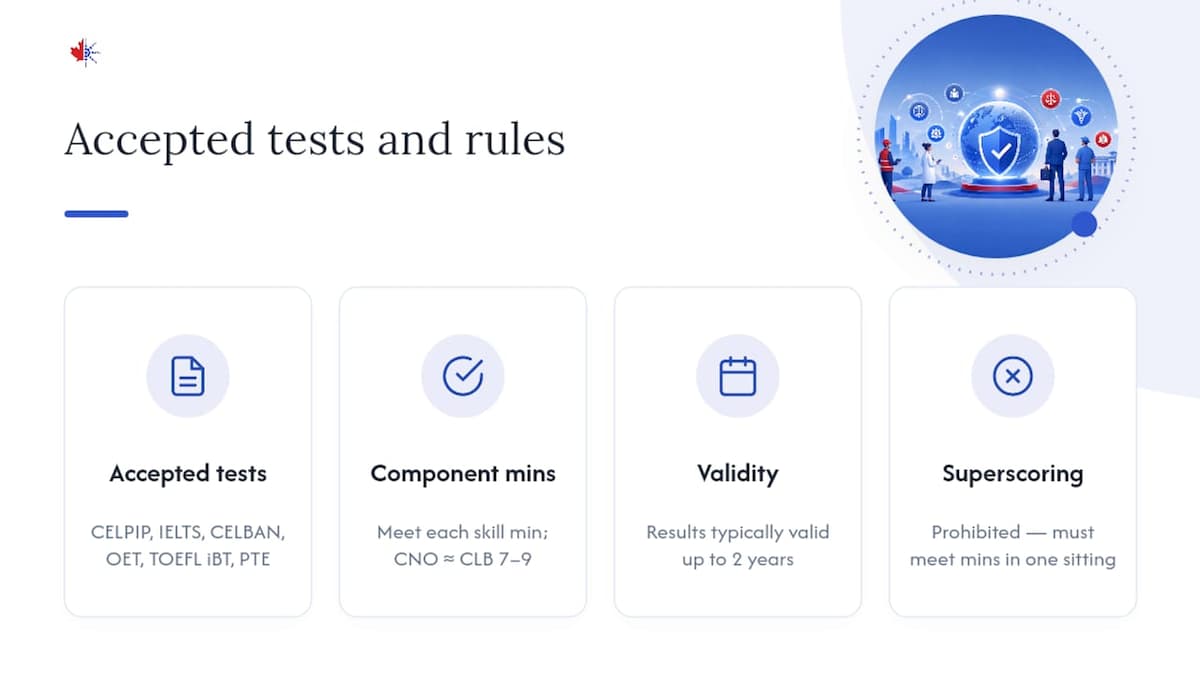
Two rules trip people up constantly. First, results are typically valid for a defined period from the test date, commonly up to two years. Second, most regulators forbid “superscoring”: combining your best reading score from one sitting with your best speaking score from another. NAPRA’s policy, for example, requires component minimums to be met in a single sitting.
A nursing applicant targeting CNO registration, for instance, needs each of listening, reading, writing, and speaking to independently clear the college’s posted benchmark, mapped roughly to CLB 7 to 9 depending on the skill. Miss one component and the whole submission fails, even if your average looks strong.
Alternatives to standardized English tests for licensing
Not everyone needs to write a formal test. Regulators generally recognize three non-test pathways, though each comes with conditions.
- Education-based evidence: a degree completed in English, often from an accredited Canadian institution or a foreign program specifically recognized by the regulator.
- Practice-based evidence: documented, recent professional practice conducted primarily in English, usually verified by employer letters.
- Prior registration: current or recent licensure in a majority-English jurisdiction, though colleges reserve the right to still require testing if concerns arise.
| Evidence type | What you typically need | Recency requirement |
|---|---|---|
| Education | Transcript confirming instruction language | Often within 2 years of application |
| Practice | Employer verification letter, hours worked | Often within 2 years |
| Prior licensure | Proof of active registration abroad | Case-by-case |
Request employer letters early. Verification can take longer than a test result does.
How to submit scores and manage the validity window
Regulators almost universally require your test results to travel directly from the testing organization to them, or to a national gateway. A scanned copy you hold yourself is usually rejected outright, even if it’s genuine.
- Register for your test and list the regulator (or gateway, like Pharmacists’ Gateway Canada) as an official recipient.
- Wait for direct transmission, typically a few weeks after your test date.
- Track your application status; processing timelines vary by regulator and by application volume.
- If your two-year validity window is going to lapse before a final decision, plan for a retake rather than letting evidence expire mid-process.
Pro Tip: When registering for your test, double-check the exact institution code or recipient name your regulator publishes. A mistyped code is the single most common cause of delayed score delivery.
A realistic study plan for professionals preparing to test
Professionals studying while working full-time need a plan that respects limited hours and targets the exact components their regulator scores.
Start with the basics: confirm your regulator’s accepted test and minimum benchmark, check how results get delivered, pick a realistic test date, and start collecting any employer or education verification you might need as a backup.
An 8 to 12 week runway works for most applicants balancing a job with test prep:
- Weeks 1 to 2: diagnostic practice across all four skills to find your weakest component.
- Weeks 3 to 6: targeted drills on that weak component, with lighter maintenance work on the others.
- Weeks 7 to 9: profession-specific vocabulary and scenario practice, like simulated patient handoffs for nurses or technical summary writing for engineers.
- Weeks 10 to 12: full-length mock exams under timed conditions, with a final review pass.
- Use a study plan generator to structure weekly goals against your target score.
- Simulate real workplace language tasks, not just generic exam questions.
- Log every practice score so you can see whether your weak component is actually improving.
Pro Tip: If you only need to lift one component to clear a cut score, some testing bodies allow single-skill retakes. Confirm this with your specific test provider before booking a full retest you don’t need.
What professionals consistently underestimate about English testing
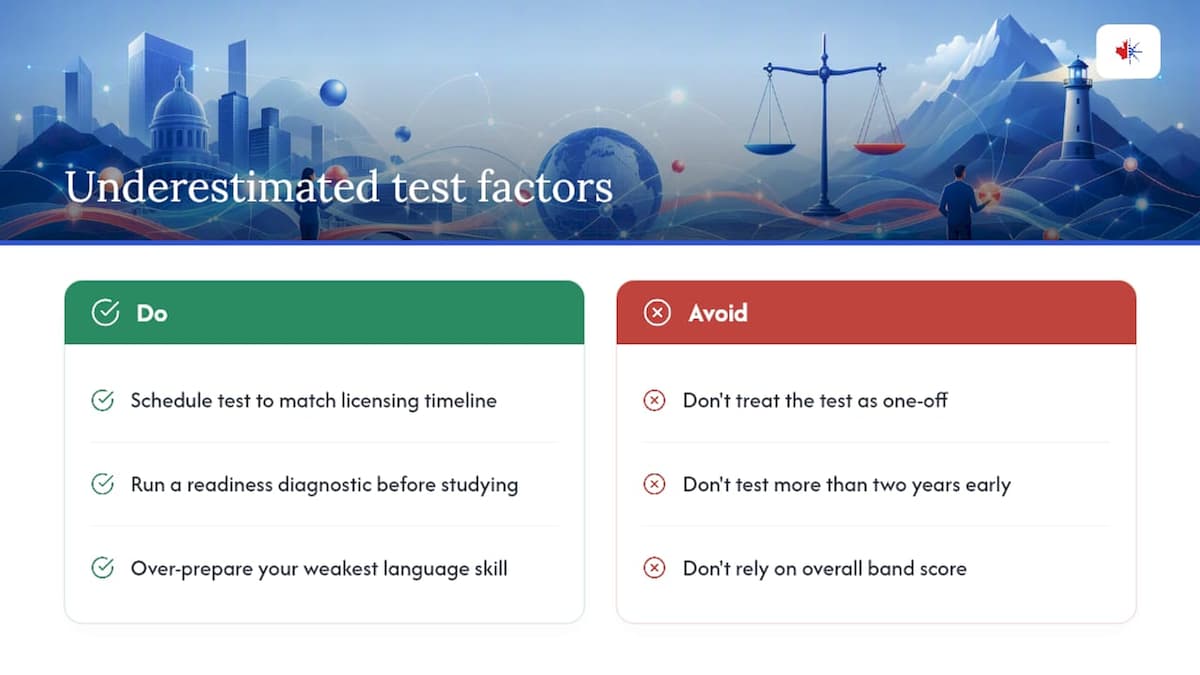
Most internationally trained professionals treat the English test as a hurdle to clear once and forget. That’s a mistake. The two-year validity clock means your test date has to be planned around your entire licensing timeline, not just your study schedule. I’ve seen candidates ace CELPIP or IELTS a year before they even finish their credential assessment, only to have the score expire three months before their regulator finally reviews the file.
The other underestimated factor is component minimums. Applicants fixate on an overall band score when regulators almost never care about the average. A strong reading score doesn’t rescue a weak speaking score. If you’re going to over-prepare for anything, over-prepare for your weakest skill, because that’s the one that decides your outcome.
Celpipguide’s diagnostic tools exist specifically to catch this early, and readers preparing for CLB-based licensing benchmarks can run a readiness check before committing to a full study cycle.
Get your English test benchmarks confirmed before you book
Booking a test blind, without knowing your regulator’s exact component minimums, is how professionals end up paying for a retake they could have avoided. Celpipguide’s CELPIP Readiness Check gives you a diagnostic read on where you currently stand against CLB-mapped benchmarks, before you spend money on an official sitting.
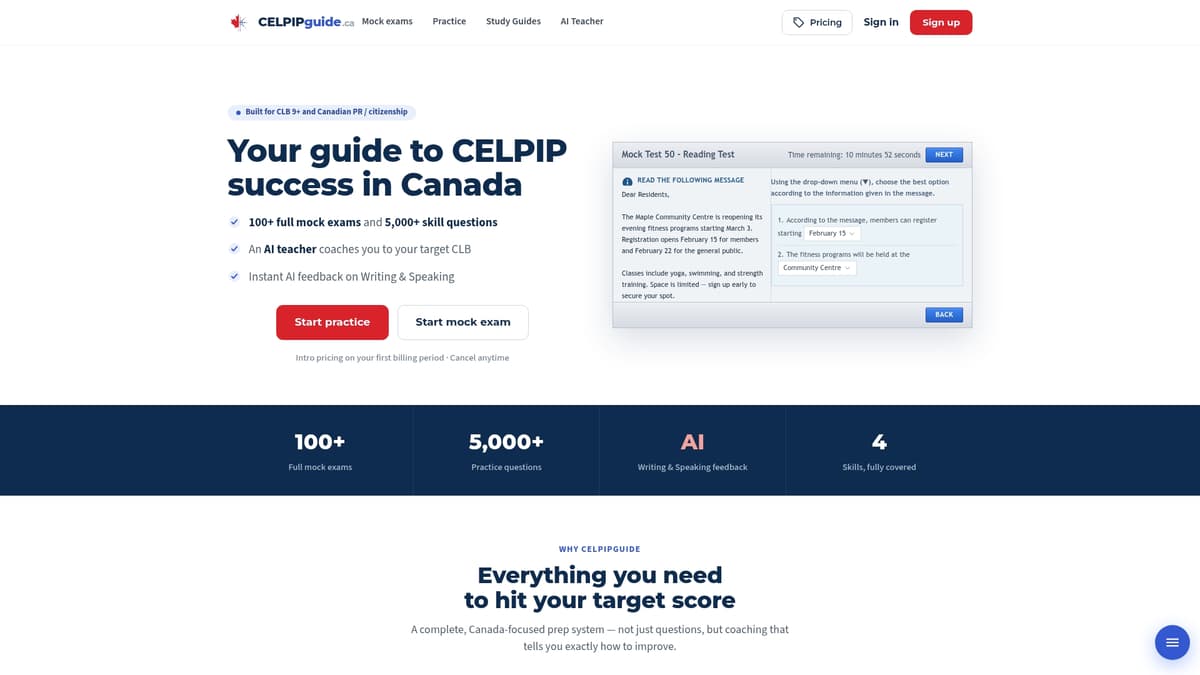
From there, the full-length mock exam library lets you simulate real test-day conditions across all four skills, with AI feedback on writing and speaking so you know which component needs the most work. If your regulator requires a specific component minimum, this is the fastest way to confirm you’ll hit it before test day, not after. Start with the readiness check, then book your mock exams once you know your target.
Where to verify your regulator’s exact requirements
- NAPRA language proficiency policy: pharmacy benchmarks and submission rules.
- CNO proficiency page: nursing test list and component minimums.
- Pharmacists’ Gateway Canada: direct submission instructions.
- Ontario regulation r22261: summary of accepted evidence types and validity rules.
This article is general information, not a substitute for advice from a qualified lawyer. Consult a qualified legal professional about your own circumstances before acting on anything here.
Sources
- NAPRA language proficiency requirement policy (February 2024)
- Ontario regulation r22261 (language proficiency rules summary)
- College of Nurses of Ontario — proficiency in English or French
- Pharmacists’ Gateway Canada — language requirements overview
- CPSBC English language proficiency requirements (College of Physicians and Surgeons of BC)
FAQ
Which English test is required for permanent residence applications?
For immigration purposes, Immigration, Refugees and Citizenship Canada accepts CELPIP General, IELTS General Training, and a small set of other approved tests, but professional licensing has its own separate rules set by your regulator.
How do I pass an English proficiency test for licensing?
Focus your prep on your weakest component first, since most regulators require every skill to independently clear its minimum, and use full-length mock exams to build accuracy under timed conditions.
What happens during an English proficiency test?
Most accepted tests assess listening, reading, writing, and speaking separately, often using real-world scenarios like workplace conversations or short reports, and each skill produces its own score.
Where can I take an English test for Canadian citizenship or licensing?
Tests like CELPIP, IELTS, CELBAN, and OET are offered at designated test centres and, in many cases, through remote proctoring that meets the same security standards as in-person testing.
Do English test results expire?
Yes, most regulators treat results as valid for two years from the test date, so you need to time your test around your expected licensing timeline to avoid a required retake.