
CELPIP Blog
Two CELPIP trouble spots costing Express Entry applicants CRS points
Two CELPIP trouble spots costing Express Entry applicants CRS points

CELPIP is manageable for most test-takers, but two areas cause the most trouble: the latter parts of Listening, where you track multiple speakers and their opinions, and the inference-heavy questions in Reading Part 4. If you’re aiming for CLB 7 or higher, those two spots deserve most of your practice time. I’ll break down exactly why they’re hard and how to fix that below.
TL;DR:
- Target practice on Listening to Viewpoints and Reading inference questions, as these areas most impact CLB 7 and above scores.
- Use visual or shorthand methods to track speakers and opinion shifts during Listening tasks, and practice stamina with full-length timed sections.
- Focus on skimming and structural cues in Reading to efficiently handle inference and integrated questions, avoiding keyword-matching traps.
- Incorporate rubric-based feedback on Speaking and Writing, especially answering fully and maintaining clear coherence across responses.
- Prioritize full mocks and targeted drills over general review to improve pacing, accuracy, and consistency in your test performance.
Table of Contents
- The question types that trip most test-takers up
- Why listening gets harder and how to avoid common traps
- Why certain reading tasks are tricky and how to answer inference and integrated items fast
- Speaking and writing: how they’re marked and the short fixes that raise scores
- A focused study plan and exam-simulation checklist for tackling the hardest parts
- Instructor evidence and how rubric-based practice shortens the learning curve
- What test-day variability really means for your score
- How CELPIPguide supports targeted practice for the hardest sections
- Official score mapping and concordance resources
- Sources
- FAQ
The question types that trip most test-takers up
Some CELPIP tasks are just harder than others, and it helps to know which ones before you sit down for a mock. Once you can name the problem, you can practise it directly instead of guessing where your score is leaking.
- Listening Part 6 (Listening to Viewpoints): multiple speakers disagree, and you need to track who said what, which taxes your working memory near the end of a long section.
- Reading Part 4 (Reading for Information): many answers require inference rather than direct matching, so skimming for keywords alone leads you to the wrong choice.
- Timed Writing tasks: you get about half an hour per task, and underdeveloped responses lose marks on task fulfillment even when grammar is clean.
- Integrated information items across Listening and Reading: they ask you to combine two or three details from different parts of a passage or clip, so partial attention means a partial answer.
- Paraphrase-heavy multiple choice: correct answers are rarely worded the way the passage or audio states them, which is a deliberate trap for surface-level readers.
Missing these item types repeatedly doesn’t just cost a few marks. It’s often the difference between landing at CLB 6 and hitting the CLB 7 or higher that Express Entry applicants commonly target for meaningful CRS points.
Why listening gets harder and how to avoid common traps
CELPIP’s Listening component runs through several parts, and the difficulty climbs as you go. By the time you reach Listening to Viewpoints, you’re dealing with multiple speakers, shifting opinions, and audio that plays only once. That combination, paired with fatigue from the earlier parts, is exactly why this section trips up so many candidates.
The mechanics are the real issue: you’re not just listening for facts, you’re mapping who believes what, and the correct answer often depends on a speaker changing their mind partway through. Distractors are built from real details in the clip, just attached to the wrong person or the wrong moment.
Three tactics help:
- Use a shorthand system: assign each speaker a quick symbol (A, B, or an arrow for “agrees”) and jot their stance the moment they state it.
- Listen for signpost phrases: words like “however,” “on the other hand,” or “I used to think” almost always flag an opinion shift worth noting.
- Eliminate before you commit: when two choices sound close, cross out the one that misattributes a detail to the wrong speaker rather than guessing.
Pro Tip: Practise with one full Listening section timed end to end at least twice a week. Stamina, not just skill, is what separates a CLB 6 from a CLB 8 on this section.
Why certain reading tasks are tricky and how to answer inference and integrated items fast
Reading is split into four timed parts, and the clock is tighter than most people expect once they hit the longer passages. The tasks that cause the most trouble aren’t the ones asking “what does the passage say,” they’re the ones asking what the passage implies.
Inference items require you to combine two details to reach a conclusion the text never states outright. Integrated-information items ask you to pull facts from separate paragraphs and merge them into one answer. Both types punish keyword hunting: the trap answer often repeats a word from the passage while getting the meaning wrong.
- Skim for gist first: read the first and last sentence of each paragraph before answering anything, so you know where each idea lives.
- Scan for structure, not just keywords: look for cause-effect or comparison language, since inference questions usually hinge on a relationship, not a single fact.
- Watch for paraphrase patterns: a correct answer restates the passage’s meaning using different words entirely, while a wrong answer often reuses the passage’s exact phrasing out of context.
Pro Tip: In mocks, give yourself a hard stop at the halfway mark of each Reading part. If you’re not past question three, move on and come back, since a rushed final question costs less than three unanswered ones.
Speaking and writing: how they’re marked and the short fixes that raise scores

Speaking has eight short, timed tasks, and Writing has two: an email and a survey response, each with its own time limit. Both are marked by trained raters against rubric categories that include content and coherence, vocabulary range, task fulfillment, and how listenable or readable your response is.
The most common mistakes are predictable: answers that stop too early, ideas that jump around without a clear structure, and long pauses that hurt listenability even when the vocabulary is strong.
- Use a planning template: spend the first 10 to 15 seconds of any Speaking task sketching a beginning, middle, and end before you speak.
- Record yourself under timed conditions: playing back your own pauses and filler words is often more useful than any grammar drill.
- Build sentence frames for transitions: phrases like “the main reason for this is” or “to give an example” keep your answer moving when you’re stuck mid-thought.
Getting rubric-style feedback on a recorded response, rather than just a numeric score, is what actually shows you which category is holding you back.
A focused study plan and exam-simulation checklist for tackling the hardest parts
A short, structured sprint beats scattered studying, especially when you’re targeting the parts covered above. Here’s a four-week blueprint that front-loads the hardest sections and builds toward full-length stamina.
- Week 1: diagnose your weak spots with a full mock, then spend most sessions on Listening Part 6 and Reading Part 4 drills.
- Week 2: add timed Writing tasks daily and Speaking recordings every other day, while keeping listening and reading drills going.
- Week 3: run two full mocks under real time limits, no pausing, to build the stamina that late-section items demand.
- Week 4: focus on your weakest rubric category from Speaking and Writing feedback, and do one final full mock three days before test day.
Use full mocks to check pacing as much as accuracy, since running out of time on Reading Part 4 is a pacing problem, not a knowledge gap. Calibrate your mock results against the CLB tables IRCC uses for CELPIP scores so you know exactly how close you are to your target, not just whether your percentage went up.
Instructor evidence and how rubric-based practice shortens the learning curve
Instructors who review CELPIP attempts regularly report the same failure modes: rushed answers late in Listening and Reading, and underdeveloped Speaking and Writing responses. Rubric-based feedback that names the exact category losing marks tends to close that gap faster than repeated untargeted practice.
CELPIPguide’s platform includes a diagnostic test, more than 100 full mock exams, and an AI teacher that gives instant, rubric-style feedback on Writing and Speaking tasks.

What test-day variability really means for your score
I’ve seen candidates score a full CLB band higher or lower on the same skill just by retesting a few weeks apart, and that’s normal, not a red flag. If your practice scores are consistently near your target, book the retake. If they’re still inconsistent, spend two more weeks on your weakest rubric category before you spend the test fee again.
— Reza
How CELPIPguide supports targeted practice for the hardest sections
If the parts above sound like your weak spots, A preparation platform can provide full-length mock exams, skill-specific drills, a diagnostic test, and AI-driven rubric feedback on Speaking and Writing, built around the types of questions discussed in this article.
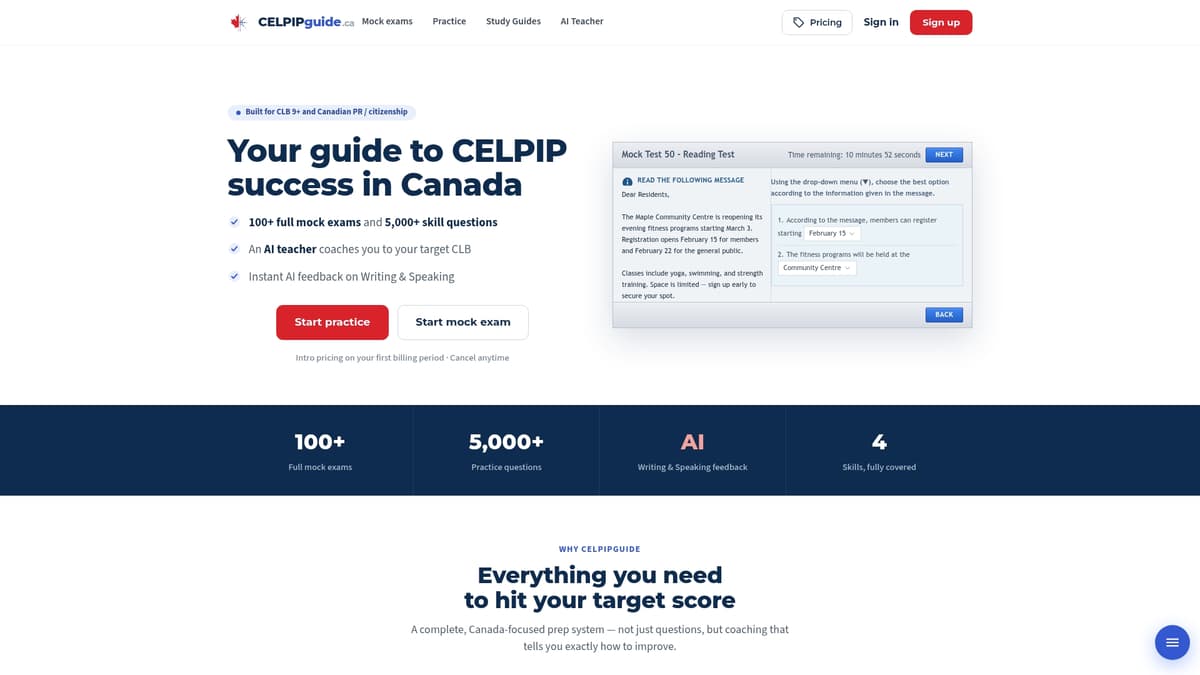
Start with a free diagnostic on the CELPIP practice hub to see which section needs your attention first, then decide if a full mock is your next step.
Official score mapping and concordance resources
For the CLB targets mentioned throughout this article, IRCC’s language test page and its Rural and Northern Immigration Pilot page both provide the official CELPIP-to-CLB tables. For comparisons with IELTS, the CELPIP-IELTS concordance study explains why score conversions should be treated as approximations, not exact swaps.
Sources
FAQ
What is the hardest part of the CELPIP exam?
Most test-takers struggle most with the later Listening tasks, especially Listening to Viewpoints, where you track multiple speakers and shifting opinions, and with inference-based Reading questions. Both demand skills beyond vocabulary, like working memory and pattern recognition, which is why targeted drills help more than general review.
Is CELPIP harder than IELTS?
Neither test is definitively harder, since a concordance study comparing the two found they measure related but not identical constructs. CELPIP focuses on everyday communicative English rather than academic register, which some test-takers find more approachable.
Is it easy to get 7 in CELPIP?
Reaching CLB 7, which many Express Entry applicants target for meaningful CRS points, takes focused practice rather than luck, particularly on inference-heavy Reading and multi-speaker Listening tasks. It’s achievable with a structured study plan, but it isn’t a given without targeted preparation.
Can I prepare for CELPIP in 3 days?
Three days is enough for a light refresher on format and timing, but not enough to fix weak spots in inference reading or speaker-tracking listening. A short sprint works best when it’s focused entirely on your known weak areas rather than general review.