
CELPIP Blog
Lose 50 or More CRS Points If You Ignore CELPIP to CLB Mapping
Lose 50 or More CRS Points If You Ignore CELPIP to CLB Mapping
Converting CELPIP to CLB isn’t complicated: CELPIP-General scores map one-for-one to Canadian Language Benchmark levels, skill by skill. A CELPIP score of 7 on any ability equals CLB 7 on that same ability. IRCC checks Listening, Reading, Writing, and Speaking separately, never as an average, and that single fact decides whether your application clears a program’s language bar.
TL;DR:
- A CELPIP score of 7 in any ability directly maps to CLB 7, with no rounding or averaging involved, according to IRCC’s official table.
- IRCC assesses Listening, Reading, Writing, and Speaking separately, so a low score in one skill can reduce your overall eligibility even if other scores are high.
- Most Express Entry streams require CLB 7 in all abilities, but some pathways like CEC or FSTP accept lower thresholds such as CLB 5 or 4, depending on occupation.
- Improving your weakest skill through targeted mock exams and rubric-based feedback can significantly increase your CRS points and eligibility chances.
- Aiming for CLB 8 or higher across all skills provides more breathing room and higher CRS points, reducing the risk of rejection due to a single low score.
Table of Contents
- Celpip to CLB conversion: the official IRCC table
- Why IRCC checks each skill on its own, not the average
- CLB thresholds for FSWP, CEC, and FSTP: what you actually need
- How to check your own eligibility in four steps
- Fixing a weak skill before it costs you the whole application
- Why aiming above the minimum CLB is the smarter play
- Get your CLB where it needs to be with our online preparation platform
- Where to verify these numbers yourself
- Sources
- FAQ
Celpip to CLB conversion: the official IRCC table
Here’s the mapping straight from IRCC’s own equivalency chart. There’s no formula, no rounding, no guesswork involved. Whatever number sits on your CELPIP-General report for each ability is your CLB level for that ability.
| CELPIP-General score | CLB level |
|---|---|
| 10+ | CLB 10 |
| 9 | CLB 9 |
| 8 | CLB 8 |
| 7 | CLB 7 |
| 6 | CLB 6 |
| 5 | CLB 5 |
| 4 | CLB 4 |
A few quick examples make this concrete:
- CELPIP 5 in Speaking = CLB 5 in Speaking. Nothing more to calculate.
- CELPIP 7 across all four abilities = CLB 7 across all four abilities, the bar most Express Entry candidates aim for.
- CELPIP 9 or CELPIP 10+ = CLB 9 or CLB 10, the range that unlocks top-tier CRS points and satisfies almost every program’s language requirement.
This exact mapping comes from IRCC’s official conversion page, so when in doubt, check your numbers against that source directly rather than a third-party chart.
Why IRCC checks each skill on its own, not the average
IRCC never blends your four scores into one number. It looks at Listening, Reading, Writing, and Speaking as four separate gates, and you need to clear the required CLB on every single one. Score CLB 9 on three abilities and CLB 6 on the fourth, and your file gets treated at the CLB 6 level for whatever program requires more than that.
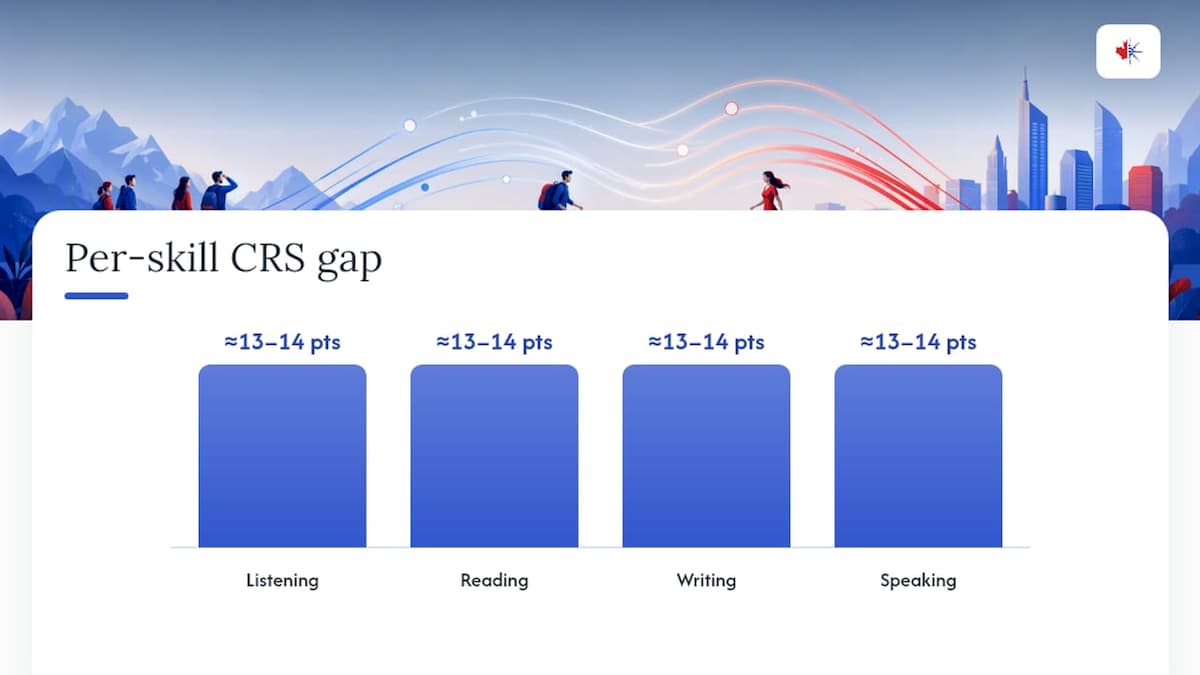
The CRS impact of this per-skill rule is significant. IRCC’s language test points table shows roughly 16 to 17 points per ability at CLB 7, jumping to somewhere around 29 to 31 points per ability once you hit CLB 9. Multiply that gap across four abilities and a candidate stuck at CLB 7 across the board can be leaving 50 or more CRS points on the table compared to someone at CLB 9.
- One weak ability can override three strong ones for eligibility purposes.
- CRS points scale per skill, so a single low score costs you four times over.
- There’s no averaging mechanism anywhere in IRCC’s process, despite what forum threads sometimes suggest.
CLB thresholds for FSWP, CEC, and FSTP: what you actually need
Different Express Entry streams set different bars, and knowing yours before you book a retest saves both money and stress.
- Federal Skilled Worker Program (FSWP): Commonly requires CLB 7 in all four abilities, which means CELPIP 7 in Listening, Reading, Writing, and Speaking. Confirm your eligibility path on IRCC’s Express Entry page.
- Canadian Experience Class (CEC): TEER 2 and TEER 3 occupations often accept CLB 5, while TEER 0 and TEER 1 occupations typically need CLB 7.
- Federal Skilled Trades Program (FSTP): Many streams ask for CLB 5 in Speaking and Listening, with CLB 4 acceptable in Reading and Writing.
Pro Tip: Don’t stop at the minimum just because it technically qualifies you. A CLB 7 score that just squeaks by leaves almost no room for a bad testing day on your next application cycle. Aiming one or two bands higher buys you both CRS points and breathing room.
How to check your own eligibility in four steps
Grab your CELPIP-General score report and work through this in the order you’d expect a careful applicant to:
- Find your four raw scores. Listening, Reading, Writing, and Speaking each get their own number between 1 and 12 (10+ is reported as a single band).
- Map each score to CLB using the table above. Do this individually. Do not average, round up, or blend the four numbers into one.
- Compare each CLB result against your target program’s threshold. FSWP wants CLB 7 everywhere; CEC and FSTP vary by occupation, so check the specific stream you’re applying under.
- Estimate your CRS impact. A CELPIP score calculator turns your four CLB levels into an estimated Express Entry points contribution in under a minute.
Fixing a weak skill before it costs you the whole application
If step two above turned up one low score dragging down an otherwise strong profile, you have time to fix it, but you need a plan rather than blind repetition.
Start with a full-length, timed CELPIP mock exam to confirm which ability is actually weak under real exam conditions, not just in casual practice. Writing and Speaking scores often surprise people because self-assessment misses the specific errors a rubric catches.
- Run one diagnostic mock to pinpoint the exact ability dragging your CLB down.
- Use rubric-based feedback on Writing and Speaking tasks to target the specific error patterns costing you marks, not generic tips.
- Follow a personalised study plan built around that weak skill, mixing focused drills with a vocabulary builder.
- Retest with two more full mocks before your real exam date to confirm the gap closed.
Pro Tip: A two-week sprint works well when time is tight: diagnostic on day one, targeted drills through week one, two full mocks in week two, with feedback reviewed after each one. That loop catches recurring mistakes fast enough to actually change your score before test day.
Why aiming above the minimum CLB is the smarter play
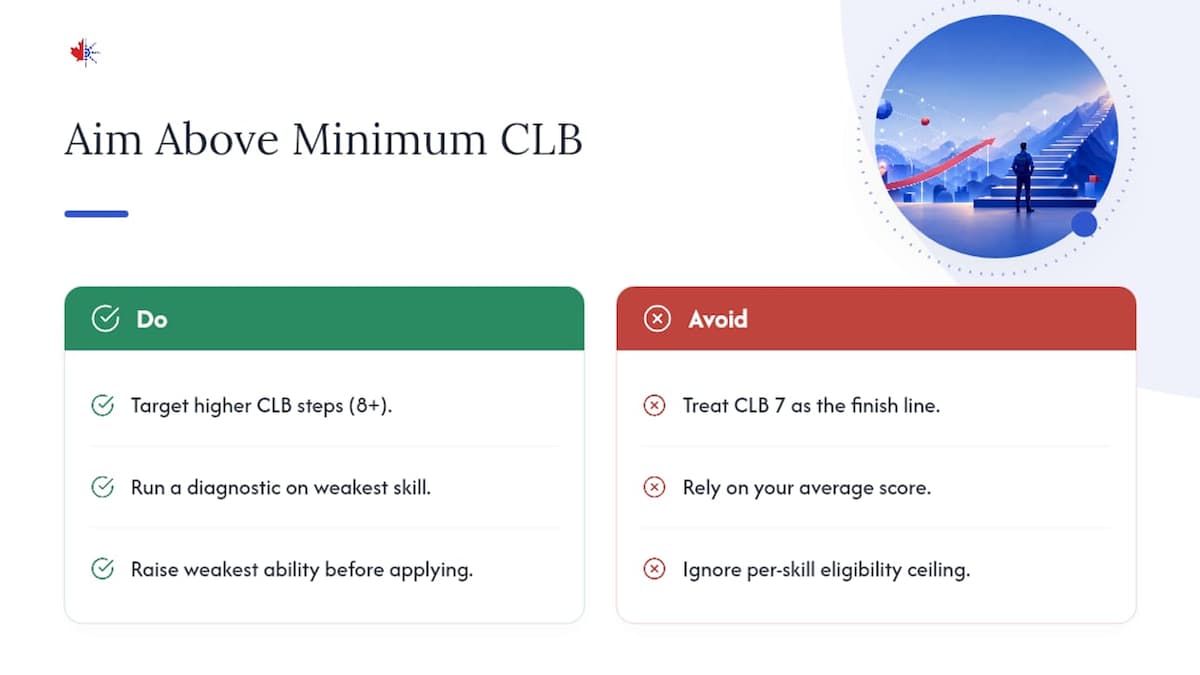
The math on this is straightforward once you’ve seen the CRS point bands. Every step up in CLB, from 7 to 8, or 8 to 9, adds meaningfully more points per ability than the step below it. Candidates who treat CLB 7 as a finish line often find themselves just short in the Express Entry pool, wondering why a technically eligible profile never gets an invitation.
The bigger trap is assuming an average will save you. It won’t. IRCC’s per-skill rule means your weakest ability sets your ceiling, so a 9-9-9-6 profile scores like a 6 for eligibility purposes on any program requiring higher than CLB 6. Before you submit anything, run a diagnostic on your weakest skill specifically. That’s the number that actually determines what you qualify for, not your best score, and not your average.
— Reza
Get your CLB where it needs to be with our online preparation platform
Reading a conversion table tells you where you stand. Closing the gap between where you stand and where you need to be is a different problem, and specialized preparation platforms are designed to solve it. Instead of generic practice sets, you get a readiness check that flags your weakest ability first, then a study plan generator that builds drills around that specific gap rather than making you guess.
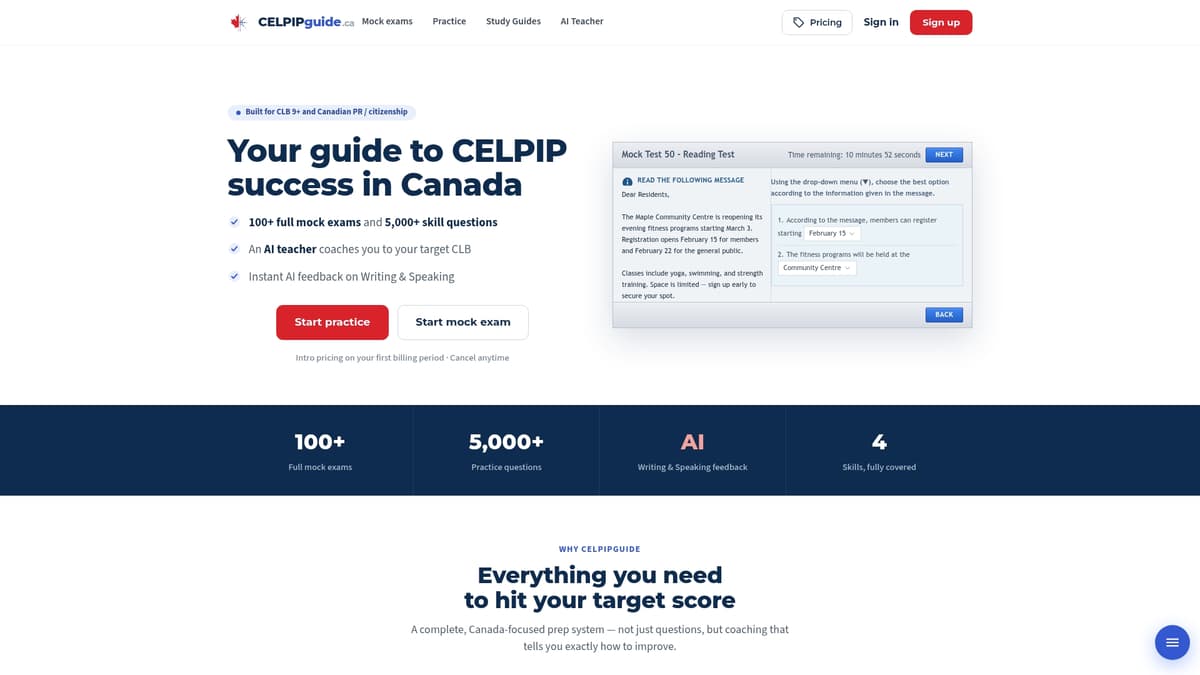
If your last attempt left one skill short of the CLB you needed, the Score Rescue diagnostic is built exactly for that situation: pinpoint what went wrong, then fix it before your retest. Full access to mock exams and AI-scored feedback is available through the CELPIP practice hub, and you can apply code BLG30 at checkout for 30% off any plan on top of whatever pricing is already showing. Start with a diagnostic today and know exactly which CLB band you’re actually testing at before you spend money on a retest.
Where to verify these numbers yourself
Always cross-check your conversion against IRCC’s official language results page and the Centre for Canadian Language Benchmarks for the underlying CLB framework. For a fast personal estimate, Celpipguide’s score calculator converts your four scores into CLB and CRS in one step.
Sources
FAQ
How do I convert CELPIP to CLB?
Match each of your four CELPIP-General ability scores directly to the same-numbered CLB level using IRCC’s official table; a CELPIP 7 in Speaking is CLB 7 in Speaking, with no averaging across skills.
How much is CLB 10 in CELPIP?
CLB 10 corresponds to a CELPIP score of 10 or higher (reported as 10+) on that ability, placing you in the top scoring band IRCC recognizes.
What score is CLB 5 in CELPIP?
A CELPIP score of 5 on any given ability equals CLB 5 on that ability, a level accepted as the minimum for some Canadian Experience Class streams in TEER 2 and TEER 3 occupations.
What does CLB 7 mean in CELPIP?
CLB 7 means a CELPIP score of 7 on each of the four abilities, and it’s the threshold most commonly required for the Federal Skilled Worker Program and many Express Entry eligible occupations.