
CELPIP Blog
CRS score boost strategies 2026: CELPIP takers' guide
CRS score boost strategies 2026: CELPIP takers’ guide

TL;DR:
- Improving your CELPIP score to CLB 9 or higher, obtaining a provincial nomination, and completing an ECA can significantly increase your CRS points. These steps can narrow your gap in the Express Entry pool and enhance your chances of receiving an Invitation to Apply. Focused preparation and strategic timing, supported by modeling tools, maximize your potential for faster, cost-effective CRS score growth.
Your three highest-ROI moves right now are a targeted CELPIP retake to hit CLB 9+, a provincial nomination (PNP) if you qualify, and completing any missing Educational Credential Assessment (ECA). Together, these can add a substantial number of CRS points, and a gain of just a modest amount can meaningfully shift your rank in the Express Entry pool.
TL;DR — your priority actions:
- CELPIP retake to CLB 9+: typically adds a notable number of points (core language + transferability)
- PNP nomination: adds a large number of CRS points and effectively guarantees an Invitation to Apply (ITA)
- ECA completion: unlocks education-based core and transferability points you may be leaving unclaimed
- Sibling in Canada: adds additional points if eligible
Pro Tip: Use the Celpipguide CRS score calculator to model your current score, then book a diagnostic mock to find your weakest CLB skill before spending a dollar on prep.
Table of Contents
- How does CRS scoring work in 2026?
- How do CELPIP scores map to CLB and CRS points?
- Which CRS strategies give you the most points?
- Your 8–16 week CELPIP study roadmap
- How to model your expected CRS gain
- What does each strategy actually cost and how long does it take?
- Common mistakes that cost candidates real points
- What to do this week, this month, and in the next three months
- Key takeaways
- What I would do if I needed +50 CRS in six months
- Celpipguide helps you hit your CLB target faster
- Useful sources
- FAQ
How does CRS scoring work in 2026?
The Comprehensive Ranking System awards up to 1,200 points across three buckets: core human capital factors (age, education, language, Canadian experience), skill transferability, and additional points. Language sits in all three.
Key 2026 mechanics to know:
- Core language points reward each CLB band directly, with steep gains at CLB 9 and CLB 10
- Transferability points multiply your language score against your education and foreign work experience, up to 50 points per combination
- Additional points cover PNP (+600), French ability (up to 50 points at NCLC 7+), a sibling in Canada (+15), and Canadian education
One major policy shift: IRCC removed arranged-employment (LMIA) points in March 2025. A job offer no longer adds CRS points directly, though it can still support PNP eligibility or a work permit. Category-based draws (French, STEM, healthcare, trades) often carry lower cut-offs than general all-program draws, making occupation and language targeting a genuine strategic lever.

How do CELPIP scores map to CLB and CRS points?
CELPIP is scored on a 1–12 scale across four skills: Listening, Reading, Writing, and Speaking. Each raw band maps directly to a Canadian Language Benchmark (CLB) level, and each CLB level carries a specific CRS point value.
| CELPIP Band | CLB Level | Core CRS Points (Single Applicant, per skill) | Transferability Unlocked? |
|---|---|---|---|
| 5 | CLB 5 | Low | No |
| 6 | CLB 6 | Moderate | No |
| 7 | CLB 7 | Moderate | Partial |
| 8 | CLB 8 | Higher | Partial |
| 9 | CLB 9 | High | Transferability fully unlocked |
| 10 | CLB 10 | Maximum | Transferability fully unlocked |
CLB 9 is the critical threshold. Reaching it across all four skills unlocks full transferability combinations which significantly boost CRS points when paired with foreign work experience or additional education. The CLB 9 transferability effect is why moving from CLB 8 to CLB 9 in all four skills can add a meaningful number of points beyond the raw language gain.
For applicants with a spouse, the spouse’s language score, education, and Canadian work experience each add separate points. Even a modest improvement in your spouse’s CELPIP result can add additional points to your combined profile.
Pro Tip: Target your single weakest skill first. Your overall CLB is capped by your lowest band, so one weak skill holds back every other gain. Use the CELPIP four-skills scoring guide to see exactly where you’re losing points.
Which CRS strategies give you the most points?
Here is how the main options stack up across the dimensions that matter most for your 2026 planning:
| Strategy | CRS Impact | Time to Implement | Estimated Cost (CAD) | Difficulty | Best Program Fit |
|---|---|---|---|---|---|
| PNP nomination | adds a large number of points | several months | several thousand dollars | High | CEC, FSW, PNP streams |
| CELPIP retake to CLB 9+ | adds a moderate number of points | 2–4 months | several hundred dollars | Medium | CEC, FSW, PNP |
| French to NCLC 7+ | adds additional points | several months | moderate cost | High | French category draws |
| Canadian work experience | adds additional points | 1–3 years | varies | Medium | CEC |
| ECA (foreign education) | adds moderate points | 3–5 months | a few hundred dollars | Low | FSW, CEC |
| Spouse language/education | adds some points | 2–4 months | several hundred dollars | Medium | All programs |
| Sibling in Canada | adds additional points | Immediate | Nil | Low | All programs |
Sample scenario: You currently sit at CLB 8 across all skills and hold a foreign bachelor’s degree without an ECA. Moving to CLB 9 in all four skills adds roughly 30–40 core and transferability points. Adding a completed ECA on top unlocks education-based transferability, potentially adding another 15–25 points. Combined, that is a realistic 45–65 point gain over 12–16 weeks, achievable without a PNP.
Canadian work experience compounds this further: it adds core points, satisfies CEC eligibility, and amplifies transferability when your language is already at CLB 9+.
Your 8–16 week CELPIP study roadmap
A structured plan beats random practice every time. Here is a week-by-week framework built around the CLB targets that matter for CRS.
- Week 1 — Diagnostic: Complete a full Celpipguide diagnostic mock. Identify your lowest CLB skill. Set a specific target (e.g., raise Speaking from CLB 7 to CLB 9).
- Weeks 2–5 — Focused skill blocks: Dedicate 80% of study time to your weakest skill using skill-specific practice tasks. Work through writing templates and speaking response structures.
- Weeks 6–9 — Integrated practice: Shift to full-length timed mocks every 10–14 days. Review scoring rubrics after each mock to track band movement.
- Weeks 10–13 — Mock intensity: Run two full mocks per week. If your mock scores consistently hit the target CLB, book your official CELPIP date.
- Weeks 14–16 — Test readiness: Final mock, review weak spots only, confirm test centre booking and ID requirements.
Key exam logistics to keep in mind:
- CELPIP results are valid for two years from the test date; plan retakes so your score is still valid when you receive an ITA
- Book your test centre slot at least 4–6 weeks in advance, especially in high-demand cities
- Targeted retakes focused on the weakest skill are more cost-effective than broad re-study
Pro Tip: After each mock that hits your target band, re-run your CRS estimate in the Celpipguide score calculator to confirm whether a retake is justified before paying the exam fee.
How to model your expected CRS gain
Translating a CLB target into a CRS number takes four steps.
- Map your current CLB: Note each skill’s current band and your lowest (this sets your effective CLB level).
- Compute the core language delta: Use the official IRCC CRS points table to find the difference between your current and target CLB for each skill.
- Add transferability delta: If your target CLB reaches 9+, calculate the additional transferability points unlocked by your education level and years of work experience.
- Stack additional points: Add French, sibling, or spouse improvements if applicable.
| Scenario | Current CLB | Target CLB | Estimated CRS Gain |
|---|---|---|---|
| Single applicant, no ECA | CLB 8 all skills | CLB 9 all skills | an increase in points |
| Applicant with foreign work experience | CLB 8 all skills | CLB 9 all skills | a larger increase due to transferability |
| Applicant with spouse | CLB 8 all skills | CLB 9 + spouse CLB 8 | combined increase from both profiles |
What does each strategy actually cost and how long does it take?
| Action | Estimated Cost (CAD) | Typical Timeline | Expected CRS Gain |
|---|---|---|---|
| Self-study + 1 CELPIP retake | moderate cost | 2–3 months | a moderate increase |
| Paid prep course + diagnostic + 2 retakes | higher cost | 3–5 months | a larger increase |
| ECA (WES or equivalent) | moderate cost | 3–5 months | a moderate increase |
| PNP application (government fees + legal) | higher cost | several months | a large increase |
Decision guide: If you need +15–30 points quickly, a targeted CELPIP retake is your fastest path. If your gap is +80 or more, research PNP streams in provinces where you have a genuine connection, or consider gaining Canadian work experience to open CEC eligibility.
Common mistakes that cost candidates real points
- Treating total language score as the only metric. Your CRS CLB is set by your lowest skill band. One weak skill at CLB 7 caps your entire language score, even if the other three are at CLB 10.
- Assuming a job offer adds CRS points. IRCC removed LMIA-based arranged-employment points in March 2025. A job offer has zero direct CRS value now.
- Skipping the ECA. Foreign credentials without a valid ECA from a designated organisation earn no CRS education points. This is one of the most common and most avoidable gaps.
- Ignoring transferability. Language mastery amplifies existing credentials rather than acting alone. Candidates who stop at CLB 8 miss the compounding effect that CLB 9 unlocks.
- Letting language test results expire. CELPIP results are valid for two years. An expired result means zero language points in your profile until you retest.
- Over-investing in low-leverage activities. Spending on expensive courses without a diagnostic first, or pursuing a second ECA from a different provider (which adds no points), wastes budget that could fund a retake or PNP application fees.
What to do this week, this month, and in the next three months
- This week: Run the Celpipguide diagnostic mock. Calculate your current CRS using the score calculator. Identify your lowest CLB skill.
- This week: Check whether you have a valid ECA. If not, start the WES or designated-body application now (it takes 3–5 months).
- Month 1: Follow the focused study plan above. Book a CELPIP test date once your mock scores consistently hit your target CLB.
- Month 1: Research PNP streams in provinces where you have a job offer, work history, or family connection.
- Months 2–3: Retake CELPIP if mock results confirm readiness. Update your Express Entry profile within 24 hours of receiving official results.
- Months 2–3: Submit a PNP Expression of Interest if you qualify. Monitor category-based draw announcements and confirm your NOC code is correctly listed.
Key takeaways
Raising your CRS in 2026 comes down to one core principle: language gains at CLB 9+ unlock transferability points that multiply the value of every other credential you already hold.
| Point | Details |
|---|---|
| CLB 9 is the critical threshold | Moving all four CELPIP skills to CLB 9 can add 30–40 points through core and transferability gains combined. |
| PNP is the single largest one-shot gain | A provincial nomination adds exactly +600 CRS points, effectively guaranteeing an ITA for most candidates. |
| Transferability multiplies your profile | Language at CLB 9+ amplifies points from education and foreign work experience; ignoring this is the most common strategic error. |
| Sequence your actions | Fix your weakest CLB skill first, complete your ECA in parallel, then pursue PNP if your gap exceeds 50 points. |
| Celpipguide tools quantify your payoff | Use the diagnostic test and score calculator to model gains before spending money on prep or exam fees. |
What I would do if I needed +50 CRS in six months
If I were sitting at CLB 8 across all four skills with a foreign degree and no ECA, my plan would be straightforward: start the ECA application on day one (it runs in the background while I study), then spend eight weeks on a targeted CELPIP retake focused entirely on my weakest skill.
Why language first? Because hitting CLB 9 does not just add core points. It unlocks transferability combinations that make your existing education and work experience worth more. That sequencing matters. Spending three months on a French course before fixing a CLB 7 Speaking score, for example, is backwards: the French bonus requires strong English too, and you will have wasted time on a mid-term strategy while your most accessible gain sat untouched.
If my gap were larger than 50 points, I would run PNP discovery in parallel, not after. Many candidates treat PNP as a last resort. It is actually a parallel track: research streams, check eligibility, and submit an Expression of Interest while you are still in the study phase. The two timelines overlap cleanly.
One risk management note: avoid spending on immigration consultants or expensive prep courses before you have a diagnostic result in hand. Know your actual gap first. And for anything involving legal status or profile accuracy, a Regulated Canadian Immigration Consultant (RCIC) is worth the fee.
Celpipguide helps you hit your CLB target faster
Knowing your weakest CLB skill is one thing. Having a structured path to fix it is another. Celpipguide gives you both, without the guesswork of generic prep resources.
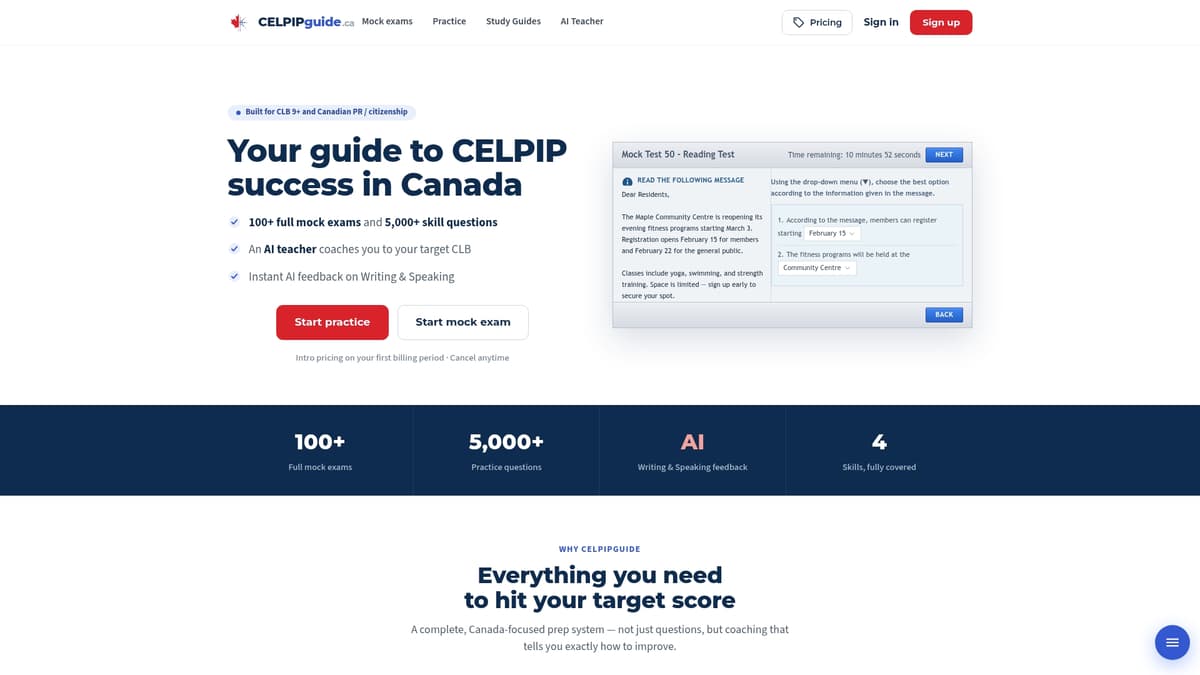
The platform’s AI-powered diagnostic pinpoints exactly which skill is holding back your CLB, then generates a personalised week-by-week study plan calibrated to your target band. Over 100 full-length mock exams and 5,000 practice questions give you the volume of timed practice that actually moves scores. Every mock is CLB-mapped, so you can see your projected CRS gain in real numbers, not guesses.
Ready to find out where you stand? Start with a full-length CELPIP practice exam and run your CRS estimate immediately after. Your next ITA could be closer than you think.
Useful sources
- IRCC Express Entry and CRS rules — official CRS calculator, draw history, and language test validity rules
- Paragon Testing Enterprises — CELPIP CLB conversion — official CELPIP to CLB equivalency table and test centre booking
- Bellissimo Law Group — practical CRS improvement guide — regulated immigration lawyer analysis of CRS factors
- ImmiNorth — 7 realistic ways to improve your CRS score — ranked strategy breakdown with 2026 draw benchmarks
- Celpipguide CRS score calculator — model your CLB-to-CRS point gains before booking a retake
- Celpipguide study plan generator — personalised 8–16 week prep plan based on your diagnostic results
Re-run your calculations after every profile change: draw cut-offs shift, and a 20-point gain that looked marginal in January can clear the bar by April.
FAQ
How many CRS points does moving from CLB 8 to CLB 9 add?
Moving all four CELPIP skills from CLB 8 to CLB 9 typically adds 30–40 points, depending on your education level and work experience, because CLB 9 unlocks full skill transferability combinations on top of the core language gain.
Does a Canadian job offer still add CRS points in 2026?
No. IRCC removed LMIA-based arranged-employment points in March 2025, so a job offer adds zero CRS points directly. It can still support PNP eligibility or a work permit application.
How often can I retake the CELPIP exam?
Paragon Testing Enterprises does not impose a mandatory waiting period between CELPIP sittings, but most candidates allow 6–8 weeks of focused preparation between attempts to see meaningful CLB improvement.
What is the fastest way to add 50+ CRS points?
A targeted CELPIP retake to CLB 9+ combined with a completed ECA is the most accessible path to 45–65 points within 12–16 weeks. A PNP nomination adds +600 points but requires meeting stream-specific eligibility criteria.
How does Celpipguide help with CRS improvement?
Celpipguide’s diagnostic test identifies your weakest CLB skill, and its AI-generated study plan targets that gap directly. The score calculator lets you model your projected CRS gain from any planned CLB improvement before you book the official exam.