
CELPIP Blog
CELPIP Test Format for Canadian Applicants: Practice by Section
CELPIP Test Format for Canadian Applicants: Practice by Section

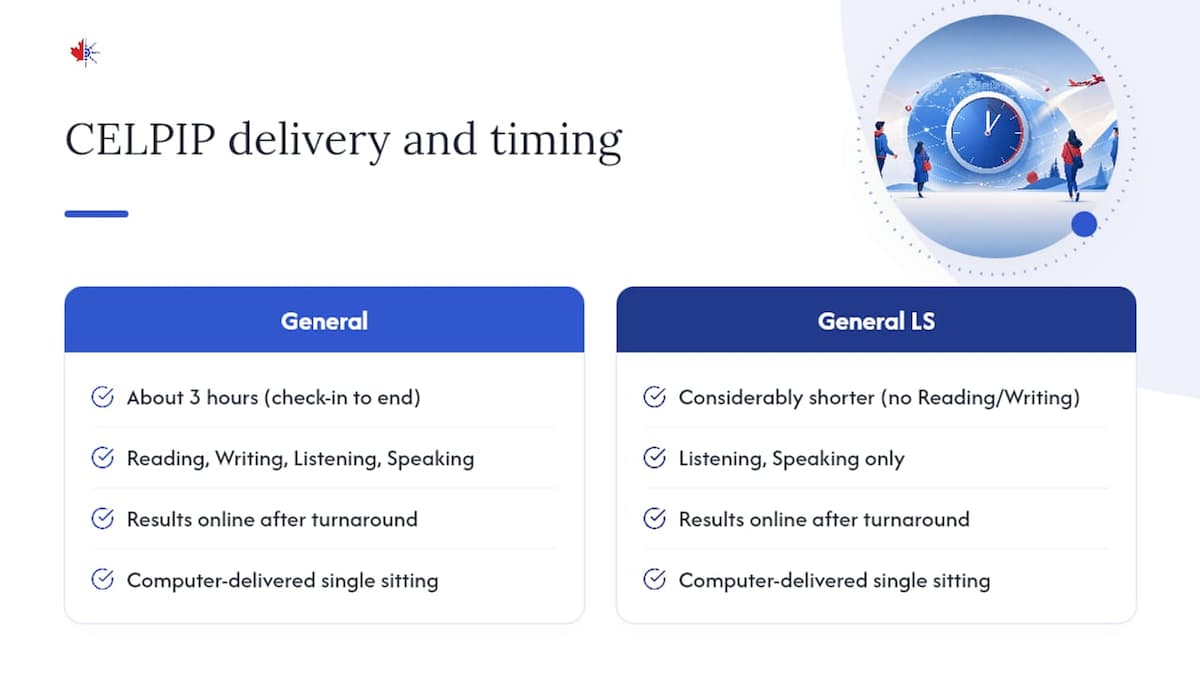
CELPIP‑General tests Listening, Reading, Writing, and Speaking, while CELPIP‑General LS covers only Listening and Speaking. Both are fully computer-delivered, and the General version runs in one sitting of roughly three hours. General supports most immigration streams; General LS is built for citizenship applications. Always confirm acceptance with the organisation receiving your scores before you book.
TL;DR:
- The CELPIP‑General typically lasts three hours in a single computer-delivered session, while CELPIP‑General LS is shorter, focusing only on Listening and Speaking.
- Permanent residence applicants usually need the full four-skill CELPIP‑General, while citizenship applicants with residency often only require CELPIP‑General LS.
- Test results are available online within a set turnaround time, with scores mapping directly to Canadian Language Benchmarks, and validity usually lasts around two years.
- Preparation should focus on timed, full-length mock exams and tasks mimicking real test conditions, especially for Listening and Speaking, which demand quick note-taking and concise answers.
- Acceptance of either test version depends on the institution or immigration body, so always verify with them before booking.
Table of Contents
- What is the CELPIP test format, and which version do I need?
- How is the CELPIP test delivered, and how long does it take?
- What does the CELPIP Listening section actually ask you to do?
- What text types and question styles appear in CELPIP Reading?
- What are the CELPIP Writing tasks, and what do raters reward?
- What happens during the CELPIP Speaking test?
- How do CELPIP scores convert to CLB levels?
- How do I register for CELPIP, and what should I bring on test day?
- How should you actually practise for this format?
- Who tends to do well with CELPIP’s format?
- Get exam-realistic practice before test day
- Official and authoritative links
- Sources
- FAQ
What is the CELPIP test format, and which version do I need?
CELPIP‑General measures all four skills: Listening, Reading, Writing, and Speaking. It’s the version most permanent residence applicants need, including those applying through Express Entry, since Immigration, Refugees and Citizenship Canada treats it as an accepted proof of language ability for most economic streams.
CELPIP‑General LS tests only Listening and Speaking. It exists specifically for Canadian citizenship applications, where IRCC requires proof of oral communication ability but not a full four-skill assessment.
Here’s how the two typically split by candidate type:
- Permanent residence applicants almost always need CELPIP‑General, since the four-skill result maps to the Canadian Language Benchmarks required for scoring.
- Citizenship applicants who already have permanent residency often only need CELPIP‑General LS, which is shorter and cheaper.
- Some provincial or professional bodies may specify their own accepted version, so check before assuming General LS is enough.
Never assume. The official CELPIP test format page describes both versions in detail, but the final word on acceptance always sits with the receiving institution.
How is the CELPIP test delivered, and how long does it take?
CELPIP‑General runs as a single computer-delivered sitting, typically lasting about three hours from check-in to the final Speaking task. There’s no splitting the exam across days or locations. CELPIP‑General LS is considerably shorter, since it skips Reading and Writing entirely.
Results for both versions are usually available within a set turnaround window after test day, viewable through your online account rather than mailed as a paper certificate.
Computer delivery changes how you should train. You’re typing your Writing responses on a keyboard under a timer, not scribbling on paper. You’re speaking into a microphone with a visible countdown, not talking to a live examiner. If your instinct is to draft on paper first or pause mid-sentence to gather your thoughts, that habit will cost you seconds you don’t have.
What does the CELPIP Listening section actually ask you to do?
Listening is arguably where candidates feel the most time pressure, mostly because every recording plays only once. The CELPIP test format page breaks the component into several parts, generally running about 46 to 55 minutes total.
You’ll work through a mix of task types:
- Short conversations about everyday topics, testing basic comprehension.
- Longer discussions or interviews, where you track multiple speakers and viewpoints.
- Problem-solving scenarios, where you infer what a speaker will likely do next.
- News item summaries, testing your ability to extract key facts from short broadcasts.
- Discussions with viewpoints, asking you to identify who agrees, disagrees, or stays neutral.
Pro Tip: Write down numbers, names, and negatives (words like “not,” “but,” and “unless”) the moment you hear them. Since there’s no replay, the biggest trap in CELPIP Listening isn’t missing information. It’s misremembering a detail because you didn’t jot it down fast enough.
Practising with CELPIP Listening drills that mimic the single-play format will train your ear for Canadian pacing and accent far faster than passive listening ever will.
What text types and question styles appear in CELPIP Reading?
Reading runs roughly 55 to 60 minutes and mixes practical and analytical text types. You’ll see everyday materials like emails and notices, alongside diagrams, charts, and longer informational or opinion-style passages.
Question styles vary by part:
- Correspondence-based questions test whether you understood a workplace or personal email’s purpose and tone.
- Diagram and information questions ask you to interpret visual data, not just prose.
- Viewpoint comparison questions require you to identify where two opinions align or clash.
- Longer passage questions test your ability to locate specific evidence rather than just general understanding.
The biggest time sink is rereading full passages when you don’t need to. Skim first for structure, then hunt for the specific sentence that answers each question instead of rereading the whole text every time.
What are the CELPIP Writing tasks, and what do raters reward?
Writing consists of two tasks, each expecting roughly 150 to 200 words, within a total component time of about 53 to 60 minutes. You type both responses directly into the test interface, with no spell-check assistance, so accuracy under pressure matters more than it would on paper.
- Task 1 is typically an email response to a workplace or personal scenario, testing tone, clarity, and appropriate register.
- Task 2 usually asks you to respond to a survey question or express an opinion with supporting reasons.
Raters aren’t grading you like an English professor grading an essay. According to CELPIP’s own guidebook for test takers, scoring emphasizes task fulfillment, clear organization, and appropriate vocabulary and grammar for the context, not literary flourish. A direct, well-organized workplace-style email will consistently outscore a flowery essay that dodges the actual prompt. If you want to see what that looks like in practice, the CELPIP Writing Task 1 samples show the structure raters expect.
What happens during the CELPIP Speaking test?
Speaking consists of eight short recorded tasks, each with a brief preparation window (often under a minute) followed by a timed response. Total speaking time runs about 15 to 20 minutes, and every answer is recorded for later scoring rather than judged live.
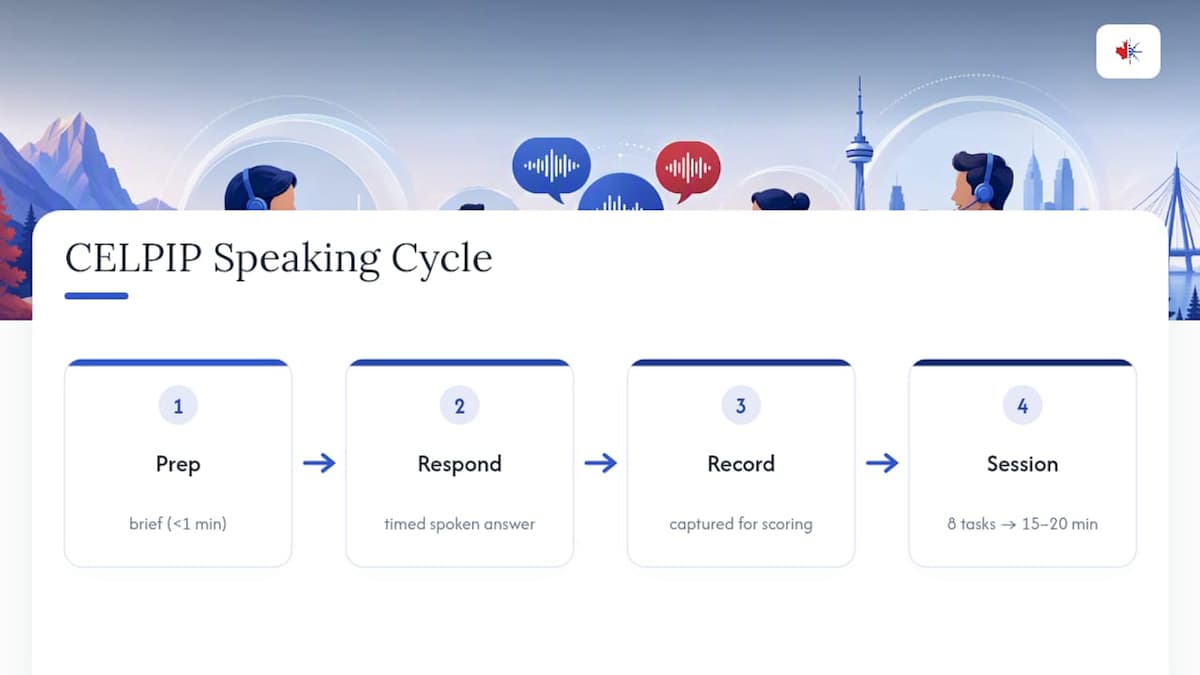
Task prompts range widely: describing a personal experience, giving advice, comparing options, or predicting an outcome based on a scenario. There’s no examiner nodding along or asking follow-up questions, so your entire performance rests on what the microphone captures in that single take.
Pro Tip: Use your prep seconds to jot two or three keywords, not a full script. Candidates who try to write out a complete answer during prep time usually run out of seconds before they’ve planned an ending, and then trail off mid-response when recording starts.
Speak at a natural, slightly deliberate pace. Rushing to fit more content in often costs more marks through mumbled pronunciation than it gains through added detail.
How do CELPIP scores convert to CLB levels?
CELPIP scores map directly onto the Canadian Language Benchmarks, with each component (Listening, Reading, Writing, Speaking) receiving its own CLB-equivalent score rather than one combined number. IRCC and other receiving bodies use these individual component scores, so a strong Speaking result won’t offset a weak Writing one on an application that requires a minimum CLB across all four.
Results are generally available online within a set turnaround period after your test date, and scores remain valid for a set window, typically around two years, for immigration purposes. Before submitting any application, check current validity rules on the Government of Canada site, since acceptance windows and minimum CLB thresholds can shift between programs.
How do I register for CELPIP, and what should I bring on test day?
Registration happens through Paragon Testing’s official portal, where you pick a test centre, choose an available date, and pay the exam fee online.
- Create an account on the Paragon registration portal and search for available dates near you.
- Confirm you’re booking the correct version (General vs. General LS) before paying, since fees and content differ.
- Arrive early (typically 30 minutes before your scheduled time) with valid government-issued photo ID matching your registration exactly.
- Leave personal items, phones, and notes in provided storage. Only what the test centre explicitly allows stays with you.
- Review the cancellation and rescheduling window on your registration confirmation, since fees typically apply if you cancel too close to your test date.
How should you actually practise for this format?
Random studying wastes time you don’t have. The most efficient approach follows three phases: a diagnostic to find your weakest skill, targeted drills that mimic the exact task constraints (single-play audio, timed typing, recorded speech), and full-length timed mocks that replicate test-day pressure before you review your mistakes.
Start with CELPIP’s own guidebook for test takers, which includes sample tasks straight from the test maker. Then build a practice rotation:
- Listening: drill single-play audio clips while taking notes, since replaying isn’t an option on test day.
- Reading: time yourself on individual passages before attempting a full section, so you learn your personal pacing limits.
- Writing: practise with templates for both the email task and the survey response task, focusing on hitting word counts without padding.
- Speaking: record your own answers on a phone and listen back critically for pacing, clarity, and whether you actually answered the prompt.
An AI-assisted study prompt can help structure a personalized drilling schedule if you’re not sure where to start. Whatever method you choose, don’t skip the full timed mock exam near the end. It’s the only way to know if your pacing holds up under real pressure, not just during isolated drills.
Who tends to do well with CELPIP’s format?
Candidates comfortable typing quickly and speaking into a microphone without an examiner’s feedback tend to adapt fastest to CELPIP. If you freeze without visual cues from a listener, or you strongly prefer handwriting over typing, a different test format might suit you better.
— Reza
Get exam-realistic practice before test day
Reading about the CELPIP test format is one thing. Sitting through a full timed mock that actually feels like test day is another. Celpipguide gives you what a guidebook can’t: over 100 full-length mock exams and more than 5,000 practice questions built to mirror the real Listening, Reading, Writing, and Speaking components, plus an AI teacher that scores your Writing and Speaking responses instantly against the same rubric criteria examiners use.
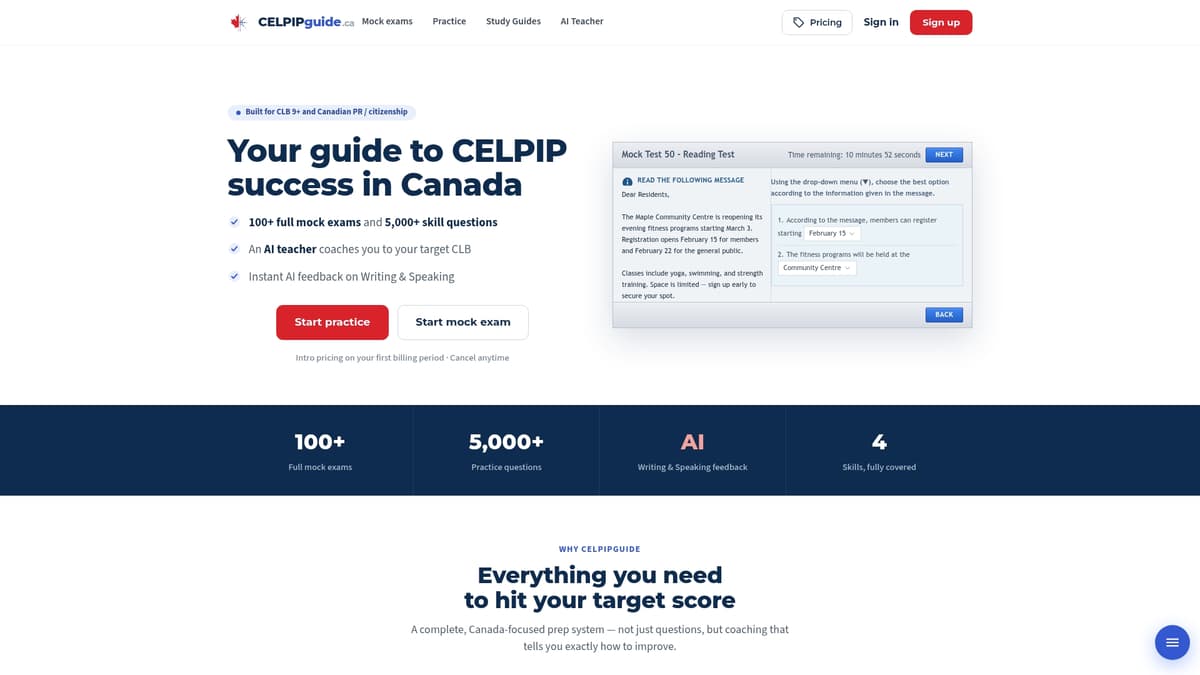
This setup works best for candidates who already know their target CLB but keep guessing at which skill needs the most attention. Instead of drilling blind, you get a diagnostic that flags your weak component, then a study plan built around it. If you’re aiming for a specific CLB threshold for permanent residence or citizenship, start with the CELPIP Exam Practice Hub to try a full-length mock, or go straight to the Plus plan to unlock full mock access and AI feedback on every Writing and Speaking task you submit.
Official and authoritative links
For the most current and legally reliable information, always cross-check against primary sources rather than third-party summaries. The CELPIP test format page and the guidebook for test takers are the two documents CELPIP itself publishes for candidates.
For booking, use the Paragon registration portal or manage an existing booking through Paragon’s secure candidate portal. To confirm whether your specific immigration or citizenship application accepts your intended test version, check the Government of Canada website directly before you register.
Sources
FAQ
Is CELPIP more difficult than IELTS?
Neither test is inherently harder. They’re structured differently: CELPIP is fully computer-delivered with Canadian English content, while IELTS often includes a face-to-face Speaking component and British/international content. Candidates who type quickly and prefer recorded speaking tasks often find CELPIP’s format more comfortable, while those who prefer speaking with a live examiner may lean toward IELTS.
What is 34 out of 38 in CELPIP reading?
CELPIP Reading scores convert raw correct answers into a CLB-equivalent band rather than a simple percentage, so exact raw scores don’t translate to fixed CLB levels. Check the official CELPIP test format page or your official score report for the exact conversion that applies to your test date.
Is CELPIP easy to pass?
There’s no fixed “pass” or “fail” on CELPIP. Instead, you receive a CLB-equivalent score for each of the four components, and whether that score is high enough depends entirely on the CLB threshold your specific immigration or citizenship application requires. Consistent, format-matched practice with tools like full-length mock exams makes hitting a target CLB far more predictable than winging it.
What is the format of the CELPIP writing exam?
CELPIP Writing has two tasks, each expecting roughly 150 to 200 words, completed by typing directly into the test interface within about 53 to 60 minutes total. Task 1 is typically an email response, and Task 2 usually asks for a survey response or opinion with supporting reasons, with raters prioritizing task fulfillment and clear workplace-appropriate register over academic style.
How much does CELPIP registration cost?
CELPIP registration fees are set by Paragon Testing and vary by version and location, so check current pricing directly on the Paragon registration portal before booking. Celpipguide’s own preparation plans are separate from the exam fee itself, with the Plus plan available for $29.99 one-time on the plans page.