
CELPIP Blog
CELPIP Apology Emails: 3 Templates, Then a 60-Second Score Check
CELPIP Apology Emails: 3 Templates, Then a 60-Second Score Check

An effective CELPIP Task 1 apology email does four things in roughly 150 words: it apologizes clearly, gives a brief reason, proposes a fix or next step, and closes politely. We built this guide around that structure, with templates you can adapt fast and a checklist tied to CELPIP’s own scoring criteria.
TL;DR:
- Match your tone to the prompt: write formally to landlords or employers, use a moderately formal tone with coworkers, and sound casual with friends.
- Put the apology in the first sentence, keep the reason brief, then state a specific remedy such as a replacement, refund, or proposed date.
- Use linkers such as however and as a result to connect ideas; CELPIP raters assess task fulfillment, coherence and cohesion, vocabulary, and grammar.
- Write one email daily from a different scenario, use the task time limit, and spend two minutes checking your draft against the criteria.
- If your draft runs long, trim the explanation first; if it is short, add detail to the remedy rather than padding the opening.
Table of Contents
- Three ready-to-use apology email templates for Task 1
- What goes in each paragraph, sentence by sentence
- Phrases and vocabulary for every part of the apology
- Common mistakes and a 60-second self-edit checklist
- Practising these templates under timed conditions
- How structured mock exams and AI feedback speed up improvement
- How cultural nuances shape tone and content
- What actually separates a passing apology email from a strong one
- Put these templates into practice with Celpipguide Plus
- FAQ
- Keep practising: resources to go further
Three ready-to-use apology email templates for Task 1
When the prompt drops an awkward situation in your lap (a cancelled appointment, a late delivery, a missed meeting), you don’t need a brilliant opening line. You need a structure you can fill in under pressure. We’ve organized three versions by tone, since CELPIP prompts often signal who you’re writing to: a landlord, a coworker, a close friend.
Formal template (about 150 words, for landlords, employers, institutions)
- Subject: Apology for [situation]
- Dear [Name/Title], I am writing to sincerely apologize for [what happened]. This was due to [brief, neutral reason], and I understand the inconvenience it may have caused.
- To make up for this, I would like to [remedy: refund, reschedule, replace, etc.]. I am available [specific day/time] if that works for you.
- Please accept my apologies again, and do let me know if there is anything further I can do. Sincerely, [Your name]
Semi-formal template (about 150 words, for coworkers, acquaintances, service providers you know a little)
- Subject: Sorry about [situation]
- Hi [Name], I wanted to reach out and apologize for [what happened]. It happened because [short explanation], and I know it put you in an awkward spot.
- Here’s what I’d like to do to fix it: [remedy or offer]. Would [day/time] work for you instead?
- Thanks for your patience with this, and sorry again for the trouble. Best, [Your name]
Informal template (about 150 words, for friends or family)
- Subject: So sorry about [situation]
- Hey [Name], I feel really bad about [what happened]. Honestly, [short, honest reason], and I know that wasn’t great timing for you.
- I’d love to make it up to you: [remedy, like treating them to coffee or covering a cost]. Let me know if [day/time] works better.
- Again, I’m really sorry, talk soon! [Your name]
Each bracket is a placeholder the prompt will tell you how to fill. The skill being tested isn’t creativity, it’s whether you can slot real details into a clean structure fast.
What goes in each paragraph, sentence by sentence
CELPIP raters aren’t looking for flair. They’re checking whether your email does its job in an order that makes sense, which is exactly what “coherence and cohesion” measures on the scoring rubric.
- Opening paragraph (one to two sentences): State the apology and name what you’re apologizing for in the same breath. Don’t bury the apology in a greeting.
- Middle paragraph (two to three sentences): Give a short, neutral reason for what happened, then move straight into your remedy or next step. Avoid justifying yourself at length.
- Closing paragraph (one to two sentences): Reaffirm the apology, offer contact details if relevant, and sign off in a tone matching the one you opened with.
Signposting matters more than vocabulary here. Words like “however,” “as a result,” and “in the meantime” show the rater you’re connecting ideas deliberately rather than listing sentences. A reader should never have to guess why one sentence follows another.
Pro Tip: Write your remedy sentence before you write your explanation. If you know where the email is going, the reason sentence stays short instead of spiralling into excuses.
Phrases and vocabulary for every part of the apology
Having a few reliable phrases ready means you’re not hunting for words while the clock runs. Group them by function so you can grab what you need for the tone the prompt calls for.
- Formal openers: “I am writing to apologize for…”, “Please accept my sincere apologies for…”
- Semi-formal openers: “I wanted to apologize for…”, “I’m sorry about…”
- Informal openers: “I feel really bad about…”, “Sorry about that…”
- Neutral explanations (no defensiveness): “This happened due to…”, “Unfortunately, [circumstance] came up”, “I wasn’t able to [X] because of [Y]”
- Remedy or next-step phrases: “I would like to offer…”, “To make things right, I will…”, “Would [day/time] work instead?”
- Formal closings: “Thank you for your understanding”, “I look forward to resolving this”
- Semi-formal/informal closings: “Thanks for being patient”, “Talk soon”, “Let me know if that works”
Neutral explanatory language tends to score better than long, emotional excuses, since it keeps the email focused and makes the remedy easier to find.
Common mistakes and a 60-second self-edit checklist
The mistakes that cost marks are rarely about vocabulary. They’re structural: wandering off-topic, over-explaining the reason, switching tone halfway through, or forgetting the remedy altogether. A rater scanning for task fulfillment notices a missing next step faster than a grammar slip.
Run this checklist in the final minute before you move on:
- Did I apologize clearly in the first sentence or two?
- Did I include a reason without over-explaining it?
- Did I offer a specific remedy or next step?
- Does my tone stay consistent (formal, semi-formal, or informal) throughout?
- Did I use at least one linker to connect ideas?
- Is my email close to the expected length for the task?
- Did I check subject-verb agreement and verb tense in the last sentence I wrote?
Short, focused editing passes like this one catch high-impact errors that a full re-read under time pressure often misses. If you’re short on words, add a sentence to the remedy paragraph rather than padding the opening. If you’re over, trim the explanation first: it’s usually the least essential part of the email.
Practising these templates under timed conditions
Templates only help once they’re fast to produce from memory, under the actual time limit. Build that speed with repetition, not by reading the templates again.
- Draft one apology email per day using a different template and a new scenario each time.
- Time yourself against the task’s limit, then spend two minutes on the self-edit checklist immediately after.
- Once a week, complete a full mock Task 1 under real exam conditions, including both writing tasks.
- Save your drafts and compare them side by side to track whether your opening sentences are getting sharper.
Pro Tip: Keep a running file of your best remedy sentences. Reusing a phrase you know works frees up mental space for the details that actually change from prompt to prompt.
Task-specific practice (writing actual email-length responses on a keyboard) transfers to test performance better than general essay practice, since it trains the exact format you’ll face.
How structured mock exams and AI feedback speed up improvement
Templates get you organized. What moves your score after that is seeing where your own writing breaks down, which is harder to catch on your own. We built our mock exams and AI teacher specifically for that gap: write a Task 1 response, submit it, and get instant feedback mapped to the same four criteria raters use (task fulfillment, coherence and cohesion, vocabulary, and grammar).
With over 100 full mock exams and more than 5,000 practice questions, we give you enough prompt variety that you stop wasting time figuring out what a new scenario is asking and start focusing on how well you answer it. Our diagnostic test flags whether your weak spot is tone consistency, remedy clarity, or grammar range, and your personalized study plan adjusts from there.
If you want to go deeper on strategy before your next mock, our writing strategies for high CLB bands page builds on the structure in this article, and our CLB 9 diagnostic plan walks through how to target your weakest skill directly. Both pair naturally with timed template practice: write, get feedback, adjust, repeat.
How cultural nuances shape tone and content
An apology that reads as sincere in one cultural context can read as either too formal or too casual in another, and CELPIP prompts don’t always tell you which register the recipient expects. The safest approach is to match the relationship stated in the prompt rather than your own instinct: a landlord or employer gets the formal register even if you’d normally speak to them casually, and a close friend gets the informal one even if your instinct is to over-apologize.
Some writers, especially those translating a politeness style from another language, add long, deferential explanations before the apology itself. In CELPIP’s email format, that reads as delay rather than respect. Keep the apology in the first sentence regardless of how formal the relationship is; formality changes your word choice, not the order of your points.
Similarly, offering a concrete remedy is expected across every register in this test, even though some cultural norms treat a direct offer of compensation as presumptuous. For CELPIP purposes, a specific remedy (a date, a replacement, a refund) is part of task fulfillment, not an optional add-on, so include it regardless of how your own communication style might otherwise handle the situation.

What actually separates a passing apology email from a strong one
Most candidates don’t lose marks because their English is weak. They lose marks because they explain too much and resolve too little. I’ve seen plenty of well-written emails spend four sentences justifying why something went wrong and then end without ever saying what happens next.
The one habit worth building is this: draft fast, then run the 60-second checklist before you touch anything else. Don’t polish sentences as you go. Get the apology, reason, and remedy down, then edit for tone and grammar in a separate pass. That separation is what timed mock exams train, and it’s the difference between an email that sounds fine and one that clearly does its job.
— Reza
Put these templates into practice with Celpipguide Plus
Reading templates helps you understand the structure. Writing them against a clock, then seeing exactly where your coherence or grammar slipped, is what actually moves your score. That’s what our platform provides: full mock exams, AI-generated instant feedback on your Task 1 writing, and personalized diagnostic plans that help you focus on tone, remedy clarity, or grammar range.
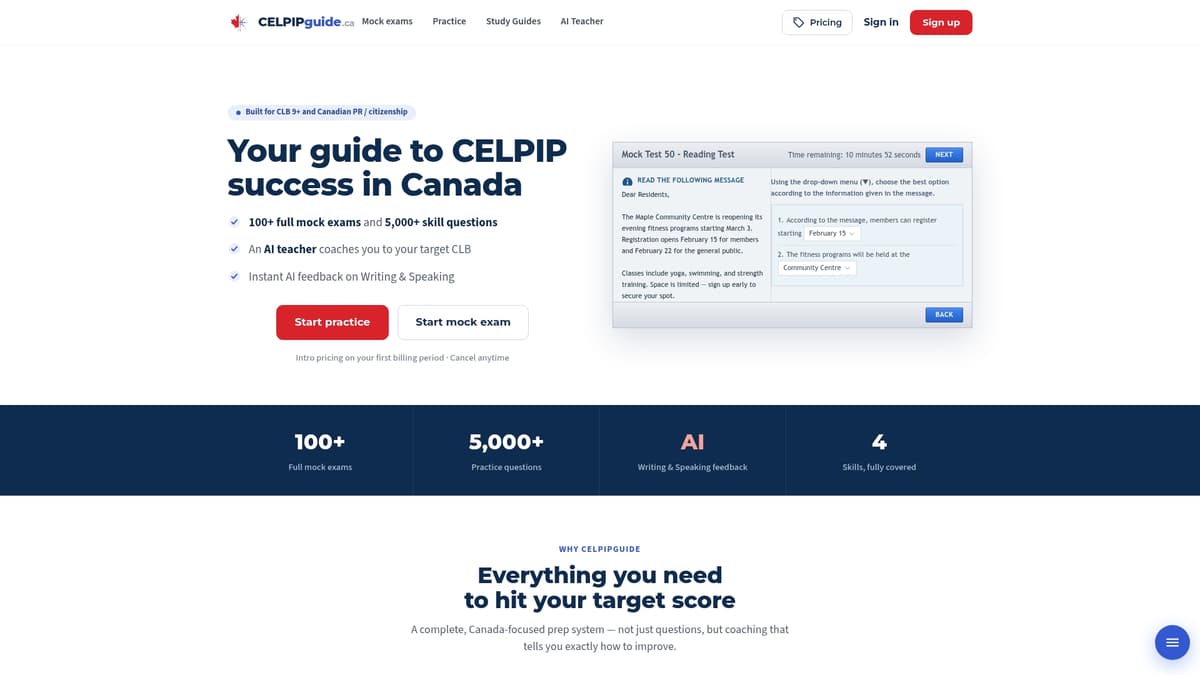
With a full subscription, you get access to a comprehensive bank of mock exams and practice questions, so every apology email prompt feels familiar before test day instead of on it.
Start with a timed Task 1 mock, run the 60-second checklist on your draft, and see your feedback mapped straight to the scoring criteria. Check out Celpipguide Plus and get going today.
FAQ
How long should a CELPIP Task 1 apology email be?
Task 1 response are expected to be a short email, typically written in about the time allotted for the writing section, so focus on hitting all four structural elements (apology, reason, remedy, close) rather than adding extra length. Trim the explanation first if you’re running long.
What tone should I use in a CELPIP apology email?
Match the tone to the relationship named in the prompt: formal for landlords or employers, semi-formal for coworkers or acquaintances, and informal for friends or family. Keep that tone consistent from the opening line to the sign-off.
What’s the biggest mistake candidates make in apology emails?
The most common issue is over-explaining the reason for the mistake while forgetting to offer a clear remedy or next step. A concrete offer, like a specific date or replacement, strengthens task fulfillment more than a longer excuse does.
Can I use the same template for every CELPIP Task 1 prompt?
The three-paragraph structure (apology, reason and remedy, closing) works across most Task 1 prompts, but you’ll need to adjust the tone and details to match each specific scenario. Practising with varied prompts, such as the ones in our mock exams, helps you adapt the structure quickly.
How can I check my apology email meets CELPIP’s scoring criteria?
Run through a short checklist covering task fulfillment, coherence, vocabulary range, and grammar before submitting, since these are the four criteria CELPIP raters use. Our self-edit routine maps directly to this process if you want a repeatable method.
Keep practising: resources to go further
For deeper strategy work, see our CELPIP writing strategies for advanced tactics, our 60-second self-edit routine for a repeatable checklist, and our study cycle guide for fitting Task 1 drills into a full prep plan.