
CELPIP Blog
Rater Aware CELPIP Writing Strategies to Hit CLB 9
Rater Aware CELPIP Writing Strategies to Hit CLB 9

The fastest way to raise your CELPIP writing score is to pair a task-specific template with strict plan→write→review timing, then check every draft against the four CELPIP performance standards. Skip the template and you’ll waste minutes hunting for structure. Skip the timing split and you’ll run out of time to review. Pick one template below, set a 27-minute timer, and write your first mock today.
TL;DR:
- Strictly allocate 3-5 minutes to plan each response, focusing on bullet points and tone, to prevent structural mistakes and run out of time.
- Use a four-part email template and the OREC structure for Task 2 to ensure complete task fulfillment and clear, confident argumentation.
- Prioritize reviewing responses for every bullet point, tone consistency, and grammatical accuracy in under three minutes to catch common score killers.
- Practice writing responses under real conditions with timed mocks and targeted drills to improve task fulfillment and manage exam pressure effectively.
- Focus on feedback grounded in the CELPIP scoring standards rather than volume of practice to reliably raise your CELPIP writing score.
Table of Contents
- Why celpip writing strategies work better than “just writing more”
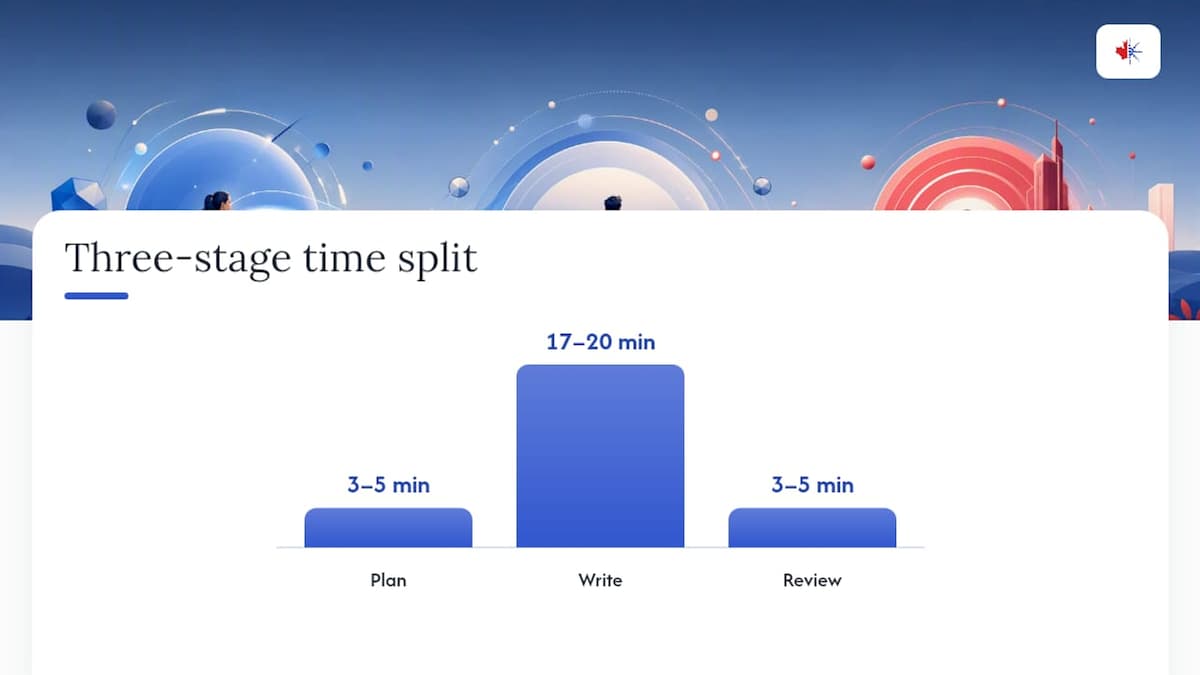
- Time management: the three-stage approach that keeps you on pace
- Task 1 email template: structure, tone, and a before/after example
- Task 2 survey response: the OREC structure and one high-impact sentence
- Grammar, vocabulary, and sentence variety tactics that raise your score
- How raters score your response and the mistakes that cost a CLB level
- Building a 4-week celpip writing practice plan that sticks
- What most candidates get wrong about CELPIP writing prep
- Get rater-aware feedback instead of guessing at your score
- Sources
- FAQ
Why celpip writing strategies work better than “just writing more”
Most candidates think they need to write more practice essays. What they actually need is a smaller number of essays written under real conditions and checked against the right criteria. That’s the core difference between generic exam prep and genuine celpip writing strategies: one produces volume, the other produces a score increase.
The CELPIP Writing test has two tasks, and both are computer-delivered, timed independently.
- Task 1 (Writing an Email): approximately 27 minutes, typically between 150 and 200 words, responding to a scenario with several required bullet points.
- Task 2 (Responding to Survey Questions): approximately 26 minutes, typically between 150 and 200 words, where you pick a side on a survey question and justify it.
Every response gets scored across four performance dimensions, and each one rewards a different skill:
- Content and coherence — did you address every part of the prompt, and does the answer flow logically from one idea to the next?
- Vocabulary — do you use precise, varied word choices instead of repeating the same three adjectives?
- Readability and task fulfilment — can a rater follow your point on a single read, and did you actually do what the task asked?
- Grammar — sentence construction, verb tense consistency, and control over complex structures.
Here’s what most guides underplay: task fulfilment is graded on whether you hit every bullet point in the prompt, not most of them. Missing a single bullet in Task 1 can pull you down a full CLB level even if your grammar is flawless. That single fact should change how you plan every response from here on.
Time management: the three-stage approach that keeps you on pace
The single most reliable timing structure trainers recommend is a three-stage split: plan, write, review. This isn’t a suggestion, it’s the structure CIC News highlights as one of the seven key strategies for the CELPIP writing test, and it works because each stage protects you from a different failure mode. Skipping the plan stage means you improvise structure mid-paragraph. Skipping the review stage means a careless typo or a missing bullet slips through uncaught.
A practical minute breakdown, drawn from timing guidance used in CELPIPguide’s task format walkthrough, looks like this for either task:
- Plan (3 to 5 minutes). Read every bullet point twice. Decide your tone (formal, semi-formal, or informal for Task 1; a clear opinion for Task 2). Jot two or three key words per bullet, not full sentences.
- Write (17 to 20 minutes). Draft continuously. Don’t stop to fix small grammar slips, mark them mentally and keep moving. Address bullets in the order given unless a different order genuinely reads better.
- Review (3 to 5 minutes). Confirm every bullet is addressed, tone is consistent start to finish, word count sits in range, and scan for subject-verb agreement, articles, and punctuation.
Pro Tip: Time your plan stage with a visible countdown, not a mental guess. Candidates who “eyeball” planning time routinely overrun it by two or three minutes, which is exactly the time you need for review.
The review checklist matters more than most candidates assume. A short, deliberate pass at the end catches the errors that actually cost levels: missing bullets and tone mismatches are two of the most common score killers, and both are catchable in under three minutes if you check for them specifically rather than just rereading for a general “feel.”
Task 1 email template: structure, tone, and a before/after example
A repeatable structure removes the guesswork under time pressure, and a four-part email template covering greeting, purpose, body, and closing helps you hit every bullet point without losing your place. The template:
- Greeting — matched to tone: “Dear Mr. Chen” (formal), “Hi Sarah” (semi-formal), “Hey Mike” (informal).
- Opening line — state your purpose immediately: “I’m writing to request a refund for the damaged order I received last week.”
- One paragraph per bullet point — each bullet gets its own paragraph with a specific detail or example, never a vague half-sentence bolted onto another idea.
- Closing — a clear ask or next step, plus a sign-off matched to the tone you opened with.
Tone consistency is where candidates lose the most points without realizing it. If your prompt calls for a formal complaint to a property manager, “Hey, so this is kind of annoying” in paragraph two undoes the “Dear Mr. Alavi” you opened with. Raters notice tone breaks fast because they read hundreds of these responses; an inconsistent register reads as a lack of control, not personality.
Here’s a before-and-after from a Task 1 scenario asking the writer to explain a scheduling conflict to a coworker:
Weak version: “I can’t come to the meeting because of stuff going on with my family and I hope that’s ok, let me know.”
This sentence has three problems raters will flag immediately: vague content (“stuff going on”), an informal tone shift mid-request, and no concrete detail satisfying the bullet point about explaining the reason.
Improved version: “Unfortunately, I won’t be able to attend Thursday’s meeting because I have a scheduled appointment with my daughter’s pediatrician that I’m unable to reschedule. I’d be happy to review the meeting notes afterward or join by phone for the last fifteen minutes if that would help.”
The improved version fixes content and coherence with a concrete reason, keeps a professional register throughout, and adds task fulfilment by offering a solution, which many prompts implicitly reward even when not explicitly asked for. Browsing a few Task 1 email samples before your first timed attempt will show you how this pattern holds across very different scenarios.
Task 2 survey response: the OREC structure and one high-impact sentence
Task 2 rewards a tight, opinionated structure more than creative phrasing, and the most reliable version of it is OREC: Opinion, Reason one with example, Reason two with example, Conclusion. State your position in the first sentence, don’t hedge, and don’t wait until paragraph two to commit.
- Opinion (1 sentence): “I believe the city should invest in public transportation rather than expanding highways.”
- Reason one plus example (1 paragraph): state the reason, then ground it in a specific, plausible detail rather than a generality.
- Reason two plus example (1 paragraph): same pattern, a different angle.
- Conclusion (1 to 2 sentences): restate your position with slightly different wording, don’t just copy sentence one.
Raters reward a clear, confident position; hedging language actually reduces your perceived task fulfilment because it reads as an inability to commit rather than nuance. “I think maybe both sides have some good points” is the opening line that costs candidates a level before they’ve written a single reason.
One technique separates a CLB 8 response from a CLB 9+ response: a single, brief counterargument sentence. Acknowledge the other side in one sentence, then explain in the same sentence or the next why your position still holds. Something like: “Some may argue that highway expansion reduces commute times in the short term, but that relief typically disappears within a few years as more drivers fill the added lanes.” This single sentence demonstrates the kind of balanced thinking raters associate with higher-level writing, but keep it to one sentence. Spend a full paragraph on the counterargument and you’ll dilute your own reasons instead of strengthening them.
Pro Tip: Write your counterargument sentence right after your second reason, before the conclusion. It reads as a natural pivot rather than an afterthought bolted onto the end.
Here’s how each part maps to scoring: the opinion sentence drives task fulfilment, the two examples drive content and coherence (raters need concrete detail, not restated generalities), the counterargument drives readability by showing genuine reasoning rather than a one-sided rant, and consistent tense and article use across all four parts drives your grammar score. Reviewing a few annotated Task 2 survey samples against this breakdown makes the pattern click faster than reading the rule in the abstract.
Grammar, vocabulary, and sentence variety tactics that raise your score
Sentence variety signals control, and it’s one of the most measurable ways to move from CLB 7 writing to CLB 9 writing without changing your ideas at all. Varying sentence length and structure rather than repeating the same subject-verb-object pattern signals a stronger level of grammatical control to raters, who read hundreds of nearly identical simple sentences in a sitting.
Practical ways to build variety into a timed response:
- Combine two short sentences with a subordinator. “The bus was late. I missed my connection.” becomes “Because the bus was late, I missed my connection.”
- Open one sentence per paragraph with a dependent clause. “Although the price increased, demand stayed steady.”
- Use one relative clause per response. “The manager, who joined the team last year, approved the request.”
Collocations beat rare vocabulary almost every time. Writing “make a decision” instead of forcing in “formulate a determination” reads as natural fluency, while an awkward, overly formal word choice actually signals lower control, not higher. Raters aren’t scoring you on how many advanced words you know, they’re scoring whether your word choices sound like something a fluent writer would naturally produce.
Three transition sets worth memorizing cold:
- Adding a point: “In addition,” “What’s more,” “Beyond that,”
- Contrasting: “That said,” “Even so,” “On the other hand,”
- Concluding: “Ultimately,” “For these reasons,” “Taking everything into account,”
One small but real trap: candidates writing for a Canadian audience sometimes default to American spelling from textbooks or online tools. Write “colour,” “organize” or “organise” consistently, “cheque” for banking, and “practise” as the verb versus “practice” as the noun. It’s a minor grammar signal, but consistency matters more than which standard you pick.
How raters score your response and the mistakes that cost a CLB level
Each performance dimension gets judged independently, which means a strong vocabulary score can’t rescue a response that skipped a bullet point. Raters work through a checklist mentally even when scoring holistically, and three mistakes come up constantly enough to be worth memorizing.
- Missing a bullet point. Test takers frequently lose a full CLB level by omitting one required bullet, treating a prompt component as optional when it isn’t. Fix: give every bullet its own paragraph or clearly marked sentence, with a specific example attached.
- Tone mismatch. Starting formal and drifting casual (or the reverse) reads as inconsistent control rather than a stylistic choice. Fix: pick your tone in the plan stage and reread your closing line specifically to check it still matches your greeting.
- Weak task fulfilment through vague generalities. “Things have been difficult lately” tells a rater nothing. Fix: replace every general statement with one concrete, specific detail before you move to the next sentence.
A short end-of-task checklist covers most of this in under three minutes: every bullet addressed, tone consistent top to bottom, word count in range, verb tense consistent, and no sentence longer than roughly 25 words that’s lost its own subject halfway through.
Building a 4-week celpip writing practice plan that sticks
Structure beats volume. A month of scattered, unfocused writing produces far less improvement than four focused weeks built around timed mocks, targeted drills, and a real feedback loop, because pairing timed practice with feedback keyed to the four scoring dimensions is what actually accelerates measurable score gains.
- Week 1: Diagnose and drill. Write one full timed mock of each task under real conditions. Identify which of the four dimensions is weakest, and spend the rest of the week on short daily drills targeting only that dimension.
- Week 2: Template mastery. Write three Task 1 emails and three Task 2 responses using the templates above, focusing purely on hitting every bullet and maintaining tone. Time each one.
- Week 3: Grammar and vocabulary sharpening. Rewrite two of your Week 2 responses, focusing only on sentence variety and collocation upgrades, then compare both versions side by side.
- Week 4: Full simulation. Run two more full mocks under exam conditions, back to back if possible, then review both against the performance standards checklist.
Keep a practice log through all four weeks: date, task type, time taken per stage, and the specific feedback or error pattern that repeated. Recurring errors, not one-off slips, tell you exactly where to focus next.
Because the exam is entirely computer-delivered, comfortable typing speed matters as much as grammar knowledge. Practise composing directly on a keyboard rather than drafting by hand first; the difference in fluency under time pressure is noticeable within a week. Rotate between full mocks on the practice hub and shorter timed drills so you’re never only doing one or the other.
What most candidates get wrong about CELPIP writing prep
Most candidates over-index on grammar drills and under-index on task fulfilment, and that’s backwards given how the scoring actually works. You can write a grammatically clean response that still lands two levels lower than it should because it skipped a bullet point or hedged on an opinion. The candidates who jump from CLB 7 to CLB 9 aren’t the ones who memorized the most vocabulary lists, they’re the ones who treated every practice response as a rehearsal for exactly how the raters score, not how a general English teacher would grade an essay.
The other pattern worth naming: candidates practise writing far more than they practise reviewing. Review is a trainable skill with its own three-minute rhythm, and most people skip it entirely because they’re relieved to finish writing at all. Timed practice paired with structured, criteria-specific feedback closes that gap faster than unlimited untimed writing ever will, because it forces the discipline that the actual exam demands. That’s the real argument for tools that score against the same performance standards raters use rather than generic essay feedback.
— Reza
Get rater-aware feedback instead of guessing at your score
Templates and timing plans get you most of the way, but you still need to know exactly where your response is losing points, and that’s the gap Celpipguide’s AI teacher closes. Instead of guessing whether your Task 2 counterargument sentence helped or your tone held steady through Task 1, you get instant feedback scored against the same performance standards raters use, tied to a personalized study plan that focuses your next session on whatever dimension is actually weak.
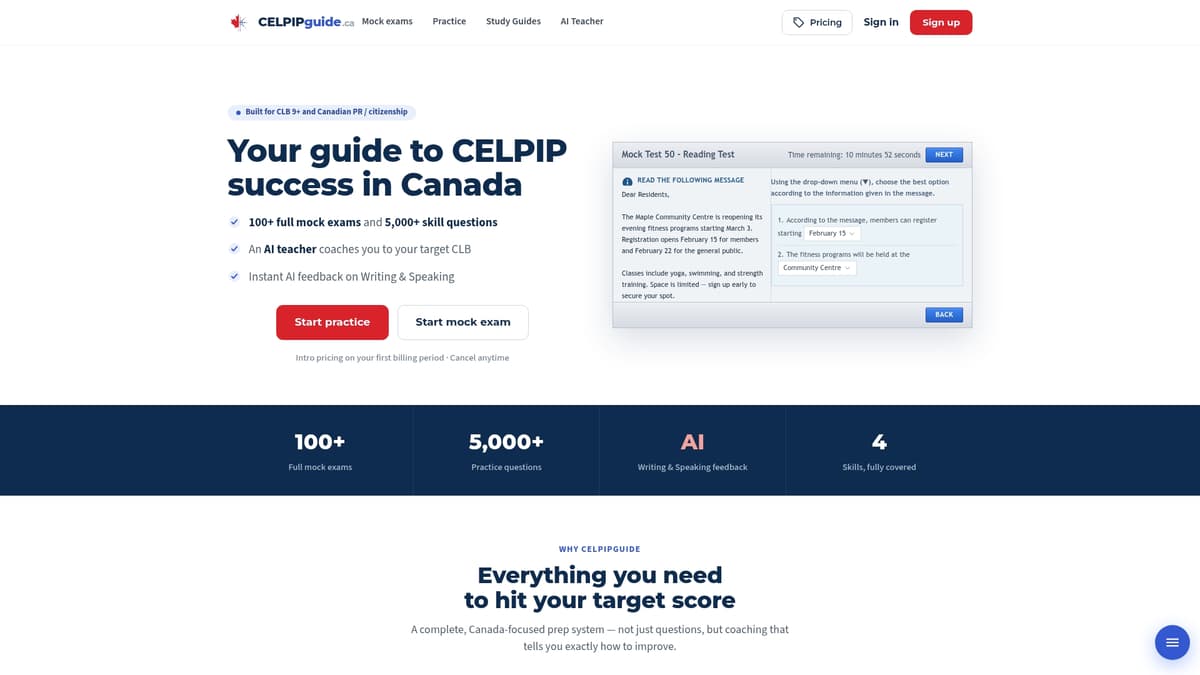
That combination of full mock exams, numerous practice questions, and AI-driven feedback on writing and speaking mirrors exactly the plan→write→review discipline covered above, except the review stage gets a second, more objective set of eyes. The Plus plan unlocks full access for $29.99, and readers of this guide can apply code BLG30 for 30% off on top of that price. Start with a diagnostic on the practice hub to see exactly which dimension needs the next two weeks of your attention.
FAQ
Is 7 a good score in CELPIP?
A CLB 7 is a solid, competitive score that satisfies many immigration and citizenship thresholds, though it sits below the CLB 9 many express entry candidates target for maximum points. Whether it’s “good enough” depends entirely on which program or application you’re using it for.
Is it hard to get a 9 in CELPIP writing?
It’s genuinely difficult but very achievable with the right approach, since CLB 9 demands consistent task fulfilment, sentence variety, and near-flawless grammar across both tasks, not just one strong response. The candidates who reach it typically build task templates and time management into every practice session rather than treating writing as free-form composition.
What are effective speaking strategies for the CELPIP exam?
The same plan→respond→review discipline used in writing carries over to speaking: outline your point quickly, speak in complete, varied sentences, and stay on topic for the full response time rather than trailing off early. Reviewing structured examples in a dedicated speaking guide helps you see how the timing and structure differ from writing tasks.
How do I score 10 in CELPIP writing?
High CLB levels require essentially flawless grammar control, sophisticated vocabulary used naturally, and airtight task fulfilment with no missed bullet points across both tasks. It’s a narrow band achieved through disciplined, criteria-specific feedback rather than volume, which is why timed mocks scored against the actual performance standards matter more at this level than at any other.
What’s the best celpip writing strategy for beginners?
Start with the four-part email template for Task 1 and the OREC structure for Task 2, since both remove the guesswork of building an answer from scratch under time pressure. Pair that structure with one full timed mock per week and a short review checklist, and you’ll see measurable improvement faster than unfocused practice.