
CELPIP Blog
Avoid a CLB Drop: CELPIP Writing Feedback and Annotated Samples
Avoid a CLB Drop: CELPIP Writing Feedback and Annotated Samples

Targeted, rubric-aligned CELPIP writing feedback zeroes in on four things: task fulfilment, coherence, vocabulary, and readability. The fastest way to raise your score is to run timed mocks, then get annotated feedback that maps directly to those four categories, whether from a tutor or an instant tool like CELPIPguide’s AI writing checker. Skip generic corrections. Chase the ones tied to how raters actually score.
TL;DR:
- Missing even one bullet point or task requirement can lower your score by a full CLB level, regardless of your grammar or vocabulary strength.
- Focusing practice on task fulfillment, including explicit coverage of all prompts, yields bigger score improvements than polishing sentences or vocabulary.
- Using timed mocks combined with rubric-aligned AI feedback helps identify and fix weak categories like coherence or task coverage more efficiently.
- Underperformers often neglect planning and sketching bullet points beforehand, leading to incomplete or unfocused responses under time pressure.
- An effective four-week practice plan involves diagnosing your weak category, drilling it intensively, then progressively testing with timed mocks and detailed feedback.
Table of Contents
- What official CELPIP writing feedback actually measures
- Annotated CELPIP writing samples: what raters actually flag
- How to time each CELPIP writing task without panicking
- The mistakes that cost a full CLB level
- Getting feedback that actually moves your score
- A 4-week practice plan that actually uses your feedback
- What most CELPIP writing feedback gets wrong
- Try CELPIPguide: AI writing feedback that catches what you’d miss
- Sources
- FAQ
What official CELPIP writing feedback actually measures
Two independent raters score every writing task, and their category scores combine into your final task score. That’s according to Paragon Testing Enterprises, the organization behind the official CELPIP performance standards. Understanding those four categories changes how you practise, because you stop polishing sentences that don’t move your score and start fixing the ones that do.
- Coherence and meaning: Does your writing flow logically, with ideas connected by clear transitions? A strong response links ideas with words like “as a result” or “in contrast.” A weak one just stacks sentences without showing how they relate.
- Vocabulary: Raters look for range and precision, not just “big words.” Using “address the issue” instead of repeating “talk about the problem” three times shows range. Misusing a word you clearly grabbed from a thesaurus hurts you more than a simple, correct word would.
- Readability: This covers sentence control and grammar clarity. Short, choppy sentences read as underdeveloped. Long, tangled ones bury your point. The sweet spot is varied sentence length with clean grammar throughout.
- Task fulfilment: Did you address every bullet point (Task 1) or take a clear position with support (Task 2)? This is the category most likely to sink your score even when your English is genuinely strong.
Here’s the part most test-takers miss: these categories don’t average out kindly. Missing task fulfilment badly, say by skipping a bullet point, can drop your overall band by a full CLB level even if your grammar and vocabulary are excellent elsewhere. Raters aren’t grading in isolation; they’re checking whether you actually did what the prompt asked.
Annotated CELPIP writing samples: what raters actually flag
Reading about the rubric only gets you so far. Seeing it applied to real text is where the feedback clicks.
Task 1 (email) excerpt, responding to a prompt about a cancelled community event:
“I am writing to express my concern about the cancellation of the neighbourhood cleanup event. I understand that scheduling conflicts arose, but I believe rescheduling to next month would allow more residents to participate. Could you please confirm an updated date by Friday?”
A rater would note: tone matches a semi-formal community request, three implied bullet points (concern, alternative solution, follow-up request) are all addressed, and the closing question gives the reader a clear action. Compare that to a weaker opening like “I am writing about the event you cancelled,” which states a fact but skips the required tone of polite concern. That single tone slip is the kind of thing CELPIP writing task 1 samples are built to catch before test day.
Task 2 (survey) excerpt, arguing for remote work options:
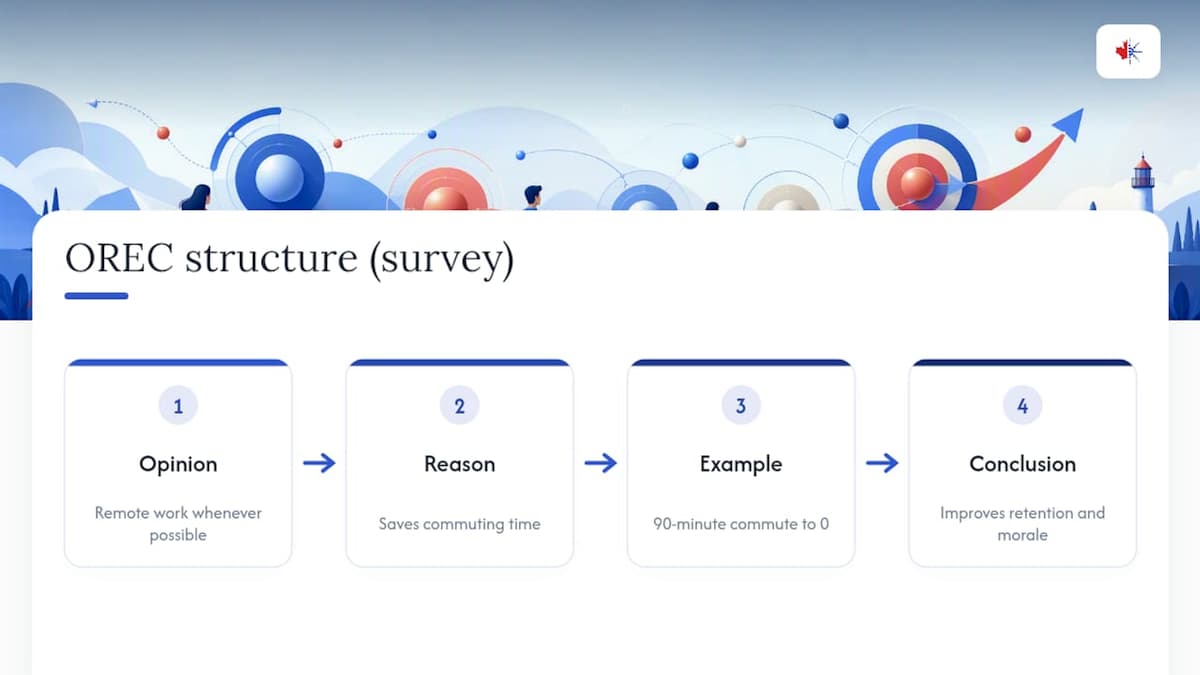
“I believe companies should offer remote work whenever possible. First, employees save significant commuting time, which they can redirect toward family or rest. For example, a friend of mine reduced her daily commute from ninety minutes to zero and used that time to finish a part-time degree. This flexibility ultimately improves retention and morale.”
This follows the OREC structure (opinion, reason, example, conclusion), a pattern that lines up closely with how survey responses get scored. The concrete example, the friend’s ninety-minute commute, is exactly the kind of textual evidence a rater cites when justifying a strong task fulfilment score. A vague version (“remote work is good for people”) gives the rater nothing to point to.
Pro Tip: Read your own draft and physically underline the sentence that answers each bullet point or supports your opinion. If you can’t underline one, a rater can’t find it either.
How to time each CELPIP writing task without panicking
The email task runs about 27 minutes and the survey task about 26 minutes, with both aiming for 150 to 200 words, based on coaching guidance from EEC. That’s tight, but it’s enough time if you split it deliberately instead of writing until the clock runs out.
- Plan (3 to 5 minutes): List the bullet points or sketch your OREC outline. For Task 1, jot one phrase per bullet so you can’t forget one mid-draft. For Task 2, write your opinion and two reasons before typing a single full sentence.
- Write (17 to 20 minutes): Draft without stopping to perfect wording. Momentum matters more than polish here.
- Review (3 to 5 minutes): Check tone consistency, confirm every bullet point is covered, scan for spelling slips, and verify your linking words actually connect ideas rather than just sitting there.
Pro Tip: Set a phone timer for the planning phase specifically. Most candidates who run out of time didn’t write too slowly. They skipped planning and wrote themselves into a corner.
The mistakes that cost a full CLB level
Some errors are cosmetic. Others are expensive. These are the ones that show up again and again in feedback from actual raters and coaches alike.
- Incomplete bullet coverage in Task 1 is the single most common score killer. The fix is boring but effective: number the bullets in your plan and cross each one off as you write it.
- Tone mismatch shows up in greetings, openings, and sign-offs that don’t match the relationship implied by the prompt. Writing “Hey there!” to a landlord reads as careless, not friendly.
- Weak argument structure in Task 2 usually means vague claims with no concrete backing. Swap “it’s better for everyone” for a specific reason plus a short example, the way the OREC structure demands.
- Grammar and spelling slips matter less than the other three, but they’re the fastest to fix in your review phase, so don’t skip that final pass just because time feels tight.
Missing a single required bullet point often costs more than several minor grammar errors combined, which is why coverage should always come before polish when you’re reviewing a draft.
Getting feedback that actually moves your score
Not all feedback is equally useful, and knowing which type to use when saves you real practice time.
- Human tutor marking gives you context. A tutor can explain why your tone felt off in a way a rubric score alone can’t, which makes it valuable when you’re stuck on the same mistake repeatedly.
- Peer review costs nothing and works well if you structure it: ask your peer to identify one bullet point coverage issue, one tone issue, and one vocabulary upgrade, rather than a general “does this look okay?”
- AI feedback delivers instant, rubric-aligned scoring, which makes it ideal for high-volume practice where you need quick turnaround rather than deep discussion. Tools like the CELPIP writing checker can flag task fulfilment gaps immediately after you write, before the habit sets in.
When raters’ initial scores disagree significantly, a benchmark rater re-evaluates the response to keep scoring consistent. That reliability check is exactly why rubric-aligned feedback, rather than a friend’s general impression, should anchor your practice. The most effective loop is simple: diagnose your weak category, drill it specifically, sit a timed mock, then read annotated feedback against the real rubric. Repeat.
A 4-week practice plan that actually uses your feedback
Random practice wastes your remaining prep time. A focused, feedback-driven plan doesn’t.
- Week 1: Diagnose. Write one Task 1 and one Task 2 response cold, get them scored against the performance standards, and identify your weakest category.
- Week 2: Drill that category specifically, using the CELPIP writing guide for templates and structure practice.
- Week 3: Alternate timed full mocks with annotated review sessions, checking whether your weak category has actually improved.
- Week 4: Run back-to-back timed mocks under real exam conditions and track whether previous errors reappear.
| Week | Focus | Output to review |
|---|---|---|
| 1 | Diagnostic baseline | Rubric score by category |
| 2 | Weak-category drills | Before/after paragraph comparison |
| 3 | Timed mocks + annotation | Error frequency log |
| 4 | Full exam simulation | Final rubric-aligned score |
What most CELPIP writing feedback gets wrong
Most students I’ve watched struggle don’t have a grammar problem. They have a coverage problem they don’t notice because their sentences sound fine in isolation. The habit that fixes it fastest is embarrassingly simple: before writing a single full sentence, write the bullet points or your opinion and two reasons as a bare list. Do this every single practice session, not just when you remember to. It takes twenty seconds and it’s the difference between a response that sounds good and one that actually fulfils the task.
— Reza
Try CELPIPguide: AI writing feedback that catches what you’d miss
Reading about rubrics helps, but nothing beats writing a response and getting it scored against those same four categories within seconds. CELPIPguide’s AI writing checker flags task fulfilment gaps, tone mismatches, and vocabulary range issues the moment you submit a draft, so you’re not waiting days to find out you skipped a bullet point.
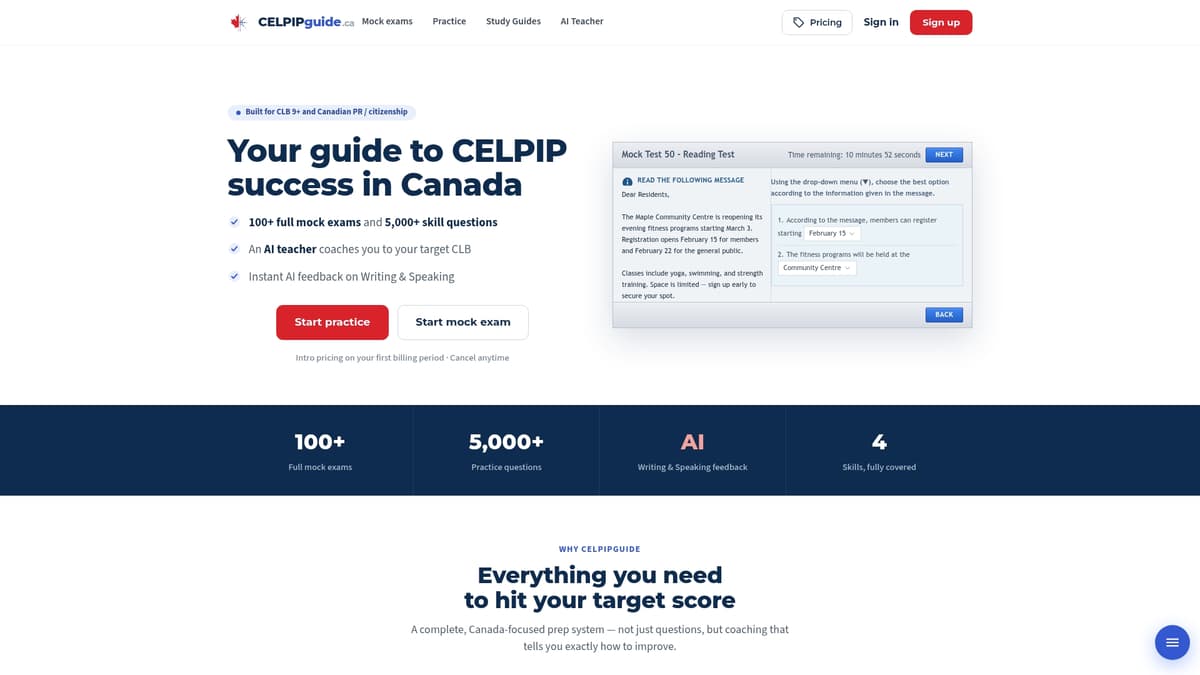
Beyond instant feedback, CELPIPguide gives you full-length mock exams built to mirror real test timing, a diagnostic readiness check that tells you exactly where to start, and a study plan generator that turns your weak categories into a week-by-week schedule. If you’re studying alongside other language or civic prep resources, Francopass covers adjacent ground for broader Canadian language requirements.
Start with a free writing check or diagnostic test today, see exactly which rubric category is holding your score back, and build your next practice session around fixing it.
Sources
- Performance Standards for the CELPIP-General Writing Test
- CELPIP Writing Tips 2026 | Email & Survey | EEC
FAQ
How can I improve my CELPIP writing score?
Focus practice on task fulfilment first, since missing a bullet point costs more than minor grammar errors, then drill coherence, vocabulary range, and readability using timed mocks with rubric-aligned feedback.
How is CELPIP writing evaluated?
Two raters score each response against four categories, coherence and meaning, vocabulary, readability, and task fulfilment, and those category scores combine into your final task score under the official performance standards.
How do I get a 10 in CELPIP writing?
A top-level response fully addresses every bullet point or argument requirement, uses precise and varied vocabulary, maintains clear sentence control, and organizes ideas with strong logical connectors throughout.
Is 7 a good CELPIP writing score?
CLB 7 is a solid, functional score that meets many immigration and citizenship thresholds, but higher-demand programs often require CLB 9 or above, so check your specific requirement before treating 7 as your target.