
CELPIP Blog
Instant feedback for CELPIP writing: your score boost guide
Instant feedback for CELPIP writing: your score boost guide

How instant feedback drives real writing improvement for CELPIP
Instant feedback in writing means receiving corrections, scores, and specific suggestions within seconds of submitting a task, rather than waiting days for a teacher’s comments. For CELPIP preparation, that speed changes everything.

Research confirms the advantage is measurable. A meta-analysis of computer-mediated feedback found an effect size of g = 0.875 for immediate feedback on L2 writing proficiency, rising to g = 1.057 for academic writing tasks specifically. A separate study showed AI-generated feedback produced a statistically significant improvement in content organisation (β = 0.311, p < 0.001), mediated by learners’ positive attitudes toward the system, and that immediate or combined AI feedback significantly outperforms delayed feedback in writing proficiency gains.
Here is what that means practically for you as a CELPIP test-taker:
- Error correction happens while the task is fresh. You remember exactly why you wrote a sentence a certain way, so the correction sticks.
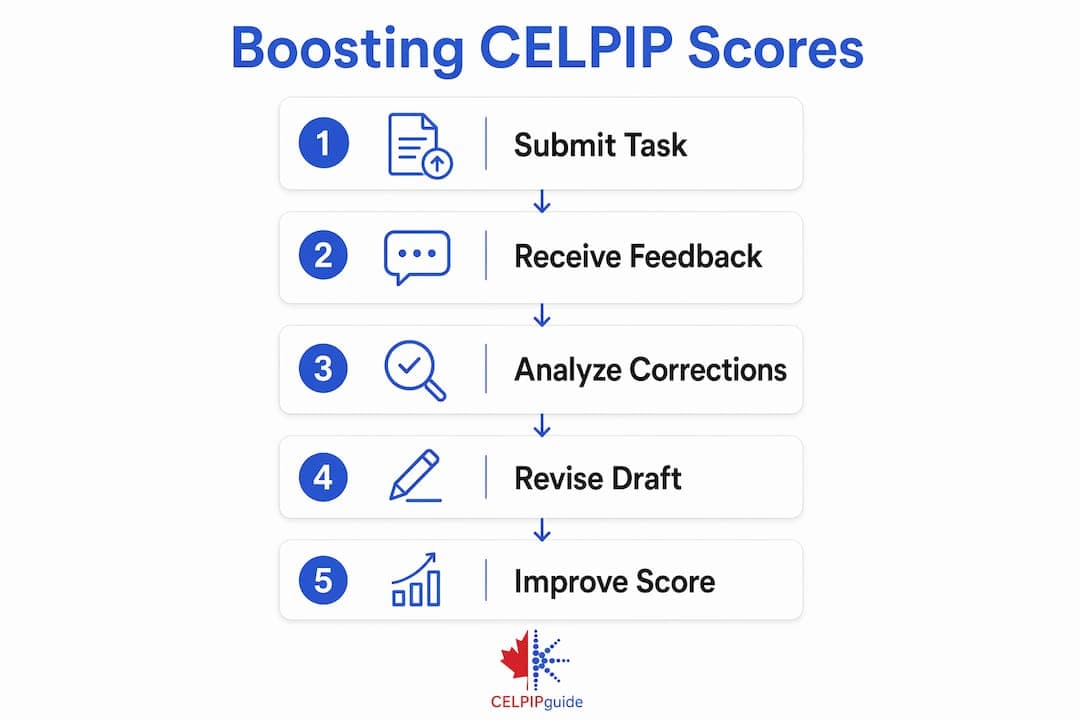
- Revision cycles shorten. Instead of one slow weekly review, you can practise, receive feedback, and revise three or four times in a single study session.
- Motivation stays high. Seeing measurable progress after each attempt keeps you engaged rather than guessing whether you are improving.
- Fluency builds faster. Repeated short cycles of write-feedback-revise train your brain to produce accurate sentences more automatically over time.
Celpipguide’s AI teacher delivers this kind of instant writing feedback directly on your CELPIP tasks, scoring your responses against CLB benchmarks and pinpointing exactly where your writing falls short.
Table of Contents
- Getting the most out of AI feedback: pedagogy, limits, and smart strategies
- Celpipguide puts instant feedback where it matters most
- FAQ
- Key takeaways
Getting the most out of AI feedback: pedagogy, limits, and smart strategies
Instant feedback does more than fix grammar. Research shows it supports working memory management, reduces cognitive overload, and builds metacognitive awareness, meaning you start noticing your own patterns rather than just accepting corrections passively. That shift from task completion to self-monitoring is what separates test-takers who plateau from those who keep climbing toward CLB 9.
“Effective feedback fosters learner autonomy by shifting focus from task completion to self-monitoring writing strategies during test scenarios. Feedback is a cognitive learning mechanism aiding progression from task execution to self-regulation.” — Expert pedagogical research on feedback and self-regulation
A randomised control trial found AI-generated feedback produced statistically significant improvements in content organisation (β = 0.311, p < 0.001), mediated by learners’ positive attitudes toward the system. Put simply: if you trust the feedback and engage with it actively, it works.
That said, AI feedback has real limits. Studies show that hybrid feedback models combining AI instant feedback with human teacher input consistently outperform AI-only approaches for deeper writing skills like argument structure and critical thinking. AI excels at surface-level corrections; a teacher or tutor catches the subtler issues. If you can access writing workshops or instructor-led sessions alongside your AI practice, do it.
Three strategies to avoid feedback overload:
- Prioritise one skill per session. Focus on vocabulary one day, sentence structure the next. Trying to fix everything at once leads to shallow revisions.
- Build feedback literacy. Read each comment carefully and ask yourself why the AI flagged it, not just what it flagged. Feedback quality depends largely on your ability to understand and act on it.
- Track patterns across sessions. If the same error appears in three consecutive tasks, that is your priority. Celpipguide’s personalised study plan surfaces these patterns automatically, so you are not hunting through old feedback manually.
Pro Tip: Use Celpipguide’s CELPIP writing guide alongside your AI feedback sessions. The templates show you what a high-scoring response looks like, giving you a concrete target to revise toward.
Celpipguide puts instant feedback where it matters most
Waiting weeks for a teacher’s comments is not a strategy when your immigration timeline is fixed. Celpipguide gives you over 100 full mock exams with AI-scored writing and speaking tasks, so every practice session ends with specific, CLB-aligned feedback rather than a vague sense of how you did.
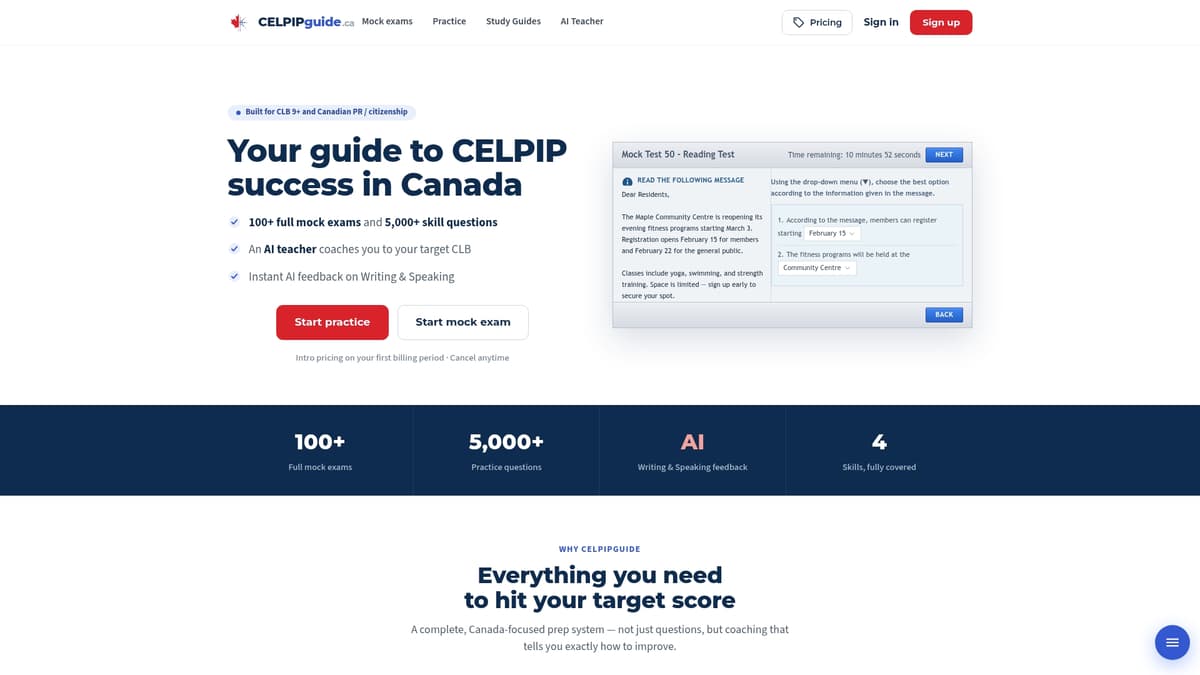
The AI teacher builds a personalised study plan around your diagnostic results, flags your recurring weaknesses, and adjusts your practice load as you improve. That is the difference between practising hard and practising smart. Start with a personalised CELPIP study plan today and see exactly where your writing stands.
FAQ
What does instant feedback mean in writing practice?
Instant feedback means receiving corrections, scores, and suggestions within seconds of completing a writing task. For CELPIP learners, this allows immediate error correction while the task context is still fresh.
Why does AI feedback improve writing scores?
AI feedback accelerates revision cycles and builds metacognitive awareness. Research shows immediate feedback produces an effect size of g = 0.875 on L2 writing proficiency, and for academic writing tasks the effect size rises to g = 1.057.
Is AI feedback enough on its own for CELPIP writing?
AI feedback handles grammar, vocabulary, and organisation well, but combining AI with teacher input produces stronger gains for complex skills. Use Celpipguide’s AI feedback as your daily foundation, then supplement with instructor review when possible.
How do I avoid becoming too dependent on AI corrections?
Focus on understanding why each correction was made, not just accepting it. Practise predicting your own errors before submitting, then compare your self-assessment to the AI’s feedback to build genuine self-regulation skills.
Key takeaways
Instant feedback accelerates CELPIP writing improvement by shortening revision cycles, reducing cognitive overload, and building the self-monitoring skills that drive long-term score gains.
| Point | Details |
|---|---|
| Immediate feedback effect | Meta-analysis found effect size g = 0.875 for immediate feedback on L2 writing proficiency, rising to g = 1.057 for academic writing tasks. |
| Organisation gains | A randomised trial found AI feedback improved content organisation at β = 0.311, p < 0.001. |
| Hybrid model advantage | AI plus teacher feedback consistently outperforms AI-only approaches for complex writing skills. |
| Feedback literacy matters | Thoughtful engagement with feedback, rather than mere acceptance of corrections, drives real improvement. |
| Celpipguide’s approach | Over 100 mock exams with CLB-aligned AI feedback and personalised study plans target your specific weaknesses. |