
CELPIP Blog
60 Second Rubric Mapped Self Edit to Raise Your CELPIP Writing Score
60 Second Rubric Mapped Self Edit to Raise Your CELPIP Writing Score

The fastest way to raise your CELPIP writing score is a focused 60-second edit done right before time runs out, mapped to the four score dimensions: Content/Coherence, Vocabulary, Readability, and Task Fulfilment. We’ve broken that edit into a routine you can memorize and run on autopilot, so the last minute of every task works for you instead of disappearing into a panicked re-read. Here’s exactly how to do it.
TL;DR:
- Focusing your 60-second edit on task fulfillment, content clarity, grammar, and vocabulary under time pressure maximizes scoring potential.
- Prioritizing fixes on incomplete responses and grammar issues like subject-verb agreement yields higher improvements than polishing style first.
- Practicing timed edits with instant feedback helps develop consistent habits, reduces editing time, and enhances overall score progression.
- Tracking repetition errors, edit speed, and rubric ratings weekly reveals whether your routine effectively improves your writing performance.
- Short, rubric-targeted edits outperform full rewrites under exam conditions, ensuring key scoring factors remain intact and errors are minimized.
Table of Contents
- The 60-second editing routine to use at the end of every writing task
- A rubric-aligned checklist for content, vocabulary, readability, and task fulfilment
- Common errors raters notice and how to fix them fast
- Time allocation and a recovery ladder for when you fall behind
- Practice drills and how feedback reinforces your editing routine
- How to track measurable improvement so you know the self-edit is working
- Why short, rubric-focused edits beat broad rewrites
- Practise this exact routine with CELPIPguide Plus
- FAQ
- Sources
The 60-second editing routine to use at the end of every writing task
Most test takers spend their last minute rereading from the top, which catches almost nothing new. We’ve found a sweep built around the score rubric catches far more, because it targets exactly what raters score instead of what feels unfinished.
Run it in this order every time:
- Confirm task fulfilment first: did you answer every part of the prompt, and does your tone match the task (formal letter versus survey response)?
- Check your word count against the target range; a response that’s too short signals underdeveloped content before a rater reads a word.
- Scan your introduction and conclusion for a clear main idea; a reader should know your point from the first two sentences alone.
- Search for two grammar errors specifically: subject-verb agreement and sentence boundaries (fragments or run-ons).
- Swap one vague word for a precise one, such as replacing “good” with “cost-effective” or “convenient.”
The order matters because task fulfilment and content carry more weight than a single fixed verb tense, so you fix the expensive problems first. A rater who sees a complete, on-topic response with one grammar slip scores higher than a grammatically clean response that dodges half the prompt.
Here are two quick examples. A sentence like “I am writing to you because I want to complain about the service, which was very bad and I was not happy” becomes “I am writing to express my dissatisfaction with the service I received.” That single edit tightens vocabulary and readability at once. In a short paragraph, changing “The product broke. I called support. They were not helpful. I want a refund.” into “After the product broke, I called support, but the representative was unhelpful, so I’m requesting a refund” fixes four fragments into one coherent sentence.
Pro Tip: Practise this exact sequence on past responses until it takes under a minute without a timer, so it survives real exam pressure.
A rubric-aligned checklist for content, vocabulary, readability, and task fulfilment
Self-editing works best when you check one dimension at a time rather than reading for a vague sense of “good.” The CELPIP score rubric breaks writing into four parts, and each one responds to a different kind of edit.
For Content and Coherence, check that:
- Every paragraph contains one clear idea supported by a specific detail or example.
- Your ideas connect logically, with each paragraph building on the last rather than restating it.
- You’ve cut any sentence that repeats a point you already made.
For Vocabulary, check that:
- Word choices are precise rather than generic, so “significant delay” replaces “big problem.”
- Collocations sound natural, since “make a decision” works but “do a decision” does not.
- No single word or phrase repeats more than twice in a short response.
For Readability, check that:
- Long sentences with three or more clauses get split into two shorter ones.
- Punctuation matches sentence type, with periods closing complete thoughts and commas separating list items or clauses, not joining two full sentences.
- Connectors like “however,” “therefore,” and “in addition” appear where they clarify a relationship, not as filler.
For Task Fulfilment, check that:
- Every bullet point or instruction in the prompt has a matching sentence in your response.
- Your tone fits the task type, whether that’s a formal complaint letter or an informal note to a friend.
- Your conclusion ties back to the original request instead of introducing a new idea.
Deciding whether an idea needs expansion or deletion comes down to one question: does it answer part of the prompt directly? If yes, add one specific detail to strengthen it. If no, cut it, because an unrelated idea dilutes coherence even when it’s well written.
Common errors raters notice and how to fix them fast
The CIC News breakdown of common CELPIP writing errors points to a short list of mistakes that show up again and again, and all of them are fixable in seconds once you know the pattern.
- Sentence fragments: “Because the flight was delayed.” has no complete thought. Repair by attaching it to the next sentence: “Because the flight was delayed, I missed my connection.”
- Run-on sentences: “I called the office they did not answer” needs a period or conjunction: “I called the office, but they did not answer.”
- Comma splices: “The package arrived late, I was not happy” should become “The package arrived late, so I was not happy” or split into two sentences.
- Punctuation errors: Overusing exclamation marks in a formal letter reads as unprofessional; one closing period per complete sentence keeps the tone steady.
- Capitalization slips: Proper nouns and the start of every sentence need capital letters, even under time pressure, since raters notice these as quickly as spelling.
A good rule of thumb: if a sentence needs more than one comma to hold its ideas together, it’s often safer to split it into two shorter sentences than to patch it with another comma. Complex corrections invite new errors when you’re rushing, while a clean split rarely does.
Three repair templates are worth memorizing: replace a vague word with a specific one, split a long sentence at its natural break point, and tighten by deleting words that add no new information. The same discipline that cleans up a CELPIP response for punctuation and capitalization also shows up in professional writing for job applications, where the same comma and capitalization mistakes cost interviews instead of points.
Time allocation and a recovery ladder for when you fall behind
Planning your minutes before you write prevents the scramble that leads to skipped self-edits entirely.
- For Task 1, spend roughly 2 minutes planning, 20 minutes writing, and the final 3 minutes running your 60-second edit twice.
- For Task 2, use a similar split: 2 minutes planning, 20 minutes writing, and the remaining time for your edit pass.
- If you’re behind at the halfway mark, cut your planned third example and move straight to your conclusion; an on-topic, complete response beats a longer one that trails off mid-thought.
- If you’re behind with less than five minutes left, triage in this order: confirm every part of the prompt is addressed, secure a logical connection between paragraphs, fix your three most obvious grammar errors, and shorten any example that’s running long.
- Sacrifice extra detail before you sacrifice tone or completeness. A short, complete, appropriately toned response consistently scores better than a detailed one that cuts off before the conclusion.
Reserving edit time matters as much in a timed writing test as it does in any deadline-driven task: the planning habits that protect focused review time under pressure carry over directly to how you manage the CELPIP clock.
Practice drills and how feedback reinforces your editing routine
Running the 60-second routine in practice builds the muscle memory you need for the real test, but only if your drills are timed and your feedback is specific.
-
Run a 10-minute drill focused only on spotting fragments and run-ons in five old responses.
-
Run a 15-minute drill where you rewrite three sentences to swap vague vocabulary for precise alternatives.
-
Run a 20-minute drill where you write a full response, then apply the 60-second edit under a visible timer.
-
Self-mark each drill against a sample response annotated by dimension, checking where your content, vocabulary, readability, and task fulfilment diverge from a stronger version.
A test environment that mimics real conditions matters: testing providers that run certification exams under strict time limits make clear why practising without a clock understates how much pressure affects editing speed and accuracy.
AI feedback and full-length mock exams accelerate this process because they produce an error list you can act on immediately instead of guessing which mistakes repeat. Our own mock exams and AI teacher at CELPIPguide generate that kind of instant, dimension-by-dimension feedback, which is covered in the next section.
Log three numbers every week: your repeat error count by category, the time your edit pass actually takes, and your self-score on each rubric dimension from one to five. Watching these numbers move is the clearest sign your editing routine is working, not just your writing.

How to track measurable improvement so you know the self-edit is working
A routine only earns its place in your prep if you can see it moving your scores, and that means tracking a few specific signals instead of a vague sense of “getting better.”
Watch for:
- A drop in repeat errors from the same category, such as comma splices appearing three times one week and once the next.
- Your edit pass taking less time to complete without skipping steps.
- Your self-scored rubric ratings trending upward across two or three practice sessions in a row, not just one lucky attempt.
A simple weekly log works well: record the test date, the error types you caught, how long your edit pass took, and your self-score for each of the four dimensions. Reviewing that log every week shows you exactly where to focus next.
If your repeat errors stop dropping after two or three weeks of focused practice, that’s the signal to get outside feedback or shift your practice focus to a different dimension, since self-marking alone can miss blind spots you’ve stopped noticing.
Why short, rubric-focused edits beat broad rewrites
We’ve seen the same pattern over and over: test takers who try to rewrite a whole paragraph under time pressure usually make it worse, while those who run a short, rubric-focused edit protect what already works. Raters aren’t looking for perfect prose; they’re checking whether you fulfilled the task, organized your ideas, and avoided the errors that break readability. A tight 60-second pass that targets those four things respects how the test is actually scored. Two takeaways worth repeating to yourself before every practice session: fix the expensive problems first, and trust a small, deliberate edit over a last-minute overhaul.
— Reza
Practise this exact routine with CELPIPguide Plus
Running this editing routine a handful of times before test day helps, but running it against realistic prompts with instant feedback on every dimension is what turns it into a habit. With the Plus plan, you get access to full-length mock exams, an AI system that reviews writing and speaking responses according to the four rubric dimensions, diagnostic tests highlighting frequent errors, and vocabulary builders to help improve word precision.
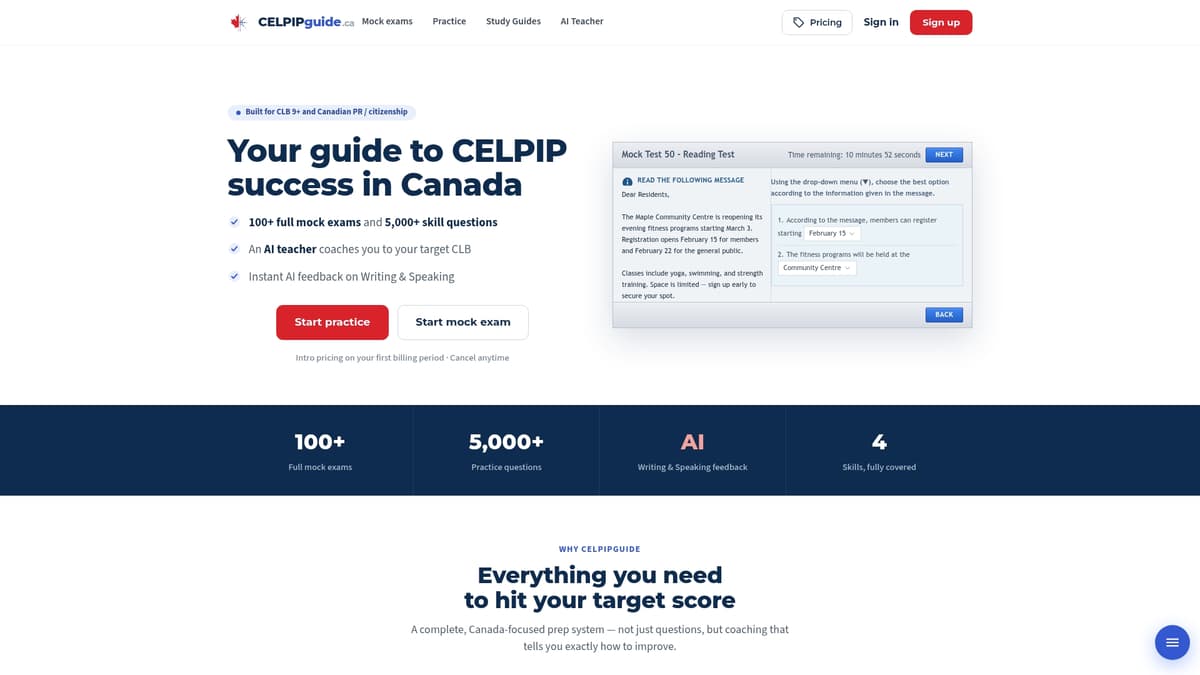
- Full-length mock exams that mirror real test timing, so your 60-second edit gets practised under genuine pressure.
- Instant AI feedback on writing tasks, broken down by Content/Coherence, Vocabulary, Readability, and Task Fulfilment.
- Diagnostic tests that flag your most frequent error types before you waste practice time guessing.
- Vocabulary builders that help you replace vague words with precise ones faster each time.
Start practising with the Plus plan today and put this routine to work on real timed drills.
FAQ
What is the fastest way to self-edit CELPIP writing responses?
A focused 60-second edit done at the end of each task, checking task fulfilment, word count, your introduction and conclusion, two grammar errors, and one vocabulary swap, catches the most scoring issues in the least time. Running it in that order addresses the highest-weighted rubric dimensions first.
What are the four CELPIP writing score dimensions?
CELPIP writing responses are scored on Content/Coherence, Vocabulary, Readability, and Task Fulfilment, with each dimension checking a different part of your response, from idea organization to grammar and tone. A useful score rubric breakdown outlines the specific factors raters look for in each category.
What common writing errors should I check for first?
Sentence fragments, run-on sentences, comma splices, and punctuation or capitalization mistakes are among the most frequent point losses according to a CIC News review of common CELPIP writing errors. Checking for these first, before stylistic polish, protects the most points in the least editing time.
How much time should I spend reviewing my CELPIP writing response?
Reserving roughly the last three minutes of each task for a dedicated edit pass, after planning and writing, gives you enough time to run a full rubric-focused check without rushing. If you fall behind schedule, shift to triaging task fulfilment and your top grammar errors rather than skipping review entirely.
How can I tell if my self-editing is actually improving my score?
Track your repeat error count by category, how long your edit pass takes, and your self-scored rating on each rubric dimension every week. A steady drop in repeat errors alongside a faster, more consistent edit pass is a reliable sign the routine is working.