
CELPIP Blog
Vocabulary precision matters for professionals taking CELPIP
Vocabulary precision matters for professionals taking CELPIP

Vocabulary precision directly affects your CELPIP speaking and writing scores. Choosing the right word instead of a vague or forced one can move you up a full CLB band, and for professionals applying for permanent residency or citizenship, that single band often decides eligibility. The CELPIP rubric rewards range, precision, and appropriacy in equal measure, which means a smaller vocabulary used accurately usually outscores a bigger one used sloppily.
Here’s what precision looks like in practice, and what it costs you when it’s missing:
- A candidate who writes “the situation was bad” scores lower than one who writes “the delay disrupted our shipment schedule.”
- Forcing in an advanced word you half-remember often reads worse than using a simple, correct one.
- The gap between CLB 7 and CLB 9 frequently comes down to word choice, not grammar.
The rest of this guide breaks down exactly how CELPIP scores vocabulary, shows real error-to-fix examples, and ends with a 4-week plan you can start this week.
Key Takeaways
Vocabulary precision, not vocabulary size, determines whether your CELPIP speaking and writing scores clear the CLB band you need.
| Point | Details |
|---|---|
| Precision beats range alone | CELPIP scores range, precision, and appropriacy together, so accurate simple words often outscore forced advanced ones. |
| Fix collocations first | Errors like “do a decision” instead of “make a decision” are among the fastest, most repeatable point-losses to correct. |
| Match vocabulary to task type | Speaking and Writing tasks each reward a different register, from advice-giving to formal email requests. |
| Feedback speeds correction | Fast, rubric-aligned feedback from mock tests corrects miscalibrated vocabulary faster than unguided self-study. |
| Use Celpipguide’s diagnostic tools | Celpipguide’s diagnostic test, AI feedback, and vocabulary tracker target precision gaps directly for faster score gains. |
Table of Contents
- Why vocabulary precision matters for professionals sitting CELPIP
- Common precision errors and side-by-side alternatives
- Matching vocabulary to each CELPIP speaking and writing task
- Building vocabulary precision through deliberate practice
- A 4-week plan to sharpen vocabulary precision before test day
- How vocabulary precision shapes professional communication
- What imprecise vocabulary actually costs at work
- Why precise vocabulary reads as credibility
- How to check your current vocabulary precision level
- Vocabulary precision needs differ across professional fields
- What I’ve seen actually move the needle for test-takers
- Build precision faster with CELPIPguide’s diagnostic and feedback tools
- Sources
- FAQ
Why vocabulary precision matters for professionals sitting CELPIP
CELPIP examiners don’t just count how many “big words” you use. They score three separate qualities: range (how many different words and structures you command), precision (whether each word means exactly what you intend), and appropriacy (whether the word fits the context, audience, and formality level). A response can have wide range and still score poorly if the words are the wrong ones for the job.
Here’s how that breaks down in practice:
- Range rewards variety. Repeating “good” five times in a Task 2 essay signals a limited vocabulary even if your grammar is flawless.
- Precision rewards accuracy. “The company terminated my position” is precise. “The company did something with my job” is not, even though both describe the same event.
- Appropriacy rewards register. Texting-style phrasing (“gonna”, “kinda”) in a formal email response drags your score down regardless of how correct the grammar is.
By the numbers: CELPIP’s own scoring descriptors treat vocabulary range, precision, and appropriacy as core criteria for the Writing tasks, meaning a meaningful share of your Writing score rests on word choice alone, separate from grammar or organization.
For professionals, this mirrors the real workplace. An engineer who writes “the system had an issue” instead of “the system experienced intermittent latency” is graded down for the same reason a client would misread the severity of the problem.
Common precision errors and side-by-side alternatives
Most vocabulary point-losses fall into four repeatable patterns. Once you can spot them in your own writing and speaking, they’re fast to fix.
- Vague everyday words: “place,” “thing,” “people,” “good” carry almost no information. Swap “the place was busy” for “the terminal was congested,” and you’ve raised both precision and range in one move.
- Forced advanced words: Reaching for “ameliorate” when you mean “improve” often reads as unnatural, and examiners notice. Precision means using the correct word naturally, not the fanciest one available.
- Wrong collocations: English pairs words in fixed patterns. You “make a decision,” not “do a decision.” You “attend a meeting,” not “assist a meeting.” Collocation errors are some of the most common ways otherwise strong test-takers lose marks.
- Register mismatch: Using casual phrasing in a formal request email, or overly stiff phrasing in a casual conversation prompt, signals weak appropriacy control even when the vocabulary itself is correct.
Pro Tip: Stop memorizing isolated words from a list. Learn them inside full phrases instead, “raise a concern,” “reach a consensus,” “meet a deadline,” because CELPIP rewards natural collocations far more than it rewards impressive vocabulary used in the wrong combination.
Choosing sharper, more specific verbs applies well beyond the exam room too. Precise action verbs that quantify or clarify intent consistently communicate more than generic ones, whether you’re writing a CELPIP response or a professional resume.
Matching vocabulary to each CELPIP speaking and writing task
Precision isn’t one skill you apply the same way everywhere. Each CELPIP task rewards a different vocabulary register, and knowing which one you need before you open your mouth or start typing saves you from guessing under time pressure.
- Speaking Task 1 (giving advice): needs suggestion language, “you might consider,” “it would be worth,” rather than blunt commands like “you should do this.”
- Speaking Task 2 (personal experience): rewards descriptive precision, sensory and specific detail (“the flight was delayed by four hours” beats “the flight was late”) over generic narration.
- Speaking Task 5 (comparing and persuading): needs evaluative vocabulary: “more cost-effective,” “a stronger long-term fit,” rather than flat comparisons like “better.”
- Speaking Task 8 (difficult situation, empathetic response): requires softened, empathetic phrasing, “I understand this has been frustrating,” instead of clinical or blunt wording.
Writing splits just as clearly. Task 1 (email writing) rewards functional, request-and-response vocabulary: “I would appreciate it if,” “please find attached,” “I look forward to your response.” Task 2 (survey response/opinion) rewards argumentative precision: “this approach outweighs the alternative because,” “a significant drawback is.”
Compare these two fragments answering the same Task 2 prompt: Low precision: “I think this option is good because it has many benefits.” High precision: “I favour this option because it reduces commute time without increasing household costs.” Same idea, one full CLB band apart. Practising both writing and speaking tasks side by side, using free CELPIP writing practice and free CELPIP speaking practice, helps you feel the register shift between task types before test day.
Building vocabulary precision through deliberate practice
Precision doesn’t come from cramming word lists the week before your test. It comes from repeated, contextual exposure paired with fast correction, the same loop language teachers have used for decades, just applied more deliberately.
- Keep phrase notebooks, not word lists. Write down full collocations you encounter, “address a concern,” “streamline a process” (used correctly, not as filler), grouped by topic rather than alphabetically.
- Build topic folders. Housing, healthcare, employment, and environment show up repeatedly across CELPIP prompts. A folder of 15 to 20 precise phrases per topic covers most exam scenarios.
- Mine authentic Canadian content. Task-driven vocabulary building from real Canadian news and workplace writing exposes you to the natural register CELPIP expects, rather than textbook English that can sound stiff.
- Use spaced repetition for collocations, not single words. Reviewing “raise awareness” as a unit cements it faster than reviewing “raise” and “awareness” separately.
- Recycle new phrases immediately in a speaking or writing response within 48 hours of learning them. Vocabulary that isn’t used within a couple of days tends to fade before it becomes automatic.
The step most self-study plans skip is fast, accurate feedback. Most test-takers overestimate how precise their vocabulary actually sounds until an examiner-style mock test corrects that miscalibration, often within a single attempt. A vocabulary tracker that logs which collocations you’ve actually used correctly across multiple mock attempts turns vague self-assessment into a measurable trend line.
A 4-week plan to sharpen vocabulary precision before test day
You don’t need three months to move your vocabulary score; you need four focused weeks with clear checkpoints.
- Week 1, diagnose and target. Take a full diagnostic, identify your current CLB vocabulary band, and build a working list of 60 target collocations across common topics (work, housing, health, environment).
- Week 2, drill in context. Practise 10 to 15 minutes daily on timed speaking responses using your target phrases, plus short written paragraphs. Focus on natural insertion, not forced usage.
- Week 3, simulate and log errors. Run timed mock Speaking and Writing tasks under examiner-style scoring. Keep an error log of every vague word or wrong collocation you catch.
- Week 4, polish and recycle. Revisit your error log, replace repeat mistakes, and run one final full mock exam to confirm your precision gains hold up under real time pressure.
How vocabulary precision shapes professional communication
The habits CELPIP rewards are the same ones that shape how colleagues and clients judge you at work. A precise vocabulary lets you say exactly what happened, what you need, and what you recommend, without the listener having to guess at your meaning or ask a follow-up question.
Imprecise vocabulary forces extra rounds of clarification. If a project update says “there were some issues with the timeline,” a manager has to ask what issues, how serious, and what’s needed to fix them. The same update phrased as “the vendor’s delay pushed delivery back two weeks, and we need approval to adjust the launch date” answers all three questions in one sentence. That’s not a stylistic preference. It’s the difference between one email exchange and four.
This is also why CELPIP weighs appropriacy so heavily. Workplace communication constantly shifts register, a quick message to a teammate uses different vocabulary than a formal client proposal, and professionals who can’t shift registers smoothly tend to sound either too casual to be taken seriously or too stiff to build rapport. Practising that shift for the exam builds a skill that outlasts the test itself.
What imprecise vocabulary actually costs at work
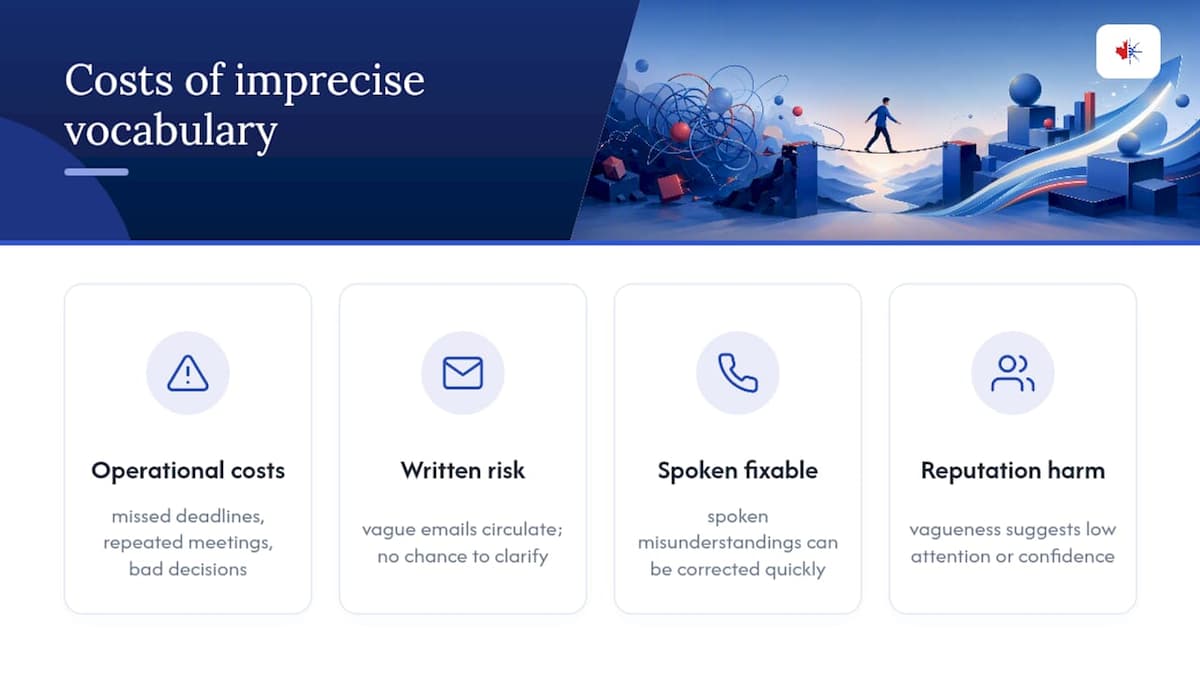
Vague language rarely causes dramatic failures on its own. It causes small, compounding misunderstandings that add up to real costs: missed deadlines, repeated meetings, and decisions made on incomplete information.
A common scenario: an employee tells a supervisor a task is “almost done” when it’s 60% complete. “Almost done” and “60% complete with the testing phase remaining” trigger very different planning decisions. The vague version feels easier to say in the moment, but it sets up a deadline conflict that surfaces later, usually at the worst possible time.
Written communication carries the same risk with less room to recover. A spoken misunderstanding can be corrected with a quick follow-up question. A vague email or report can circulate, get forwarded, and get acted on by people who never get the chance to ask for clarification. Precision in writing matters more, not less, because there’s often no second exchange to fix it.
For newcomers building a professional reputation in a new workplace, this compounds further. Colleagues form judgments about competence quickly, and a pattern of vague, imprecise language, even from someone who is highly skilled technically, can be read as a lack of confidence or attention to detail. Getting the words right isn’t cosmetic. It’s part of how competence gets recognized.
Why precise vocabulary reads as credibility
People judge expertise partly through language before they ever see the work behind it. A candidate or colleague who says “the numbers suggest a modest decline in Q3” sounds more in control of the material than one who says “the numbers went down a bit.” The second phrasing might be describing the exact same data.
This isn’t about sounding impressive for its own sake. Precision signals that you understand the situation well enough to describe it accurately, and that distinction is exactly what CELPIP examiners are trained to detect. A response full of hedged, generic language, “sort of,” “kind of,” “a lot of things”, reads as someone unsure of what they actually mean, even when the underlying idea is sound.
The reverse is also true: forcing overly formal or complex vocabulary to sound smart often backfires, because it reads as performance rather than understanding. Precision that comes from genuinely knowing the right word beats vocabulary that comes from trying to impress. That balance, natural but accurate, is what separates a CLB 9 response from a CLB 7 one, and it’s what separates a professional who sounds credible from one who sounds like they’re guessing.
How to check your current vocabulary precision level
You can’t improve what you haven’t measured, and vocabulary precision is one of the easiest skills to overestimate on your own. A few concrete checks reveal your actual level faster than gut feeling.
Start by recording yourself answering a CELPIP-style speaking prompt, then transcribe it. Reading your own spoken words on paper exposes vague fillers (“things,” “stuff,” “kind of”) that pass by unnoticed when spoken aloud. Do the same with a timed writing sample: circle every generic word and try to replace it with a more specific alternative.
A faster route is a structured diagnostic that scores your vocabulary against the actual CLB descriptors rather than a general impression. A readiness check that benchmarks your current speaking and writing against CLB bands shows you precisely where range, precision, or appropriacy is holding your score down, rather than leaving you to guess which one needs the most work.
Vocabulary precision needs differ across professional fields
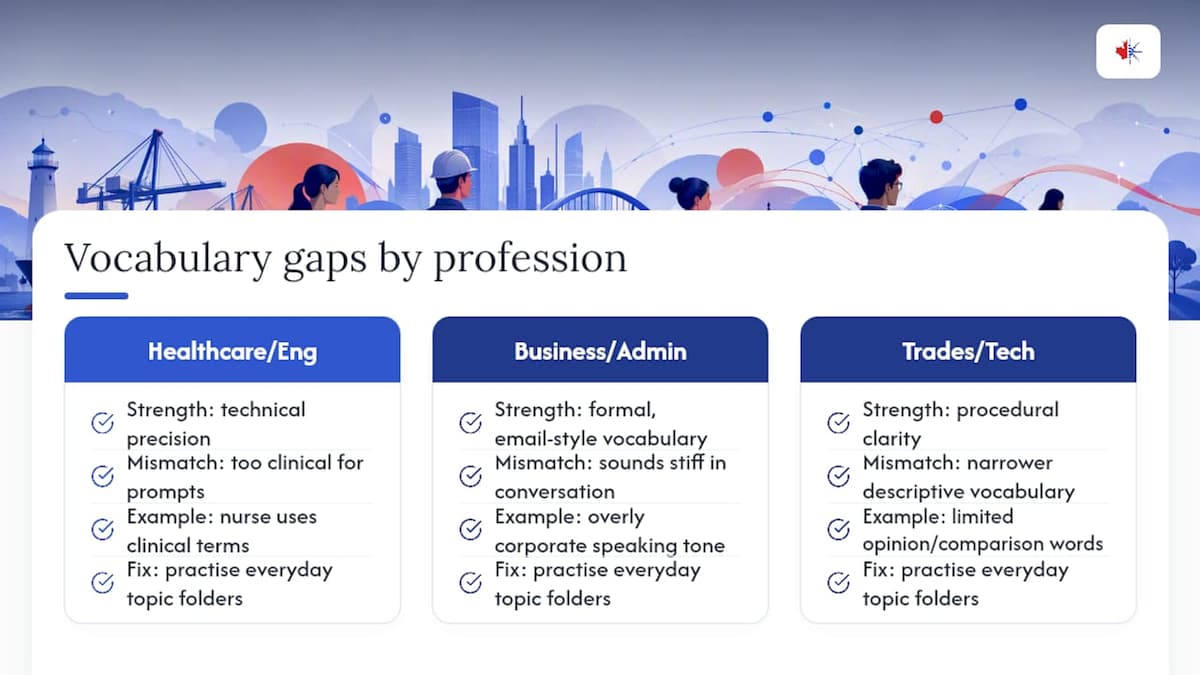
Not every profession needs the same vocabulary precision, and CELPIP test-takers coming from different career backgrounds often need to consciously adjust rather than assume their workplace vocabulary transfers directly to exam tasks.
Healthcare and engineering professionals tend to over-rely on technical terminology that doesn’t map to CELPIP’s general-topic prompts about housing, community, or daily routines. A nurse who’s precise describing patient symptoms may still say “the neighbourhood was nice” on a Speaking Task 2 prompt, because the vocabulary muscle for everyday description hasn’t been exercised as much as the clinical one.
Business and administrative professionals often have the opposite problem: strong formal, email-style vocabulary that can sound stiff or overly corporate on conversational speaking tasks. Trades and technical professionals sometimes have a narrower descriptive vocabulary overall, having spent more career time on procedural language than on the kind of nuanced opinion and comparison language Speaking Task 5 requires.
The practical takeaway is the same regardless of background: your professional vocabulary is a strength, but it’s not automatically the vocabulary CELPIP is testing. Building topic folders across housing, community, health, and environment, rather than assuming your work vocabulary will cover the exam, closes that gap fastest.
What I’ve seen actually move the needle for test-takers
Years of watching CELPIP candidates plateau taught me one thing: the ones who improve fastest aren’t the ones cramming the longest vocabulary lists. They’re the ones who fix the same three or four collocation errors after seeing them flagged clearly. One learner stuck at CLB 7 for months jumped to CLB 9 within weeks once she stopped saying “make a research” and started catching her own register slips in real time.
— Reza
Build precision faster with CELPIPguide’s diagnostic and feedback tools
Reading about precision helps, but closing the gap between knowing the right word and using it under exam pressure takes structured, task-aligned practice. Celpipguide is built around exactly that loop: a diagnostic test that pinpoints whether your weak spot is range, precision, or appropriacy, an AI teacher that gives instant, rubric-based feedback on your actual speaking and writing responses, and a vocabulary tracker that shows which collocations you’ve mastered and which keep slipping.
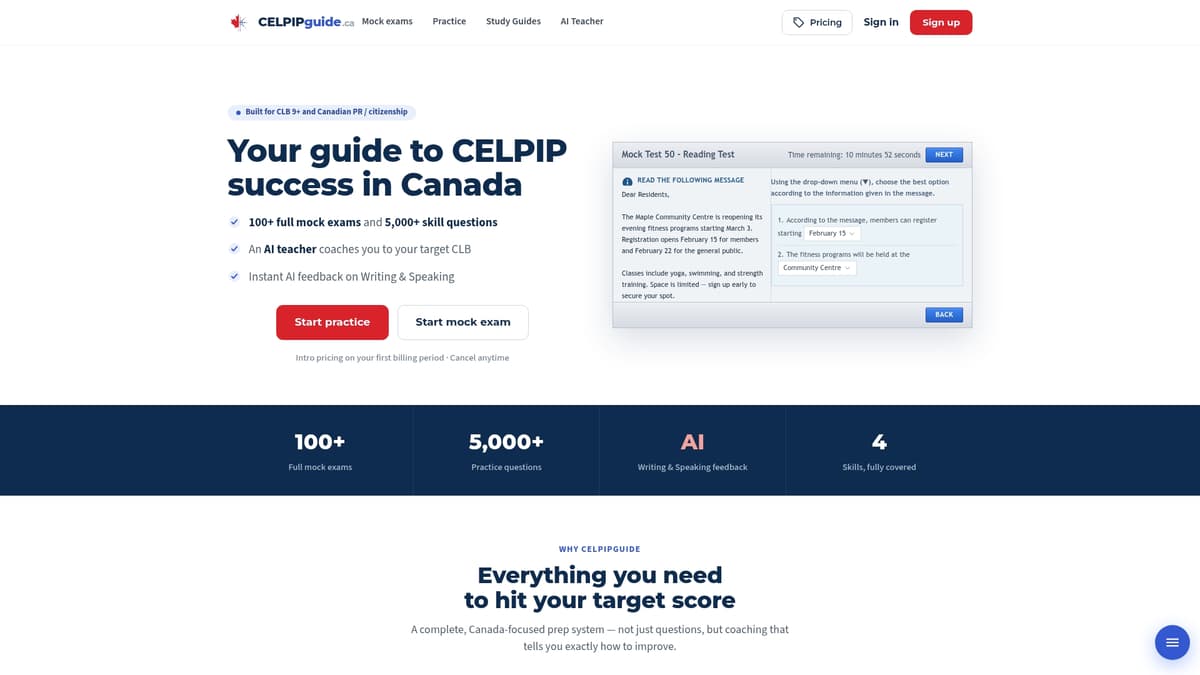
That combination shortens the feedback loop that self-study can’t replicate. Instead of guessing whether your Task 2 essay sounds precise, you get scored feedback the same day, then a targeted mock exam that recycles the phrases you missed. Over 100 full mock exams and 5,000 practice questions mean you’re never short on task-specific material to apply your new vocabulary against real timing pressure.
Ready to see where your vocabulary precision actually stands? Start with the full practice exam hub and use code BLG30 for 30% off your plan.
FAQ
Why does vocabulary precision matter so much for CELPIP scores?
CELPIP explicitly scores vocabulary on range, precision, and appropriacy, so using the exact right word in context directly raises your Writing and Speaking band, separate from grammar accuracy.
What’s the fastest way to fix vague vocabulary?
Replace generic words like “thing,” “good,” or “place” with specific alternatives, and log every collocation error you make during mock tests so you stop repeating it.
How much of my CELPIP Writing score depends on vocabulary?
CELPIP’s own descriptors list vocabulary range, precision, and appropriacy as core scoring criteria for Writing, alongside grammar, coherence, and task fulfillment.
Should I memorize advanced words to raise my score?
No. Forcing in complex vocabulary you don’t use naturally usually lowers your score, since CELPIP rewards accurate, natural word choice over impressive but awkward phrasing.
How can Celpipguide help me improve vocabulary precision quickly?
Celpipguide pairs a diagnostic test with an AI teacher that gives instant feedback on your actual responses, plus a vocabulary tracker that shows exactly which collocations still need work.