
CELPIP Blog
Why grammar matters in CELPIP writing: 2026 guide
Why grammar matters in CELPIP writing: 2026 guide

TL;DR:
- Grammar influences half of your CELPIP writing score by affecting clarity and readability. Minor errors are tolerated at lower levels, but consistent control and sentence variety improve overall communication. Practicing full responses, managing time effectively, and focusing on clarity help achieve higher scores.
Grammar directly shapes your CELPIP writing score because it controls clarity, coherence, and how well your response communicates meaning to the examiner. Without a solid grammatical framework, even strong vocabulary cannot convey meaning effectively. Understanding why grammar matters in CELPIP writing gives you a real advantage: you stop guessing what examiners want and start writing with purpose. The good news is that perfection is not the goal. At CLB 9 and above, the scoring rewards clear communication and structural control, not flawless grammar. This guide breaks down exactly how grammar affects your score and what you can do about it.
Why grammar matters in CELPIP writing: the scoring breakdown
The CELPIP writing test scores your responses across four main dimensions: content and coherence, vocabulary, readability and grammar, and task fulfilment. Grammar sits inside the readability category, which covers how clearly and accurately your sentences communicate your ideas. Grammar and vocabulary combined account for roughly 50% of your writing score. That means half your mark depends on how well you structure sentences and choose words.
Understanding this split changes how you prepare. You cannot ignore grammar and coast on vocabulary alone. Equally, you cannot drill grammar rules obsessively and neglect the other half of the rubric.
Here is how the four scoring dimensions interact:
- Content and coherence: Are your ideas logical, relevant, and well-organised?
- Vocabulary: Do you use a range of words accurately and appropriately?
- Readability and grammar: Are your sentences clear, varied, and grammatically controlled?
- Task fulfilment: Have you addressed the prompt fully and in the right format?
The difference between CLB 9 and CLB 10+ comes down to the degree of grammatical control you demonstrate. At CLB 9, minor grammatical errors are acceptable as long as they do not interfere with meaning. At CLB 10 and above, examiners expect more consistent accuracy and a wider range of sentence structures used correctly.
| CLB Level | Grammar expectation | Error tolerance |
|---|---|---|
| CLB 7–8 | Basic sentence control | Frequent minor errors allowed |
| CLB 9 | Mix of sentence types, mostly accurate | Minor slips tolerated if meaning is clear |
| CLB 10+ | Consistent accuracy, varied structures | Very few errors; none that block meaning |
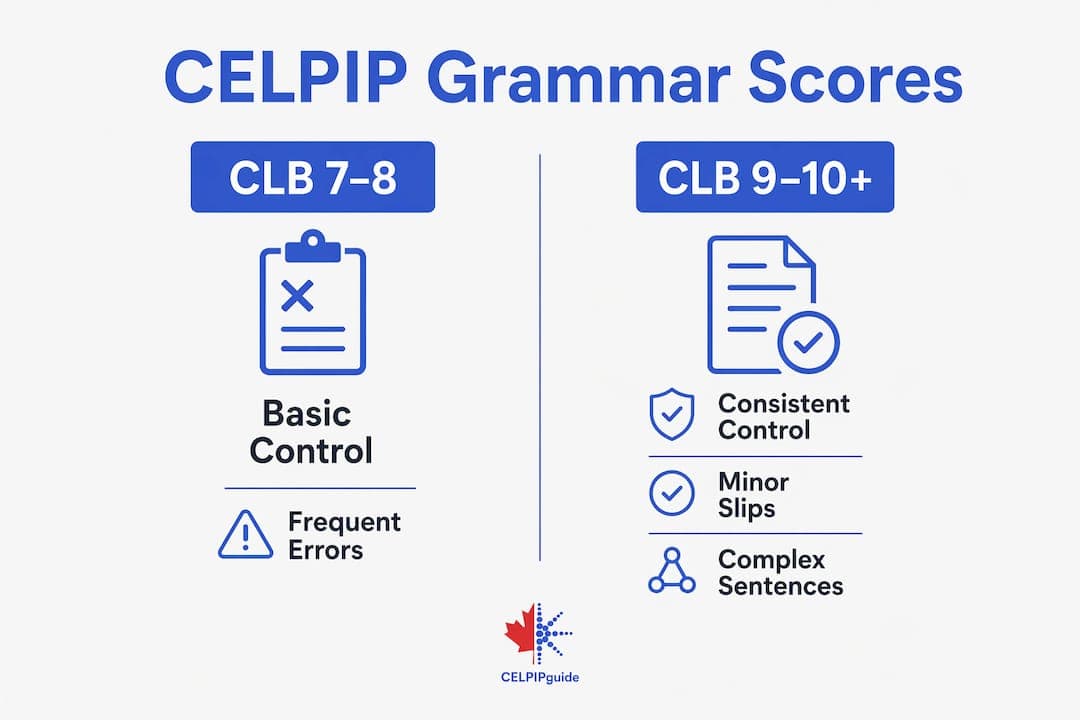
This table shows that moving from CLB 9 to CLB 10 is not about eliminating every error. It is about demonstrating consistent control across a wider range of structures.
What grammar skills does CELPIP writing actually require?

High scores in CELPIP writing require more than knowing grammar rules. They require applying those rules under time pressure, across different sentence types, and in response to specific prompts.
At CLB 9, examiners expect a mix of simple, compound, and complex sentences. A response built entirely from short, simple sentences reads as flat and limited. A response that varies sentence length and structure signals grammatical confidence.
The grammar skills that matter most at this level include:
- Tense consistency: Switching tenses without reason confuses the reader and signals poor control.
- Subject-verb agreement: Errors here are noticeable and disrupt flow.
- Pronoun clarity: Vague pronoun references create ambiguity and lower your readability score.
- Sentence boundaries: Fragments and run-on sentences are high-impact errors that block comprehension.
- Article use: Missing or incorrect articles (“a,” “an,” “the”) are minor slips at CLB 9 and are usually forgiven.
- Transition phrases: Words like “however,” “as a result,” and “in addition” connect ideas and improve coherence.
Varied sentence structures and transitions directly improve your coherence score alongside your grammar score. These two dimensions reinforce each other.
Pro Tip: Write one complex sentence for every two simple sentences. This ratio keeps your writing readable while showing the examiner you can handle subordinate clauses and relative clauses with control.
The most common grammar traps for test-takers include mixing past and present tense in the same paragraph, overusing the passive voice, and writing sentences that are too long to follow. Each of these is fixable with targeted practice. Celpipguide’s resource on common CELPIP mistakes covers the most frequent grammar pitfalls and how to avoid them.
How does time management reduce grammar errors?
Time pressure is the main reason grammar breaks down in CELPIP writing. You have 53 minutes total for both writing tasks. Without a clear plan for how to use that time, most test-takers rush the writing and skip the review.
A structured approach to time makes a measurable difference. Here is a reliable framework:
- Plan for 3–4 minutes. Decide your main points before you write a single sentence. Planning forces you to think in full ideas, which leads to better sentence structure from the start.
- Write for the bulk of your time. Focus on getting your ideas down clearly. Do not stop mid-sentence to fix grammar. Keep moving.
- Proofread for 1–2 minutes. Read your response once from start to finish. Look specifically for tense shifts, missing subjects, and sentence fragments.
Proofreading with a mental checklist can improve your score by half a CLB level or more. Catching two or three small errors in that final minute is worth the time.
Your proofreading checklist should cover:
- Do all verbs agree with their subjects?
- Are tenses consistent throughout the response?
- Does every sentence have a clear subject and verb?
- Are transition words used correctly?
- Are there any obvious spelling errors?
Pro Tip: Read your response backwards, sentence by sentence. This breaks the flow of meaning and forces you to look at each sentence in isolation, which makes grammar errors easier to spot.
Practising this time structure on CELPIP writing tasks before exam day builds the habit. On test day, the structure runs automatically.
Is grammar alone enough to score well in CELPIP writing?
Grammar is the structural framework of good writing, but it is not the whole picture. Scoring well in CELPIP writing requires grammar, vocabulary, tone, and task fulfilment working together. Focusing only on grammar drills misses this reality.
At CLB 9 and beyond, the shift from grammar drilling to communicative clarity is what actually moves scores. Grammar gives you the structure. Vocabulary and tone give you the substance. Without both, your writing sounds technically correct but hollow.
Excessive grammar drills beyond CLB 9 yield diminishing returns. Once you have a solid grammar base, the next gains come from vocabulary range and tone calibration, not from memorising more rules.
Here is what a balanced preparation approach looks like:
- Practise writing full responses, not isolated sentences. Grammar in context is different from grammar in a textbook exercise.
- Build vocabulary alongside grammar. A sentence can be grammatically correct and still score poorly if the word choices are weak or repetitive.
- Match your tone to the task. Task 1 (email writing) requires a formal tone in most cases. Using casual language in a formal email costs you marks even if your grammar is accurate.
- Read your response as the examiner would. Ask: does this make sense? Is the meaning clear? If yes, minor grammar slips will not hurt you significantly.
Grammar prevents ambiguity and protects the clarity of your ideas. That is its core function in high-stakes writing. The goal is not a perfect grammar score. The goal is a response where the examiner never has to re-read a sentence to understand what you meant.
Key takeaways
Grammar and vocabulary together account for roughly half the CELPIP writing score, making grammatical control one of the most direct levers for improving your band level.
| Point | Details |
|---|---|
| Grammar drives half your score | Vocabulary and grammar combined make up roughly 50% of the CELPIP writing mark. |
| Minor errors are tolerated at CLB 9 | Small slips like missing articles do not lower scores if overall meaning stays clear. |
| Sentence variety signals competence | Mixing simple, compound, and complex sentences shows examiners you have grammatical range. |
| Proofreading recovers lost marks | A 1–2 minute review at the end can catch errors worth half a CLB level or more. |
| Balance grammar with vocabulary and tone | Once you have a solid grammar base, vocabulary range and appropriate tone drive the next score gains. |
Grammar is a tool, not a test in itself
I have worked with a lot of CELPIP test-takers who spend weeks drilling grammar rules and then freeze during the actual writing tasks. They second-guess every sentence. They rewrite the same line three times. And they run out of time before they can proofread.
Here is what I have found actually works: treat grammar as a communication tool, not a performance. Your job is to make the examiner’s reading experience effortless. If your sentence is clear and the meaning lands, you are doing it right. If the examiner has to pause and re-read, that is where grammar has failed you, and that is what you fix.
I always recommend practising with full writing responses rather than isolated grammar exercises. Write a complete Task 1 email. Then read it back and ask: would a Canadian colleague understand this immediately? If the answer is yes, your grammar is working. If something sounds off, that is the error worth fixing.
The test-takers I have seen improve the fastest are the ones who stop obsessing over perfection and start focusing on clarity. They use varied sentence structures because it makes their writing more interesting to read, not because they are ticking a box. They proofread because they care about the reader, not because they are afraid of losing marks.
That shift in mindset, from grammar as a rule set to grammar as a communication skill, is what separates a CLB 9 response from a CLB 10+ response. You can get there with smart, consistent practice.
— Reza
How Celpipguide helps you build writing skills that score
Knowing what examiners want is one thing. Practising it under real conditions is another.

Celpipguide gives you access to over 100 full-length mock exams that replicate actual CELPIP writing conditions, including timed tasks and scoring feedback. The platform’s AI teacher reviews your writing responses and flags specific grammar and vocabulary issues, so you know exactly where to focus. You can also use the vocabulary builder to strengthen word choice alongside grammar, which is the combination that moves scores at CLB 9 and above. If you want to see how your writing holds up right now, a free practice test is a fast way to find your baseline.
FAQ
How much does grammar affect the CELPIP writing score?
Grammar and vocabulary together account for roughly 50% of the CELPIP writing score. Grammatical control directly affects your readability band, which examiners assess alongside content and task fulfilment.
Are minor grammar errors acceptable in CELPIP writing?
Yes. At CLB 9, minor slips like missing articles or small agreement errors are tolerated as long as they do not block the reader’s understanding.
What grammar errors hurt CELPIP writing scores the most?
High-impact errors like wrong tense usage, pronoun confusion, and sentence fragments reduce scores significantly because they force the reader to re-interpret your meaning.
How much time should I spend proofreading in CELPIP writing?
Spend 1–2 minutes proofreading at the end of each task. This short review can catch two or three errors and improve your score by half a CLB level or more.
Should I focus only on grammar to improve my CELPIP writing score?
No. Once you have a solid grammar base, shifting focus to vocabulary range and tone calibration produces better score gains than continuing to drill grammar rules alone.