
CELPIP Blog
Listening accuracy on CELPIP workplace items: your score guide
Listening accuracy on CELPIP workplace items: your score guide

TL;DR:
- Your CELPIP Listening score is determined by converting raw correct answers into CELPIP Levels that match Canadian Language Benchmarks. Improving accuracy on workplace items through targeted diagnostics and drills can increase your Level and CRS points for Express Entry. Focused practice on specific error types yields faster gains than generic listening exercises.
Your CELPIP Listening score is not a mystery. Raw correct answers (0–38) are converted by Paragon Testing Enterprises through statistical equating into CELPIP Levels (M–12), and each Level maps exactly to a Canadian Language Benchmark. That CLB number is what Immigration, Refugees and Citizenship Canada (IRCC) reads when it reviews your Express Entry profile. Most federal streams require at least CLB 7 in every module; hitting CLB 9–10 gives you a meaningful CRS advantage.
The role of listening accuracy on CELPIP workplace items is direct: every additional correct answer moves you closer to the Level your immigration goal requires. Start right now by running a diagnostic listening test and noting your raw score by item type.
Check these four things first:
- Test format: The Listening section runs for a set time across multiple parts, several of which use workplace and community contexts.
- Total items: 38 questions total; your raw correct count out of 38 is what converts to your Level.
- Workplace item types: multi-speaker conversations, phone calls, workplace announcements, and meetings.
- Common errors: missing specific details, misattributing statements to the wrong speaker, incorrect inference from tone, and unfamiliar Canadian workplace vocabulary.
Table of Contents
- Key takeaways and your three-step plan
- Why accuracy-focused drills beat generic listening practice
- Celpipguide gives you a measurable path to your target raw score
- Useful sources and next steps
- FAQ
Key takeaways and your three-step plan
Raise your raw correct answers by following three steps in order: diagnose, drill, and measure.
Step 1 — Diagnose. Take a timed practice test and record your raw score broken down by item type (detail, inference, speaker attribution, attitude/tone). This tells you exactly where you are losing points.
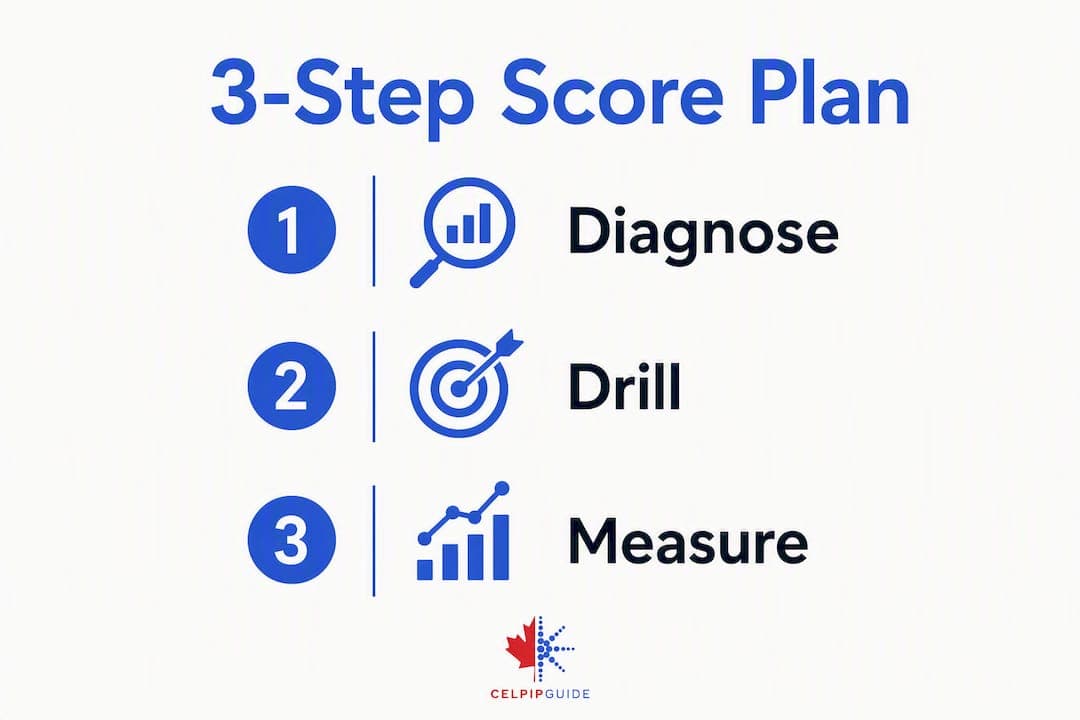
Step 2 — Drill workplace item types. Practise workplace listening scenarios that mirror the test: office meetings, phone instructions, and multi-speaker discussions. Focus on the error categories your diagnostic exposed.
Step 3 — Measure weekly with mock tests. Run a full-length mock exam each week and track your raw correct count. A gain of even two or three correct answers can shift your Level.
Listening accuracy on CELPIP workplace items matters most at the CLB 7 threshold. Raw scores and their approximate Level equivalents shift slightly between test forms because Paragon equates for difficulty, so focus on consistent raw-score gains rather than chasing a single magic number.
| Point | Details |
|---|---|
| Raw score range | 38 items total; every correct answer counts toward your CELPIP Level. |
| CLB 7 minimum | Express Entry and many federal streams require at least CLB 7 per module. |
| CLB 9–10 advantage | Higher CLB boosts CRS points for competitive Express Entry rounds. |
| Equating stability | Paragon’s equating means a Level 9 on any test form equals Level 9 on another. |
| Celpipguide diagnostic | Run Celpipguide’s diagnostic test first to set a raw-score target by item type. |
Why accuracy-focused drills beat generic listening practice
Most candidates I work with spend hours on general English podcasts and wonder why their raw score barely moves. Generic listening builds fluency, but CELPIP workplace items test something more specific: can you catch a detail buried in a two-person office exchange, correctly attribute a complaint to the right speaker, or infer a manager’s attitude from word choice alone?

Focused diagnostic testing that measures raw correct answers by item type produces faster, measurable gains than unfocused listening practice. When you know you are dropping points on speaker attribution, you can fix that in a week of targeted drills. When you only know your overall Level, you have no idea where to start.
My recommended session checklist includes about half an hour to an hour of practice.
- Listen to a workplace clip once without pausing; answer the questions cold.
- Review every wrong answer and identify the error type (detail, inference, speaker, vocabulary).
- Re-listen to the same clip and note exactly where the answer was stated or implied.
- Practise micro-skills for inference and speaker shifts with two or three shorter clips.
- Log your raw correct count and error breakdown before finishing.
Canadian workplace English has its own rhythms: indirect disagreement, polite hedging, and regional expressions that can trip up even strong listeners. Familiarise yourself with phrases like “I’m not sure that’s the best approach” (a soft refusal) or “Let’s circle back on that” (deferral). These appear in CELPIP workplace clips and carry meaning that affects inference questions.
Celpipguide gives you a measurable path to your target raw score
Spending months on generic practice when your test date is approaching is a real risk. Celpipguide is built specifically for CELPIP candidates who need to close the gap between their current raw score and their immigration target, faster than self-study alone allows.
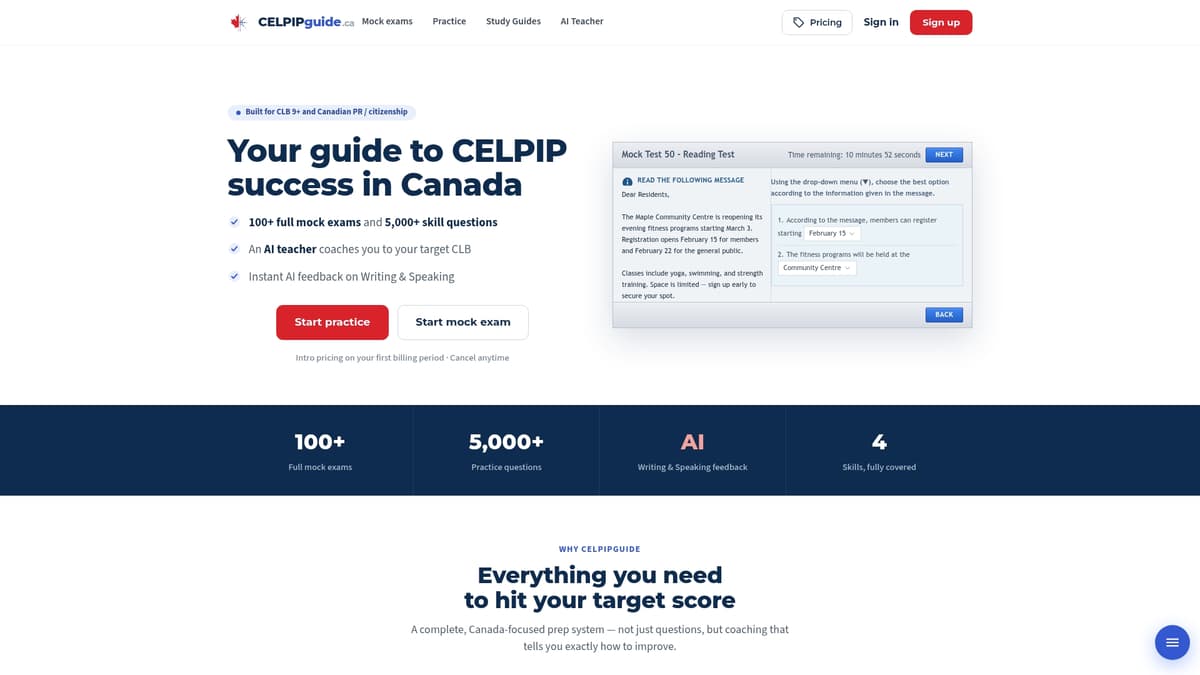
Start with Celpipguide’s diagnostic listening test, which breaks your raw score down by item type so you know exactly which workplace-item errors are costing you points. From there, an AI-personalised study plan adapts your weekly practice to your weakest categories, drawing from 5,000+ practice questions and a dedicated workplace-item bank. Full-length, timed mock exams let you track raw-correct gains week over week, so you can see progress in concrete numbers rather than guessing.
Save 30% on your subscription with coupon code BLG30 — apply it at checkout on top of any current offer.
Access the AI study plan generator to build your week-by-week prep schedule today.
Useful sources and next steps
Official resources:
Celpipguide practice pages:
- CELPIP Listening practice test — free timed tasks mirroring workplace-item formats
- CELPIP Listening Guide — section walkthrough, note-taking methods, and practice routines
- CELPIP four-skills immigration scoring guide — how Listening fits into your overall CLB profile
On score validity and retesting: CELPIP results are valid for two years and there is no appeals process for band scores. If your score falls short, plan your retest timeline carefully against your application deadline.
This article is general information, not immigration or legal advice. Confirm current CLB requirements directly with IRCC or a regulated immigration consultant before submitting an application.
FAQ
How many correct answers do I need for CELPIP Level 7?
The exact raw-score cutoff varies slightly between test forms because Paragon applies statistical equating, but aiming for a correct answer count that meets the Level 7/CLB 7 benchmark is advisable.
What workplace scenarios appear in CELPIP Listening?
Workplace clips typically include office meetings, phone instructions, two-person discussions between colleagues, and workplace announcements — all featuring Canadian English accents and expressions.
Why does my CELPIP Level matter for Express Entry?
Each CELPIP Level maps directly to a CLB level, and IRCC uses CLB to determine eligibility and CRS points. Most Express Entry streams require at least CLB 7 per module; CLB 9–10 adds significant CRS points.
How does Celpipguide help me raise my raw listening score?
Celpipguide’s diagnostic test identifies your weakest item types, and its AI study plan directs your practice to those gaps using 5,000+ questions and workplace-item banks, so you improve the specific skills that cost you correct answers.
Can I retake CELPIP if my Listening score is too low?
Yes. Results arrive within 4–8 business days and are valid for two years, so you can retest and submit the better score before your application deadline.