
CELPIP Blog
CELPIP diagnostic test advantages: 2026 guide
CELPIP diagnostic test advantages: 2026 guide

TL;DR:
- A CELPIP diagnostic test measures your current English skills across all four areas and maps your score to a CLB level. It provides precise baseline data, identifies weak sub-skills, and helps tailor an effective study plan, increasing the chances of success. Using early diagnostics and AI feedback can save time and money while improving test performance significantly.
A CELPIP diagnostic test is a full-length, timed assessment that measures your current English proficiency across all four skills and maps the result to a Canadian Language Benchmark (CLB) level. The CELPIP diagnostic test advantages go well beyond a simple score. They give you a precise starting point, pinpoint your weakest sub-skills, and shape a study plan that targets exactly what your CLB score needs. Test-takers who begin preparation with a structured diagnostic approach score 1–2 CLB levels higher on average than those who skip this step. That gap can mean the difference between a successful Express Entry application and a costly retake.

1. CELPIP diagnostic test advantages: accurate baseline scoring
The single biggest benefit of diagnostic testing is knowing exactly where you stand before you study a single hour. Without a baseline, you risk spending weeks on skills you have already mastered while ignoring the gaps that will cost you points on test day.
AI-powered diagnostic tests predict CELPIP scores within 0.5 CLB levels, compared to a 1.5–2 level margin of error from basic untimed practice tests. That accuracy matters because a CLB 9 target requires a very different study plan than a CLB 7 target. Starting with a precise baseline means every study hour is directed at a real gap.
Here is what an accurate baseline gives you:
- A confirmed CLB starting point mapped to the CELPIP scoring rubric
- A skill-by-skill breakdown across Listening, Reading, Writing, and Speaking
- A realistic timeline to reach your target CLB before your application deadline
- Confidence that your study plan is built on data, not guesswork
Structured diagnostic plans shift pass rates from 52% to 89%. That is not a small improvement. It reflects what happens when preparation is grounded in measurement rather than assumption.
2. Examiner-level feedback on Speaking and Writing
Speaking and Writing are the two sections where self-assessment fails most test-takers. You cannot hear your own filler words. You cannot judge whether your written response stays on topic the way a trained evaluator can.
AI-driven feedback for Speaking and Writing is 73% more accurate than self-assessment. That accuracy closes the gap between what you think you said and what an examiner actually scores. Celpipguide’s AI teacher delivers this feedback instantly, flagging issues with time management, off-topic answers, and vocabulary range.
The most common pitfalls that detailed feedback catches include:
- Filler words and pauses: “Um,” “like,” and long silences lower your fluency score. Recording your speaking practice is the only reliable way to catch these habits before test day.
- Off-topic responses: CELPIP Writing tasks have specific prompts. Drifting off-topic costs marks on task completion, regardless of grammar quality.
- Time overruns: Many test-takers run out of time on Speaking Task 6 because they over-explain early tasks. Feedback identifies this pattern early.
- Weak cohesion: Transitions between ideas affect your Writing score more than most test-takers realise.
Pro Tip: After each diagnostic Speaking task, use a recorder to replay your response and count filler words. Aim to reduce them by half before your next attempt. This single habit can lift your Speaking score by a full CLB level.
3. Realistic timed practice builds test-day readiness
The CELPIP exam runs on a strict one-directional flow. You cannot go back to a previous question. The computer-based interface moves at its own pace, and the time pressure is real. Practising without these constraints is like training for a race on a treadmill and then running on a hilly course.
Experts recommend dedicating the first one to two weeks of preparation to timed diagnostic testing and format familiarisation. This period reveals weaknesses that textbooks simply cannot expose. You learn how fatigue affects your Reading speed in Part 4. You discover that Speaking Task 5 feels very different when a timer is counting down.
Four specific readiness skills that timed diagnostic tests build:
- Pacing awareness: You learn how long 60 seconds actually feels when you are speaking under pressure, and you adjust your response length accordingly.
- Reading stamina: The Reading section requires sustained concentration. Timed practice trains your brain to maintain focus across all eight parts without slowing down.
- Listening resilience: Diagnostic tests expose you to varied accents and ambient noise that reflect real Canadian English test conditions. This builds the listening flexibility that simple audio drills cannot replicate.
- Stress reduction: Familiarity with the interface and format lowers anxiety on test day. Practising at the same time of day as your scheduled exam also sharpens cognitive readiness by aligning your mental rhythm with the actual test window.
4. How diagnostic results sharpen your study plan
A diagnostic result is only as useful as the study plan it informs. The real CELPIP diagnostic benefit is not the score itself. It is the data that tells you where to spend your next 80–120 study hours.
Early diagnostic testing directs 80–120 study hours toward weaknesses rather than spreading effort evenly across all skills. Expert coaches consistently emphasise this point. Spending equal time on a CLB 9 Listening skill and a CLB 6 Writing skill is inefficient. The diagnostic result removes that inefficiency.
Pro Tip: Treat your diagnostic score report as a weekly checklist, not a one-time read. After each study week, re-run a short diagnostic on your weakest section to measure progress. Adjust your plan based on what the data shows, not how you feel about your progress.
Here is a practical way to structure your plan around diagnostic results:
| Diagnostic finding | Recommended weekly focus |
|---|---|
| Writing below CLB 7 | Three timed writing tasks per week with AI feedback review |
| Speaking below CLB 8 | Daily recorded responses reviewed against CELPIP rubrics |
| Listening gaps in Part 3–4 | Targeted listening drills using Canadian English audio sources |
| Reading speed too slow | Timed reading sets with a focus on skimming and scanning techniques |
High-scoring candidates use diagnostic results as data to refine their weekly plans rather than fixating on the final score. That mindset shift is what separates efficient preparation from anxious repetition. Sustained focus on weak sub-skills identified by diagnostics, adjusted weekly, produces the fastest score gains. Discipline using diagnostics beats raw talent on CELPIP, consistently.
5. Financial and time savings from diagnostic preparation
Diagnostic testing saves money. That is a direct, measurable benefit that most test-takers overlook when they are focused on study materials. Diagnostic preparation can save an average of $105 in retake fees by raising first-attempt pass rates. One targeted preparation cycle costs far less than two or three unguided attempts at the full exam.
The time savings are equally significant. Without a diagnostic baseline, many test-takers spend weeks studying areas that are already strong. That is preparation time that could have gone toward closing a real gap. A diagnostic test completed in week one of your preparation redirects every subsequent hour toward what actually matters for your CLB target.
6. Format alignment: choosing the right exam for your strengths
One underappreciated CELPIP diagnostic benefit is format alignment. The CELPIP Speaking section uses a computer-based, recorded format. There is no face-to-face examiner. For many test-takers, this format feels less intimidating than a live interview. A diagnostic test lets you experience this format firsthand and decide whether the CELPIP format suits your strengths before you commit to a test date and fee.
This is a practical advantage that goes beyond score prediction. Knowing you are comfortable with the format removes a significant source of test anxiety. Celpipguide’s free CELPIP practice test gives you that format experience at no cost, so your first encounter with the interface is not on test day.
7. Overcoming the fear of early diagnostic testing
Many test-takers avoid diagnostic tests at the start of preparation because they fear a low score. This is the most common and most costly mistake in CELPIP preparation. Early diagnostic testing is the single most efficient step you can take. A low early score is not a failure. It is a map.
The fear of seeing a CLB 5 when you need a CLB 9 is understandable. But avoiding that information does not change your actual level. It just means you will discover the gap later, with less time to close it. Test-takers who take a diagnostic in week one have more time to address weaknesses, adjust their plans, and build confidence through measurable progress. You can review common CELPIP mistakes to understand what early diagnostics typically reveal, and start your preparation with clear eyes.
Key takeaways
CELPIP diagnostic tests are the most efficient starting point for preparation because they replace guesswork with a precise, skill-level map that directs every study hour toward your actual CLB gaps.
| Point | Details |
|---|---|
| Accurate baseline scoring | AI diagnostics predict your CLB level within 0.5 levels, far more precisely than untimed practice. |
| Examiner-level feedback | AI feedback on Speaking and Writing is 73% more accurate than self-assessment, catching errors you cannot hear yourself. |
| Timed format readiness | Practising under real exam conditions builds pacing, stamina, and listening resilience before test day. |
| Targeted study efficiency | Diagnostic results direct 80–120 study hours toward weak sub-skills, eliminating wasted effort on strengths. |
| Financial savings | Structured diagnostic preparation can save $105 in retake fees by raising first-attempt pass rates. |
Why I think most test-takers use diagnostic tests the wrong way
I have seen a lot of CELPIP preparation strategies, and the pattern that frustrates me most is this: test-takers take one diagnostic test, look at the overall CLB score, feel either relieved or discouraged, and then put the report away. That is the wrong way to use a diagnostic. The score is almost irrelevant. The sub-skill breakdown is everything.
When I first worked through a diagnostic assessment, my overall score looked acceptable. But the Writing section was two CLB levels below my Listening score. If I had studied evenly across all four skills, I would have wasted weeks reinforcing a strength while my Writing dragged my total score down. The diagnostic report told me exactly where to focus, and that focus made the difference.
The other misconception I hear constantly is that diagnostic tests are only useful at the start of preparation. They are not. The most effective test-takers I have seen use diagnostics as a weekly check-in tool. They run a short diagnostic on their weakest section, measure the movement, and adjust their plan. That is how you turn a CLB 6 Writing score into a CLB 9 in eight weeks. It is not talent. It is measurement.
If you are avoiding your first diagnostic because you are afraid of a low score, I understand that feeling completely. But a low score at week one is the best possible outcome. It gives you the most time to act on what the data shows. Take the test early, read the full report, and build your plan around the weakest number on the page.
— Reza
Put your diagnostic insights to work with Celpipguide
Knowing your CLB gaps is only half the work. The other half is having the right practice materials to close them.
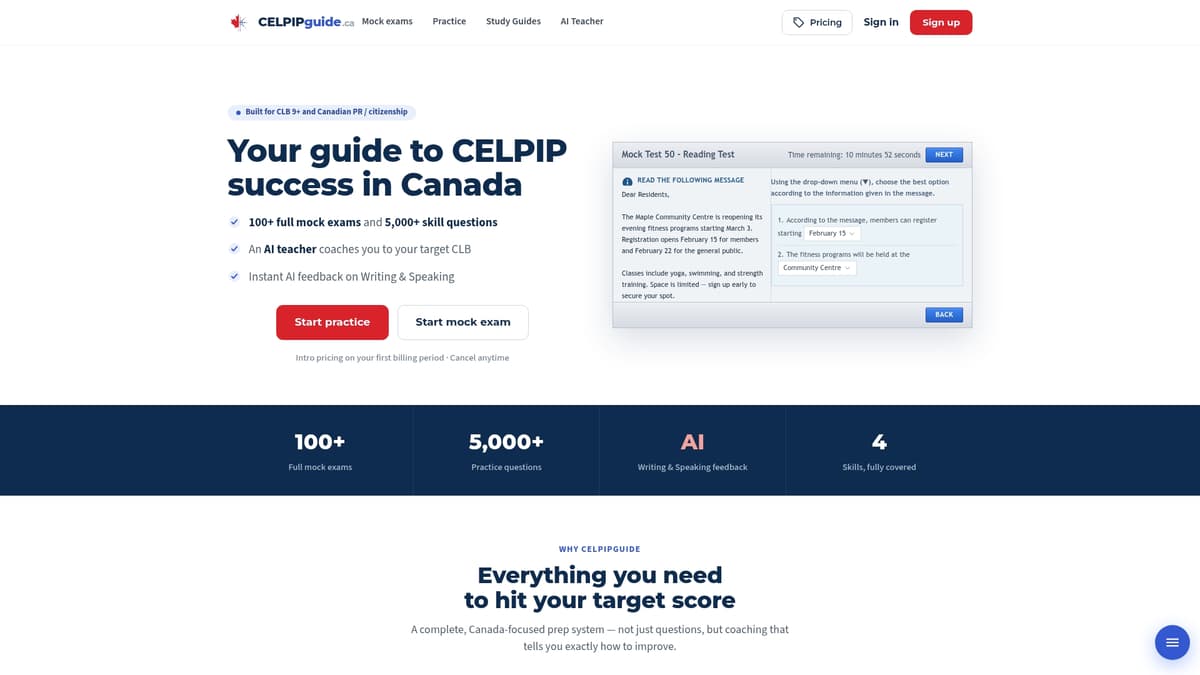
Celpipguide offers over 100 full-length mock exams and 5,000 practice questions built to CEFR language standards, all with instant AI feedback on Writing and Speaking tasks. Every test mirrors the real CELPIP interface, so your timed practice feels like the actual exam. You can start with the CELPIP practice hub to access skill-specific tasks across all four sections and track your CLB progress week by week. The AI teacher personalises your study plan based on your diagnostic results, so you are always working on what matters most for your target score.
FAQ
What is a CELPIP diagnostic test?
A CELPIP diagnostic test is a full-length, timed practice exam that assesses your current English proficiency across Listening, Reading, Writing, and Speaking, then maps your performance to a CLB level. It identifies your strongest and weakest sub-skills so you can build a targeted study plan.
How accurate are CELPIP diagnostic test scores?
AI-powered diagnostic tests predict your CELPIP score within 0.5 CLB levels, compared to a 1.5–2 level margin of error from basic untimed practice tests. This accuracy gives you a reliable starting point for planning your preparation.
When should I take a CELPIP diagnostic test?
Take your first diagnostic test in week one of preparation. Early testing reveals your weakest sub-skills while you still have time to address them, and it prevents you from wasting study hours on areas that are already strong.
Can a diagnostic test help me avoid a CELPIP retake?
Structured diagnostic preparation raises first-attempt pass rates significantly and can save an average of $105 in retake fees. Targeted preparation based on diagnostic data is more effective than unguided study across all four skills.
Does Celpipguide offer diagnostic testing?
Celpipguide includes a diagnostic test feature alongside over 100 full-length mock exams and AI-powered feedback on Speaking and Writing tasks. The platform uses your diagnostic results to personalise your study plan and track CLB progress over time.