
CELPIP Blog
Improve your English listening comprehension for CELPIP
Improve your English listening comprehension for CELPIP

TL;DR:
- Adopting a three-pass listening routine improves CELPIP scores by enhancing listening flexibility and comprehension accuracy. Daily targeted drills and weekly timed mocks, tailored through Celpipguide’s resources, develop micro-skills essential for exam success. Focusing on strategy and practice consistency ensures meaningful progress over the six-week preparation period.
The single most effective thing you can do today is adopt the three-pass listening routine: listen once for gist, once for specific details, then review the transcript to catch what you missed. Pair that with daily focused targeted drills and one timed mock test per week, and you have a plan that maps directly onto what Paragon Testing Enterprises scores on the CELPIP exam. Language educators consistently show that strategic listening flexibility outperforms trying to catch every word, and the CELPIP format rewards exactly that skill. Celpipguide is built around CEFR-aligned practice that puts this routine into action from day one.
Start today with these three steps:
- Today: Run a free CELPIP listening practice test to set your baseline accuracy score.
- This week: Complete one 20–30 minute three-pass drill daily using CELPIP-style audio, and log how many details you capture correctly on the first listen.
- 7-day check: Retake the diagnostic and compare your detail-capture rate. If accuracy on mock questions has risen, your routine is working.
Table of Contents
- What does the CELPIP listening section actually test?
- How to use the three-pass method on CELPIP tasks
- High-impact drills to run between mock tests
- A 6-week CELPIP listening study plan
- How Celpipguide features map onto this plan
- Exam-day tactics that protect your listening score
- Key takeaways
- What actually moves the needle in CELPIP listening prep
- Celpipguide gives you a structured path to a higher listening score
- Useful sources and CELPIP resources
- FAQ
What does the CELPIP listening section actually test?
The CELPIP listening section, developed by Paragon Testing Enterprises, covers three main task types: recorded everyday conversations, spoken instructions, and extended speeches or news items. You cannot rewind the audio, and each task runs on a fixed timer, so pacing is part of what is being assessed.
Scoring focuses on four things: gist comprehension (the overall message), detail recognition (specific facts, numbers, names), inference (reading between the lines), and pragmatic understanding (the speaker’s attitude or purpose). Missing the attitude of a speaker can cost you just as many marks as missing a fact.
What this means for how you practise:
- Read the questions before the audio starts so you know what details to hunt for.
- Practise under time pressure from the beginning; never allow yourself to pause and rewind during drills.
- Prioritise gist on the first listen. Details come in the second pass.
- Train yourself to notice tone and purpose, not just content words.
Cambridge English recommends timetabling regular practice in short chunks and using non-interactive audio (no rewind) to replicate real test conditions.
How to use the three-pass method on CELPIP tasks
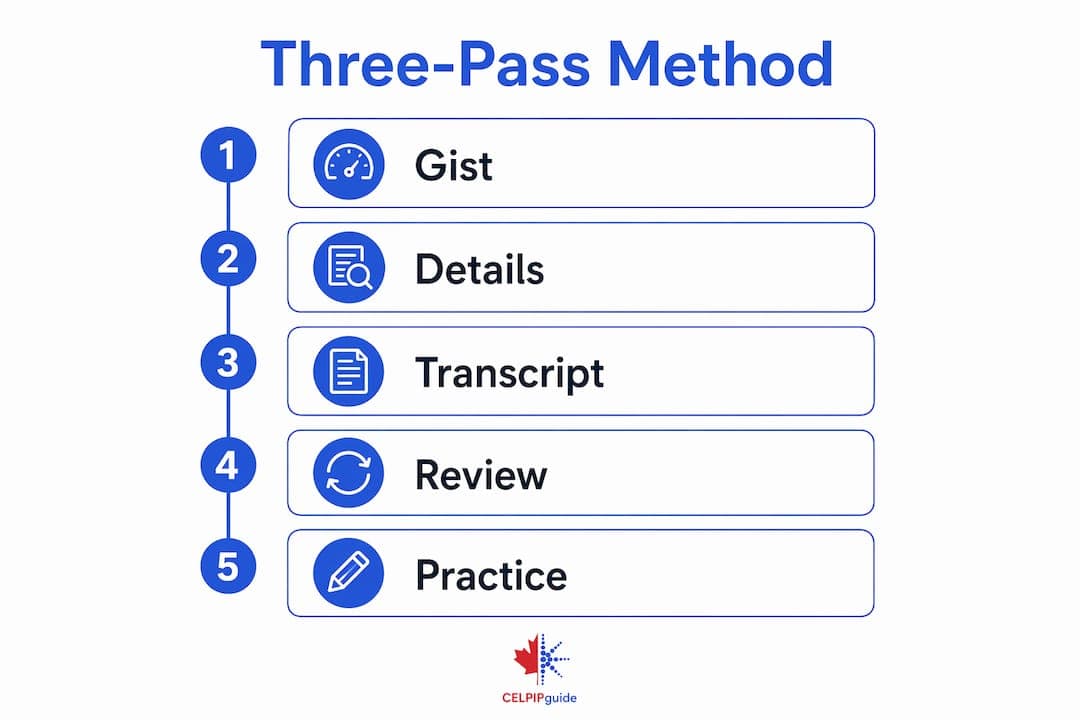
The three-pass approach is the most direct way to build the flexibility the CELPIP rewards. Each pass has one job, and mixing them up is what causes cognitive overload.
- Pass 1 — Gist (no pausing): Play the audio straight through. Write down only the topic, the setting, and the speaker’s general purpose. Do not chase individual words.
- Pass 2 — Details: Play again. This time, focus on answering the specific questions you read before the audio. Jot keywords, numbers, and names only.
- Pass 3 — Transcript review: Read the transcript while replaying the audio. Identify every word or phrase you missed, note connected-speech patterns (contractions, reduced vowels, linked words), and add new vocabulary to your log.
Mini-checklist for a 1–3 minute practice clip:
- Did you capture the gist correctly on Pass 1?
- How many question-specific details did you get right on Pass 2?
- How many seconds did you spend per question?
- What connected-speech patterns tripped you up in Pass 3?
Log your errors by category (missed detail, wrong inference, unfamiliar vocabulary) so each session feeds directly into your next drill.
High-impact drills to run between mock tests
These drills target the micro-skills that separate a 9 from a 10 on the CLB scale. Run one or two per session, not all of them at once.
- Gist-only listens: Play a clip once, write a single sentence summary. No notes during playback.
- Shadowing: Repeat the audio aloud a half-second behind the speaker. This shortens the lag between hearing and comprehension, which is exactly what timed tests demand.
- Dictation: Transcribe a 30–60 second clip word for word, then check against the transcript to pinpoint your exact gaps.
- Reduced-speech spotting: Listen for contractions, weak forms (“gonna,” “wanna,” “d’you”), and linked words. Mark them on the transcript.
- Number and name extraction: Play a clip and write down every number, name, and date you hear. CELPIP tasks frequently test these.
- Accent rotation: Use a library of 300+ graded exercises to rotate through Canadian, British, and other English accents heard on the test.
Transcript exercise template: After each dictation, highlight every phrase where your version differed from the transcript. Group errors into three columns: vocabulary gap, connected speech, and speed. Review the vocabulary column before your next session.
| Drill | Primary skill | Session length |
|---|---|---|
| Gist-only listen | Global comprehension | 5–10 min |
| Shadowing | Processing speed | 10–15 min |
| Dictation | Detail accuracy | 10–15 min |
| Accent rotation | Accent flexibility | 10–20 min |

Pro Tip: When you miss a word mid-listen, do not freeze. Working-memory overload after a missed word is the main reason listeners lose the whole thread. Train yourself to let the word go, hold the gist, and pick up the next sentence. One missed word should never cost you the paragraph.
A 6-week CELPIP listening study plan
Follow this progression. Each week builds on the last, and the weekly mock keeps your pacing sharp throughout.
- Week 1: Run a diagnostic on Celpipguide. Identify your two weakest task types. Do 20-minute gist-only and dictation drills daily.
- Week 2: Add shadowing and reduced-speech spotting. Increase session length to 30 minutes. Review transcript errors nightly.
- Week 3: Rotate accents daily. Introduce timed question sets (no pausing). Run your first full timed mock exam on the weekend.
- Week 4: Focus on your weakest task type from Week 3 mock results. Add number/name extraction drills. Second full mock on the weekend.
- Week 5: Increase session length to 40 minutes. Mix all drill types in one session. Third full mock; compare accuracy trends across all three.
- Week 6: Consolidate. Run targeted drills on remaining weak areas only. Final mock under strict exam conditions. Retake the diagnostic and measure your improvement.
Daily session template (30 minutes):
| Time | Activity |
|---|---|
| — | Warm-up: gist listen to a short clip |
| 5–20 min | Main drill (shadowing, dictation, or accent rotation) |
| 20–30 min | Transcript review and error logging |
| 20–30 min | Vocabulary review from error log |
Progress metrics to track weekly: accuracy on CELPIP-style questions, number of words missed per minute in dictation, and whether you can extract at least two key details on the first listen.
How Celpipguide features map onto this plan
Celpipguide is built specifically for CELPIP preparation, which means every feature connects directly to a step in the plan above.
- Diagnostic test: Run this in Week 1 to set your baseline and let the AI study-plan generator prioritise your weakest subskills.
- AI study-plan generator: Produces a personalised week-by-week schedule based on your diagnostic results, so you are not guessing which drills to run.
- Full-length mock exams: Over 100 full mock exams reproduce CELPIP timing and question sequencing. Schedule one per week from Week 3 onward.
- Skill-specific practice sets: More than 5,000 CEFR-aligned questions let you drill individual task types between mocks.
- Transcripts and vocabulary builders: Use these for Pass 3 of every three-pass session and for your nightly error-log review.
Use-case flow: Diagnostic (Week 1) → two-week micro-skill block guided by AI plan → first mock (Week 3) → adjust drills based on mock feedback → repeat through Week 6. Each checkpoint gives you a concrete accuracy number to compare against the last.
Exam-day tactics that protect your listening score
The week before your test, shift from building new skills to protecting the ones you have.
- Read every question set before the audio begins. Mark the keywords you need to listen for.
- Use shorthand during the listen: arrows for cause/effect, circles for names, boxes for numbers.
- Keep moving. If you miss a word, mark the question and move on. Do not let one gap pull you out of the next task.
- Watch for attitude and purpose cues: words like “unfortunately,” “surprisingly,” or a shift in tone often signal the answer to an inference question.
Common mistakes to avoid:
- Obsessing over one unclear word while the speaker moves on.
- Spending too long on a single question and missing the next audio segment.
- Ignoring the speaker’s tone and treating every question as a fact-retrieval task.
- Failing to use context: if you missed a number, the surrounding sentence often narrows it down.
Pro Tip: If the audio includes an unfamiliar accent, do not panic. Shift to global listening immediately: focus on sentence rhythm and key content words rather than individual sounds. Accent exposure rotation during your drills is the best long-term fix, but on test day, gist-first is your recovery tool.
Key takeaways
The most effective way to improve CELPIP listening is to combine the three-pass routine with daily targeted drills and weekly timed mocks, tracking accuracy and detail-capture rate across all six weeks.
| Point | Details |
|---|---|
| Three-pass routine | Listen for gist first, then details, then review the transcript to catch connected speech and vocabulary gaps. |
| Daily drills | Shadowing, dictation, and accent rotation each target a different micro-skill; run one or two per 30-minute session. |
| Weekly mock exams | Schedule a full timed mock from Week 3 onward and compare accuracy scores across sessions to measure real progress. |
| Exam-day discipline | Read questions before audio starts, use shorthand notes, and keep moving after a missed word to prevent cascade loss. |
| Celpipguide | Use the diagnostic test and AI study-plan generator to personalise the 6-week plan and track improvement with over 5,000 practice questions. |
What actually moves the needle in CELPIP listening prep
Most learners I work with arrive convinced that more hours equals better scores. The ones who improve fastest are not the ones who listen the longest. They are the ones who practise with a clear purpose for each session and let go of the idea that they need to understand every single word.
The three-pass method works because it trains you to do what the CELPIP actually rewards: shift between global and detailed listening on demand. Flexibility, not perfection, is the goal. Learners who spend their first two weeks on gist-only listens often find that their detail accuracy rises on its own, because they stop panicking and start processing. The weekly mock is what keeps that progress honest. Without a timed test, it is easy to feel like you are improving when you are really just getting comfortable with familiar material.
The CELPIP study guide on Celpipguide ties this listening plan into a full four-skill programme, which matters because your speaking score on the CELPIP is partly a function of how well you process spoken English. The two skills reinforce each other more than most test-takers realise.
Celpipguide gives you a structured path to a higher listening score
Spending weeks on generic listening practice when you are preparing for a specific exam is a slow route to improvement. Celpipguide is built for exactly your situation: a prospective Canadian immigrant who needs a measurable score on the CELPIP, not just general English fluency. The platform’s diagnostic test identifies your weak task types in one session, and the AI study-plan generator turns those results into a personalised week-by-week schedule. From there, over 100 full mock exams and 5,000 CEFR-aligned practice questions give you the volume and variety to build real exam stamina.
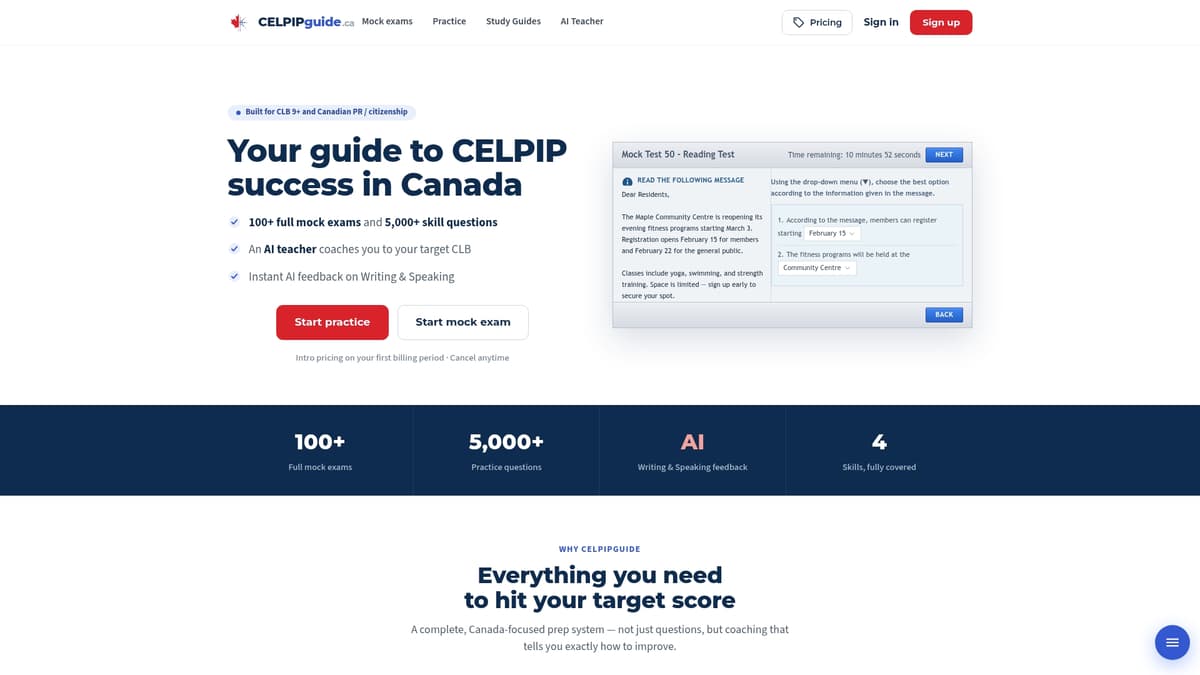
Run your free diagnostic and generate your study plan today, or go straight to the full mock exam hub if you are ready to simulate test conditions right now.
Useful sources and CELPIP resources
Use these resources alongside your Celpipguide practice sessions:
- CELPIP Listening Guide on Celpipguide: Best starting point for note-taking templates, task-type breakdowns, and transcript-based drills. Use this in Weeks 1–2.
- Free CELPIP Listening Practice Test: Run this for your Week 1 diagnostic and again in Week 6 to measure improvement. Includes transcripts.
- Skill-specific practice sets: Use for targeted micro-drills between mocks. Filter by task type to focus on your weakest area.
- Cambridge English listening tips (PDF): Authoritative guidance on session length, chunking, and test-like conditions. Useful for structuring your daily sessions.
- Lenguia: three-pass method explained: Clear walkthrough of the gist-to-transcript progression with practical examples.
- Leonardo English: shadowing and dictation guide: Detailed instructions for shadowing technique and dictation drills, with examples of connected-speech patterns to target.
- LingoLogic: free practice resources for English exams: Curated free exercise banks for varied listening exposure and graded accent practice.
“Effective listening practice aims for flexibility rather than perfect word-for-word decoding. A proficient listener shifts between gist and detail as the task demands.” — Simon & Simon language educators
FAQ
What is the three-pass listening method for CELPIP?
The three-pass method means listening once for overall gist, a second time to answer specific questions, and a third time with the transcript to catch missed vocabulary and connected-speech patterns. It prevents cognitive overload and builds the flexibility the CELPIP rewards.
How long should I practise CELPIP listening each day?
Cambridge English recommends 15-minute practice blocks as a minimum; for CELPIP preparation, 20–40 minutes of focused daily drills, structured around the three-pass routine, produces measurable gains within a six-week plan.
How do I handle accents I am not familiar with on the CELPIP?
Rotate through varied accents during your drills using graded exercise libraries, and on test day shift to global listening: focus on sentence rhythm and key content words rather than individual sounds.
Can Celpipguide help me build a personalised listening study plan?
Yes. Celpipguide’s diagnostic test identifies your weakest task types and the AI study-plan generator produces a personalised week-by-week schedule, supported by over 100 full mock exams and 5,000 CEFR-aligned practice questions.
What should I do if I miss a word during the CELPIP listening section?
Let it go immediately. Fixating on one missed word triggers working-memory overload and causes cascade loss across the next several sentences. Mark the question, hold the gist, and re-engage with the audio on the next sentence.