
CELPIP Blog
Why everyday English matters for your CLB score
Why everyday English matters for your CLB score

TL;DR:
- Everyday English is essential for achieving high Canadian Language Benchmark scores by emphasizing real-world communication. Practicing natural speaking, listening, reading, and writing skills improves fluency and meets the test’s practical focus. Targeted skill practice increases both immigration points and career opportunities in Canada.
Everyday English is the practical, functional language you use to book a doctor’s appointment, chat with a coworker, or follow a news broadcast. It is also the single most important factor in your Canadian Language Benchmark (CLB) score. The CLB, used by Immigration, Refugees and Citizenship Canada (IRCC) to assess language ability, tests real-world communication across four skills, not grammar textbooks. Learners who master conversational English consistently outperform those who rely on formal academic training alone. If you are preparing for Canadian immigration or education, understanding why everyday English matters for your CLB score is the most direct path to results.
Why everyday English matters for your CLB score across all four skills
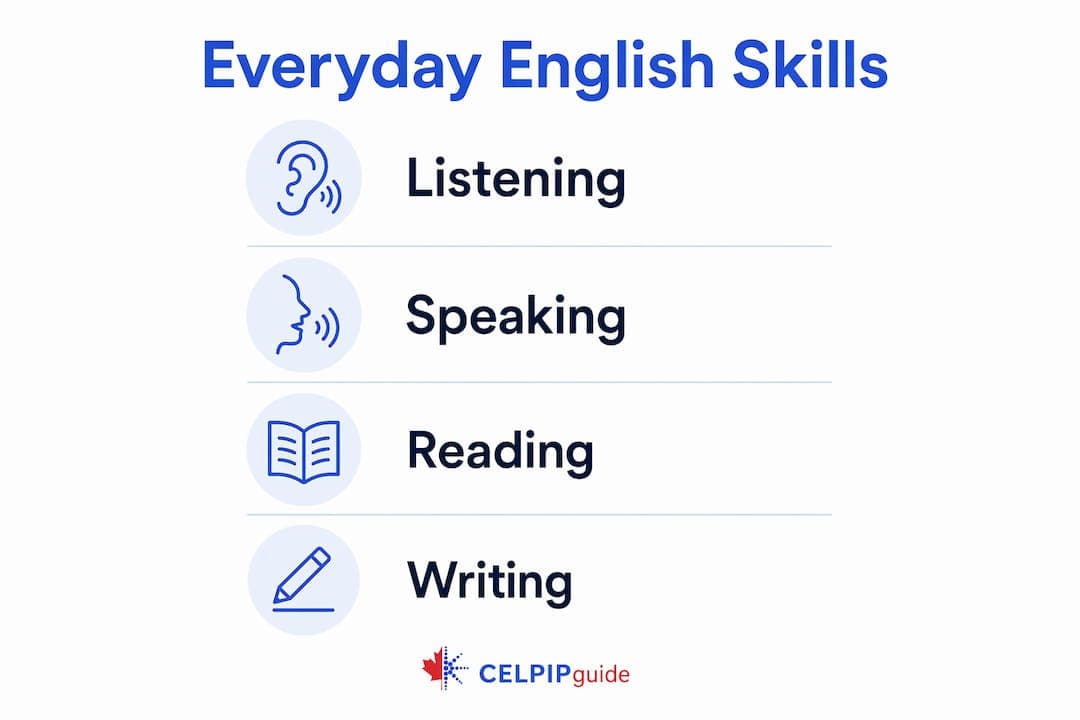
The CLB assesses listening, speaking, reading, and writing through real-world tasks rather than grammar recall. CLB 4 enables routine conversations, while CLB 8 involves understanding complex workplace discussions and producing professional reports. Each skill reflects a different slice of daily life, and everyday English feeds directly into all four.

Listening
Functional listening means following varied accents, catching informal contractions, and processing speech at natural speed. The CELPIP listening section uses recordings from everyday Canadian contexts: phone messages, workplace conversations, and neighbourhood announcements. Learners who only practise with scripted textbook audio often miss the rhythm of real speech. Practising with authentic Canadian media builds the ear for these natural patterns.
Speaking
Speaking tasks reward natural phrasing, not perfect grammar. Examiners assess whether you communicate clearly and fluently, which means fillers like “well” and “actually,” natural pauses, and conversational intonation all count. A candidate who speaks in rigid, textbook sentences sounds unnatural and loses marks for fluency. The goal is to sound like someone who uses English to live, not just to pass a test.
Reading
Reading tasks use everyday texts: emails, notices, news articles, and workplace memos. You need to extract meaning quickly, not analyse literary devices. Learners who read only academic prose often slow down on practical texts because the register feels unfamiliar. Regular reading of Canadian newspapers, community newsletters, and workplace documents builds the speed and comprehension the CLB rewards.
Writing
CLB writing tasks focus on practical communication: emails, short reports, and opinion responses. Formal academic prose with complex subordinate clauses can actually hurt your score if it obscures your message. Clear, direct sentences that get the point across score higher than elaborate constructions that confuse the reader.
A critical detail many learners miss: CLB tests require meeting minimum levels individually for each skill, not just an overall average. Weakness in speaking can disqualify you even if your reading and writing are strong. That makes targeted, skill-specific practice non-negotiable.
Academic English vs. everyday English: what CLB tests actually reward
Many learners arrive with years of formal English education and still struggle with CLB speaking and listening tasks. The reason is straightforward: academic English and everyday English are different systems.
Academic English prioritises complete sentences, passive constructions, and formal vocabulary. Everyday English uses contractions, phrasal verbs, fragments, and fillers. When a test-taker says “I am unable to ascertain the location of the meeting room,” they are technically correct but socially unnatural. A fluent speaker says “I’m not sure where the meeting room is.” The CLB rewards the second version.
Transitioning from textbook to everyday English requires embracing fillers, fragments, and social conversational norms. Fillers like “actually” and “well” act as social glue. Native speakers rely on these for natural flow rather than perfect grammar. Learners who suppress fillers in an attempt to sound “correct” end up sounding hesitant and unnatural, which lowers fluency scores.
There is also a psychological dimension. Many learners feel embarrassed to use imperfect, conversational English because it feels less educated. True fluency includes psychological comfort with imperfections and using natural speech rhythms to connect authentically. Letting go of the need to sound formal is not a step down. It is a step toward the score you need.
Pro Tip: Record yourself answering a CELPIP-style speaking prompt, then listen back and count how many times you used a natural filler or phrasal verb. If the count is zero, your speech is likely too formal for the CLB rubric.
A common preparation mistake is spending most study time on grammar exercises. Successful candidates approach the CLB as a functional, task-based examination rather than grammar recall. Shift your study time toward speaking and listening tasks that mirror real Canadian conversations.
Practical strategies to build everyday English for better CLB results
The most effective approach connects language practice to real situations you will actually face in Canada. Everyday English is a life skill that builds confidence for assessment when learners connect grammar to meaningful tasks like requesting, networking, and problem-solving.
Start with a diagnostic test. Diagnostic testing before studying allows learners to avoid wasted effort and focus on weakest skills to enhance overall CLB scores. Celpipguide offers a diagnostic test that maps your current level across all four CLB skills, so you know exactly where to focus.
Here are the most effective daily habits for building practical English proficiency:
- Listen to Canadian podcasts and radio for 20–30 minutes daily. CBC Radio and TVO Today use natural Canadian speech patterns and accents.
- Practise speaking with fillers and fragments. Narrate your day out loud, using phrases like “So, what happened was…” or “Actually, I think…”
- Read everyday Canadian texts. Scan local news, community boards, and workplace emails rather than academic articles.
- Write short, practical pieces daily. Draft a mock email to a landlord, a response to a job posting, or a short opinion on a news story.
- Role-play switching registers. Practise the same scenario in both formal and informal English to build flexibility.
The table below links each practice method to the CLB skill it strengthens most directly.
| Practice method | Primary CLB skill | Why it works |
|---|---|---|
| Canadian podcasts and radio | Listening | Exposes you to natural speed, accents, and informal speech |
| Speaking fillers and narration | Speaking | Builds fluency and natural intonation patterns |
| Reading local news and emails | Reading | Trains comprehension of practical, everyday register |
| Writing mock emails and opinions | Writing | Practises clear, direct communication over academic prose |
| Register role-play | Speaking and writing | Builds flexibility between formal and informal contexts |
Pro Tip: Use Celpipguide’s skill-specific practice tasks to simulate real CLB conditions. Practising under timed, test-like conditions is the fastest way to close the gap between your daily English and your exam performance.
How everyday English proficiency shapes your immigration and career prospects
The stakes of your CLB score extend well beyond the test room. Achieving CLB 7 or higher commonly strengthens immigration profiles and increases Comprehensive Ranking System (CRS) scores under Express Entry. The point difference is significant: a CLB 9 across all four skills earns 124 CRS points, while CLB 7 earns 68 points. That 56-point gap can determine whether you receive an invitation to apply.
The CLB scores and Express Entry points relationship is direct and measurable. Many applicants retake their language test specifically to push one or two skills above a CLB threshold, because the CRS point gain is worth the effort.
| CLB level | Approximate CRS points (language factor) | Typical use case |
|---|---|---|
| CLB 7 | 68 points | Minimum for most Federal Skilled Worker streams |
| CLB 8 | ~90 points | Competitive range for Express Entry draws |
| CLB 9 | 124 points | Strong advantage in competitive draw rounds |
Beyond immigration, English proficiency shapes your career in Canada. 92% of global employers say English proficiency is more important today, with AI integration increasing the need for strong English communication. That figure reflects a real shift: AI tools handle routine tasks, but communicating clearly with colleagues, clients, and managers still requires fluent, natural English. Strong everyday English also supports professional licensing applications and academic admissions, both of which often require CLB certification as proof of language ability.
The practical benefits compound after you arrive. Everyday English fluency helps you build relationships with neighbours, navigate healthcare, advocate for yourself at work, and participate in your community. The CLB score is the gateway. Everyday English is what you use once you walk through it.
Key takeaways
Everyday English proficiency is the foundation of every high CLB score, because the benchmark tests functional communication, not grammar knowledge.
| Point | Details |
|---|---|
| CLB tests real-world tasks | Each of the four skills is assessed through practical, everyday scenarios, not grammar exercises. |
| Individual skill minimums apply | A weak score in one skill can disqualify you, even if other skills are strong. |
| Academic English is not enough | Fillers, phrasal verbs, and natural intonation are rewarded; rigid formal prose is not. |
| CLB 9 earns 124 CRS points | Improving from CLB 7 to CLB 9 adds 56 CRS points, a significant immigration advantage. |
| Diagnostic testing saves time | Identifying your weakest skill before studying focuses your effort where it counts most. |
Why I think most learners are practising the wrong kind of English
I have seen this pattern repeatedly: a learner spends months on grammar workbooks, scores well on written exercises, and then freezes during the CELPIP speaking task because no one ever told them that “um, well, I think…” is not a mistake. It is fluency.
The biggest misconception I encounter is that sounding educated means sounding formal. The CLB does not test formality. It tests whether you can communicate effectively in the situations Canadians actually face. A candidate who can confidently say “So, I’d go with the second option, because…” will outscore someone who laboriously constructs “I would select the second option due to the fact that…” every single time.
What I have found works best is treating English as a social tool, not a performance. Learners who watch Canadian TV shows, chat with neighbours, and narrate their grocery shopping out loud improve faster than those who only study. The CLB 7 skills checklist is a good reality check for where you actually stand versus where you think you stand.
My honest advice: embrace imperfection early. The learners who reach CLB 9 are not the ones with the best grammar. They are the ones who stopped being afraid to sound like a real person. You can get there too, and the path is shorter than you think.
— Reza
Celpipguide: practise the English that actually moves your score
Knowing what the CLB rewards is one thing. Practising it under real test conditions is another. Celpipguide is built specifically for this gap.
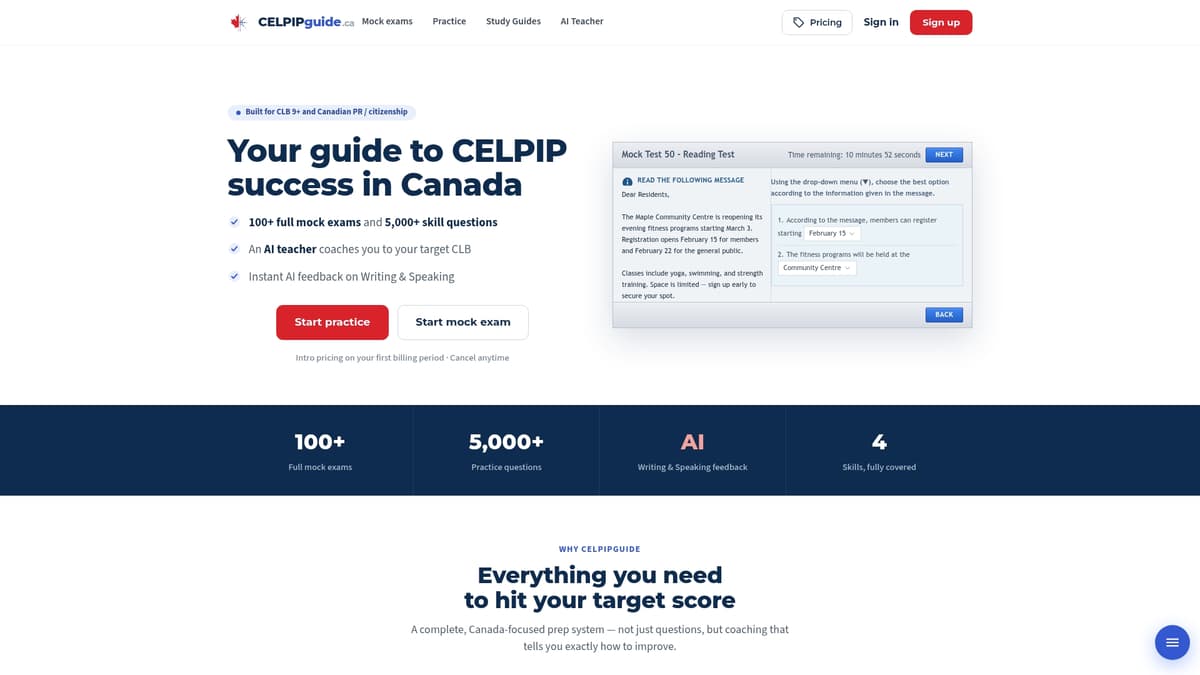
With over 100 full mock exams and 5,000 practice questions aligned to CEFR language standards, Celpipguide puts you inside real CLB-style tasks from day one. The AI teacher delivers instant feedback on your speaking and writing responses, so you know exactly what to fix and why. A built-in diagnostic test identifies your weakest skill before you waste time on areas you have already mastered. Whether you need to push your listening from CLB 7 to CLB 9 or sharpen your writing for a professional report task, the CELPIP practice exam hub gives you the targeted repetitions that build real confidence.
FAQ
What is the CLB and why does it matter for immigration?
The Canadian Language Benchmark (CLB) is Canada’s national standard for describing English language ability. Immigration, Refugees and Citizenship Canada uses CLB scores to determine eligibility for Express Entry and other skilled worker programmes.
How does everyday English differ from academic English in CLB tests?
CLB tests reward natural, functional communication including fillers, phrasal verbs, and conversational intonation, rather than formal grammar or academic prose. Learners who speak in rigid, textbook sentences typically score lower on fluency.
What CLB level do I need for Express Entry?
CLB 7 is the common minimum for most Federal Skilled Worker streams under Express Entry. Reaching CLB 9 across all four skills earns 124 CRS points, compared to 68 points at CLB 7.
Can a low score in one CLB skill hurt my application?
Yes. CLB tests require meeting minimum levels individually for each skill. A weak speaking score can disqualify an applicant even if listening, reading, and writing scores are strong.
How do I know which CLB skill to practise first?
A diagnostic test is the most direct way to identify your weakest skill. Celpipguide’s diagnostic tool maps your current level across all four CLB skills so you can focus your study time where it will have the greatest impact on your score.